NJ Workers Compensation 2026: Rates, Deadlines, and How Claims Actually Work
Quick Answer
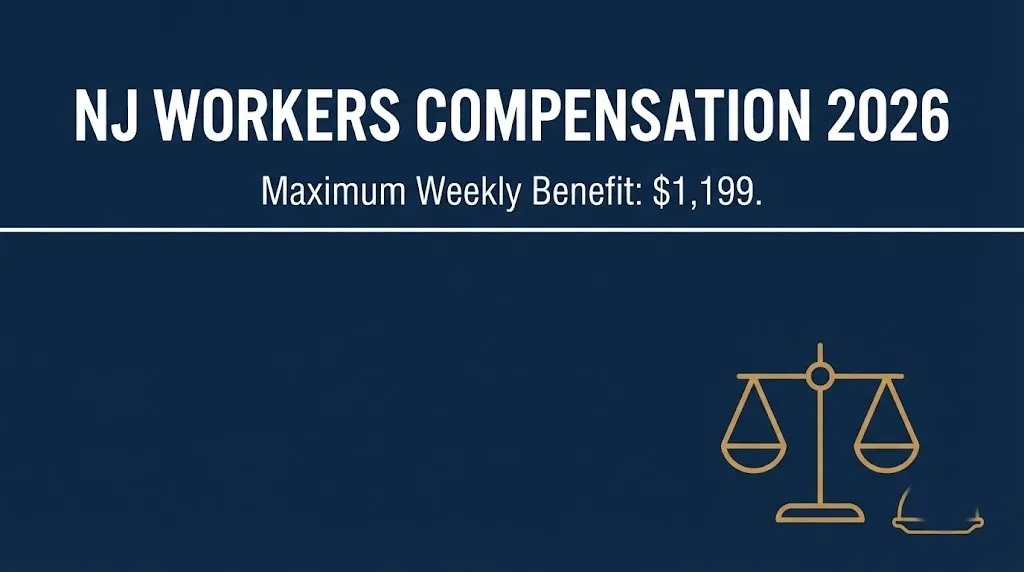
- NJ workers’ comp pays 70% of your average weekly wage, capped at $1,199 per week for 2026.
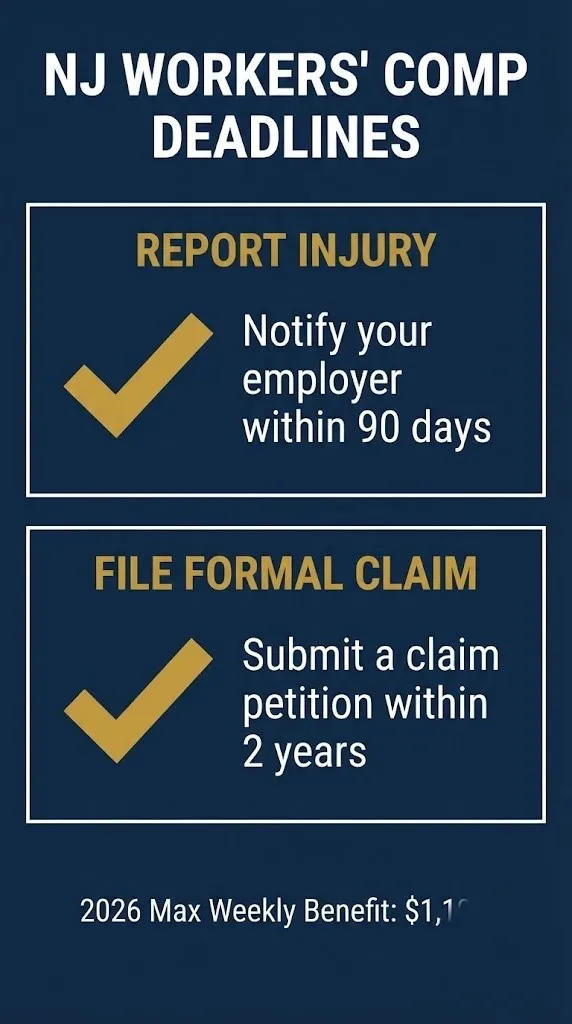
- You must report your injury to your employer within 90 days, and file a formal claim within 2 years.
- Nearly every NJ employer with even one employee must carry workers’ compensation coverage, no exceptions for small businesses.
Getting hurt on the job in New Jersey triggers a specific legal process, and most people searching this term want two things fast: how much they’ll get paid, and how not to blow their deadline. The state’s maximum weekly benefit for 2026 is $1,199, up from $1,159 last year.
This affects nearly every employee in New Jersey, since coverage is mandatory the moment a business hires its first worker. The single deadline that trips people up most: you have only 90 days to formally notify your employer of the injury, even though the legal filing deadline is two years.
This guide breaks down exactly how NJ workers’ comp pays out, how to file a claim, what happens if your employer disputes it, and how the rules compare across New York, Pennsylvania, and Maryland. One detail that surprises a lot of injured workers: the weekly benefit cap is not the same as what you’ll actually receive, since your payout is based on your own wages first.
The Facts
| Topic | New Jersey workers’ compensation law and 2026 benefit rates |
| Governing Law | New Jersey Workers’ Compensation Act, N.J.S.A. 34:15-1 et seq. |
| Administering Agency | NJ Division of Workers’ Compensation, part of the NJ Department of Labor and Workforce Development |
| Max Weekly Benefit (2026) | $1,199, up from $1,159 in 2025 |
| Min Weekly Benefit (2026) | $320 per week |
| Wage Replacement Rate | 70% of your average weekly wage, subject to the maximum |
| Injury Report Deadline | 90 days from the date of injury or diagnosis |
| Formal Claim Deadline | 2 years from the date of injury or last compensation payment, whichever is later |
| Employer Coverage Requirement | Mandatory for nearly all employers with even one employee |
Not yet confirmed: individual claim outcomes and settlement amounts vary by case and are determined by the Division of Workers’ Compensation or negotiated settlement, not by this article. Amounts you may qualify for depend on your specific wages, injury, and employer’s insurance.
What Is NJ Workers’ Compensation Insurance?
NJ workers’ compensation insurance is a state-mandated coverage that pays medical bills and partial wage replacement when an employee gets hurt or sick because of their job. It works on a no-fault basis, meaning you don’t have to prove your employer did anything wrong to qualify.
New Jersey requires this coverage as soon as a business hires its first employee, with no minimum employee threshold. That’s stricter than many states, where small employers sometimes get exemptions.
What NJ workers’ comp insurance typically covers:
- Medical treatment related to the workplace injury or illness
- Partial wage replacement while you’re unable to work
- Permanent disability benefits if the injury causes lasting impairment
- Death benefits for dependents in fatal workplace accidents
In exchange for this no-fault coverage, employees generally give up the right to sue their employer directly for the injury, outside of narrow exceptions.
Is Workers’ Compensation Mandatory in New Jersey?
Yes, workers’ compensation coverage is mandatory in New Jersey for virtually every employer, starting with their very first hire. There’s no small-business carve-out based on employee count.
New Jersey operates as a competitive state, meaning employers can buy coverage from any of over 400 private insurance carriers rather than being forced into a single state fund. This creates real price competition, but coverage itself isn’t optional.
Key Takeaway: New Jersey requires workers’ comp coverage from the moment you hire your first employee, and penalties for skipping it run up to $5,000 for every 10-day period without coverage.
Some exceptions do exist:
- Independent contractors with no employees of their own are exempt.
- LLC members and partners can exempt themselves if they aren’t classified as employees.
- New Jersey uses a strict “ABC test” to determine true worker classification, so misclassifying employees as contractors carries serious penalties.
How Much Does NJ Workers’ Compensation Pay in 2026?
NJ workers’ comp pays 70% of your average weekly wage before the injury, subject to a 2026 maximum of $1,199 per week and a minimum of $320 per week. This 70% figure applies to temporary disability, permanent total disability, and dependency benefits.
Here’s how the math typically works:
| Your Average Weekly Wage | 70% Benefit Estimate | Applies? |
|---|---|---|
| $500/week | $350/week | Yes, within range |
| $1,000/week | $700/week | Yes, within range |
| $1,800/week | $1,199/week (capped) | Capped at maximum |
| $300/week | $320/week (minimum applies) | Minimum floor applies |
The 2026 maximum rate reflects New Jersey’s statewide average weekly wage, which was $1,598.66 for 2024, and increased 3.4% from the prior year. Rates are recalculated annually and tied directly to that wage data.
Reality Check: No insurance adjuster or third party will text you offering to “speed up” your workers’ comp check for a fee. Filing a claim through the Division of Workers’ Compensation is free, and legitimate benefit payments come from your employer’s insurance carrier, not a stranger contacting you online.
What Is the Maximum Weekly Workers’ Comp Benefit in NJ for 2026?
The maximum weekly workers’ compensation benefit in New Jersey for 2026 is $1,199. This is a hard ceiling that applies regardless of how high your actual wages were before the injury.
This figure increased from $1,159 in 2025, continuing a steady annual climb. New Jersey’s Department of Labor and Workforce Development announced the new rate on December 29, 2025, effective January 1, 2026.
Historical context on this rate’s growth:
- The 2026 maximum represents roughly a 40% total increase from 2015 through 2026.
- The rate is recalculated every year based on the statewide average weekly wage from two years prior.
- Higher earners routinely hit this cap, meaning workers’ comp often replaces a smaller share of take-home pay than the 70% figure suggests.
How Is Workers’ Compensation Calculated in New Jersey?
New Jersey calculates most wage-loss benefits as 70% of your average weekly wage at the time of injury, capped between the state’s minimum and maximum rates. Different injury categories use slightly different formulas.
Breakdown by benefit type:
| Benefit Type | Formula | 2026 Cap |
|---|---|---|
| Temporary total disability | 70% of average weekly wage | $1,199 max, $320 min |
| Permanent total disability | 70% of average weekly wage | $1,199 max, $320 min |
| Permanent partial disability | Fixed weeks per scheduled body part, paid at your rate | Same wage cap applies |
| Dependency benefits | 70% of average weekly wage | $1,199 max, $320 min |
Permanent partial disability works differently from the others. Rather than a simple wage percentage, the state pays a fixed number of weeks tied to a statutory schedule, based on which body part was injured and the severity of the impairment.
Key Takeaway: Your actual weekly check depends on your own wages first, and only hits the state maximum if 70% of your earnings exceeds it.
How Do You File a Workers’ Compensation Claim in New Jersey?
You file a workers’ compensation claim by reporting your injury to your employer immediately, then submitting a formal claim petition to the Division of Workers’ Compensation if needed. New Jersey’s no-fault system is designed to get you medical care first, without requiring proof of employer negligence.
Steps to file correctly:
- Report the injury to your employer as soon as possible, and no later than 90 days after it occurs.
- Seek medical treatment through your employer’s designated provider if one is assigned.
- Request that your employer notify their workers’ comp insurance carrier.
- Keep copies of all medical records and any correspondence about the injury.
- If your claim is denied or disputed, file a formal Claim Petition with the Division of Workers’ Compensation.
- Attend any required hearings and provide requested documentation promptly.
- Consult an attorney if your employer disputes your claim or benefits stop unexpectedly.
Missing the 90-day reporting window is one of the most common reasons claims get denied, even when the injury itself is clearly work-related.
How Do You Find Workers’ Compensation Insurance Near Me in NJ?
Employers looking for workers’ compensation insurance in New Jersey can shop among more than 400 licensed private carriers, since the state operates a competitive insurance market rather than a single state fund. This gives businesses real leverage to compare pricing and coverage terms.
For workers, rather than employers, searching “workers’ compensation insurance near me” usually means looking for the carrier or claims adjuster tied to your specific employer’s policy. Your employer or HR department should be able to provide this information directly after you report an injury.
Steps for employers seeking coverage:
- Compare quotes from multiple licensed NJ carriers.
- Review whether your industry classification affects your premium rate.
- Confirm the policy includes employers’ liability coverage, which is typically bundled in competitive states like New Jersey.
- Check annually for rate changes, since premiums can shift as carriers compete for business.
Can You File a Workers’ Compensation Lawsuit in New Jersey?
Generally no, in the traditional sense, since New Jersey’s workers’ comp system replaces most lawsuits against your employer with a no-fault claims process instead. This trade-off is central to how the system works.
In exchange for guaranteed no-fault benefits, employees generally can’t sue their employer directly for a workplace injury, even if the employer was careless. There are narrow exceptions, mainly involving intentional harm by the employer.
Where a separate lawsuit can still apply:
- Claims against a third party who isn’t your employer, such as a negligent contractor or equipment manufacturer.
- Cases involving intentional wrongdoing by your employer, which fall outside standard workers’ comp protection.
- Disputes over denied or reduced benefits, which go through the Division of Workers’ Compensation, not a standard civil lawsuit.
Think of it like a warranty claim on a new appliance. You generally can’t sue the manufacturer over a broken part covered by warranty, you go through the warranty process instead, and that’s similar to how workers’ comp replaces most direct lawsuits.
What Is the Workers’ Compensation Claim Deadline in New Jersey?
New Jersey gives injured workers two years to file a formal claim petition, counted from the date of injury or the date of the last compensation payment, whichever is later. This is separate from the 90-day employer notification requirement.
Both deadlines matter for different reasons:
| Deadline | Time Limit | Purpose |
|---|---|---|
| Report injury to employer | 90 days | Establishes the injury record and preserves medical care access |
| File formal claim petition | 2 years | Legal deadline to formally pursue benefits through the Division |
Occupational diseases work differently. New Jersey law doesn’t set a fixed time limit for filing an occupational disease claim, but once you know the condition is linked to your job, the two-year clock starts running from that discovery date.
Not yet confirmed: individual circumstances, like informal compensation agreements with your employer, can affect exactly when your two-year clock starts. Consult the Division of Workers’ Compensation or an attorney if your situation involves ongoing informal payments.
How Long Do NJ Workers’ Compensation Benefits Last?
Temporary disability benefits generally continue until you can return to work or reach maximum medical improvement, while permanent total disability benefits follow a statutory base period of 450 weeks. After that period, continued payment depends on specific conditions.
To keep receiving permanent total disability payments past the 450-week base period, you generally must show you submitted to physical or educational rehabilitation as ordered, and that you still can’t earn wages comparable to your pre-injury income because of the disability.
Permanent partial disability pays differently, based on a fixed schedule of weeks tied to the specific body part and severity of impairment, rather than an open-ended wage replacement period.
What Is Workers’ Compensation and What Does It Cover?
Workers’ compensation is a no-fault insurance system that covers medical costs and partial wage replacement for employees injured or made ill because of their job. Nearly every U.S. state, including New Jersey, requires most employers to carry this coverage.
Typical coverage includes:
- Emergency and ongoing medical treatment tied to the workplace injury
- Partial wage replacement while you’re unable to work or working reduced hours
- Compensation for permanent impairment once you reach maximum medical improvement
- Death benefits for dependents in fatal workplace incidents
One detail people often miss: workers’ comp benefits are exempt from federal income tax under federal law, and they’re also exempt from state income tax nationwide. You won’t receive a W-2 or 1099 for these payments.
What Injuries Qualify for Workers’ Compensation in New Jersey?
Any injury or illness that arises out of and in the course of your employment generally qualifies for workers’ compensation in New Jersey. This includes sudden accidents as well as conditions that develop gradually over time.
Common qualifying categories:
- Sudden traumatic injuries, like falls, lifting injuries, or machinery accidents
- Repetitive stress injuries, such as carpal tunnel syndrome from repeated motion
- Occupational diseases, including respiratory illness from workplace exposure
- Aggravation of a pre-existing condition, if work activity worsened it
The key legal test is whether the injury happened “in the course and scope” of your job duties. Injuries during your normal commute generally don’t qualify, but injuries during work travel or job-related errands often do.
How Does NJ Workers’ Compensation Compare to New York?
New York’s system pays a higher percentage cap in dollar terms, with a maximum weekly benefit of $1,222.42 for injuries between July 1, 2025, and June 30, 2026, rising to $1,281.50 starting July 1, 2026. That’s noticeably higher than New Jersey’s flat $1,199 for all of calendar year 2026.
Key structural differences:
| Feature | New Jersey | New York |
|---|---|---|
| Wage replacement rate | 70% of average weekly wage | Two-thirds (66.67%) of average weekly wage |
| Rate change timing | Annually, January 1 | Annually, July 1 |
| 2026 maximum weekly benefit | $1,199 (calendar year) | $1,222.42 through June 2026, then $1,281.50 |
| Minimum weekly benefit | $320 | $384.45 starting July 2026 |
| Administering agency | NJ Division of Workers’ Compensation | New York State Workers’ Compensation Board |
New York calculates its cap as two-thirds of the New York State Average Weekly Wage, updated every July 1, while New Jersey uses 70% of the worker’s own wage, capped by a rate that changes every January 1.
How Does NJ Workers’ Compensation Compare to Pennsylvania?
Pennsylvania pays a similar wage replacement percentage to New York, using two-thirds (66 2/3%) of average earnings, with a 2026 maximum weekly rate of $1,394. That’s noticeably higher than New Jersey’s $1,199 maximum.
Pennsylvania’s structure includes a sliding scale for lower earners:
- Workers earning $774.43 per week or less receive 90% of that amount.
- Workers earning between $774.44 and $1,045.50 per week receive a flat rate of $697 per week.
- The 2026 rate increase in Pennsylvania was 3.5% over the prior year, applied to both wage and medical benefits.
Key Takeaway: New Jersey’s 70% wage replacement rate is actually higher in percentage terms than New York’s or Pennsylvania’s two-thirds formula, but both neighboring states currently have higher dollar-value maximum caps for 2026.
How Does NJ Workers’ Compensation Compare to Maryland?
Maryland’s system uses the same two-thirds (66.67%) wage replacement formula as New York and Pennsylvania, with a 2026 maximum weekly benefit around $1,403 according to third-party workers’ comp rate summaries. That places Maryland’s cap above New Jersey’s for the year.
Not yet confirmed: this Maryland figure comes from a third-party rate aggregator rather than a direct Maryland state agency release reviewed for this article. Confirm current Maryland rates directly with the Maryland Workers’ Compensation Commission before relying on this figure for a specific claim.
What Is the NYS Workers’ Compensation Board and How Does It Differ From NJ’s System?
The New York State Workers’ Compensation Board is the state agency that administers claims, sets benefit rates, and resolves disputes for New York workers, functioning similarly to New Jersey’s Division of Workers’ Compensation but with some structural differences. Both agencies process claims, but their rate-setting calendars and formulas differ.
Key operational differences:
- New York’s Board updates maximum and minimum rates every July 1, based on the prior year’s statewide average wage.
- New Jersey’s Division updates rates every January 1, following the same general wage-indexing concept but on a different schedule.
- New York requires a disability to keep a worker out of work more than seven days before certain lost-wage benefits apply.
- New Jersey’s system doesn’t use that same seven-day threshold structure.
If you work across state lines, or your employer operates in both states, confirming which state’s system governs your specific claim matters, since coverage isn’t automatically interchangeable.
Frequently Asked Questions
How much does workers’ comp pay in New Jersey in 2026?
NJ workers’ comp pays 70% of your average weekly wage, up to a 2026 maximum of $1,199 per week.
The minimum weekly benefit is $320.
Your actual payment depends on your specific wages before the injury.
How long do I have to report a workplace injury in NJ?
You must report your injury to your employer within 90 days.
Missing this window is one of the most common reasons claims get denied.
For occupational diseases, the clock starts when you learn the condition is work-related.
What is the deadline to file a formal workers’ comp claim in NJ?
You generally have two years from the date of injury, or from your last compensation payment.
This is separate from the 90-day employer notification deadline.
Missing this deadline can permanently bar your right to benefits.
Is workers’ compensation insurance required for small businesses in NJ?
Yes, New Jersey requires coverage starting with an employer’s very first hire.
There is no small-business exemption based on employee count.
Independent contractors with no employees of their own are generally exempt.
Can I sue my employer instead of filing a workers’ comp claim in NJ?
Generally no, since workers’ comp replaces most direct lawsuits against your employer.
Exceptions exist for third-party negligence or intentional employer misconduct.
Disputes over denied benefits go through the Division of Workers’ Compensation, not a standard lawsuit.
Is workers’ compensation money taxable in New Jersey?
No, workers’ compensation benefits are exempt from both federal and state income tax nationwide.
You won’t receive a W-2 or 1099 for these payments.
This applies to New Jersey and all other states equally.
How does NJ workers’ comp compare to New York’s system?
New Jersey pays 70% of wages, while New York pays two-thirds, but New York’s dollar cap is currently higher.
New York’s maximum rises to $1,281.50 starting July 1, 2026.
New Jersey’s $1,199 maximum applies for the full 2026 calendar year.
What happens if my workers’ comp claim is denied in New Jersey?
You can file a formal Claim Petition with the Division of Workers’ Compensation to dispute the denial.
Gathering medical records and documentation strengthens your case.
Consulting an attorney early can help protect your rights during a dispute.
New Jersey’s workers’ comp system moves fast on paper, but real claims often hit delays, disputes, or confusion over deadlines. If you were hurt on the job, report it to your employer now, note the date, and don’t wait to see if the pain resolves on its own.
The one number to remember for 2026: the maximum weekly benefit is $1,199, and your 90-day reporting window starts the day the injury happens.