Workers Compensation South Carolina: 2026 Claim Rates, Deadlines, and Settlement Rules
Quick Answer
- South Carolina workers compensation is a no-fault system covering medical bills and part of lost wages for most employees.
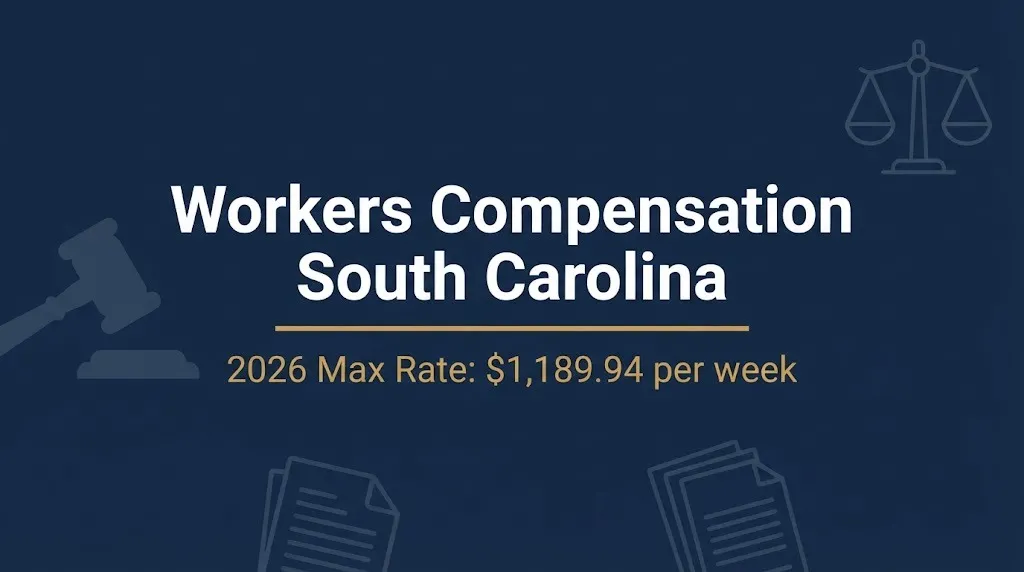
- Payouts depend on your average weekly wage and impairment rating, with a maximum of $1,189.94 per week in 2026.
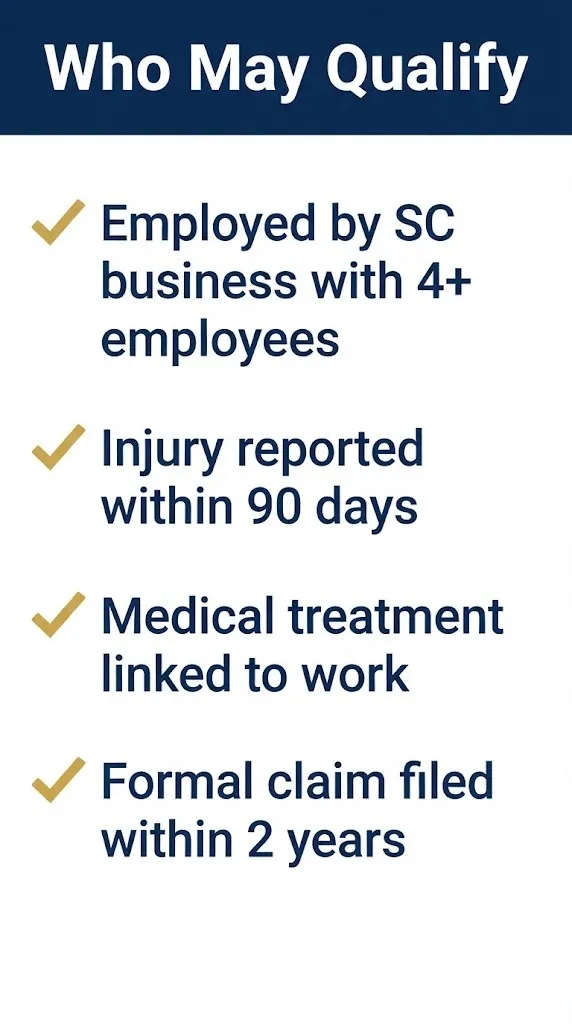
- You must report a work injury to your employer within 90 days and file a formal claim within two years.
If you got hurt on the job in South Carolina, the system is supposed to work without you having to prove your boss did anything wrong. That part is real. What trips people up is everything after the injury report: the waiting period, the doctor you did not choose, and the settlement number that never seems to match what you expected. This article covers the 2026 rates, the deadlines that kill claims, and how settlement math actually works in South Carolina.
The Facts
Case: South Carolina Workers’ Compensation System (state-administered, not a single case)
Status: Active; 2026 maximum rate set; new medical fee rules effective May 18, 2026
Fund Size: Not applicable (individual claims, not a class settlement)
Est. Per Person: Varies widely; maximum weekly benefit $1,189.94 for 2026 injuries
Claim Deadline: Report injury within 90 days; file formal claim within 2 years
Administrator: South Carolina Workers’ Compensation Commission (SCWCC)
Proof Needed: Medical records linking injury to work; Form 50 for disputes
Is South Carolina Workers Compensation Legit and How Does It Work?
South Carolina workers compensation is a legitimate, state-mandated insurance system. It covers medical care and wage replacement for employees injured on the job, and it is overseen by the South Carolina Workers’ Compensation Commission .
The tradeoff is simple. You get benefits without proving fault. In exchange, you generally cannot sue your employer for pain and suffering. That means the system is faster and more predictable than a lawsuit, but it also caps what you can recover.
Most South Carolina employers with four or more employees must carry coverage . If your employer does not have it, you can still file a claim with the Commission, but collecting becomes harder.
The Commission is not a court. It is an administrative agency that approves settlements, resolves disputes, and sets the medical fee schedule doctors use for work injuries.
How Much Can You Get in a South Carolina Workers Comp Settlement?
There is no single average settlement in South Carolina. Workers comp settlements are not publicly reported, so any “average” you see online is a lawyer’s estimate, not a state figure . What you can get depends on your wages, your injury, and your impairment rating.
The core formula is: two-thirds of your average weekly wage, capped at the state maximum . For 2026 injuries, that cap is $1,189.94 per week .
Here is how different injury types typically break down using the state’s scheduled weeks:
| Injury Type | Weeks Assigned | Example Payout at 50% Impairment |
|---|---|---|
| Back (spine) | 300 weeks | $70,000 (at $700 AWW) |
| Arm (shoulder) | 220 weeks | $47,850 (at $650 AWW) |
| Hand | 185 weeks | $37,012 (at $600 AWW) |
| Leg | 195 weeks | $42,187 (at $650 AWW) |
| Loss of vision (one eye) | 140 weeks | $28,000 (at $600 AWW) |
Those numbers come from the state’s scheduled benefits and typical wage assumptions . Your actual offer will hinge on the impairment rating a doctor assigns when you reach maximum medical improvement, which is the point where your condition stops improving .
Some real settlements in 2026 landed higher when claims were disputed. A Charleston port truck driver with a traumatic brain injury received $325,000 after his claim was initially denied . A North Myrtle Beach worker with a hip replacement got $91,000 after her employer claimed she was an independent contractor . Both involved attorneys and disputes. Straightforward claims settle for less.
Key Takeaway: There is no published average workers comp settlement in South Carolina; your payout is built from your wage, your impairment rating, and whether the insurer disputes the claim.
What Is the 2026 Maximum Weekly Compensation Rate in SC?
The maximum weekly compensation rate for South Carolina injuries occurring on or after January 1, 2026 is $1,189.94 . That figure equals the state’s average weekly wage for the prior fiscal year, as certified by the Department of Employment and Workforce.
This cap applies to temporary total disability, temporary partial disability, and permanent total disability benefits . If your average weekly wage is high enough, your two-thirds calculation will hit this ceiling and stop.
The rate changes every January. In 2025 it was lower. The Commission publishes the new number each year, and it applies to accidents on or after January 1, not to claims filed that year.
What Are the Deadlines to File a Workers Compensation Claim in SC?
You must report a work injury to your employer within 90 days and file a formal claim with the Commission within two years . Miss either deadline and you can lose your right to benefits entirely.
The 90-day clock starts when you know or should know about the injury. For gradual conditions like repetitive stress or occupational disease, that can be later than you think. But do not test it. Report in writing the moment you suspect the job caused it.
The two-year deadline is for filing Form 50 with the Commission if your claim is denied or your benefits stop . You can file earlier, and you should if the insurer is dragging its feet.
One more timing rule: there is a seven-day waiting period before wage replacement starts. If you are out for more than 14 days, those first seven days get paid retroactively .
How Do You File a Workers Compensation Claim in South Carolina?
Filing starts with your employer, not the Commission. Here are the steps:
- Report the injury to your supervisor immediately, in writing if possible.
- Get medical treatment from a provider your employer approves, unless it is an emergency.
- Confirm your employer filed a Form 12 with their insurance carrier.
- If benefits are denied or stop, file Form 50 with the SCWCC.
- Attend any hearings or mediation the Commission schedules.
- Keep copies of every medical record, wage statement, and letter.
The Commission’s website has the forms. Filing Form 50 is free. You do not need a lawyer to file it, though disputed claims often end up needing one.
What Is the South Carolina Workers Compensation Commission and What Does It Do?
The South Carolina Workers’ Compensation Commission is the state agency that administers the workers comp system . It approves settlements, sets medical fee schedules, resolves disputes through hearings, and tracks coverage compliance.
The Commission is located at 1333 Main Street in Columbia . It holds monthly business meetings, and its commissioners hear contested cases. If you disagree with a commissioner’s decision, you can appeal to the Full Commission and then to the courts.
The Commission does not pay benefits. Employers and their insurers do. The Commission is the referee, not the bank.
Does Workers Comp Pay Full Salary in South Carolina?
No. Workers compensation in South Carolina pays two-thirds of your average weekly wage, not your full salary, and it is capped at the state maximum . If you made $1,500 per week before the injury, your benefit would normally be $1,000, but if the state cap is $1,189.94, you would actually get $1,000 because that is below the cap.
The payments are tax-free . That helps close the gap somewhat, since your regular paycheck had taxes withheld.
There are four main types of wage replacement:
- Temporary Total Disability (TTD): You cannot work at all during recovery.
- Temporary Partial Disability (TPD): You can work light duty but earn less than before.
- Permanent Partial Disability (PPD): You have a lasting impairment to a body part.
- Permanent Total Disability (PTD): You cannot work in any capacity, potentially for life.
For TPD, you get two-thirds of the difference between your pre-injury and post-injury wages . For PTD, payments can continue for life if the disability persists.
Reality Check: If someone calls or texts you promising a workers comp settlement for a fee, hang up. Filing a claim with the SCWCC is free, and the Commission does not charge you to process it. Third-party “claim helpers” charging upfront fees are unnecessary and often predatory.
What Happens If Your Workers Comp Claim Is Denied in SC?
A denial is not the end. You have the right to file Form 50 with the Commission and request a hearing . Many denied claims get reversed or settled after a lawyer gets involved.
The most common denial reasons are causation disputes (the insurer says the injury was not work-related), independent contractor misclassification, and late reporting. The Charleston port case and the North Myrtle Beach case both started as denials .
If you are denied, do not wait. The two-year filing deadline still applies. Get the denial letter in writing and file Form 50.
Key Takeaway: A denial letter is not a final answer; it is the start of the dispute process, and you have two years from the injury to file with the Commission.
What Changes Did South Carolina Make to Workers Comp in 2026?
House Bill 3874 amended the workers comp law effective May 18, 2026 . The change requires the Commission to review its medical fee schedule annually, hold a public hearing, and consult with a new 9-member cost containment committee.
The bill also removed a 10% cap on price adjustments and lets the Commission apply single or multiple conversion factors to Medicare’s relative value scale . In plain terms, the state now has more flexibility in how it sets what doctors and hospitals get paid for treating injured workers.
Another bill, H. 3163, would add stroke to the list of conditions presumed to be work-related for South Carolina firefighters . It passed the Senate Judiciary Committee in April 2026 and was moving through the legislature.
A third bill, H. 4820, would raise the minimum weekly disability payment to $150 and add inflation-based increases . It was referred to committee in January 2026 and had not passed as of this update.
Frequently Asked Questions
How long do you have to report a work injury in South Carolina?
You must report a work injury to your employer within 90 days of the accident or discovery. Missing this deadline can bar your claim entirely, so report it in writing even if you are unsure whether you will file.
What is the maximum workers comp payout in SC for 2026?
The maximum weekly compensation rate for 2026 injuries is $1,189.94, which equals the state’s average weekly wage. There is no flat maximum on total settlement value, but weekly benefits cannot exceed that amount.
Can you get a lump sum settlement in South Carolina workers comp?
Yes. Lump sum settlements are common, especially when you and the insurer agree on a final number for permanent disability. Structured weekly payments are also an option and may make sense for long-term injuries.
Do you need a lawyer to file a workers comp claim in SC?
No. You can file Form 50 yourself with the Commission for free. A lawyer helps most when the claim is denied, the impairment rating is disputed, or the insurer undervalues your injury.
What is the average workers comp settlement in South Carolina?
There is no reliable state-published average because settlements are not publicly reported. Estimates from law firms range from a few thousand dollars to more than $40,000 for typical cases, with higher amounts for severe injuries or disputed claims .
Does workers comp cover pain and suffering in SC?
No. South Carolina workers compensation does not pay pain and suffering damages . It covers medical bills, wage replacement, permanent disability, and death benefits. That is the tradeoff for not having to prove fault.
What happens if my employer does not have workers comp insurance in SC?
You can still file a claim with the SCWCC, but collecting from an uninsured employer is harder. The Commission can penalize the employer, and you may need to pursue the case through the courts or the state’s uninsured employer fund.
How long does a workers comp settlement take in SC?
Straightforward claims with clear medical records often settle in 3 to 6 months . Disputed claims with hearings, appeals, or independent contractor issues can take a year or longer.
What Happens Next
Expected Q4 2026: Commission continues annual medical fee schedule review under H. 3874; public hearing date not yet confirmed.
Expected early 2027: New maximum weekly compensation rate announced for 2027 injuries.
Pending: H. 3163 (firefighter stroke presumption) and H. 4820 (minimum weekly payment increase) remain in committee; no vote scheduled as of this update.