Workers Compensation Lawyers Florida 2026: Fees, Settlements, and How to Choose
Quick Answer
- Florida workers’ comp lawyers charge no upfront fees, with statutory caps under Section 440.34.
- Average settlements in Florida range from $20,000 to $40,000 for moderate injuries.
- You must report a workplace injury within 30 days and file a petition within 2 years.
Hiring a workers compensation lawyer in Florida works differently than most people expect. You don’t pay hourly. You don’t pay a retainer. The state sets the maximum your attorney can charge, and it comes out of your settlement.
That fee structure exists to protect injured workers. But it also means finding the right lawyer matters more than finding the cheapest one. This guide breaks down what Florida attorneys actually cost, what settlements look like in 2026, and how to know when you need representation.
The Facts
| Item | Verified Value |
|---|---|
| System Type | No-fault workers’ compensation |
| Coverage Requirement | Employers with 4+ employees (all construction employees) |
| Average Settlement | $20,000 to $40,000 for moderate claims |
| Attorney Fee Structure | Contingency, capped by Florida Statute 440.34 |
| Injury Reporting Deadline | 30 days from accident or discovery |
| Petition Filing Deadline | 2 years from knowledge of injury |
| 2026 Maximum Weekly Benefit | $1,358 |
Are Workers Compensation Lawyers in Florida Legit?
Yes. Workers’ compensation attorneys in Florida are licensed by The Florida Bar and regulated by the Office of the Judges of Compensation Claims. The system is legitimate, but it’s also complex.
Florida operates a no-fault workers’ compensation system. You don’t have to prove your employer was negligent to get benefits. You only need to show you were injured in the course and scope of your employment .

In exchange for that no-fault coverage, you generally give up the right to sue your employer in civil court. This trade-off is called the exclusive remedy doctrine .
That doesn’t mean you can’t hire a lawyer. You can. Workers’ comp attorneys help you navigate the claims process, challenge denials, and negotiate settlements. The system is designed to work without a lawyer, but many injured workers find they need one when benefits are delayed or denied.
Reality Check
No legitimate Florida workers’ comp lawyer charges you upfront. The fee system is contingency-based and state-regulated. If someone asks for a retainer before reviewing your case, that’s a red flag. Also, your employer cannot fire you for filing a workers’ comp claim, and retaliation is illegal.
How Much Does a Workers Compensation Lawyer Cost in Florida?
Florida workers’ comp lawyers work on contingency, meaning you pay nothing upfront and nothing unless you recover benefits or a settlement. Attorney fees are capped by Florida Statute 440.34.
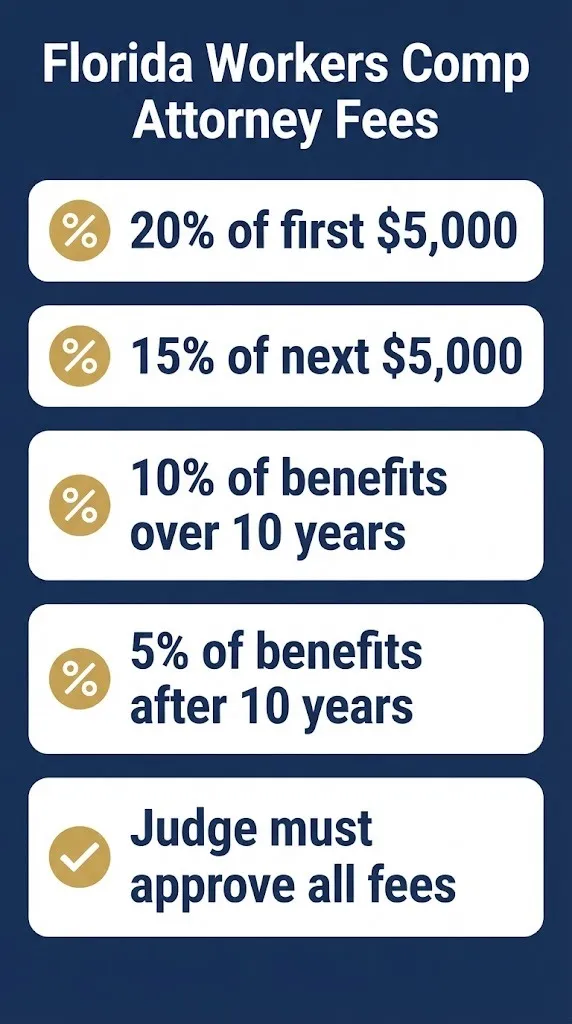
The statutory fee schedule works like a sliding scale :
| Benefits Secured | Maximum Attorney Fee |
|---|---|
| First $5,000 | 20% |
| Next $5,000 | 15% |
| Remaining benefits (first 10 years) | 10% |
| Benefits beyond 10 years | 5% |
A judge of compensation claims must approve the fee. The judge cannot approve a fee higher than what the statute allows .
Most attorneys advertise “no fee unless we win.” That’s accurate for workers’ comp. They also front case costs like independent medical exams, expert witnesses, and deposition fees. Those costs get reimbursed from your settlement before you receive your portion .
The practical result: if your case settles for $30,000, your attorney’s fee might be around $4,000 to $5,000 under the statutory schedule. The rest goes to you, minus any case costs advanced.
Key Takeaway: Florida workers’ comp attorney fees are capped by law, with no upfront costs, and a judge must approve the final fee before it’s paid.
What Is the Average Workers Compensation Settlement in Florida?
The average workers’ comp settlement in Florida falls between $20,000 and $40,000 for moderate claims . Minor claims might settle for $2,000 to $5,000. Catastrophic injuries can reach well over $100,000 .
There’s no single “average” that predicts your payout. Two workers with identical injuries can settle for very different amounts. The number depends on your average weekly wage, your impairment rating, and your future medical needs.
Settlements typically happen at Maximum Medical Improvement (MMI), the point where your doctor says your condition won’t improve further . At that stage, the insurance company may offer a lump sum to close out future benefits.
Here’s what drives settlement value up:
- Higher average weekly wage. Your benefits are based on the 13 weeks before your injury.
- Higher impairment rating. A permanent impairment rating translates to weeks of benefits.
- Future medical needs. If you’ll need ongoing care, that cost gets factored in.
- Lost earning capacity. If you can’t return to your previous job, that loss has value.
A worker with a permanent back injury that prevents heavy lifting will settle for more than a worker with a sprain that heals in six weeks. That’s not opinion. It’s how the system calculates value.
What Is the Maximum Weekly Benefit for Florida Workers Comp in 2026?
The maximum weekly benefit for 2026 injuries is $1,358 per week . That’s the cap on temporary total disability (TTD) and other wage-replacement benefits.
Temporary total disability pays 66 2/3% of your average weekly wage, up to that maximum . If you earned $1,500 per week before your injury, your TTD check would be $1,000 per week. If you earned $3,000 per week, your check would still be $1,358 because of the cap.
Temporary partial disability (TPD) applies when you return to lighter duty at lower pay. It covers part of the difference between your old wage and your reduced earnings .
Impairment income benefits kick in after you reach MMI. You receive 75% of your TTD rate for a set number of weeks based on your impairment rating .
Permanent total disability applies if your injuries prevent you from working at all. These cases are hard to win and heavily contested by insurers .
How Does Florida Calculate Permanent Impairment Benefits?
Florida uses a statutory chart to convert your impairment rating into weeks of benefits. The higher your rating, the more weeks you receive.
For 2026 injuries, the calculation works like this :
| Impairment Rating | Weeks Per Percentage Point |
|---|---|
| 1% to 10% | 2 weeks per point |
| 11% to 15% | 3 weeks per point above 10% |
| 16% to 20% | 4 weeks per point above 15% |
| 21% and higher | 6 weeks per point above 20% |
Here’s an example. If you receive a 12% impairment rating, you get 20 weeks for the first 10% (10 x 2), plus 6 weeks for the remaining 2% (2 x 3). That’s 26 weeks of benefits. If your weekly TTD rate was $800, you’d receive $600 per week for 26 weeks, or $15,600 .
Insurance company doctors often assign the lowest possible impairment rating. That’s one reason having your own attorney matters.
How Do You File a Workers Compensation Claim in Florida?
Filing a workers’ comp claim in Florida involves notifying your employer, seeking authorized medical care, and filing a petition if benefits are denied.
Here are the steps :
- Report the injury to your employer within 30 days.
- Seek treatment from the authorized treating physician chosen by the insurer.
- Confirm the claim has been filed with the insurance carrier.
- Track your wage benefits and medical treatment.
- If benefits are denied or delayed, file a Petition for Benefits with the OJCC.
- Attend any scheduled mediation or hearing.
- Negotiate a settlement at MMI or continue the claim.
The 30-day reporting deadline is strict. Missing it can bar your claim. The two-year filing deadline for a Petition for Benefits also applies, though payments or treatment can toll the clock .
What Should You Do If Your Workers Comp Claim Is Denied?
If your claim is denied, you have the right to challenge the denial by filing a Petition for Benefits with the Office of the Judges of Compensation Claims. A denied claim doesn’t mean you have no options.
Denials happen for many reasons. The insurer might dispute that your injury happened at work. They might argue your condition is pre-existing. They might claim you missed a deadline.
When you file a petition, the case goes before a Judge of Compensation Claims. The judge decides whether you’re entitled to benefits. This is where having an attorney makes a difference.
The complexity of Florida’s workers’ comp system has increased in 2026, according to the Workers Compensation Research Institute. Many injured workers don’t understand their full rights under state law .
If your claim is denied, don’t wait. The two-year statute of limitations still applies, and delays can hurt your case.
How Do You Choose the Right Workers Compensation Lawyer in Florida?
Choosing the right workers’ comp lawyer means looking for Florida Bar membership, relevant experience, and a clear fee structure. Here’s what to check.
Verify Florida Bar membership. Any attorney you hire must be a member in good standing with The Florida Bar. You can check membership status through the Bar’s public directory .
Look for workers’ comp experience. Some attorneys handle workers’ comp as one of many practice areas. Others focus on it exclusively. For a complex claim, specialization matters.
Ask about fee structure. Florida law caps attorney fees in workers’ comp cases. Your attorney should explain the statutory schedule and confirm there are no upfront costs.
Check for free consultations. Most Florida workers’ comp attorneys offer free initial consultations . Use that to ask questions and assess whether the attorney seems genuinely interested in your case.
Ask about case costs. Your attorney may front costs for independent medical exams, expert witnesses, and depositions. Ask how those costs are handled and whether you’re responsible if the case loses.
Trust your judgment. If an attorney seems rushed, dismissive, or unclear about the process, keep looking. You’re hiring someone to represent you for months or years. Communication matters.
What Happens Next in Your Florida Workers Compensation Case?
Here’s a timeline of what to expect after a workplace injury.
Immediate: Report the injury to your employer in writing within 30 days .
Within days: Seek treatment from the authorized physician. Confirm the claim is filed with the insurance carrier.
Ongoing: Receive medical treatment and wage benefits while you recover.
At MMI: Your doctor assigns an impairment rating and determines whether you can return to work .
If benefits are denied: File a Petition for Benefits within the two-year window .
At settlement: Negotiate a lump-sum payout that closes future medical and wage benefits.
Frequently Asked Questions
How much does a workers comp lawyer cost in Florida?
Nothing upfront. Florida workers’ comp attorneys work on contingency with fees capped by statute under Section 440.34.
What is the average workers comp settlement in Florida?
Average settlements range from $20,000 to $40,000 for moderate claims, though minor claims settle lower and catastrophic injuries can exceed $100,000.
Do I need a lawyer for a workers comp claim in Florida?
Not always. Simple claims with accepted benefits may not require one. But if your claim is denied, delayed, or involves permanent impairment, a lawyer can help.
How long do I have to report a workplace injury in Florida?
You must report the injury to your employer within 30 days of the accident or discovery of an occupational disease.
What is the maximum weekly workers comp benefit in Florida for 2026?
The maximum weekly benefit for 2026 injuries is $1,358 per week for temporary total disability and related wage benefits.
Can I sue my employer for a workplace injury in Florida?
Generally no. Workers’ compensation is the exclusive remedy, meaning you cannot sue your employer directly for most workplace injuries.
What happens if my workers comp claim is denied in Florida?
You can file a Petition for Benefits with the Office of the Judges of Compensation Claims to challenge the denial.
How long does a Florida workers comp case take?
Timelines vary. Simple claims resolve in months. Disputed claims that go to hearing can take a year or more.