Internet Defamation Lawsuit 2026: What You Can Actually Sue For and Win
Quick Answer
- Internet defamation lawsuits are real and winnable, but public figures must prove “actual malice,” a hard legal bar.
- Recovery is not fixed: pre-suit settlements often run $10,000 to $50,000, while litigated verdicts vary far more widely.
- Most states give you only 1 to 3 years from first publication to sue, under the single publication rule.
Someone posted something false about you online, and you want to know if suing actually works. It does, but the July 2026 dismissal of Trump Media’s $3.8 billion suit against The Washington Post shows exactly how high the bar can be.
This case matters to you even if you’re not a public figure. It confirms, in real time, what courts require before a defamation claim survives past summary judgment.
This article covers what you legally have to prove, what it actually costs, how to unmask an anonymous poster, and the real statute of limitations deadlines that apply in your state.
The Facts
| Featured Case | Trump Media and Technology Group v. The Washington Post, U.S. District Court, Middle District of Florida |
| Status | Dismissed on summary judgment, July 7, 2026. Trump Media is weighing an appeal |
| Fund Size | Not applicable. Internet defamation cases are individual lawsuits, not a shared settlement fund |
| Est. Per Case | Pre-suit settlements often run $10,000 to $50,000. Litigated verdicts vary widely and can reach seven figures |
| Claim Deadline | Not fixed nationally. Most states allow 1 to 3 years from first publication, under the single publication rule |
| Administrator | Not applicable. Each case has its own plaintiff, defense counsel, and court |
| Proof Needed | A false statement of fact, publication to a third party, identification, fault, and actual damages |
Is an internet defamation lawsuit actually possible to win?
Yes, internet defamation lawsuits are winnable, but the outcome depends heavily on whether you’re a private person or a public figure.
Courts across the country hear these cases regularly. Canadian courts alone issued multiple online defamation damage awards in June 2026, ranging from $30,000 to $250,000, according to tracking by defamation law site Libel and Privacy.
In the United States, private individuals generally only need to prove the statement was false, published, and caused harm. Public figures and public officials face a much tougher standard: actual malice.
That’s exactly what sank Trump Media’s case. U.S. District Judge Thomas Barber ruled the company “failed to present evidence that would allow a jury to find, by clear and convincing evidence,” that the Post acted with actual malice.
Key Takeaway: Internet defamation lawsuits are real and winnable, but the standard of proof for public figures is significantly higher than most people expect.
Can you sue someone for posting about you on social media?
Yes, you can sue over a tweet, Facebook post, TikTok video, Instagram caption, or Reddit comment if it meets the legal elements of defamation.
The medium doesn’t change the underlying law. A false, damaging statement of fact posted to social media is treated the same way courts treat a false statement in a newspaper or broadcast.
Recent case examples show this plays out in real courtrooms. A Dallas County jury awarded photographer Andrea Polito a $1.08 million verdict after a couple’s social media “smear campaign” over a disputed album fee.
- The statement must be a factual claim, not pure opinion.
- It must be published or shown to at least one other person.
- It must be about you specifically, even if not named directly.
- It must cause real, provable harm.
How much does an internet defamation lawsuit cost?
An internet defamation lawsuit can run anywhere from a few thousand dollars for a quick pre-suit resolution to well over $100,000 for a fully litigated case.
Costs depend heavily on how far the case goes. Filing fees, discovery, expert witnesses, and John Doe subpoenas to unmask anonymous posters all add up quickly if the case doesn’t settle early.
| Stage | Typical Cost Range |
|---|---|
| Cease and desist letter only | Several hundred to a few thousand dollars |
| Pre-suit settlement negotiation | $10,000 to $50,000 |
| Filed lawsuit, resolved before trial | $15,000 to $100,000+ |
| Full litigation through trial | $100,000 and up |
Some defamation attorneys take strong cases on contingency, meaning they collect a percentage of any recovery instead of an upfront fee. That’s more common in high-value cases with clear evidence, not guaranteed for every claim.
How much can you actually recover in an online defamation case?
Not a fixed amount. Recovery in an internet defamation case ranges enormously depending on your evidence, your damages, and whether the defendant can pay.
Reported settlement and verdict figures vary by orders of magnitude. Musician Courtney Love settled a Twitter defamation claim for $430,000 in 2011. A Dallas jury awarded $1.08 million in the Polito photography case. A Quebec court awarded $30,000 in moral damages plus $16,000 in punitive damages in a June 2026 YouTube and Facebook defamation ruling.
- Documented lost income or lost clients strengthens a damages claim significantly.
- Emotional distress claims generally need supporting medical or psychological records.
- Punitive damages are possible in some states if the defendant acted with actual malice or reckless disregard.
- A defendant’s ability to actually pay a judgment matters as much as the verdict amount itself.
Even a massive damage demand can end in zero recovery, as Trump Media’s $3.8 billion claim shows. A jury never even heard that case because the judge found the evidence didn’t clear the actual malice bar.
Key Takeaway: There is no standard payout for internet defamation. Some cases settle for a few thousand dollars, some verdicts reach seven figures, and some multi-billion dollar claims get thrown out before trial entirely.
What are the legal elements you have to prove?
You generally have to prove four things: a false statement of fact, publication to a third party, that the statement identifies you, and that it caused real damages.
Courts require all four elements, and missing even one usually ends the case. A statement that is provably true is not defamatory, no matter how damaging it feels.
- False statement of fact: Opinions and hyperbole generally don’t count.
- Publication: The statement reached at least one person besides you.
- Identification: A reasonable reader would understand it was about you.
- Fault: Negligence for private figures, actual malice for public figures.
- Damages: Provable harm to reputation, finances, or in some cases, emotional wellbeing.
Some states also recognize “defamation per se,” where certain categories of false statements, like falsely accusing someone of a crime, are presumed damaging without separate proof of financial loss.
How do you find out who posted an anonymous defamatory statement?
You can identify an anonymous poster through a “John Doe” lawsuit, which lets you subpoena the platform or internet service provider for the account holder’s identifying information.
This is the most common legal tool in internet defamation cases, since a large share of online attacks come from anonymous or fake accounts.
- File suit against an unnamed “John Doe” or “Jane Doe” defendant.
- Ask the court to authorize a subpoena to the platform.
- The platform typically discloses an IP address, email, or registration data.
- A second subpoena may go to the internet service provider for the subscriber’s identity.
- Many platforms notify the user first, giving them a chance to fight the subpoena.
- Once identified, you amend the complaint to name the real defendant.
Courts generally require you to make a prima facie showing of each defamation element before ordering disclosure. That’s a real evidentiary hurdle, not a formality, so weak or vague claims often get denied at this stage.
Step by step: how to file an internet defamation lawsuit
Filing an internet defamation lawsuit follows a fairly consistent sequence, though exact procedures vary by state court.
- Preserve evidence immediately. Screenshot the post, URL, timestamp, and any comments or shares before it can be deleted.
- Document your damages. Save records of lost clients, income, job offers, or medical treatment tied to the harm.
- Check your state’s statute of limitations. Some states give you as little as one year from first publication.
- Consult a defamation attorney. Confirm whether you’re dealing with a private figure or public figure standard.
- File a John Doe suit if needed to preserve your deadline while you identify an anonymous poster.
- Draft and file your complaint with the appropriate state or federal court.
- Serve the defendant according to your jurisdiction’s specific service rules.
- Proceed through discovery, motions, and either settlement or trial.
A wrong step here isn’t just inconvenient. Errors in filing or service can delay or derail an otherwise valid claim, the same way a missed warranty registration deadline can void an otherwise legitimate product claim.
Key Takeaway: Filing correctly and on time matters as much as having a strong underlying claim, since procedural errors can end a case before the facts are ever considered.
What’s the latest major internet defamation ruling in 2026?
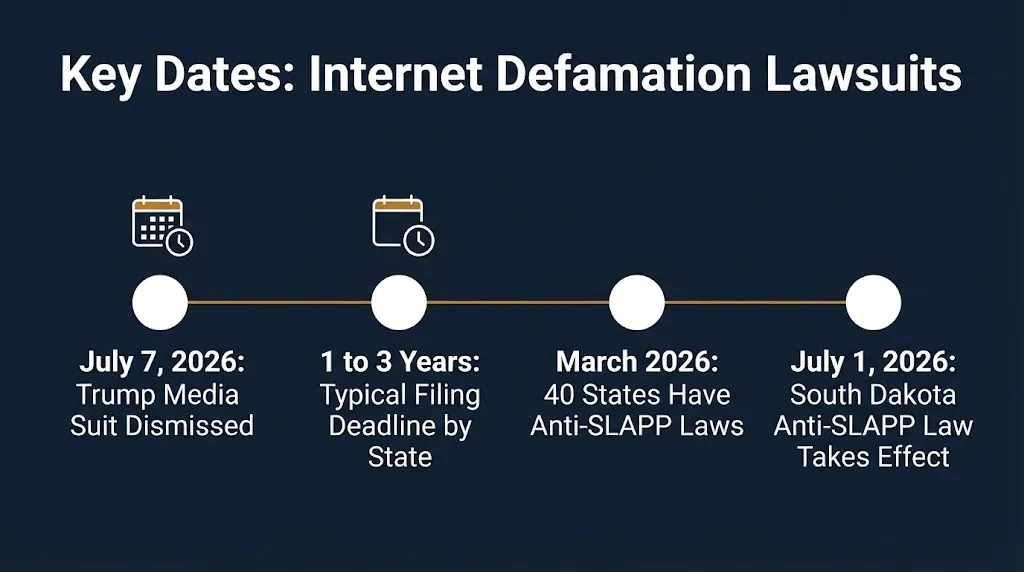
The biggest verified internet-era defamation ruling of 2026 is the July 7 dismissal of Trump Media and Technology Group’s $3.8 billion lawsuit against The Washington Post.
Trump Media sued in 2023 over a Post article about the company’s financing efforts ahead of its SPAC merger. The company alleged a “years-long crusade” and an “egregious hit piece.”
U.S. District Judge Thomas Barber granted the Post’s motion for summary judgment in a Tampa federal court, finding Trump Media hadn’t shown clear and convincing evidence of actual malice under the New York Times v. Sullivan standard.
The Post did issue a correction after discovery closed, acknowledging one factual detail in the original story was inaccurate. Trump Media called that a partial vindication and said it’s evaluating an appeal.
Are internet defamation lawsuits increasing in 2026?
Not yet independently confirmed at a nationwide, official level. Some industry trackers report a 34% increase in internet libel filings between 2023 and 2025, though that figure comes from a private legal guide rather than a government court-tracking source.
What is better documented is the broader environment driving these cases. A research dataset covering nearly 2,850 online defamation matters across US state courts, UK courts, and EU national courts between January 2024 and December 2025 points to sustained, high case volume tied to social media’s reach.
Anonymous posting, fast content spread, and permanent digital records all make online defamation easier to both commit and later prove, compared to spoken slander. That combination is widely cited by defamation attorneys as the reason online cases keep climbing.
Can you sue the platform, or only the person who posted it?
Generally, you can only sue the person who posted the content, not the platform that hosted it.
Section 230 of the Communications Decency Act gives platforms like Facebook, Yelp, and Google broad immunity from liability for content posted by their users, even if the platform knows about the content and leaves it up.
- Section 230 does not shield the original poster, only the platform.
- Federal criminal law is one of a small number of express exceptions.
- Intellectual property claims, like copyright, are also excluded from Section 230 immunity.
- Suits against platforms for user content are dismissed at the motion-to-dismiss stage in the large majority of reported cases.
There is no federal repeal of Section 230 as of 2026. Multiple bills have been introduced in Congress, and the statute remained the subject of active Senate hearings as recently as March 2026, but it remains fully in force.
What is the actual malice standard and who has to meet it?
The actual malice standard requires a public figure to prove the defendant knew a statement was false, or acted with reckless disregard for whether it was true, when they published it.
This standard comes from the 1964 Supreme Court case New York Times Co. v. Sullivan and applies to public officials and public figures, not typically to private individuals.
It is a genuinely hard standard to meet. The Trump Media case shows why: even after years of litigation and discovery, the court found no evidence clearing that bar, and the case never reached a jury.
Private individuals generally face a lower bar, usually negligence, meaning the defendant failed to exercise reasonable care in checking whether a statement was true before publishing it.
Key Takeaway: Whether you’re a public figure or a private person changes your legal burden dramatically, and misjudging which category you fall into can sink an otherwise valid claim.
How long do you have to file (statute of limitations)?
Most states give you between 1 and 3 years to file an internet defamation lawsuit, measured from the date the statement was first published, not from when you discovered it or when it was last viewed.
This is called the single publication rule. Courts, including in New Jersey and Texas, have specifically applied it to online content, ruling that technical edits or continued availability of a post do not restart the clock.
| Limitation Window | Representative States |
|---|---|
| 1 year | California, New York, Texas, Illinois, Arizona, Colorado, District of Columbia |
| 2 years | Alabama, Alaska, Connecticut, Delaware, Florida, Virginia |
| Up to 3 years (libel) | Arkansas |
If a defamatory article was first posted on a specific date, the clock generally starts that day, not the day you happened to see it. Waiting to act is one of the most common ways valid claims get barred entirely, similar to letting a tax refund window quietly close.
What is an anti-SLAPP law and could it get your case thrown out?
An anti-SLAPP law lets a defendant ask a court to quickly dismiss a lawsuit that appears designed to punish or silence protected speech rather than address genuine harm.
As of March 2026, 40 states and the District of Columbia have anti-SLAPP statutes, according to the Reporters Committee for Freedom of the Press. South Dakota’s law was set to take effect July 1, 2026.
- Protections vary significantly by state; some cover only government-petitioning activity, others cover any speech on a matter of public concern.
- There is still no federal anti-SLAPP statute as of 2026, despite repeated bills like the SPEAK FREE Act.
- Federal courts are split on whether state anti-SLAPP procedures even apply in federal diversity cases.
- A successful anti-SLAPP motion can result in the plaintiff paying the defendant’s attorney fees.
If you’re filing a claim, know whether your target state has a strong anti-SLAPP law before you file. If you’re the one being sued over something you posted, an anti-SLAPP motion may be your fastest and cheapest way out.
Can a business sue over a bad online review?
Yes, a business can sue over a false factual claim in a review, but genuine opinions and honest negative experiences are generally protected speech.
The distinction matters enormously. Saying “the food made me sick” as your honest experience is very different, legally, from falsely claiming a restaurant “got shut down for health code violations” when it didn’t.
Businesses that sue over ordinary negative reviews often run straight into anti-SLAPP motions in states that protect consumer speech on matters of public concern, including reviews. Courts in Virginia and elsewhere have specifically applied anti-SLAPP protection to anonymous online reviews.
Reality Check
No legitimate attorney contacts you out of the blue promising a guaranteed six or seven figure payout for an online post. Filing a lawsuit always costs money, and a strong claim still has to clear every legal element, including proof of real damages. Be skeptical of any guide, including this one, that promises a specific recovery amount before your case has even been evaluated.
What defenses can stop an internet defamation lawsuit?
Truth is the single strongest defense to an internet defamation lawsuit, since a true statement, however damaging, generally cannot be defamatory.
Several other defenses come up regularly in online cases, and any one of them can end a claim early.
- Truth: The core defense. If the statement is substantially true, the claim fails.
- Opinion: Statements that can’t be proven true or false, like pure commentary, are generally protected.
- Privilege: Certain statements, like testimony in court proceedings, carry legal immunity.
- Consent: If the plaintiff consented to the publication, the claim generally fails.
- Statute of limitations: Filing after the deadline bars the claim regardless of merit.
- Anti-SLAPP motion: Can result in early dismissal plus fee-shifting against the plaintiff.
The Trump Media case shows a related but distinct defense in action: even where a statement turns out to contain an error, a defendant can still win if the plaintiff can’t prove the defendant knew it was false or acted recklessly.
What Happens Next
July 2026: Trump Media weighing whether to appeal the dismissal of its Washington Post lawsuit; a full written opinion from the court is still forthcoming.
Ongoing through 2026: State legislatures continue considering new or expanded anti-SLAPP protections, with South Dakota’s law taking effect July 1, 2026.
Ongoing in Congress: Federal anti-SLAPP legislation, including versions of the SPEAK FREE Act, remains introduced but not passed as of this year.
Expected 2027: Updated annual online defamation filing data from legal trackers, which should confirm whether 2026 case volume matched or exceeded 2025 levels.
Frequently Asked Questions
Can you sue someone for defamation over a text message or DM?
Yes.
Private direct messages can support a defamation claim if they were seen by at least one other person besides you.
A Canadian court’s June 2026 ruling specifically involved defamatory direct messages sent through Instagram.
Do you need a lawyer to file an internet defamation lawsuit?
Not legally required, but strongly recommended given the procedural complexity.
Identifying anonymous defendants, meeting your state’s deadline, and proving actual malice for public figures all involve technical legal standards.
Many defamation attorneys offer free initial consultations to evaluate whether a claim is viable.
What happens if the person who defamed you has no money?
You can still win a judgment, but collecting on it becomes the real challenge.
Courts do not guarantee payment just because they issue a ruling in your favor.
Some plaintiffs pursue defendants’ wages or assets separately after winning, which adds time and cost.
Is it defamation if the person says “in my opinion”?
Not automatically protective.
Courts look at whether a reasonable reader would understand the statement as a factual claim, regardless of a disclaimer.
Adding “I think” to a false factual accusation doesn’t reliably convert it into protected opinion.
Can you sue an anonymous Reddit or forum account?
Yes, through a John Doe lawsuit and subsequent subpoena to the platform.
The process can take weeks to months depending on how quickly the platform responds and whether the user contests disclosure.
Filing the John Doe suit promptly can also help preserve your statute of limitations deadline.
How is internet defamation different from regular defamation?
The core legal elements are the same as traditional libel or slander.
What differs is enforcement: online content is easier to document, easier to trace through subpoenas, and often reaches a much larger audience than a local newspaper or broadcast.
Courts have specifically extended doctrines like the single publication rule to cover online posts.
Does deleting the post protect the person who wrote it?
Deletion doesn’t erase legal liability for what was already published.
Courts evaluate the statement’s content and reach at the time it was published, not whether it still appears online.
Deleting content can, however, be relevant to a damages calculation.
Bottom Line
Internet defamation lawsuits are real, but they live or die on hard evidence, not outrage. Check your state’s statute of limitations right away, since most states give you a year or less from first publication.
If you’re considering a claim, start preserving screenshots and documentation today. Waiting past your filing deadline is one of the most common and preventable ways a valid case gets thrown out.