Who Is Exempt From Workers’ Compensation Insurance in Texas? 2026 Rules
Quick Answer
- Who is exempt? Most private Texas employers can legally opt out, but governmental entities cannot.
- What does it cost? Non-subscribers lose key legal defenses and face unlimited damages in employee lawsuits.
- Key deadline: Non-subscribers must file DWC Form-005 annually and report injuries within specified timeframes.
Texas operates differently from every other state on workers’ compensation. Private employers can choose not to carry coverage. That choice comes with serious consequences.
If you’re a Texas business owner wondering whether you’re required to have workers’ comp, the short answer is: probably not, unless you’re a governmental entity. But “not required” doesn’t mean “safe.” Going bare exposes you to personal injury lawsuits with almost unlimited damages.
This article breaks down exactly who must carry workers’ compensation in Texas, who can opt out, what happens when you do, and how the rules compare to states like Kansas. You’ll also learn the reporting requirements that apply even if you’re a non-subscriber.
The Facts
| Item | Detail |
|---|---|
| Texas Private Employers | Coverage is optional, not required |
| Texas Governmental Entities | Coverage is mandatory for all public schools, cities, counties, and utilities |
| Non-Subscriber Penalty | Loss of common law defenses; unlimited damages exposure |
| Notice Requirements | Must notify employees of non-coverage and file DWC Form-005 |
| Kansas Threshold | Coverage required if annual payroll exceeds $20,000 |
| Kansas Penalty | Twice the annual premium or $25,000, whichever is greater |
Who is exempt from workers’ compensation insurance in Texas?
Private employers in Texas are exempt from the requirement to carry workers’ compensation insurance. The state does not mandate coverage for most private businesses.

This is unique. Texas is the only state that gives private employers this choice. In every other state, workers’ compensation is mandatory for businesses with employees.
The Texas Department of Insurance confirms: “In Texas, private employers can choose to carry workers’ compensation insurance coverage, but it is not required in most cases.”
But there’s a catch. If you choose not to carry coverage, you become a “non-subscriber.” That status comes with legal consequences that can cost far more than insurance premiums.
Governmental entities do not have this choice. “All Texas governmental entities (public school, utility, city, or county) must have workers’ compensation coverage.”
Key Takeaway: Private Texas employers can legally opt out of workers’ compensation. Governmental entities cannot.
What happens if a Texas employer doesn’t carry workers’ compensation?
Non-subscriber employers lose key legal defenses and face almost unlimited damages if an injured employee sues them.
This is the trade-off. You save on premiums, but you give up protection.
According to the Texas Guidebook for Employers: “Being a ‘non-subscriber’, i.e., going ‘bare’ or without coverage, leaves an employer open to personal injury lawsuits from employees who are injured on the job – the damages and attorney’s fees are almost unlimited.”
The defenses you lose are significant. In most personal injury lawsuits, defendants can argue assumption of risk, contributory negligence, and co-worker negligence. Non-subscribers cannot use those defenses in job injury cases.
The National Association of Insurance Commissioners explains it this way: “Employers in Texas that elect to ‘opt-out’ of purchasing workers’ compensation coverage can be sued and retain their traditional legal defenses.” Actually, that’s backwards. Non-subscribers lose traditional defenses. They can be sued, and they cannot use the defenses that would normally limit their liability.
Key Takeaway: Going without coverage means you can be sued for unlimited damages and cannot use standard legal defenses.
What are the notice requirements for Texas non-subscribers?
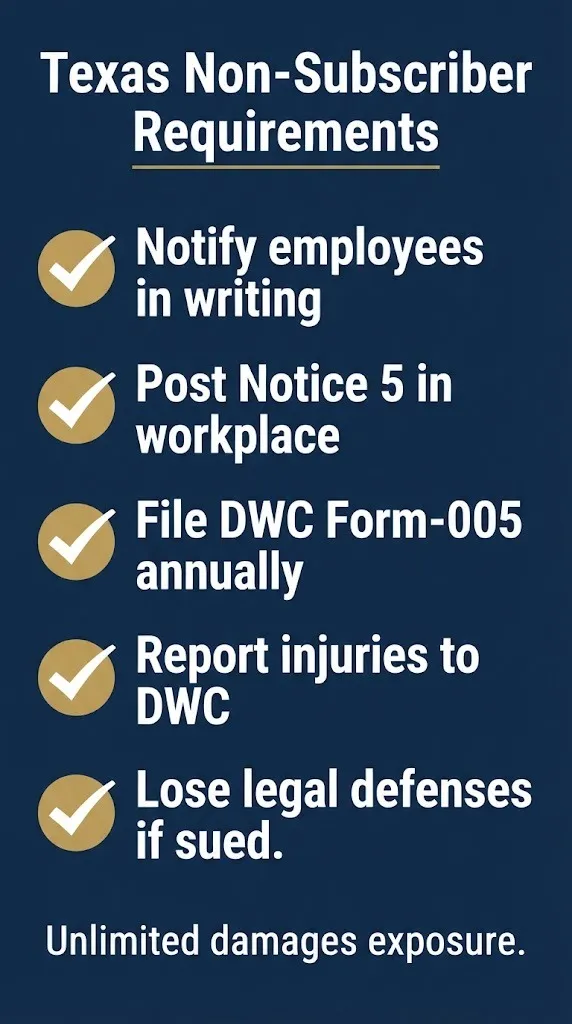
Non-subscribers must notify employees in writing that they do not carry coverage, post the notice in the workplace, and file DWC Form-005 with the state annually.
You cannot simply decide not to carry coverage and stay silent. The law requires transparency.
At hire, you must notify each new employee of non-coverage using Notice 5. You must also post the same notice along with other required workplace posters.
Employees have five days to elect to waive their right to workers’ compensation benefits and retain their common-law right to sue. The notice must explain that giving up workers’ compensation means giving up the right to receive medical or income benefits under the workers’ compensation law.
You must also file DWC Form-005, the “Employers’ Notice of No Coverage or Termination of Coverage,” annually with the Division of Workers’ Compensation.
If you discontinue coverage after having it, you must inform employees and the Workers’ Compensation Division as soon as possible via Form DWC005.
Key Takeaway: Non-subscribers have specific notice and filing requirements. Failing to comply adds legal risk on top of the coverage gap.
How does Texas compare to Kansas workers’ compensation rules?
Kansas requires workers’ compensation coverage for employers with annual payroll exceeding $20,000. Texas does not mandate coverage for private employers at all.
The contrast is stark. Kansas law states that “an employer in a non-agricultural business, with more than $20,000 in gross annual payroll in a calendar year, must fulfill two requirements under the Workers Compensation Act: Secure workers compensation coverage for employees; File reports of alleged work accidents.”
The penalty for non-compliance in Kansas is serious: “The civil penalty for violating this provision is twice the annual premium or $25,000, whichever is greater.”
Kansas also has specific exemptions. The state’s Department of Labor lists excluded employers as: certain agricultural pursuits, realtors who qualify as independent contractors, firefighters in relief associations that waived coverage, sole proprietors, LLC members and partners, and certain owner-operator vehicle drivers.
| Rule | Texas | Kansas |
|---|---|---|
| Coverage Requirement | Optional for private employers | Mandatory if payroll > $20,000 |
| Governmental Entities | Mandatory | Mandatory |
| Penalty for Non-Compliance | Loss of defenses, unlimited damages | Twice annual premium or $25,000 |
| Agricultural Exemption | Varies | Certain pursuits excluded |
Key Takeaway: Texas gives private employers a choice. Kansas does not, once payroll exceeds the threshold.
Who is exempt from workers’ compensation in Kansas?
Kansas exempts certain agricultural pursuits, realtors, firefighters, sole proprietors, LLC members, partners, and certain owner-operator drivers from mandatory coverage.
The Kansas Department of Labor provides the specific list of excluded employers:
- Certain agricultural pursuits
- Realtors who qualify as independent contractors
- Firefighters belonging to a firefighter’s relief association which has waived coverage
- Sole proprietors, LLC members and partners (all other employees need coverage if payroll is greater than $20,000)
- Certain owner-operator vehicle drivers covered by their own occupational accident insurance policy
Corporate officers with less than a 10% ownership share are considered employees and must be included in workers’ comp. Those with 10% or greater ownership share have the option of excluding themselves.
Kansas also allows exempt employers and employees to opt into coverage if they find it beneficial. This applies to sole proprietors, partners, corporate officers with 10% or greater ownership, employers wanting coverage for volunteers, and volunteer directors of nonprofits.
Key Takeaway: Kansas has specific statutory exemptions, but the $20,000 payroll threshold is the key dividing line.
How do you get workers’ compensation insurance in Texas?
You get workers’ compensation insurance by purchasing a policy from a licensed Texas carrier, qualifying as a self-insurer, or joining a governmental pool.
The Texas Department of Insurance lists the coverage categories:
- Subscriber with carrier coverage: Purchasing coverage through a licensed insurance carrier. Verify coverage at TXCOMP NCCI website.
- Certified self-insured: A private employer approved to pay its own losses. Apply with TDI’s Division of Workers’ Compensation.
- Governmental self-insured: A governmental entity that funds its own program or joins a pool.
If you’re a non-subscriber, you must report to the state that you don’t have coverage and report work-related injuries resulting in more than one day of lost time, as well as all work-related illnesses and deaths.
Key Takeaway: Texas employers have multiple options to secure coverage, from private insurance to self-insurance.
How do you get workers’ compensation insurance in Kansas?
Kansas employers can buy private insurance, join the assigned risk plan, self-insure, or join a group-funded pool.
The Kansas Insurance Department outlines four choices:
- Private insurance companies: Contact carriers independently or work with an agent or broker.
- The assigned risk plan: For employers unable to get insurance from commercial insurers, administered by the Kansas Insurance Department.
- Self-insurance: Employers who meet financial requirements can self-insure. Must demonstrate to the Kansas Department of Labor the ability to cover claims.
- Group-funded pools: Employers can join a pool with other employers, subject to Kansas Insurance Department approval.
The average cost of workers’ compensation in Kansas is $65 per month, or $777 annually, based on Insureon customer data.
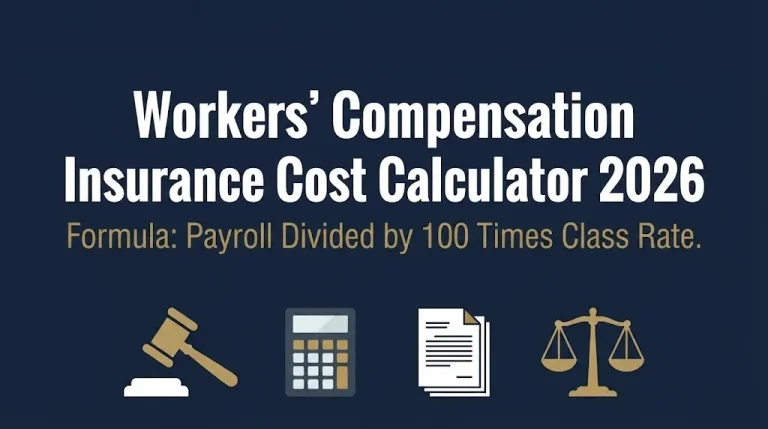
Premiums are calculated using a formula: Classification rate × Experience modification rate × (Annual payroll / $100).
Key Takeaway: Kansas has a structured market with multiple options, including an assigned risk plan for high-risk employers.
What does workers’ compensation insurance protect?
Workers’ compensation protects both employees and employers. Employees get medical care and wage replacement without proving fault. Employers get immunity from most lawsuits.
The system is a compromise. The Delaware Division of Industrial Affairs explains: “It protects both workers and employers by providing benefits without requiring the employee to prove fault. It also shields employers from most lawsuits related to workplace injuries.”
Benefits include lifetime medical benefits for necessary treatment, disability income benefits up to statutory limits, limited funeral expenses, and death benefits for surviving dependents.
But workers’ compensation doesn’t cover everything. Exclusions typically include injuries caused by intoxication, drugs, horseplay, self-inflicted injuries, and voluntary participation in off-duty recreational activities.
For employers, the immunity from lawsuits is the key benefit. Without coverage, that immunity disappears.
Key Takeaway: Workers’ compensation is a trade-off: guaranteed benefits for workers, lawsuit protection for employers.
Reality Check
Skipping workers’ compensation insurance in Texas is legal, but it’s not free. The premium savings come with unlimited lawsuit exposure and the loss of legal defenses you’d normally have. If an employee gets hurt and sues, you could lose everything. Most insurance agents will tell you the same thing: for most businesses with employees, the coverage is worth the cost even when it’s not required.
What happens next if you’re a Texas non-subscriber?
Immediately: Post the required Notice 5 informing employees of non-coverage.
At hire: Provide written notice to each new employee and explain the five-day election window.
Annually: File DWC Form-005 with the Texas Department of Insurance, Division of Workers’ Compensation.
After any injury: Report work-related injuries resulting in more than one day of lost time, all illnesses, and deaths to DWC.
If sued: You cannot use assumption of risk, contributory negligence, or co-worker negligence as defenses.
Frequently Asked Questions
Are Texas employers required to have workers’ compensation insurance?
No. Texas is the only state that does not require private employers to carry workers’ compensation coverage. Governmental entities must carry it.
What happens if a Texas employer doesn’t have workers’ compensation?
The employer becomes a “non-subscriber” and loses key legal defenses if sued. Damages and attorney’s fees are almost unlimited.
Do Texas non-subscribers have to notify employees?
Yes. They must provide written notice at hire, post the notice in the workplace, and file DWC Form-005 annually.
What is the workers’ comp payroll threshold in Kansas?
Kansas requires coverage for non-agricultural employers with more than $20,000 in gross annual payroll.
Who is exempt from workers’ comp in Kansas?
Certain agricultural pursuits, realtors, firefighters, sole proprietors, LLC members, partners, and certain owner-operator drivers are exempt.
Can a Texas employee sue a non-subscriber employer?
Yes. Non-subscribers can be sued for work injuries, and they cannot use assumption of risk, contributory negligence, or co-worker negligence defenses.
How much does workers’ comp cost in Kansas?
The average cost is $65 per month, or $777 annually, based on Insureon customer data.
What forms do Texas non-subscribers file?
They file DWC Form-005 annually to report no coverage or termination of coverage.
If you’re a Texas private employer considering going without coverage, understand what you’re giving up. If you’re a Kansas employer with payroll over $20,000, coverage is mandatory. The single most important fact: Texas is the only state where private employers can legally skip workers’ compensation, but that choice removes your legal defenses and exposes you to unlimited damages.