Average Settlement for Car Accident Back and Neck Injury in 2026: What the Real Numbers Show
Quick Answer
- The typical back and neck injury settlement after a car accident runs $10,000 to $100,000, with severe spinal cases going higher.
- One widely cited “national average” of $925,169 is skewed upward by rare multi-million-dollar verdicts, not what most people actually receive.
- There’s no universal deadline. Your filing window is set by your state’s statute of limitations, typically one to six years from the crash date.
If you got rear-ended, saw a chiropractor for weeks, and started Googling what your claim might be worth, you’ve probably noticed something strange. One site says $12,000 to $90,000. Another says $925,000. A third says $73,000 flat.
None of them are lying exactly. They’re measuring different things, and most of them have a financial interest in the number that makes you want to call. This article breaks down what’s actually verified, why the “average” you see depends entirely on who’s counting, and what real settlement ranges look like by injury type.
We cover minor whiplash payouts, surgical spine cases, rear-end collision specifics, gross negligence claims, and how insurance adjusters actually calculate a number. One detail worth knowing upfront: the median settlement in most published data is far lower than the average, because a handful of catastrophic cases pull the average way up.
The Facts
| Case Type | Individual car accident injury claims (not a class action or lawsuit fund) |
| Status | Ongoing; settlements negotiated case-by-case with insurers |
| Fund Size | Not applicable, there is no shared settlement pool |
| Est. Per Person | $10,000 to $100,000 typical range; severe spinal cases can exceed $500,000 |
| Claim Deadline | Set by your state’s statute of limitations, generally 1 to 6 years from the accident |
| Administrator | Not applicable; claims go through the at-fault driver’s insurance company |
| Proof Needed | Medical records, bills, police report, imaging, wage-loss documentation |
Is the “Average Settlement” Number You’re Seeing Actually Real?
Most of the figures circulating online are real data, pulled from actual firm case files, but they measure different populations of cases. That’s why they don’t match.
Mighty.com’s compiled data puts the typical back and neck injury settlement between $12,000 and $90,000, with the range depending on injury type and severity. A separate multi-state study from The Miley Legal Group found something wildly different: a national average of $925,169 and a median of $316,000, a gap so large it reveals the problem with “average” as a metric.
Key Takeaway: When a report says “average,” check whether it also gives a median. If the average is many times higher than the median, a small number of massive verdicts are distorting the picture.
That same Miley Legal Group study found the highest recorded amount was a $71,000,000 verdict in New York, while the lowest was $1,719 in Minnesota, both car accident cases. Averaging those two numbers together with everything in between produces a figure that describes almost no actual person’s outcome. A separate law firm, Brown & Crouppen, reviewed 4,500 of its own car accident cases dating back to 2021 and found an average settlement of $37,248.62, a number grounded in firm-level data rather than headline verdicts. Insurance industry data tends to run lower still: the Insurance Information Institute’s bodily injury claim figures, cited by multiple firms, put the average bodily injury claim settlement around $26,500.
None of these sources is wrong. They’re answering different questions: “what do injured people typically get” versus “what does the average dollar amount look like once you include outliers.”
Average Settlement for Car Accident Back and Neck Injury
The average settlement for a car accident back and neck injury generally falls between $10,000 and $100,000, with the exact number depending heavily on how severe the injury is and whether surgery was required.
Multiple independent sources converge around this same core range even though their headline averages differ. One firm puts the range at $10,000 to $100,000, noting that final payouts depend heavily on the severity of the diagnosis and required medical care. Another firm’s public data shows the same $12,000 to $90,000 range. A third source frames it slightly wider, at $20,000 to $300,000 nationally, cautioning that averages can be misleading because extreme cases skew the numbers.
A Pennsylvania firm, Cordisco & Saile, reports a single flat figure: about $73,000 for a back or neck injury settlement, based on its own case history, a useful reality check against the more dramatic multi-hundred-thousand-dollar averages.
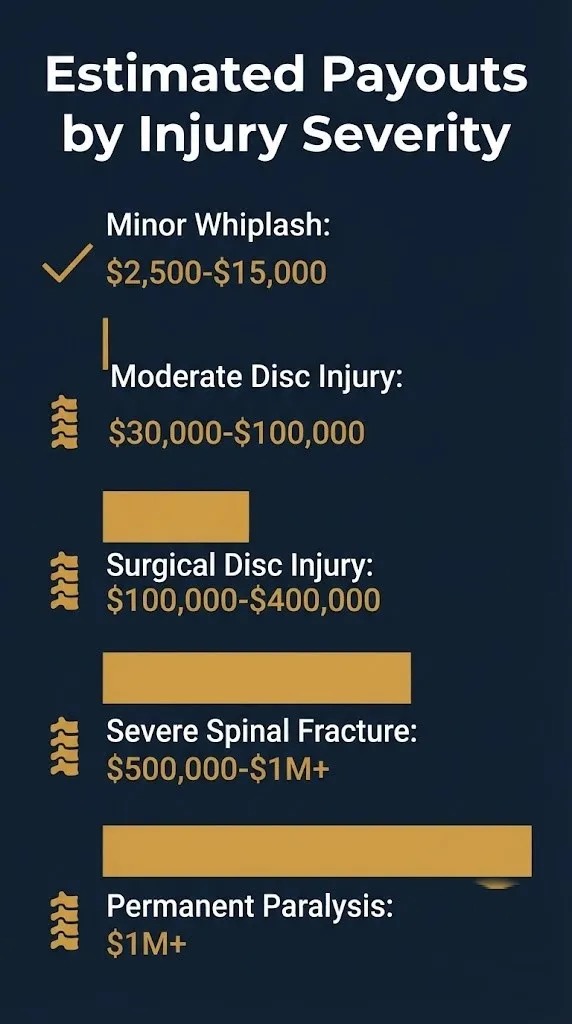
Where these numbers come from, broken down by severity:
| Injury Severity | Typical Settlement Range |
|---|---|
| Minor whiplash / soft tissue | $2,500 to $15,000 |
| Moderate (herniated disc, no surgery) | $30,000 to $100,000 |
| Herniated disc with surgery | $100,000 to $400,000 |
| Severe spinal fracture or nerve damage | $500,000 to $1,000,000+ |
| Permanent paralysis or spinal cord injury | $1,000,000 and up |
Every dollar figure in that table traces back to the sources cited throughout this article. If your case doesn’t fit neatly into one row, that’s normal. Insurance adjusters weigh your specific medical file, not a chart.
Neck Injury Car Accident Settlement Amounts by Severity
A neck injury settlement can mean anywhere from a few thousand dollars for whiplash to over a million for permanent nerve damage, and the difference comes down almost entirely to what your MRI shows.
Whiplash and minor soft tissue strain is the most common category. Settlements for that tier run $10,000 to $50,000 in one dataset. Cervical strain or a herniated disc pushes that up to $50,000 to $200,000. Severe neck injuries involving fractures, nerve damage, or long-term disability can reach $500,000 to $5,000,000 or more.
A separate analysis narrows the cervical spine category further, putting cervical spine injury settlements between $100,000 and $500,000, with cases involving permanent paralysis or major spinal cord damage exceeding $1 million.
What pushes a neck injury settlement higher:
- Documented nerve compression or radiating pain
- Surgical intervention (fusion, discectomy)
- Permanent range-of-motion loss confirmed by imaging
- Lost income tied directly to the injury
- Clear liability, with the other driver fully at fault
Neck Pain Car Accident Settlement: What Whiplash Actually Pays
Neck pain alone, without imaging that shows structural damage, is the hardest injury type to get fully compensated, and settlements reflect that.
Because soft tissue injuries don’t show up on standard X-rays, insurance adjusters often view them with skepticism. That skepticism translates directly into lower offers. Settlements for straightforward whiplash typically land between $2,500 and $15,000, covering diagnostic visits, short-term chiropractic care, physical therapy, and over-the-counter medication. One Florida-focused report narrows it further, putting whiplash and soft tissue strain settlements at a few thousand dollars for minor cases up to $30,000 or more when treatment stretches on and pain becomes chronic.
Key Takeaway: Consistent, documented treatment is what separates a $3,000 whiplash claim from a $30,000 one. Gaps in treatment give the insurer an argument that you weren’t really hurt.
Back Injury Car Accident Settlement and Compensation Amounts
Back injury settlements follow a similar pattern to neck injuries: minor strains settle for thousands, herniated discs settle for tens of thousands, and spinal cord damage settles for hundreds of thousands or more.
One breakdown puts minor back strains and sprains at $10,000 to $50,000, herniated discs and chronic back pain at $50,000 to $200,000, and severe spinal cord injuries or paralysis above $200,000, sometimes exceeding $1,000,000. A Georgia firm’s public case data lands in a similar band, citing $10,000 to $100,000 or more for back and neck injury claims broadly.
Numbered checklist to document a back injury claim properly:
- Get imaging (X-ray, MRI, or CT) as soon as symptoms appear.
- Keep every treatment appointment on the record, don’t skip visits.
- Save all bills, including physical therapy and prescriptions.
- Track missed work days and lost income in writing.
- Get a written prognosis from your treating physician.
- Photograph visible injuries and the vehicle damage.
- Avoid posting about the accident or your activity level on social media.
Back and Neck Injury Settlement Without Surgery
You can still receive a substantial settlement without surgery, but non-surgical cases generally settle lower than those involving an operation, typically in the $10,000 to $100,000 range.
One source frames it directly: a back or neck injury settlement without surgery is typically lower than cases involving surgical procedures, but non-surgical settlements often still range from $10,000 to $100,000. A Florida-specific breakdown gets more granular, putting non-surgical herniated disc settlements between $30,000 and $90,000, while surgical cases commonly settle for $100,000 to $400,000 or more.
Reality Check: No insurance company or “claims specialist” will text or email you out of the blue offering a guaranteed payout for a back or neck injury. Filing a claim through the at-fault driver’s insurer costs nothing upfront, and any company demanding a fee before it will “unlock” your settlement is not a legitimate part of the process.
Average Rear-End Collision Settlement
Rear-end collision settlements typically range from $10,000 to $50,000 for moderate injuries, with minor cases settling for a few thousand dollars and severe cases climbing into six figures.
The spread across sources is wide but consistent in direction. One firm reports rear-end payouts ranging from $10,000 to over $100,000 depending on injury severity, evidence, and degree of fault. Another dataset breaks it down by tier: $5,000 to $10,000 for minor whiplash, $15,000 to $30,000 for general injury cases, and $75,000 to $250,000 or more for high-speed or truck-involved collisions with spinal damage.
A separate firm’s figures land close to the middle: around $38,859 average for moderate injuries like herniated discs, with high-impact collisions settling between $20,000 and $50,000, and severe cases ranging from $100,000 to over $2,000,000.
| Rear-End Collision Severity | Typical Settlement |
|---|---|
| No injury / minor property damage | $750 to $5,000 |
| Minor whiplash | $5,000 to $25,000 |
| Moderate (herniated disc, PT) | $25,000 to $100,000 |
| Severe (surgery, spinal damage) | $100,000 to $500,000+ |
State matters too. Texas data shows some claims settling around $3,000 before legal representation gets involved, while California data shows average settlements of $15,000 to over $100,000, and severe injury cases there can exceed $1,000,000.
Gross Negligence Settlement Amounts in Car Accident Cases
Gross negligence claims, which apply when a driver’s conduct was reckless rather than simply careless, tend to settle higher than ordinary negligence claims because they can unlock punitive damages on top of standard compensation.
One source puts the average gross negligence claim settlement above $250,000, though outcomes vary widely by case. Gross negligence differs from ordinary negligence in a specific legal way: it requires showing a reckless disregard for the safety of others, where the at-fault party knew or should have known their conduct created a substantial risk of serious harm.
Drunk driving is the clearest example. In cases involving intoxication, punitive damage caps can disappear entirely in some states. Georgia removes its usual $250,000 punitive damages cap entirely when the at-fault driver was under the influence. Florida’s punitive damages in gross negligence or intentional misconduct cases have been reported ranging from $50,000 to $1 million or more depending on the severity of the misconduct.
Key Takeaway: Gross negligence claims require a higher legal burden of proof (clear and convincing evidence, not just a preponderance), which is why they take longer and often need an attorney’s involvement to pursue successfully.
Neck Injury Settlement Calculator: How Insurers Actually Do the Math
Insurance adjusters don’t use a public “calculator.” They start with your documented economic losses, then apply a multiplier for pain and suffering, typically between 1.5 and 5 times that base number.
One firm explains the formula plainly: adjusters total your economic damages, meaning medical bills and lost wages, then apply a multiplier, usually between 1.5 and 5, to account for non-economic pain and suffering. A California-focused source describes the same process: final values are typically calculated by multiplying “special damages” (medical bills and lost wages) by a multiplier of 1.5 to 5x.
A simple example: if your medical bills and lost wages total $20,000, and the adjuster applies a 3x multiplier for pain and suffering, the starting settlement offer lands around $60,000, before any negotiation. This isn’t a guaranteed formula, insurers adjust the multiplier based on how strong your evidence is and how serious the injury looks on paper.
Steps to estimate your own rough range:
- Add up every medical bill related to the injury.
- Add any lost wages, documented by pay stubs or employer letter.
- Multiply that combined total by 1.5 for a conservative estimate.
- Multiply the same total by 5 for a high-end estimate.
- Treat the result as a starting range, not a guarantee.
- Adjust down if you share any fault for the accident.
How to File an Injury Claim Settlement After a Car Accident
Filing a claim means notifying the at-fault driver’s insurer, submitting documentation of your injury and losses, and negotiating a payout before or instead of filing a lawsuit.
Think of it like a warranty claim on a major appliance. You don’t just call and ask for money, you have to show the receipt, the proof of the problem, and a clear timeline. Skip a step and the company has an easy excuse to lowball you.
How to file, step by step:
- Seek medical treatment immediately, even for symptoms that feel minor.
- File a police report if one wasn’t already generated at the scene.
- Notify your own insurer and the at-fault driver’s insurer.
- Keep every medical record, bill, and receipt organized by date.
- Avoid recorded statements to the other driver’s insurer without guidance.
- Wait until treatment concludes, or your doctor gives a stable prognosis, before accepting an offer.
- Compare any settlement offer against your documented economic and non-economic losses.
What Affects Your Settlement Amount
Settlement amounts move up or down based on a small set of factors: injury severity, medical documentation, fault percentage, insurance policy limits, and the strength of your evidence.
Policy limits matter more than people expect. Even a catastrophic injury may not result in a high settlement if the at-fault driver’s policy limits are low, unless that driver has other collectible assets. Comparative negligence rules also change your final number directly. In states like California, if you’re found 20% at fault for the accident, your settlement is reduced by 20%.
Factors that typically increase a settlement:
- Clear fault on the other driver
- High policy limits on the at-fault driver’s insurance
- Objective imaging showing structural injury
- Documented, consistent medical treatment
- Significant lost income
Factors that typically decrease one:
- Shared fault under comparative negligence law
- Gaps in treatment
- Low policy limits
- Soft tissue injury with no imaging findings
Why Two People With the Same Injury Get Different Payouts
Two people can suffer nearly identical whiplash injuries and walk away with wildly different settlements, and the gap almost always comes down to documentation and negotiation, not the injury itself.
One firm’s data makes this explicit: two people with similar injuries can receive vastly different compensation, one might get $25,000 while another gets $250,000. Median figures reinforce how wide that spread runs. One national study reports a median ranging from $34,065 to $316,000 for back and neck injuries, depending on which subset of cases is measured.
This is also why comparing your case to a friend’s settlement, or to a number you saw online, rarely tells you much. The variables that matter (your specific medical file, your state’s laws, your insurer’s policy limits) are unique to your situation.
What Happens Next
Immediately after the accident: Get medical treatment and document everything before symptoms fade or evidence disappears.
Within days to weeks: File a police report if needed, notify insurers, and begin consistent treatment for any diagnosed injury.
During treatment: Continue building your medical file; most attorneys and adjusters wait until your condition stabilizes before valuing a claim.
Before your state’s filing deadline: Decide whether to accept a settlement offer or pursue further action, based on your state’s statute of limitations, generally one to six years from the crash date.
Expected outcome: A negotiated settlement, or in disputed cases, a lawsuit filed before the deadline expires.
Frequently Asked Questions
What is the average settlement for a car accident back and neck injury?
Most sources put it between $10,000 and $100,000, though some national studies report much higher headline averages.
The gap depends heavily on whether the data includes rare high-verdict outlier cases.
Your specific case depends on injury severity and documentation, not a single national number.
How much is a neck injury settlement without surgery?
Non-surgical neck injury settlements commonly fall between $10,000 and $90,000.
Surgical cases involving fusion or disc removal typically settle much higher, often $100,000 or more.
The presence or absence of surgery is one of the biggest single factors in settlement value.
Is there a settlement calculator I can trust?
There’s no single official calculator, since insurers use internal formulas that vary by company.
A common industry method multiplies your medical bills and lost wages by 1.5 to 5 for pain and suffering.
Treat any online “calculator” as a rough estimate, not a guarantee.
What counts as gross negligence in a car accident?
Gross negligence means the at-fault driver showed a reckless disregard for others’ safety, not just ordinary carelessness.
Drunk driving and extreme speeding are common examples.
Gross negligence claims can unlock punitive damages beyond standard compensation.
How long do I have to file a claim?
Your deadline is set by your state’s statute of limitations, generally one to six years from the accident date.
There is no universal national deadline for individual injury claims.
Missing your state’s deadline can permanently bar you from recovering compensation.
Do I need a lawyer to get a fair settlement?
You’re not required to hire one, but insurers often start with lower offers when a claimant is unrepresented.
Multiple firms report meaningfully higher average payouts on represented cases versus self-filed ones.
Whether it’s worth it depends on your injury severity and how much is in dispute.
Why do average settlement figures vary so much between sources?
Different firms and studies pull from different case pools, some include rare multi-million-dollar verdicts, others don’t.
A high “average” paired with a much lower “median” usually signals outlier distortion.
Always check whether a cited figure is a mean, a median, or a specific severity tier.
What if I was partly at fault for the accident?
Most states reduce your settlement by your percentage of fault under comparative negligence rules.
Some states bar recovery entirely if you’re found more than 50% at fault.
Fault percentage is often negotiated and disputed as part of the claims process.
Your next move is simple: get your medical documentation in order and check your state’s statute of limitations before doing anything else. Whatever your final settlement number turns out to be, it will trace back to that paperwork, not to any headline average you read online.