Longshore and Harbor Workers Compensation Act 2026: Benefits, Rates, and Filing Rules
Quick Answer
- The LHWCA is a federal workers’ compensation law covering maritime workers injured on navigable waters or adjoining areas .
- You may receive 66 2/3% of your average weekly wage, up to a maximum of $2,082.70 per week .
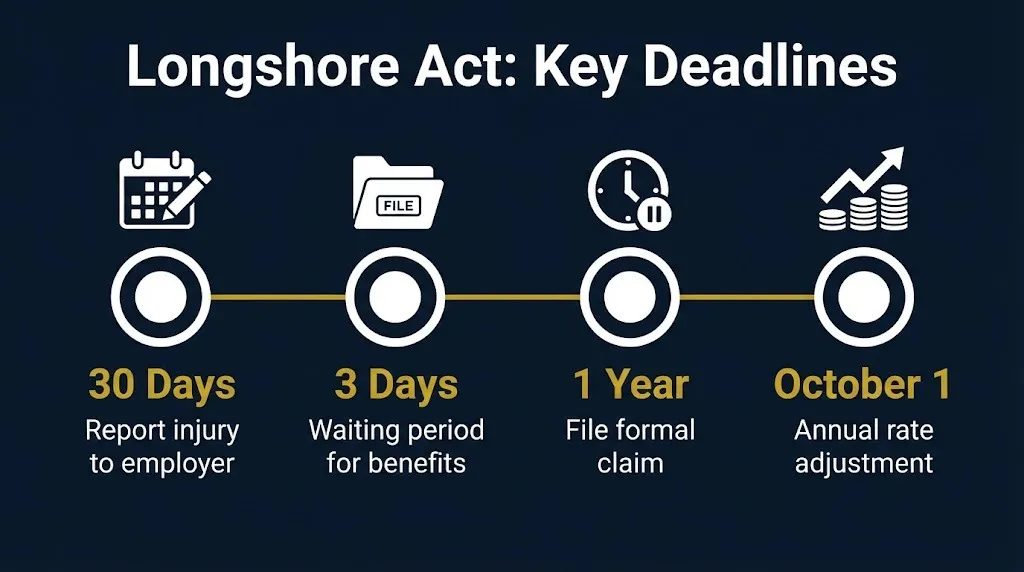
- You must report your injury within 30 days and file a formal claim within one year .
If you work on or near the water and got hurt on the job, you’re probably wondering which rules apply to you. The Longshore and Harbor Workers’ Compensation Act is a federal law that fills the gap for maritime workers who don’t qualify for state workers’ comp .
This system covers dock workers, shipbuilders, harbor construction crews, and others injured on navigable waters or adjoining shoreside areas. The benefits are often better than state workers’ compensation, especially for higher-wage workers.
This article explains the current 2026 compensation rates, who qualifies, how to file a claim, and what happens if your employer disputes it.
The Facts
| Item | Detail |
|---|---|
| Law | Longshore and Harbor Workers’ Compensation Act, 33 U.S.C. § 901 et seq. |
| Agency | U.S. Department of Labor, Office of Workers’ Compensation Programs (OWCP) |
| Division | Division of Longshore and Harbor Workers’ Compensation (DLHWC) |
| Maximum Weekly Benefit | $2,082.70 (October 1, 2025 – September 30, 2026) |
| Minimum Weekly Benefit | $520.68 (October 1, 2025 – September 30, 2026) |
| National Average Weekly Wage | $1,041.35 |
| Reporting Deadline | 30 days to notify employer |
| Filing Deadline | 1 year from injury or last compensation payment |
| Funeral Expenses | Up to $3,000 |
Is the Longshore and Harbor Workers Compensation Act Legit or a Scam?
The Longshore and Harbor Workers’ Compensation Act is real federal law. It’s been on the books since 1927 and is administered by the U.S. Department of Labor .
It’s not a scam, a lawsuit, or a class action settlement. If you work in maritime employment and got hurt, you may be entitled to benefits under this Act.
The system is no-fault. You don’t have to prove your employer was negligent . You just need to show the injury happened while you were working in covered maritime employment.
What makes this different from state workers’ comp is the “status” and “situs” tests. You must be working in a covered role on or near navigable waters . That’s the legal doorway into the federal system.
Key Takeaway: The LHWCA is a federal entitlement program, not a private insurance scheme. But employers and carriers dispute claims, and you’ll need to know the rules to collect.
How Much Does the Longshore Act Pay in 2026?
The Longshore Act pays 66 2/3% of your average weekly wage, subject to a maximum and minimum set annually . For the period October 1, 2025 through September 30, 2026, the maximum weekly compensation rate is $2,082.70 and the minimum is $520.68 .
The rates adjust every October 1 based on the National Average Weekly Wage (NAWW). For FY26, the NAWW is $1,041.35, which represents a 4.18% increase over the prior year .
2026 Longshore Compensation Rates:
| Rate Type | Amount |
|---|---|
| Maximum Weekly Benefit | $2,082.70 |
| Minimum Weekly Benefit | $520.68 |
| National Average Weekly Wage | $1,041.35 |
| Compensation Percentage | 66 2/3% of AWW |
If your average weekly wage is less than the minimum, you receive your full wage instead . The minimum doesn’t apply to Defense Base Act claims.
Beyond weekly wage replacement, the Act covers medical treatment, vocational rehabilitation, and death benefits for survivors .
Who Qualifies for Longshore Act Coverage?
You may qualify if you’re a maritime worker injured on navigable waters of the United States or in adjoining shoreside areas used for loading, unloading, shipbuilding, or repair .
The Act covers approximately 500,000 workers . Typical covered jobs include:
- Longshore workers and stevedores
- Shipbuilders and ship repairers
- Harbor construction workers
- Dock and terminal workers
- Certain oil rig workers covered by extensions of the Act
The test is legal, not just job-title based. Your work must meet both the “status” test (you’re engaged in maritime employment) and the “situs” test (the injury occurred on covered premises) .
If you’re a true independent contractor, you’re generally not covered. But the definition of employee is broad under this Act, and some workers classified as contractors may still qualify.
How Do You File a Longshore Act Claim?
You must notify your employer within 30 days and file a formal claim within one year of the injury or last compensation payment .
Here’s the step-by-step process:
- Report the injury to your employer immediately and ask for Form LS-1 to authorize medical treatment .
- Get medical treatment from a doctor of your choice, as authorized by the Act .
- File Form LS-201 (Notice of Injury) with your employer within 30 days .
- File Form LS-203 (Claim for Compensation) with the OWCP within one year .
- Keep records of medical visits, mileage, parking, and tolls for reimbursement .
- Attend any medical examinations scheduled by the employer or carrier, or your benefits may be suspended .
- Respond to requests from the district director or claims examiner.
Mileage is reimbursed at the GSA rate in effect when travel occurred . There’s no special form, but you must document dates, destinations, and mileage.
What Is the Deadline to File a Longshore Act Claim?
You have one year from the date of injury or the date of your last compensation payment to file a claim . For occupational diseases that develop over time, you have two years from when you knew or should have known about the connection between your job and the illness .
The clock doesn’t start until you’re aware of the relationship between your injury and your employment . That’s a crucial exception for hearing loss and repetitive stress injuries that build up slowly.
If you’re a minor or mentally incompetent and have no guardian, the deadline doesn’t run against you .
Missing the deadline can bar your claim. But the Act allows some flexibility if the employer fails to object at the first hearing .
What Benefits Does the Longshore Act Cover?
The Longshore Act covers medical care, wage replacement, vocational rehabilitation, and death benefits for survivors .
Medical Benefits: Your employer or its insurance carrier must pay for reasonable and necessary treatment for your work injury. You choose the treating physician, though the carrier may decline to pay for care far outside your area if local treatment is available .
Disability Compensation: If you lose more than three days from work, you may receive compensation for lost wages. The rate is 66 2/3% of your average weekly wage .
Vocational Rehabilitation: If you can’t return to your regular job, you may be eligible for retraining, job placement assistance, and skills testing .
Death Benefits: Surviving spouses, children, and other dependents may receive benefits. Funeral expenses are paid up to $3,000 .
Mileage Reimbursement: Transportation costs for medical treatment, including mileage, parking, and tolls, are reimbursable .
What Happens If Your Longshore Act Claim Is Denied?
You can request a formal hearing before an Administrative Law Judge (ALJ) if your claim is denied or disputed .
The process starts with an informal conference before the district director or claims examiner. If that doesn’t resolve the dispute, any party can request a hearing .
Appeal Timeline:
| Step | Process | Notes |
|---|---|---|
| Informal Conference | District director attempts resolution | No formal record |
| Hearing Request | Transfer to OALJ | ALJ assigned docket number |
| Pre-Hearing | Discovery, depositions, settlement talks | May include mediation |
| Hearing | Present evidence and witnesses | Written or live, per ALJ discretion |
| Decision | ALJ issues compensation order | Binding unless appealed |
| Appeal | Benefits Review Board, then federal court | Further review possible |
You don’t need a lawyer for the initial stages, but having one can help with complex disputes or appeals.
Reality Check: No one texts you Longshore Act money. Filing is free. The OWCP doesn’t charge fees, and any “claims service” demanding upfront payment to process your federal workers’ comp is unnecessary. The Department of Labor doesn’t appoint attorneys or refer you to one .
What Other Laws Extend Longshore Act Coverage?
The Longshore Act has been extended to cover workers in several other categories through separate statutes .
Defense Base Act (DBA): Covers civilian employees working on U.S. military bases overseas or on certain contracts abroad . The minimum compensation rate doesn’t apply to DBA claims .
Outer Continental Shelf Lands Act (OCSLA): Extends coverage to workers on oil and gas platforms on the Outer Continental Shelf .
Non-Appropriated Funds Instrumentalities Act (NAFIA): Covers civilian workers on military bases who are paid from non-appropriated funds .
War Hazards Compensation Act (WHCA): Provides benefits for injuries caused by war-related hazards .
Each extension has its own eligibility rules, but the compensation rates and procedures generally follow the Longshore Act.
What Happens Next for Longshore Act Benefits in 2026?
The current compensation rates are locked in through September 30, 2026. New rates will take effect October 1, 2026, based on the updated National Average Weekly Wage .
Expected Timeline:
- October 1, 2026: New NAWW and compensation rates take effect.
- Ongoing: Claims processing and hearings continue through OWCP district offices.
- Rolling: Section 10(f) annual adjustments apply to permanent total disability and death cases every October 1 .
No major legislative changes to the Act are currently pending. The FY26 rates represent a 4.18% increase over FY25, reflecting wage growth in the broader economy .
Frequently Asked Questions
What is the Longshore and Harbor Workers Compensation Act?
It’s a federal law that provides workers’ compensation benefits to maritime workers injured on navigable waters or adjoining shoreside areas.
Who is covered by the Longshore Act?
Longshore workers, shipbuilders, harbor construction workers, and others in maritime employment may qualify if they meet the status and situs tests.
How much does the Longshore Act pay in 2026?
The maximum weekly benefit is $2,082.70 and the minimum is $520.68 for the period October 1, 2025 through September 30, 2026.
How long do I have to file a Longshore Act claim?
You must report your injury within 30 days and file a formal claim within one year of the injury or last compensation payment.
Can I choose my own doctor under the Longshore Act?
Yes. You have the right to choose one treating physician, as authorized by the Secretary of Labor.
What happens if my employer doesn’t have Longshore Act insurance?
Employers are required to secure coverage through private insurance or self-insurance. If they don’t, you may have additional legal options.
Does the Longshore Act cover hearing loss?
Yes. Hearing loss is a compensable injury under the Act, but it’s often underclaimed because it develops slowly.
How do I check the status of my Longshore Act claim?
Contact the OWCP Longshore program or your assigned claims examiner. You can also submit documents through the Secure Electronic Access Portal.
What Should You Do If You Were Hurt on the Water?
Report your injury to your employer within 30 days. Get medical treatment. File your formal claim within one year of the injury or last payment.
The Longshore Act is a federal entitlement, not a favor. But collecting requires knowing the deadlines and the process.
The most important fact to remember: for the current fiscal year, the maximum weekly benefit is $2,082.70.