What Is a Compensation System in 2026? Types, Structure & How It Works
Quick Answer
- What it is: A compensation system defines how employers pay employees, including salary, bonuses, benefits, and rewards.
- How much: Total compensation ranges from base pay alone to packages worth 30% to 50% more when benefits and incentives are included.
- Key deadline: No deadline. Compensation systems are ongoing frameworks, not one-time payouts.
A compensation system is the backbone of every employment relationship. It’s the set of rules, structures, and practices that determine what you get paid, how raises work, what benefits you receive, and how your performance connects to your paycheck.
You may be searching for this because you’re evaluating a job offer, negotiating a raise, or trying to understand why your pay doesn’t match what you expected. The system behind your paycheck isn’t random, though it can feel that way when you don’t understand it.
This article breaks down what a compensation system actually is, the different types, how they’re structured, and what’s changing in 2026. One detail stands out: employees who believe they are paid fairly are 85% more engaged and 60% more committed to their organizations.
The Facts
| What It Is | Structured framework for employee pay and rewards |
| Core Components | Base pay, incentives, benefits, recognition |
| Typical Structure | Pay grades, salary ranges, job evaluation |
| 2026 Trend | Pay transparency and skills-based pay |
| Legal Framework | FLSA, anti-discrimination laws, state pay transparency rules |
| Key Metric | 51% of orgs say employees want more than budgets allow |
What Is a Compensation System and Why Does It Matter?
A compensation system is a framework that outlines every employee’s compensation practices for their company, including how pay is determined, structured, and administered.
It’s more than just a payroll function. A well-designed compensation system aligns pay with business objectives, ensures internal equity, and helps attract and retain talent.
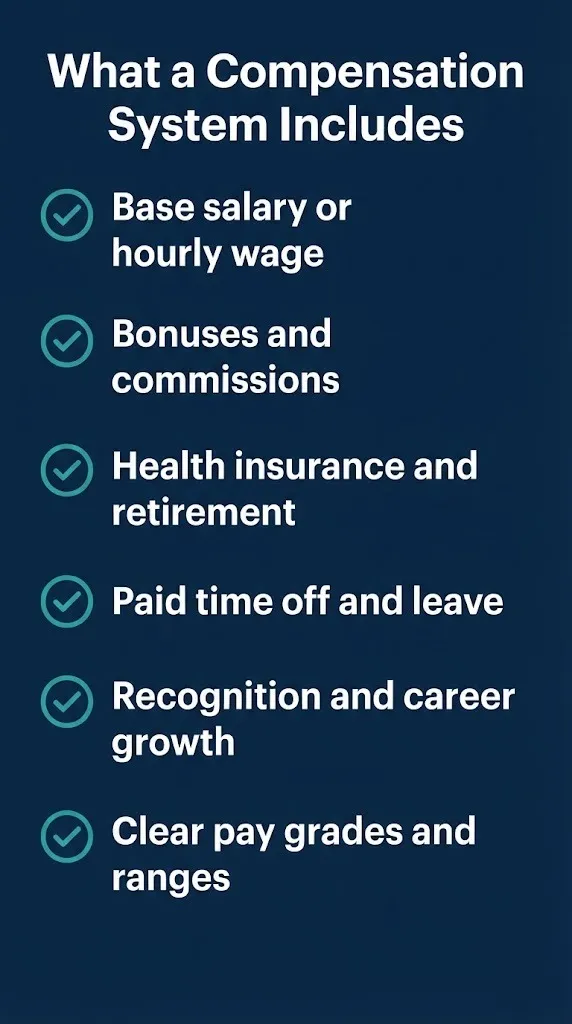
The system typically includes direct compensation (salary, hourly wages, bonuses, commissions) and indirect compensation (health insurance, retirement plans, paid time off, and other benefits).
Why does this matter to you as an employee? Because a clear system means you can understand how your pay is set, what you need to do to earn more, and whether you’re being treated fairly compared to colleagues.
What Are the Main Types of Compensation?
The main types of compensation are direct pay, indirect benefits, incentives, and non-monetary rewards. Most employers combine several types into a total rewards package.
Here’s how the categories break down:
| Type | Examples | Tax Treatment |
|---|---|---|
| Direct pay | Salary, hourly wages | Taxable income |
| Incentives | Bonuses, commissions, profit-sharing | Taxable income |
| Indirect benefits | Health insurance, retirement plans, PTO | Often tax-advantaged |
| Non-monetary | Recognition, flexible schedules, development | Not taxable |
Direct compensation is what shows up in your paycheck. Indirect compensation includes benefits that have financial value but aren’t cash.
Incentives tie pay to performance. Commissions reward sales results, bonuses recognize exceptional work, and profit-sharing gives employees a stake in company success.
Non-monetary compensation includes recognition programs, career development opportunities, and flexible work arrangements. These don’t cost the employer much but can significantly impact retention and engagement.
How Is a Compensation System Structured?
A compensation system is structured through job analysis, job evaluation, pay grades, and salary ranges that determine where each role fits and what it pays.
The structure starts with job analysis, which defines the duties, responsibilities, and requirements of each position. Job evaluation then determines the relative value of each job within the organization.
From there, employers create pay grades, which are salary ranges from minimum to maximum for groups of similar jobs. Assignment within a pay grade depends on experience, performance, and qualifications.
Market data plays a critical role. Employers benchmark against competitors to set competitive pay ranges. The midpoint of a salary range typically represents the market value for a fully proficient employee.
This structure gives you a clear path. You can see where your role fits, what the range is, and what you need to do to move up.
Key Takeaway: A compensation system uses job analysis, market data, and pay grades to create a transparent structure that determines what each role pays and how employees can progress.
What Is Compensation Management in HR?
Compensation management in HR is the process of designing and implementing a compensation strategy that aligns with business objectives while ensuring fair pay and attracting talent.
HR professionals handle the day-to-day administration of the compensation system. They conduct market research, maintain pay structures, manage merit increase cycles, and ensure compliance with labor laws.
The role has shifted significantly. Compensation used to be a reactive, compliance-focused function. In 2026, it’s a strategic lever that sits at the center of trust, retention, and business strategy.
HR teams now must connect pay to talent strategy and prove ROI on compensation investments. They also need to navigate pay transparency laws, which require disclosing salary ranges in job postings in many states.
For employees, this means HR is the department that determines whether your pay is competitive, whether your raise is fair, and whether the company’s pay practices comply with the law.
What Are the Different Compensation Models?
The main compensation models are traditional pay structures, performance-based pay, location-agnostic pay, and skills-based pay. Each has different implications for how you’re paid and what you need to do to earn more.
Traditional pay structure: Fixed salary or hourly wage with annual increases. Predictable but may not reward high performers differently.
Performance-based pay: Compensation tied to individual or company results. Includes bonuses, commissions, and profit-sharing. Higher earning potential but less predictable.
Location-agnostic pay: Employees are paid the same regardless of location. Common for remote-first companies. May mean lower pay for employees in high-cost areas.
Skills-based pay: Compensation tied to the skills you develop and demonstrate. Growing in prevalence as employers face talent shortages in critical areas.
Each model has trade-offs. The best fit depends on your priorities: stability, upside potential, or career growth.
What Is the Difference Between Direct and Indirect Compensation?
Direct compensation is cash paid to employees, including salary, hourly wages, commissions, and bonuses. Indirect compensation is non-cash benefits like health insurance, retirement plans, and paid time off.
Direct compensation is what you can spend immediately. It’s the number in your job offer letter and the amount that appears on your pay stub.
Indirect compensation has financial value but isn’t cash. Health insurance premiums your employer covers, retirement contributions, and paid leave all represent real money that doesn’t show up in your paycheck.
A competitive offer considers both. A job with a $60,000 salary plus fully covered health insurance and a 5% retirement match may be worth more than a $70,000 salary with minimal benefits.
The 2026 trend is toward holistic well-being. Over half of total rewards leaders are adding or increasing mental health and wellbeing support, recognizing that benefits beyond salary drive retention.
What Are Legally Required Benefits in a Compensation System?
Legally required benefits include Social Security, unemployment compensation, workers’ compensation, and Family and Medical Leave Act (FMLA) protections.
These aren’t optional for employers. Social Security provides retirement, disability, and survivor benefits. Unemployment compensation offers temporary income if you lose your job through no fault of your own.
Workers’ compensation covers medical costs and wage replacement if you’re injured on the job. FMLA guarantees unpaid leave for qualifying family and medical reasons with job protection.
The Affordable Care Act also affects employer-provided health insurance, requiring certain employers to offer coverage that meets minimum standards.
Knowing what’s legally required helps you evaluate whether your benefits package meets the baseline. Everything beyond that is voluntary and negotiable.
Reality Check: A compensation system is not the same as a settlement or payout. If someone promises you money from a “compensation system claim,” that’s a scam. Compensation systems are how employers pay employees, not public funds you can apply for.
How Does Pay Transparency Affect Compensation Systems in 2026?
Pay transparency laws now require employers in many states to disclose salary ranges in job postings and provide pay information to employees upon request. This has fundamentally changed how compensation systems operate.
The EU Pay Transparency Directive will be transposed into national law across Europe in 2026. It requires employers to provide information on individual and average pay levels by gender and conduct pay assessments upon request.
In the United States, states including California, Washington, and New York have implemented pay transparency requirements. Some large employers have responded by sharing salary ranges across all 50 states to simplify compliance.
For employees, this is good news. You have more information to negotiate with. You can see what a role pays before applying and check whether your pay is within range.
49% of organizations are targeting organization-wide or public pay transparency in 2026, up sharply from 33% last year.
What Compensation Trends Are Shaping 2026?
The biggest compensation trends in 2026 are strategic alignment with business goals, skills-based pay, AI integration, and holistic total rewards that extend beyond salary.
Compensation is moving from an HR administrative function to an executive-level priority. 61% of organizations now have a formal compensation strategy.
AI skills are desired but not yet commanding pay premiums. 55% of companies offer no additional pay for AI skills, even as 42% have added AI-specific roles.
Base pay budgets have stabilized in the mid-three percent range. Employers are shifting toward variable pay and targeted investments in critical roles rather than broad-based increases.
Non-monetary recognition is growing. 63% of total rewards leaders are leaning into spot bonuses, and 53% are prioritizing non-monetary recognition and career opportunities.
What Happens Next in the Evolution of Compensation Systems?
Compensation systems are evolving toward greater transparency, personalization, and data-driven decision-making.
Ongoing 2026: More states and countries implement pay transparency requirements. The EU Directive takes effect across member states.
Ongoing 2026-2027: Employers continue shifting from annual pay cycles to more dynamic, skills-based models. Job architecture becomes a strategic tool.
Expected 2027: AI adoption in compensation administration matures from pilot stages to practical application, though human judgment remains essential for equity and fairness.
TBD: Whether AI skills premiums become standard or remain niche. Current data suggests most employers aren’t paying extra yet.
Frequently Asked Questions
What is a compensation system in simple terms?
A compensation system is how a company decides what to pay employees, including salary, bonuses, benefits, and rewards.
What are the 4 main types of compensation?
Direct pay (salary, hourly), incentives (bonuses, commissions), indirect benefits (health insurance, retirement), and non-monetary rewards (recognition, flexibility).
What is compensation management in HR?
Compensation management is the HR function that designs and administers pay structures, ensures fairness, and keeps pay competitive with the market.
What is the difference between direct and indirect compensation?
Direct compensation is cash you receive (salary, wages, bonuses). Indirect compensation is non-cash benefits (insurance, retirement plans, PTO).
How are pay grades and salary ranges determined?
Pay grades are set through job analysis, market benchmarking, and internal equity considerations. Each grade has a range from minimum to maximum.
What are legally required employee benefits?
Social Security, unemployment compensation, workers’ compensation, and FMLA protections are required by federal law.
What is pay transparency?
Pay transparency laws require employers to disclose salary ranges in job postings and provide pay information to employees upon request.
How does performance affect compensation?
Performance affects bonuses, merit increases, and advancement within salary ranges. The specific impact depends on the employer’s compensation model.
What Should You Do to Understand Your Compensation?
Ask your HR department for your company’s compensation philosophy and pay structure. Understand where your role fits, what the salary range is, and how performance affects your pay.
Check market data for your role and location to see if your pay is competitive. If it’s below market, you have data to support a negotiation.
The single most important fact: employees who believe they are paid fairly are 85% more engaged and 60% more committed. Understanding your compensation system is the first step to ensuring you’re paid what you’re worth.