Guaranteed Pre-Settlement Funding in 2026: Why No Legitimate Funder Can Promise Approval
Quick Answer
- Is it legit? No. Legitimate lawsuit funding companies cannot guarantee approval because they must evaluate case strength first.
- How much could you get? Advances typically range from $500 to $1,000,000, but amounts depend on case value and underwriting.
- Most important factor: Repayment only happens if you win or settle; if you lose, you owe nothing on a non-recourse advance.
If you searched for “guaranteed pre-settlement funding,” you already know the pitch: cash in 24 hours, no credit check, no risk. The word “guaranteed” is doing a lot of work in that sentence, and it’s the part most likely to get you into trouble.
Pre-settlement funding is a non-recourse cash advance against your expected lawsuit recovery. Repayment comes only from your settlement or judgment. If you lose, you typically owe nothing. That structure makes it impossible for any funder to guarantee approval, because approval depends entirely on case merits, not your credit score.
This article explains why guaranteed approval doesn’t exist in this industry, what underwriting actually looks for, how much funding really costs, and what your legal options are if you’re struggling financially while your case is pending.
The Facts
| Product Type | Non-recourse pre-settlement cash advance |
|---|---|
| Regulation | State-by-state; no federal law directly governs the industry |
| Status | Active market in 2026 with increasing state regulation |
| Advance Range | $500 to $1,000,000 depending on funder and case |
| Typical Cost | 2% to 4% monthly fees, compounding or simple depending on contract |
| Repayment | Only from settlement or judgment proceeds |
| Approval | Cannot be guaranteed; requires case underwriting |
| Regulated States | Arkansas, California, Georgia, Illinois, Indiana, Maine, Missouri, Montana, Nebraska, Nevada, New York, Ohio, Oklahoma, Tennessee, Utah, Vermont, West Virginia, Wisconsin |
Is Guaranteed Pre-Settlement Funding Real or a Scam?
Guaranteed pre-settlement funding is not real, and the phrase itself is a red flag. No legitimate funding company can guarantee approval because every advance requires case evaluation.
Here’s the core problem. Pre-settlement funding is non-recourse. The funder only gets paid if you win or settle. That means the funder takes on 100% of the risk if your case fails. No rational business guarantees approval without first checking whether the case has merit.
When you see “guaranteed approval” in an ad, it usually means one of two things. Either the company has a high approval rate and is stretching the truth, or it’s running a lead-generation scam that sells your information to actual funders. Neither scenario helps you.
Reputable funders advertise fast approval, not guaranteed approval. The distinction matters because it tells you whether the company is being honest about how underwriting works.
How Does Pre-Settlement Funding Underwriting Actually Work?
Underwriting is the process funders use to decide whether your case qualifies for an advance. It focuses entirely on case strength, not your credit history.
The underwriter asks two questions. First, does your case have a reasonable likelihood of success? Second, will the projected recovery be large enough to cover the advance plus fees and still leave you with meaningful compensation?
Here’s what underwriters evaluate:
| Factor | What They Look For |
|---|---|
| Liability | Clear fault supported by police reports or witness statements |
| Damages | Documented injuries matching the incident and treatment records |
| Insurance Coverage | Adequate policy limits to support the requested advance |
| Attorney Cooperation | Responsive counsel who provides case documents promptly |
| Existing Liens | Prior funding or medical liens that could reduce your recovery |
If liability is disputed, if there are gaps in medical treatment, or if your attorney won’t cooperate with the funder, your application gets declined. That’s not a bug in the system. It’s the system working as intended to prevent overfunding.
How Much Does Pre-Settlement Funding Cost in 2026?
Pre-settlement funding costs 2% to 4% per month on average, but the total payoff depends on whether fees compound and how long your case takes to resolve.
Here’s the math on a $10,000 advance at 3% monthly:
| Time to Resolution | Simple Interest Payoff | Compound Interest Payoff |
|---|---|---|
| 6 months | $11,800 | $11,940 |
| 12 months | $13,600 | $14,258 |
| 24 months | $17,200 | $20,328 |
| 36 months | $20,800 | $28,982 |
The difference between simple and compound interest is enormous over long cases. A $10,000 advance that compounds at 3% monthly for 36 months costs nearly $29,000 to repay.
Some funders cap total repayment at a multiple of the principal, often two to three times. Others don’t cap at all. Always ask for a written payoff schedule showing what you’d owe at 6, 12, 24, and 36 months.
Key Takeaway: Guaranteed approval doesn’t exist because funders must underwrite case strength, and the real cost of funding depends on whether fees compound and how long your case takes.
What States Regulate Pre-Settlement Funding in 2026?
Eighteen states have enacted laws regulating pre-settlement funding as of 2026, with requirements ranging from registration and disclosure to fee caps.
The regulated states include Arkansas, California, Georgia, Illinois, Indiana, Maine, Missouri, Montana, Nebraska, Nevada, New York, Ohio, Oklahoma, Tennessee, Utah, Vermont, West Virginia, and Wisconsin.
Common regulatory requirements include:
- Registration or licensure with a state agency before offering advances
- Written disclosure spelling out fees, total repayment, and cancellation rights
- Attorney acknowledgment before funds are disbursed
- Prohibited practices like paying referral fees to attorneys or soliciting at hospitals
Some states restrict or effectively prohibit pre-settlement funding, including Arkansas, Colorado, Kentucky, Maryland, North Carolina, and West Virginia. Colorado courts have treated certain funding agreements as consumer loans subject to usury caps.
If you live in a state without specific funding laws, contract law and court oversight still apply. The absence of regulation doesn’t mean the funder can do whatever it wants.
Reality Check
No legitimate pre-settlement funder guarantees approval, and no one should text you offering settlement cash first. The “guaranteed” language is designed to bypass your skepticism when you’re financially desperate. If a company promises approval before reviewing your case, that’s not confidence, it’s a scam signal. Filing for funding is free, and you should never pay an upfront fee to “reserve” an advance.
How Do You Apply for Pre-Settlement Funding?
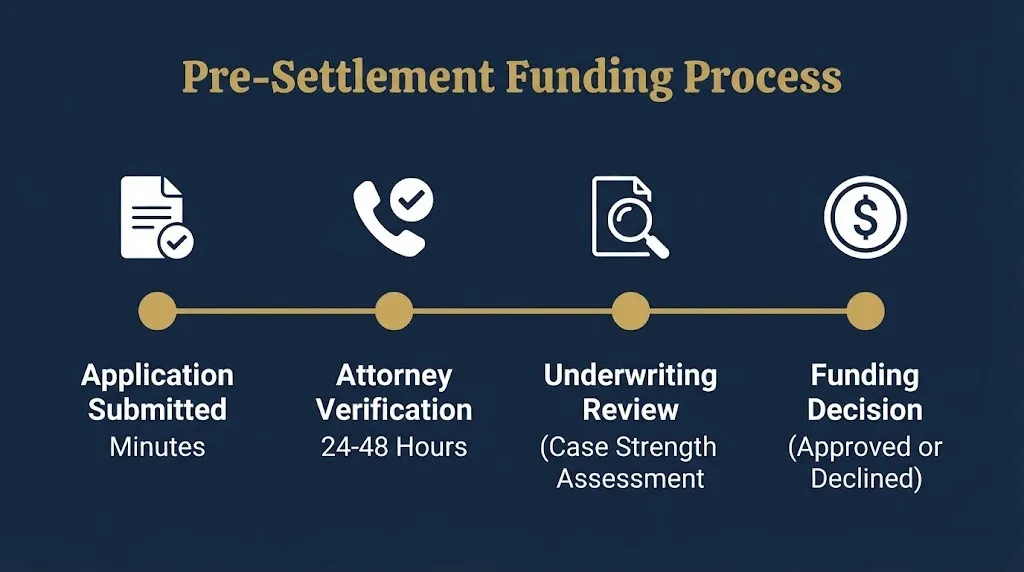
Applying for pre-settlement funding takes minutes, but approval depends on case review and attorney cooperation. The process typically moves faster when your lawyer responds quickly to the funder’s document requests.
Here are the steps:
- Submit an application. Provide basic case details: lawsuit type, attorney name, and litigation stage.
- Funder contacts your attorney. The company needs case documents and confirmation you’re represented.
- Underwriting review. The funder evaluates liability, damages, insurance coverage, and case timeline.
- Receive an offer. If approved, you get a written contract specifying the advance amount, fees, and repayment terms.
- Sign and receive funds. Once you and your attorney sign, money is wired within 24 to 48 hours.
Most applications take a few minutes. The underwriting decision often depends more on your attorney’s responsiveness than anything else.
What Happens If You Lose Your Case?
If you lose your case, you owe nothing on a non-recourse pre-settlement advance. That’s the defining feature of this funding model.
The funder assumed the risk when it advanced money based on case merits. If the case fails, the funder absorbs the loss. You don’t pay back the principal, and you don’t owe fees.
This is why underwriting matters so much. The funder isn’t being generous. It’s making a calculated investment and pricing the risk of total loss into the fee structure.
Some plaintiffs worry that funding will affect their credit if the case fails. It won’t. Non-recourse advances don’t appear on credit reports, and there’s no personal liability if the case doesn’t produce a recovery.
What Types of Cases Qualify for Pre-Settlement Funding?
Personal injury cases qualify most often, but funding is also available for employment claims, product liability, and certain class action claims. The common thread is a likely cash settlement.
Cases that typically qualify include:
- Car accidents and truck accidents
- Slip and fall incidents
- Premises liability claims
- Medical malpractice (in some states)
- Product liability claims
- Workers compensation (limited availability)
Some funders also advance money to plaintiffs in bankruptcy proceedings or mass tort settlements, like the Boy Scouts of America case or PG&E wildfire claims. These situations often involve longer timelines and documented claim values.
Cases that rarely qualify include family law disputes, criminal matters, and cases without clear liability or documented damages. If your attorney won’t cooperate with the funder, approval is nearly impossible.
How Long Does Pre-Settlement Funding Approval Take?
Approval typically takes 24 to 48 hours after your attorney provides case documents. The bottleneck is almost always document collection, not underwriting.
If your attorney responds to the funder’s request the same day, you could have a decision within a business day. If documents sit for a week, the decision waits.
Funding companies understand that plaintiffs need money quickly. But they can’t evaluate a case without records. The speed of your attorney’s response often determines whether you get funded in 24 hours or two weeks.
What Are the Risks of Pre-Settlement Funding?
The biggest risk is cost. Monthly fees of 2% to 4% can consume a large share of your settlement if the case takes years to resolve.
A plaintiff who takes a $10,000 advance on a case that settles for $50,000 after three years could owe $25,000 or more, leaving them with far less than expected. Attorneys report clients being shocked by payoff amounts, sometimes forcing fee waivers to help them stay afloat.
Other risks include:
- Reduced settlement leverage: Insurance companies may argue you’re “over-funded” and push for lower offers
- Compounding fees: If your contract compounds, the balance grows faster than you expect
- Multiple advances: Taking a second advance can reset fee periods or extend caps
Funding isn’t inherently predatory, but it’s expensive. Treat it like a last resort, not a first option.
What Happens Next
Before applying: Ask your attorney whether they cooperate with funders and how quickly they respond to document requests.
During underwriting: Request a written payoff schedule at 6, 12, 24, and 36 months before signing anything.
If approved: Review the contract for compounding fees, caps, and cancellation rights. Sign only after your attorney reviews the terms.
If declined: Ask why. Sometimes cases can be reconsidered after additional documentation or case developments.
If you’re struggling financially: Ask your attorney about alternatives, including case expense advances or referrals to nonprofit funding organizations.
Frequently Asked Questions
Can anyone actually guarantee pre-settlement funding approval?
No. Legitimate funders must underwrite each case to assess risk, so approval cannot be guaranteed before review.
Why do some companies advertise guaranteed approval?
It’s a marketing tactic to attract desperate plaintiffs. Those companies still conduct case reviews before disbursing funds.
Is pre-settlement funding a loan?
No. It’s a non-recourse cash advance. You only repay if you win or settle, and there’s no personal liability if you lose.
How much does pre-settlement funding cost?
Rates range from 2% to 4% monthly on average, but total cost depends on whether fees compound and how long your case takes.
Do I need good credit to get pre-settlement funding?
No. Funders evaluate case strength, not credit scores. Your financial history doesn’t affect approval.
What happens if I lose my case after taking funding?
You owe nothing. The funder absorbs the loss, which is why underwriting is strict.
Can I get funding if my case is in a regulated state?
Yes, but the funder must comply with that state’s registration, disclosure, and fee requirements.
How long does approval take?
Most decisions come within 24 to 48 hours after your attorney provides case documents to the funder.