Probate Litigation Attorney Near Me: 2026 Guide to Finding the Right Lawyer
Quick Answer
- Probate litigation attorneys handle will contests, trust disputes, and fiduciary breach claims in probate court.
- Hourly rates range from $150 to $600, though California and Florida use statutory fee schedules.
- You can find qualified attorneys through state bar referral services, attorney directories, and local probate court lists.
A probate litigation attorney near you is a lawyer who specializes in disputes arising during estate administration. These disputes include will contests, trust disagreements, claims of undue influence, and accusations that an executor or trustee breached their fiduciary duty. Finding the right one starts with understanding what your case actually involves.
Probate litigation affects anyone named in a will, trust, or estate plan who believes something went wrong. It also affects beneficiaries, heirs, creditors, and personal representatives accused of misconduct. The most important factor in choosing an attorney is experience with the specific type of dispute you face, not just general probate experience.
This article explains what probate litigation attorneys do, how much they charge, how to find one in your area, and what to expect from the process. One surprising fact: some probate disputes are not worth pursuing financially, even when you are right on the merits.
The Facts
| Case | Probate litigation representation |
|---|---|
| Status | Active; attorneys available nationwide |
| Fund Size | Not applicable (legal service, not settlement) |
| Est. Per Person | Hourly rates $150 to $600; statutory fees in CA and FL |
| Claim Deadline | Case-specific; statutes of limitations vary by state |
| Administrator | Not applicable; you hire your own attorney |
| Proof Needed | Documentation of your interest in the estate |
What Does a Probate Litigation Attorney Do?
A probate litigation attorney represents clients in disputes that arise during estate administration. These disputes happen in probate court, which handles the legal process of distributing a deceased person’s assets.
The work falls into several categories. Will contests challenge the validity of a will based on lack of capacity, undue influence, forgery, or defective drafting . Trust disputes involve disagreements over how a trust is managed or interpreted. Fiduciary litigation targets executors, trustees, or agents who allegedly failed to act in the estate’s best interests .
Common claims include breach of fiduciary duty, failure to account for estate assets, self-dealing, and improper distributions. For example, in a Maine case, a son with power of attorney was ordered to restore $271,815 to his mother’s estate after breaching his fiduciary duty .
Probate litigation attorneys also defend executors and trustees against unfounded claims. The work requires knowledge of state probate codes, local court procedures, and evidentiary rules specific to estate disputes.
Key Takeaway: Probate litigation attorneys handle disputes about estate administration, not routine probate filings, and their expertise matters most when the case involves contested facts or fiduciary misconduct.
How Much Does a Probate Litigation Attorney Cost?
Probate litigation attorney costs depend on your location, the complexity of your case, and the fee structure your attorney uses. In 2026, hourly rates typically range from $200 to over $600 per hour depending on the market and attorney experience .
In general, probate attorney fees range from $150 to $400 per hour for routine matters, with contested cases and major metro rates climbing higher . Complex litigation with multiple parties, extensive discovery, or appeals can push costs well beyond baseline rates.
Fee structures vary by state. Here is a comparison:
| State Type | Fee Structure | Typical Range |
|---|---|---|
| California | Statutory percentage | 4% of first $100K, sliding scale |
| Florida | Statutory percentage | 3% of first $40K, sliding scale |
| New York | Hourly | $350 to $600, NYC rates reach $800 |
| Texas | Hourly or flat | $200 to $500 in major metros |
| Illinois | Hourly | $250 to $450 |
California’s statutory schedule, under Probate Code Section 10810, sets attorney fees at 4% of the first $100,000, 3% of the next $100,000, and 2% of the next $800,000 . A $500,000 California estate generates roughly $13,000 in statutory attorney fees .
In negotiated-fee states, attorneys may charge hourly, flat fees for routine matters, or hybrid arrangements. Contested wills and family disputes often require court appearances and additional legal work, which increases costs .
Reality Check: Attorney fees in probate litigation are typically paid from the estate, not from your personal funds, but this depends on the court’s orders and the outcome of the dispute. Some states allow fee-shifting, while others require each party to pay their own way.
How Do I Find a Probate Litigation Attorney Near Me?
You find a probate litigation attorney near you by using state bar referral services, attorney directories, and local probate court resources. The best starting point is your state bar association’s lawyer referral service, which can connect you with licensed attorneys who practice in your county.
Here are the most reliable methods:
- State bar lawyer referral service: Every state bar offers a free or low-cost referral program that matches you with attorneys by practice area and location.
- Attorney directories: Sites like Legygo and similar platforms list probate lawyers by state and city, with reviews and credentials .
- Local probate court lists: Some courts maintain lists of attorneys who regularly appear before them.
- Ask other attorneys: Even if they don’t handle probate litigation, attorneys you know can recommend colleagues.
- Legal aid organizations: For low-income clients, legal aid may provide free or reduced-cost representation.
- Law school clinics: Some law schools operate estate law clinics that serve the public.
When evaluating attorneys, ask about their specific experience with the type of dispute you face. A lawyer who handles routine probate administration may not be the right choice for a contested will or fiduciary breach claim.
What Types of Probate Disputes Require an Attorney?
Probate disputes that require an attorney include will contests, trust disagreements, fiduciary breach claims, and disputes over asset valuation or distribution. If the parties agree on everything, you may not need litigation counsel, but once a formal objection is filed, representation becomes important.
The most common grounds for probate litigation include:
- Lack of testamentary capacity: The testator did not understand what they were signing .
- Undue influence: Someone manipulated the testator into changing their will or trust .
- Forgery: The will or signature was falsified .
- Defective drafting: The will was not properly executed or witnessed .
- Breach of fiduciary duty: The executor or trustee failed to act in the estate’s best interests .
- Exceeding bequest limits: In some jurisdictions, bequests above certain limits are invalid without consent .
A contested will or complicated estate dispute can take several years to complete . Probate litigation timelines vary widely depending on court backlogs, the complexity of the estate, and whether appeals are filed.
For families dealing with a disputed estate, the process can feel like a delayed tax refund that keeps getting pushed back. You know the money exists, but you cannot access it until the process resolves.
How Long Does Probate Litigation Take?
Probate litigation timelines range from several months to several years, depending on the complexity of the dispute and the court’s schedule. A contested will or complicated tax litigation may take several years to complete .
Most estates with clear wills and no disputes complete probate in 6 to 12 months . Adding litigation extends that timeline substantially. Discovery, motions, hearings, and potential appeals all add time.
California probate typically takes 9 to 18 months for standard estates, with a mandatory 4-month creditor claim period . Contested estates and those involving real estate, business interests, or family disputes can take several years.
Factors that extend probate litigation include:
- Multiple parties with competing claims
- Complex asset valuations
- Out-of-state or international property
- Tax complications
- Appeals of probate court decisions
- Court scheduling backlogs
If you are a beneficiary waiting for distributions, litigation can delay your inheritance significantly. However, in some cases, partial distributions may be made while the dispute proceeds .
Key Takeaway: Probate litigation can extend estate administration from months to years, so weighing the likely recovery against the time and cost of litigation is essential before filing.
What Should I Look for in a Probate Litigation Attorney?
You should look for an attorney with specific experience in the type of probate dispute you face, a clear fee structure, and familiarity with your local probate court. General estate planning experience is not the same as litigation experience.
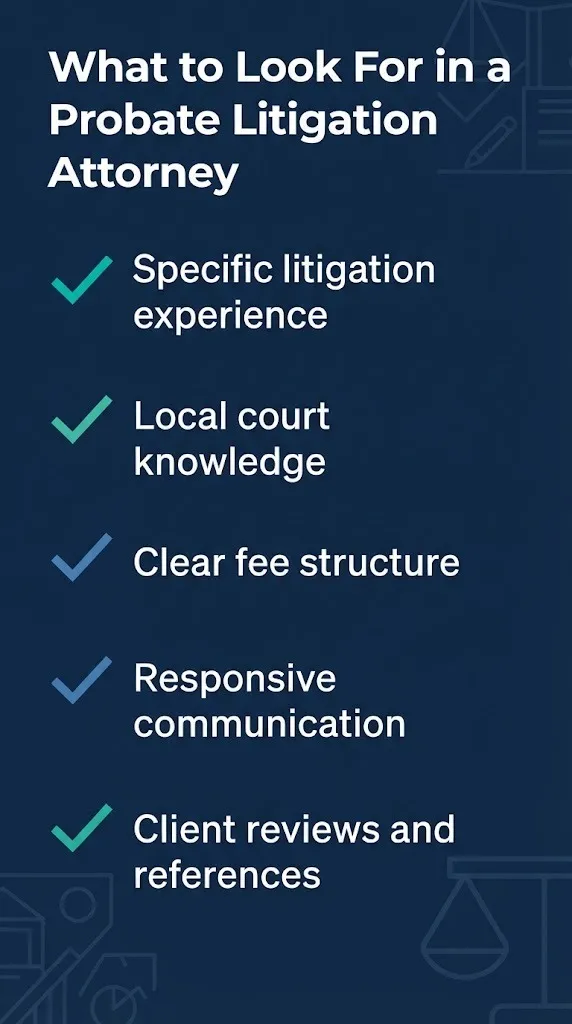
Here are the key factors to evaluate:
- Specific litigation experience: Have they handled will contests, fiduciary breach claims, or trust disputes?
- Local court knowledge: Do they regularly appear in your county’s probate court?
- Fee transparency: Can they explain their fee structure and estimate total costs?
- Communication style: Will they return calls and explain the process clearly?
- References or reviews: What do former clients say about their representation?
- Conflict check: Do they represent any other party in the estate?
State bar directories and attorney review platforms can help you verify credentials and disciplinary history. The best attorney for your case is one who has handled similar disputes and can give you a realistic assessment of your chances.
Key Takeaway: The right probate litigation attorney has specific experience with your type of dispute, practices in your local probate court, and provides clear fee expectations upfront.
What Happens Next in a Probate Dispute
The next stages in a probate dispute depend on whether you are challenging an estate document, defending one, or pursuing a fiduciary claim. Here is the typical timeline:
Initial consultation: You meet with an attorney to review your case and assess the merits.
Investigation and demand: Your attorney gathers evidence and may send a demand letter before filing.
Filing: If the dispute cannot be resolved informally, a formal petition or complaint is filed in probate court.
Discovery: Both sides exchange documents and conduct depositions.
Hearings or trial: The court hears arguments and evidence, then issues a ruling.
Appeal (if applicable): Either party may appeal the probate court’s decision.
Distribution: Once the dispute is resolved, the estate can be distributed according to the court’s orders.
Frequently Asked Questions
How do I find a probate litigation attorney near me?
Start with your state bar’s lawyer referral service, then check attorney directories and local probate court resources. Ask about specific experience with your type of dispute.
How much do probate litigation attorneys charge?
Hourly rates typically range from $150 to $600 depending on location and complexity. California and Florida use statutory fee schedules based on estate value.
Do I need a probate litigation attorney for a will contest?
Yes, will contests involve formal court proceedings and evidentiary rules that require attorney representation. Most people cannot navigate these effectively on their own.
What is the difference between probate and probate litigation?
Probate is the routine court process of administering an estate. Probate litigation is a dispute within that process, such as a will contest or fiduciary breach claim.
How long does probate litigation take?
It depends on the complexity of the dispute, but contested estates can take months to years. Appeals add additional time.
Can I contest a will without a lawyer?
You can file documents yourself, but probate litigation involves complex evidentiary and procedural rules. Without an attorney, your chances of success drop significantly.
What happens if I lose a probate litigation case?
If you lose, the court may order you to pay the other side’s attorney fees in some circumstances. You also lose the right to challenge the same issue again.
Are probate litigation attorney fees paid from the estate?
In many cases, yes, especially if the litigation benefits the estate. But if you are pursuing a personal claim, you may be responsible for your own fees.
What You Should Do Now
If you believe you have a probate dispute, contact your state bar’s lawyer referral service or search attorney directories for probate litigation specialists in your county. Gather all relevant documents, including the will or trust, any prior versions, and correspondence about the estate.
Most attorneys offer free or low-cost initial consultations. Use that meeting to assess whether your case has merit and whether the potential recovery justifies the cost. The single most important step is getting a qualified attorney to review your situation before any filing deadlines pass.