Multidistrict Litigation in 2026: How the JPML Moves Thousands of Cases Into One Courtroom
Quick Answer
- Multidistrict litigation consolidates federal cases with common facts for pretrial proceedings under 28 U.S.C. § 1407.
- MDL cases do not settle automatically. Each case keeps its own facts, damages, and trial venue.
- The JPML is a seven-judge panel appointed by the Chief Justice. Four votes are needed for any action.
You have probably seen the phrase “MDL” in a settlement notice or a lawyer’s advertisement. Multidistrict litigation is the federal process that pulls similar lawsuits from courts across the country into one courtroom for pretrial work .
The system exists because trying 4,000 Roundup cases in 4,000 different courthouses would be chaos. One judge, Vince Chhabria in the Northern District of California, oversees nearly 3,900 pending Roundup actions right now . That is not a class action. Each plaintiff has their own case.
This article explains how the JPML works, what happens to your case if it gets transferred, and why an MDL is not the same as a settlement program.
The Facts
| Item | Details |
|---|---|
| Governing Law | 28 U.S.C. § 1407 |
| Panel Size | Seven circuit and district judges |
| Vote Required | Four of seven members |
| What Transfers | Pretrial proceedings only, not trial |
| Next Hearing | September 24, 2026, Chicago, Illinois |
| Largest Active MDL | Roundup Products Liability, ~3,900 pending actions |
| Effect on Your Case | Case moves to transferee court for discovery and pretrial motions |
What Is Multidistrict Litigation?
Multidistrict litigation is a procedural tool that consolidates federal civil cases involving common questions of fact into one district court for coordinated pretrial proceedings .
The key word is “pretrial.” The JPML does not decide your case. It does not rule on the merits. It moves your case to a judge who will manage discovery, expert challenges, and pretrial motions for all the similar cases at once .
Think of it like a hospital triage system. Instead of every patient seeing a different specialist at a different hospital, the system routes similar cases to one expert who can handle the shared medical questions efficiently.
The law requires the panel to find that transfer will serve “the convenience of parties and witnesses” and “promote the just and efficient conduct of such actions” . Those two standards sound vague. In practice, the JPML grants most motions to centralize cases when multiple similar suits are pending in different districts.
Since the statute passed in 1968, the panel has handled hundreds of thousands of civil actions . The system is not optional for defendants. If the panel orders transfer, the case moves.
Who Is on the Judicial Panel on Multidistrict Litigation?
The Judicial Panel on Multidistrict Litigation consists of seven federal judges, no two from the same circuit, appointed by the Chief Justice of the United States .
The current panel includes judges from across the country. Judge Matthew F. Kennelly of the Northern District of Illinois and Judge David C. Norton of the District of South Carolina are among the members who signed the September 2026 hearing order .
The panel operates like a small appellate body for case consolidation. It does not hold trials. It reviews motions, holds hearings, and issues transfer orders.
Four judges must agree for the panel to act . That supermajority requirement prevents a narrow split from reshaping litigation on a close vote.
A few things the panel does not do:
- It does not decide whether your case has merit
- It does not set settlement amounts
- It does not pick your lawyer
- It does not prevent your case from returning to its home court for trial
The panel’s job is narrow but powerful. It decides where pretrial happens.
How Does a Case Get Into an MDL?
A case gets into an MDL through a transfer motion filed with the JPML, usually by a plaintiff or defendant who wants similar cases consolidated . The panel can also act on its own initiative.
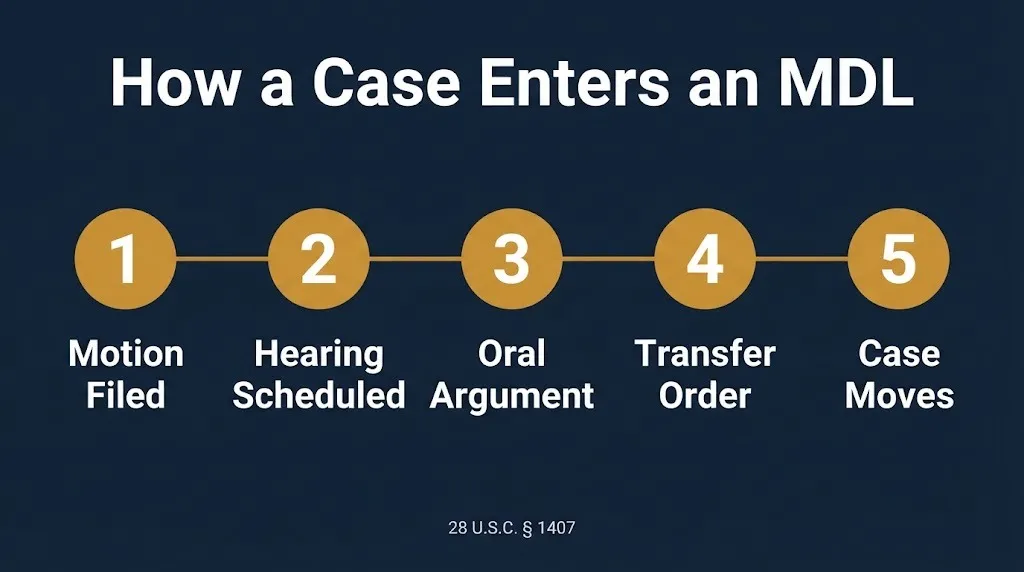
The process follows a predictable path:
- A motion is filed. A party asks the JPML to create a new MDL or transfer cases to an existing one.
- The panel schedules a hearing. Notice goes to all parties in affected cases .
- The panel holds oral argument. Attorneys present their positions on whether transfer makes sense and which district should get the cases.
- The panel issues an order. If it grants transfer, the order is filed in the transferee court and becomes effective .
- Cases move. The clerk transmits certified copies of the transfer order to the courts where cases were pending.
The panel strongly discourages demonstrative exhibits at oral argument because time is short . Attorneys are expected to stick to the positions they filed in writing.
If your case is already pending in the district where the MDL is located, you may have filed directly into the MDL. In the Covidien hernia mesh MDL, hundreds of cases were filed straight into the District of Massachusetts rather than transferred from elsewhere . That direct filing option saves time.
What Happens to Your Case After Transfer?
Your case moves to the transferee court for pretrial proceedings, but it does not stay there forever unless it settles or the parties waive their right to remand .
Under the statute, each transferred action “shall be remanded by the panel at or before the conclusion of such pretrial proceedings to the district from which it was transferred” unless the case is terminated first . That means if your case does not settle in the MDL, it goes back to the court where you filed it for trial.
This is a critical point that many people miss. An MDL is not a permanent home for your lawsuit. It is a temporary stop for shared pretrial work.
The pretrial work includes:
- Coordinated discovery. Defendants produce documents once instead of thousands of times.
- Expert challenges. The MDL judge can rule on whether expert testimony is admissible across all cases.
- Bellwether trials. A small number of cases go to trial first to test how juries react.
- Settlement negotiations. A global settlement may be negotiated, but it is not automatic.
For the 3,900 pending Roundup cases in MDL 2741, the MDL judge has already overseen general discovery and at least one bellwether trial . Plaintiffs in newer cases have argued that transfer is no longer warranted because the bulk of common discovery is done .
What Is a Conditional Transfer Order?
A conditional transfer order is the JPML’s mechanism for moving a case into an existing MDL without a full hearing, and it gives you seven days to object .
The process works like a tag-along. When a new case is filed that appears to belong in an existing MDL, the panel clerk issues a CTO. The order does not take effect immediately.
Here is the timeline:
- The CTO is entered. It identifies the case and the MDL it would join.
- A seven-day stay begins. The order is not filed in the transferee court yet .
- You can file a notice of opposition. If you object within those seven days, the stay continues until the panel rules .
- If no objection, the order becomes effective. The case transfers.
In the Cartiva Synthetic Cartilage Implant MDL, the JPML has issued CTO-4 to bring in cases from Pennsylvania and West Virginia . In the Rare Breed Triggers Patent Litigation, CTO-12 added 85 more actions to the Eastern District of Texas .
The tag-along process keeps MDLs growing without requiring a new hearing for every case.
Can You Object to Transfer Into an MDL?
You can object to a conditional transfer order, but you must show good cause why consolidation no longer serves the goals of the statute .
The standard comes from the statute itself. Transfer must “promote the just and efficient conduct” of the actions . If you can show that consolidation would not serve that purpose anymore, the panel may vacate the CTO.
The Roundup plaintiffs who objected argued that MDL 2741 was too far along. General discovery was complete. A bellwether trial had happened. Adding new cases to a mature MDL does not create the efficiency gains that justified centralization in the first place .
The JPML has recognized that “multidistrict litigation is not static” and that “after a certain point, the benefits of transfer should not be assumed to continue” .
When objections succeed:
- The MDL is at an advanced stage and common discovery is done
- Your case has unique facts that will not benefit from shared pretrial work
- Transfer would delay rather than speed up your case
- The transferee court’s docket is so congested that transfer would cause prejudice
Objections are not common, but they do work when the facts support them.
How Long Does an MDL Take?
Most MDLs take two to five years from transfer to resolution, and some last much longer. The Roundup MDL has been active since 2016 .
The timeline depends on how many cases are in the MDL, how complex the discovery is, and whether a global settlement emerges. A small MDL with 20 cases may resolve in 18 months. A sprawling one with thousands of cases can run for a decade.
The JPML does not set deadlines for MDL judges. The transferee judge controls the schedule. That judge decides when discovery ends, when bellwether trials happen, and when settlement talks begin.
For plaintiffs, the wait can feel like a delayed tax refund that keeps getting pushed back. You know money might come eventually, but you cannot plan around it. That uncertainty is why some plaintiffs choose to file directly in the transferee district or opt out of settlement classes when offers arrive.
What Is the Difference Between an MDL and a Class Action?
An MDL is not a class action. In an MDL, every case stays individual, with its own plaintiff, its own injuries, and its own damages .
A class action combines all claims into one lawsuit with one named plaintiff representing everyone. An MDL keeps cases separate but manages them together for pretrial.
The practical difference matters for your money. In a class action, everyone in the class gets the same treatment, usually a small payment. In an MDL, your recovery depends on your specific injuries, your medical records, and your lawyer’s negotiation.
The Covidien hernia mesh MDL is explicitly not a class action. Every case in MDL 3029 is an individual lawsuit with its own facts and outcome .
What Happens Next for MDL Litigation in 2026?
September 24, 2026: The JPML holds its next hearing session in Chicago to consider new MDL petitions, including a proposed Abbott Laboratories spinal cord stimulator MDL .
Throughout 2026: The JPML continues processing tag-along cases through conditional transfer orders. New MDLs are created as mass torts emerge.
February 19, 2026: Amended JPML rules of procedure took effect, including new provisions on sealed filings, potential tag-along actions, and multicircuit petitions .
December 1, 2025: New Federal Rule of Civil Procedure 16.1 took effect, giving MDL judges explicit authority to manage cases through initial management orders and coordinated schedules .
Ongoing: The Roundup MDL and other mature litigations may see phased remands as pretrial work concludes .
Frequently Asked Questions
What does the Judicial Panel on Multidistrict Litigation do?
The JPML decides whether to consolidate federal cases with common facts into one court for pretrial proceedings. It also picks the transferee judge.
How many judges are on the JPML?
Seven circuit and district judges. No two can be from the same circuit. Four votes are needed for any action.
Can I opt out of an MDL?
You cannot opt out of MDL transfer if the JPML orders it. But you can object to a conditional transfer order before it takes effect.
Does my case stay in the MDL forever?
No. The statute requires remand to the original court for trial unless the case settles or the parties waive remand.
What is a bellwether trial?
A bellwether trial is a test case tried early in an MDL to see how juries respond. The results help both sides value the remaining cases.
Do I need my own lawyer in an MDL?
Yes. An MDL is not a class action. Each plaintiff needs their own attorney to represent their individual case.
What happens if I do nothing after my case transfers to an MDL?
Your case still moves forward, but your attorney handles it in the transferee court. You do not need to file anything yourself.
How long does it take to get money from an MDL?
Most MDLs take two to five years to resolve. Some take longer. There is no fixed timeline.
If your case has been transferred to an MDL, the most important thing to do is confirm which district now holds your case and make sure your attorney is actively participating. The JPML’s next hearing is September 24, 2026, and new MDLs are created every year.