Civil Lawsuit Lawyer in 2026: Costs, Fees and How to Hire
Quick Answer
- A civil lawsuit lawyer represents you in a noncriminal dispute over money, property, or harm.
- Cost: Clio’s 2026 data shows a $349 national average hourly rate; contingency lawyers take a percentage instead.
- Deadline: Most personal injury deadlines run one to six years, depending on your state.
A civil lawsuit lawyer handles disputes over money, property, or injury. Clio’s 2026 data puts the average U.S. lawyer rate at $349 an hour. That’s the number most people see first, and it’s only part of the bill.
This guide is for anyone weighing a lawsuit right now. Your deadline matters most. For personal injury in Kentucky and Tennessee, it’s one year. Miss it, and the court can toss a strong claim.
Below, you’ll find real fee ranges, a hiring checklist, and the questions to ask first. One 2026 surprise: a federal appeals court sanctioned two lawyers $15,000 each over AI-invented citations.
| The Facts | |
|---|---|
| Case | General guide to hiring a civil lawyer (no single case or class action) |
| Status | Not applicable, this is an ongoing legal-process topic |
| Fund Size | Not applicable, no settlement fund exists |
| Est. Per Person | Not applicable. Average U.S. lawyer rate: $349 per hour (Clio) |
| Claim Deadline | Your state’s statute of limitations, often 1 to 6 years for injury claims |
| Administrator | None. Your state bar licenses and disciplines lawyers |
| Proof Needed | Written fee agreement, ID, and records of the dispute |
Do you need a civil lawsuit lawyer, or can you sue on your own?
You can sue without a lawyer, but complex or high-value cases usually need one.
Federal courts accept complaints from people who represent themselves, called pro se filers. The clerk can’t give legal advice. A sloppy complaint can sink a good claim. Self-filing works best for small, simple disputes.
A lawyer is usually worth the cost in these situations:
- You were injured and have ongoing medical bills.
- You were fired, demoted, or underpaid, and your employer has counsel.
- The amount you want exceeds your state’s small claims cap.
- The other side has already hired an attorney.
- You’ve been sued and face a possible judgment.
- A filing deadline is close.
Even then, ask whether a lawyer will review your papers for a flat fee. Partial help can cost far less than full representation.
Going solo isn’t free either. Opening a federal civil case costs $405, unless the court waives the fee.
When is small claims court a better move than hiring a lawyer?
Small claims court is the better move when your claim fits under your state’s dollar cap.
Published 2026 tables put those caps between roughly $2,500 and $25,000. They disagree on a few states, so confirm the number with your court clerk. Fees are low, and the process is built for people without lawyers.
| State | Individual limit (2026 tables) |
|---|---|
| California | $12,500 (businesses: $6,250) |
| Texas | $20,000 |
| Delaware | $25,000 |
| Tennessee | $25,000 |
| Kentucky | $2,500 (lowest in most tables) |
California adds a wrinkle. You can file only two claims per year above $2,500. Some states limit or bar lawyers at small claims hearings, so check before you hire one.
If your claim is larger, it moves to a higher court. Procedures get formal there, and a lawyer becomes the practical choice.
How do you know a civil lawsuit lawyer is legit?
A legitimate attorney holds an active license in the state where your case will be filed.
Check that license on your state bar’s website before you sign anything. The same lookup usually shows discipline history. It takes about five minutes.
Then confirm four more things:
- The lawyer has handled your type of case, not just “litigation” in general.
- The fee terms are in writing, in plain language.
- The lawyer explains the risks, including losing and still owing costs.
- You’re not pressured to sign on the spot.
Treat these as red flags: a guaranteed win, a demand for upfront “processing” money on a contingency case, or a refusal to put fees on paper. No honest lawyer can promise a verdict. Judges and juries decide.
Ask about technology too. In 2026, that means how the firm uses AI, covered in a later section.
Key Takeaway: Check the license, get the fee terms in writing, and never trust a guaranteed result.
How much does a civil lawsuit lawyer cost in 2026?
The average U.S. lawyer charges $349 an hour in 2026, according to Clio’s latest rate data.
Reports on Clio’s March 2026 update put that figure 4% above the prior year. Paralegals and other non-lawyer staff average $187 an hour. A law firm’s blended rate, mixing both, averages $311.
Hourly billing works like a taxi meter. It keeps running while you sit in traffic, and every phone call counts.
| State (Clio state pages) | Avg. civil litigation lawyer rate |
|---|---|
| Connecticut | $435 per hour |
| Washington | $363 per hour |
| Illinois | $357 per hour |
| Florida | $324 per hour |
| Iowa | $310 per hour |
| Oklahoma | $308 per hour |
Washington, D.C. has the highest overall average in Clio’s data, at $492 an hour. Alabama’s overall average is just $248.
Hourly isn’t the only option. Published cost guides list flat fees of $500 to $5,000 for simple matters, and up to $15,000 or more for complex ones. Retainers, the upfront deposit against hourly billing, run from about $2,250 to $25,000 in those guides. Employment lawyers billing hourly typically charge $250 to $600.
What is a contingency fee, and what percentage is normal?
A contingency fee means your lawyer takes a percentage of your recovery and nothing if you lose.
Most 2026 cost guides cite 33% to 40% for injury and employment claims. Some list a wider 25% to 40% range. The percentage often rises once a lawsuit is filed. One guide describes 33.3% before filing and 40% after.
No single law sets one number everywhere. Colorado, for example, has no statewide cap on personal injury contingency fees, according to a cost guide citing the Colorado Judicial Branch. Workers’ compensation fees are usually capped by state law.
Expenses change your take-home pay. Here’s an illustration, not a real case. It assumes a $60,000 settlement, a one-third fee, and $6,000 in costs.
| Method | Lawyer’s fee | Your net |
|---|---|---|
| Fee on the gross amount, then costs | $20,000 | $34,000 |
| Costs first, then fee | $18,000 | $36,000 |
The agreement must say which method applies. That one clause moved $2,000 in this example.
What other costs come on top of the lawyer’s fee?
Court costs, records, experts, and service fees come on top of the lawyer’s fee in most cases.
The federal filing fee is $405. That’s a $350 statutory fee plus a $55 administrative fee. State court fees vary by court and county. Courts can waive filing fees through in forma pauperis status if you can’t pay.
Typical add-ons include:
- Process server or sheriff fees to deliver court papers
- Medical, employment, and financial records requests
- Court reporters and transcripts for depositions
- Expert witnesses, which one 2026 cost guide lists at $300 to $800 an hour
- Mediator fees if the parties try to settle
- Copying, travel, and e-filing charges
On contingency, the lawyer often fronts these costs and takes them from your recovery. Ask whether you owe them if you lose. Under ABA Model Rule 1.5(c), the agreement must clearly say.
Key Takeaway: Hourly rates average $349, contingency fees commonly run 33% to 40%, and costs can shift your net by thousands.
Can you get a civil lawsuit lawyer for free?
You may qualify for a free civil lawyer through legal aid if your income is low enough.
The Legal Services Corporation funds 129 independent nonprofit legal aid groups across the country. Eligibility generally caps at 125% of federal poverty guidelines. In 2026, that’s $19,950 for one person and $41,250 for a family of four in the contiguous U.S. Some programs can serve households up to 200% in hardship cases.
Congress funded the Corporation at $540 million for fiscal 2026. Its grantees helped 6.4 million people in 2024. Even so, the Corporation says it needs far more money to meet demand. Apply early and expect triage.
Legal aid typically covers civil matters like evictions, family disputes, and benefits appeals. It won’t cover every claim.
Free can mean other things too. Contingency lawyers collect nothing upfront. Many offer free first consultations, but confirm that before you book.
Reality Check: No lawyer can guarantee a win, and no one texts you settlement money first. A “claims helper” demanding upfront fees on a contingency case is a warning sign. Verify any license with your state bar before you pay anyone.
How do you hire a civil lawsuit lawyer, step by step?
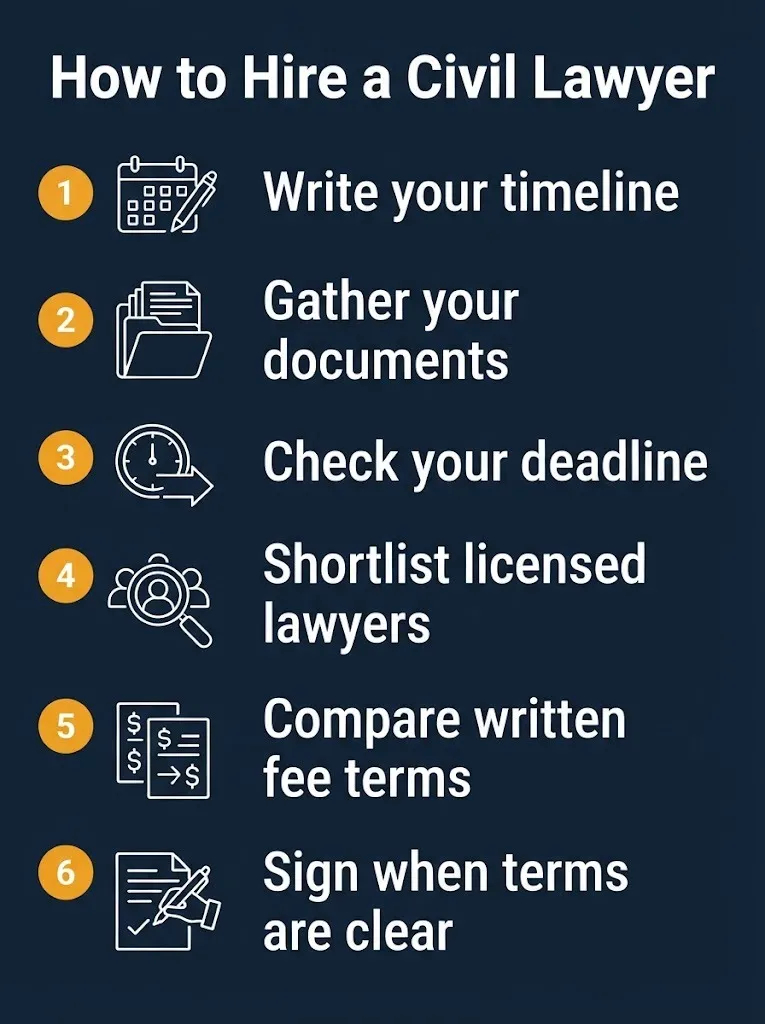
Hire a lawyer by shortlisting licensed attorneys, meeting two or three, and signing only a clear written agreement.
- Write a one-page timeline with dates and dollar amounts.
- Gather contracts, emails, photos, bills, and records.
- Check your filing deadline before calling anyone.
- Shortlist three licensed lawyers who handle your dispute type.
- Compare written fee terms after each consultation.
- Sign only when every term is clear.
Don’t hire the first firm that picks up the phone. Compare at least two. Keep copies of everything you hand over.
Step 5 matters more than most people expect. A 33% fee with costs deducted first can beat a 30% fee that deducts them last. Run the math on a sample settlement before you choose.
What should a civil lawyer’s fee agreement say?
A fee agreement should state, in writing, exactly how the lawyer gets paid and what you owe.
ABA Model Rule 1.5(c) requires contingency agreements to be in a writing signed by the client. States adopt their own versions of the rule, so your state’s text controls.
Look for these terms:
- The percentage at settlement, at trial, and on appeal
- Which expenses get deducted from your recovery
- Whether expenses come out before or after the fee
- Whether you owe expenses if you lose
- Whether other lawyers will share the fee, which needs your written consent
- A written closing statement showing how your payout was calculated
Rule 1.5(a) bans unreasonable fees. Rule 1.5(d) bars contingency fees in certain family law and criminal matters.
A handshake deal is like a store return without a receipt. You can’t prove what was promised. If a clause confuses you, ask for it in plain words before you sign.
Key Takeaway: Never hire on a handshake, because a signed fee agreement protects what you keep.
What should you ask at the first consultation?
Ask about experience, fees, costs, communication, and risk, in that order.
Bring your timeline and documents. Then work through these questions:
- How many cases like mine have you handled recently?
- Who will actually work on my file: you, an associate, or a paralegal?
- What fee structure do you propose, and why?
- Which costs will I owe, and when?
- What’s the realistic range of outcomes, including losing?
- What’s my filing deadline?
- How often will you update me?
- How does your firm use AI tools, and who checks the work?
Question 2 affects your bill. Paralegals average $187 an hour in Clio’s data, against $349 for lawyers. Smart delegation can save you money.
Take notes during the meeting. A good lawyer welcomes hard questions. If the answers feel vague, keep shopping.
How long do you have to file a civil lawsuit?
Your deadline is your state’s statute of limitations, and it can be as short as one year.
Two years is the most common window for personal injury. One 2025 count found 28 states use it, while 12 allow three years. Kentucky and Tennessee allow one year. Maine and North Dakota allow six.
| Claim | Typical deadline | Note |
|---|---|---|
| Personal injury | 1 to 6 years, most often 2 | Colorado adds a year for motor vehicle injuries |
| Florida negligence | 2 years | Cut from 4 years by HB 837 in 2023 |
| Louisiana injury | 2 years | Extended for acts on or after July 1, 2024 |
| Medical malpractice | Often shorter | One year in California, Kentucky, Louisiana, Ohio, Tennessee |
| New York | 3 years injury, 2.5 years malpractice, 2 years wrongful death | Varies by claim |
| Written contracts | Often 6 years | Range runs 3 to 15 years |
Exceptions exist. The discovery rule and special rules for minors can change the clock. Claims against government agencies often carry different, shorter notice rules. Published sources disagree on a few states, so confirm yours with a lawyer or the court clerk.
What are courts doing about lawyers who use AI in 2026?
Courts are sanctioning lawyers who file AI-invented case citations without checking them.
In March 2026, a Sixth Circuit panel sanctioned two Tennessee attorneys in Whiting v. City of Athens. Reports put the penalty at $15,000 each, plus fees and costs. The briefs held more than two dozen fabricated citations and misstatements of fact.
The problem is growing. Researchers tracked at least $145,000 in AI-citation sanctions in the first quarter of 2026 alone. A Bloomberg Law analysis, cited by the Illinois courts, counted more than 280 filings with hallucinated citations since 2023. Cases surged sevenfold in 2025.
Firms are adopting AI faster than they write rules. A 2026 survey of more than 1,300 legal professionals found 69 percent used general-purpose AI. Only 9 percent of firms had a written, enforced AI policy.
Here’s what that means for you. Courts don’t ban AI. They punish unchecked output. ABA Formal Opinion 512, issued in July 2024, applies existing competence, confidentiality, and supervision rules to AI tools. Ask your lawyer who verifies every citation before filing. Some courts require disclosure of AI use.
Key Takeaway: AI use isn’t banned, but your lawyer must verify every citation, so ask who checks.
What happens after your lawyer files the case?
After filing, a civil case moves through pleadings, discovery, motions, settlement talks, and possibly trial.
- Complaint: Your lawyer files a document stating the facts, your claims, and the relief you want.
- Service and answer: The defendant is formally notified and files a response.
- Discovery: Both sides exchange documents and take sworn testimony.
- Motions: Either side asks the judge to dismiss claims or decide issues early.
- Settlement or mediation: Many disputes end here, before a trial date.
- Trial and appeal: A judge or jury decides, and the loser may appeal.
Discovery is like opening a wall during a renovation. You learn what’s really behind it, and the budget can change. That’s why hourly clients should ask for regular billing updates.
Timing varies by court and case. Cost guides give wide duration ranges, so treat any single number with caution. Be wary of any lawyer who promises a finish date.
What is a civil lawsuit, and how is it different from a criminal case?
A civil lawsuit is a private dispute where one side seeks money or a court order, not jail time.
The plaintiff must prove the claim by a preponderance of the evidence. That means more likely than not. Criminal cases demand proof beyond a reasonable doubt, a much higher bar.
| Feature | Civil case | Criminal case |
|---|---|---|
| Who brings it | A person or business | The government |
| Goal | Money or a court order | Punishment |
| Burden of proof | More likely than not | Beyond a reasonable doubt |
| Free lawyer | Not guaranteed; legal aid may help | Public defender if you can’t afford counsel |
One event can trigger both cases. A car crash caused by a drunk driver might lead to charges and a lawsuit. The outcomes are separate.
Civil remedies include damages, which are money awards, and injunctions, which are court orders to act or stop acting. A civil verdict can’t send you to jail.
Which type of civil lawyer fits your case?
Pick a lawyer who focuses on your type of dispute, such as injury, employment, contract, or malpractice.
Fee structures often follow the practice area:
- Personal injury: Usually contingency, commonly 33% to 40% in cost guides.
- Employment: Contingency of 33% to 40%, or hourly at $250 to $600 with retainers of $5,000 to $25,000.
- Business and contract disputes: Usually hourly or flat fee. One guide lists a simple contract dispute at $2,500 to $5,000.
- Defamation: Hourly, flat, or hybrid fees, and rarely contingency.
- Medical malpractice: Contingency or hybrid, with expert-heavy costs and short deadlines in some states.
- Workers’ compensation: Fees usually capped by state law.
- Civil rights: Section 1983 claims borrow your state’s personal injury deadline.
Ask each candidate for examples of similar cases they’ve handled. Specifics beat slogans. A lawyer who regularly tries injury cases may not be your best pick for a contract fight.
Key Takeaway: Match the lawyer to your type of dispute, and the fee structure usually follows.
What Happens Next
Your next steps depend on your deadline, so start there.
- Today (October 3, 2026): Write your timeline and look up your state’s filing deadline.
- Expected within one week: Verify licenses with your state bar and book two or three consultations.
- Expected after the meetings: Compare written fee agreements and sign the clearest one.
- Expected after signing: Your lawyer may send a demand letter or file the complaint.
- Expected next stage: Discovery and settlement talks begin, with timing set by the court.
Frequently Asked Questions
How much does a civil lawyer cost per hour in 2026?
The average U.S. lawyer charges $349 an hour, per Clio’s 2026 data.
Civil litigation averages run from $308 in Oklahoma to $435 in Connecticut among the state pages checked.
Do civil lawyers work on contingency?
Many do for injury and employment claims, taking a percentage of what you recover.
Defense work and some disputes are usually billed hourly or by flat fee.
ABA Model Rule 1.5(d) bars contingency fees in certain family law and criminal matters.
How much does it cost to file a civil lawsuit?
Filing in U.S. district court costs $405.
That’s a $350 fee plus a $55 administrative fee.
State court fees vary by court and county.
Can I sue someone without a lawyer?
Yes, courts allow people to represent themselves, called pro se filing.
Small claims court is built for that.
Complex or high-value cases are harder to handle alone.
What is the burden of proof in a civil lawsuit?
The plaintiff must show the claim is more likely true than not.
Courts call this preponderance of the evidence.
Criminal cases require proof beyond a reasonable doubt.
Where can I find a free civil lawyer?
Start with a legal aid group funded by the Legal Services Corporation.
Income generally must be at or below 125% of the federal poverty guidelines.
In 2026, that’s $19,950 for one person in the contiguous U.S.
How long do I have to file a civil lawsuit?
It depends on your state and claim type, from one year to six or more.
Most personal injury claims allow two or three years.
Check your deadline before you do anything else.
Can my lawyer use AI on my case?
Yes, if the lawyer verifies the work.
ABA Formal Opinion 512 applies existing competence and confidentiality rules to AI tools.
Ask who checks citations before anything is filed.
Start with your deadline, then your budget. A short call to your state bar or a legal aid office can save you months.
Gather your documents this week and compare at least two fee agreements. Whatever you decide, one date controls everything: your state’s statute of limitations.