Workers Compensation Insurance Virginia 2026: Coverage Rules, Rates, and Carrier Options
Quick Answer
- Virginia requires workers’ comp coverage for any employer with one or more full-time or part-time employees.
- The 2026 maximum weekly benefit is $1,507.01, up from $1,463.10 the previous year.
- Coverage is sold through a competitive private market, with Group Self-Insurance Associations (GSIAs) offering an alternative for construction and other trades.
The Facts
| Coverage Rule | Mandatory for any employer with employees |
|---|---|
| 2026 Maximum Weekly Benefit | $1,507.01 (effective July 1, 2026) |
| 2026 Minimum Weekly Benefit | $376.75 |
| Benefit Rate | 66 2/3% of average weekly wage |
| TTD Duration Cap | 500 weeks |
| Regulatory Body | Virginia Workers’ Compensation Commission |
| Insurance Market | Competitive private carriers, NCCI-rated |
| GSIA Alternative | Available for qualifying employer groups |
Is Workers Compensation Insurance Required in Virginia?
Yes, workers’ compensation insurance is required in Virginia for any employer with employees. Unlike some states that set a minimum employee count, Virginia law presumes acceptance of the Workers’ Compensation Act for every employer and employee unless specifically rejected .
The duty to insure is absolute. Every employer subject to the compensation provisions must insure the payment of compensation to employees . There is no small-business exemption that lets you skip coverage because you only have two or three workers.
Executive officers can reject coverage under the Act, but only by following a specific written notice procedure and filing it with the Commission . That rejection does not cover occupational diseases. And if you reject coverage, you proceed at common law in any injury lawsuit, which means you lose the protections of the no-fault system .
For most Virginia employers, the practical answer is simple: if you have employees, you need coverage from day one.
How Much Does Workers Compensation Insurance Cost in Virginia?
The average workers’ compensation rate in Virginia is approximately $1.00 per $100 of payroll, though your actual rate depends heavily on your industry classification and claims history .
Rates are built using a formula: (annual payroll divided by 100) multiplied by your class code base rate, then adjusted by your experience modification rate (EMR) . The EMR is the biggest lever you control. A clean claims history compounds into lower premiums year over year.
High-risk trades pay dramatically more. Roofing and construction class codes carry some of the highest rates because of fall exposure . A clerical class code might run well under $0.50 per $100 of payroll, while a roofing code can run into the double digits.
Here is what drives your premium:
| Factor | Impact on Cost |
|---|---|
| Class code | Determines base rate; varies by industry |
| Payroll | Higher payroll means higher premium |
| Experience Modifier (EMR) | Claims history multiplier; 1.0 is average |
| Safety programs | Some carriers offer credits for formal programs |
| Carrier selection | Multipliers vary; comparing matters |
Virginia operates a competitive market, with rates built on loss costs filed by NCCI, the national rating bureau . Each carrier applies its own multiplier on top, so shopping around can produce real savings.
Key Takeaway
Key Takeaway: Virginia requires workers’ comp coverage from the first employee, and your premium is driven primarily by your industry class code and your claims history, not by your size alone.
How Much Is Workers Compensation in Virginia in 2026?
The maximum weekly workers’ compensation benefit in Virginia for injuries occurring on or after July 1, 2026, is $1,507.01 . The minimum weekly benefit is $376.75 .
Virginia pays 66 2/3 percent of your average weekly wage, subject to those caps . The Commission adjusts the maximum and minimum annually based on the statewide average weekly wage, which is calculated from contribution reports filed with the Virginia Employment Commission .
How does the math work? If you earned $900 per week before your injury, two-thirds is $600. That is below the cap, so your weekly benefit is $600. If you earned $3,000 per week, two-thirds would be $2,000, but the cap limits you to $1,507.01 .
To hit the maximum, you need an average weekly wage of approximately $2,260.52 or higher. That works out to about $117,547 annually.
| Effective Date | Maximum Weekly Rate |
|---|---|
| July 1, 2026 | $1,507.01 |
| July 1, 2025 | $1,463.10 |
| July 1, 2024 | $1,410.95 |
The cost-of-living adjustment (COLA) rate effective October 1, 2026, is 2.65 percent . COLA is not automatic in Virginia. You must specifically request it, and eligibility depends on whether your combined workers’ comp and Social Security benefits fall below a certain limit .
Who May Qualify for Virginia Workers Compensation Benefits?
You may qualify for Virginia workers’ compensation benefits if you suffered an injury by accident arising out of and in the course of your employment. The system is no-fault, meaning you do not have to prove your employer was negligent.
Virginia provides several types of benefits:
- Medical treatment. The employer must furnish a physician of your choice from a panel of at least three doctors, plus all necessary medical attention .
- Temporary Total Disability (TTD). Weekly checks while you are unable to work at all, paid at 66 2/3% of your average weekly wage.
- Temporary Partial Disability (TPD). Partial wage replacement if you return to light duty at reduced pay.
- Permanent Partial Disability (PPD). Compensation for specific body part losses or impairments.
- Permanent Total Disability (PTD). Lifetime benefits for total and permanent incapacity from severe injuries.
- Death Benefits. For surviving dependents.
The employer must also furnish prosthetic devices, orthotic appliances, wheelchairs, and other equipment when the injury requires it, up to an aggregate cap of $55,000 per accident, adjusted annually .
Vocational rehabilitation services may be ordered by the Commission if they are reasonable and necessary . The goal is to help you return to suitable employment when possible.
Reality Check: No one calls you out of the blue and offers workers’ comp settlement money without paperwork. If someone promises a fast settlement for an upfront fee, it is a scam. Filing a claim with the Commission is free, and legitimate settlements go through the Commission’s approval process.
What Are the Different Types of Virginia Workers Comp Settlements?
Virginia workers’ compensation cases can conclude in several ways, and the right path depends on your medical needs and your willingness to accept risk.
1. Lump-Sum Settlement (Redemption). Liability for compensation may be redeemed in whole or in part through a lump-sum payment when the parties agree and the Commission deems it to be in your best interests . The lump sum must be approved by the Commission to be binding.
2. Structured Settlement with Annuity. Some settlements combine a lump sum with ongoing monthly or annual payments. In one 2026 case, a traumatic brain injury claimant received a total upfront cash value of $2.7 million, including monthly lifetime payments, an annuity of $120,000 per year for home healthcare, and a Medicare Set-Aside .
3. Award and Ongoing Benefits. If you and the carrier cannot agree on a settlement, the case proceeds to hearing before a Deputy Commissioner. The Commissioner decides the award, and medical benefits generally remain open.
Here is how recent Virginia settlements have broken down:
| Case Type | Settlement Amount | Year Resolved |
|---|---|---|
| Traumatic brain injury (forklift) | $2.7 million | 2026 |
| Scissor lift fall with PTSD | $1,324,270 | 2026 |
| Paralyzed in tobacco baler | $800,000 | 2026 |
The Commission must approve lump-sum settlements. An unrepresented claimant must appear before a Commissioner for approval.
Key Takeaway
Key Takeaway: Virginia settlements range from structured lifetime annuities to lump-sum redemptions, and every lump-sum agreement must be approved by the Workers’ Compensation Commission to be binding.
Who Are the Virginia Workers Compensation Insurance Companies?
Virginia has a competitive workers’ compensation insurance market with dozens of private carriers. Several major national carriers write coverage in the state, alongside regional and specialty insurers.
The largest writer of workers’ compensation in Virginia is a Group Self-Insurance Association, not a traditional carrier. Commonwealth Contractors Group Self-Insurance Association (CCGSIA) is the 6th largest writer of workers’ compensation in Virginia across all industries . It is member-owned, A.M. Best rated A-, and has returned more than $89 million in dividends to members since 1981 .
Other carriers active in Virginia include:
- Travelers
- Hartford
- ICW Group
- Summit (through Bridgefield Casualty Insurance Co., Bridgefield Employers Insurance Co., and Bridgefield Indemnity Insurance Co.)
Group Self-Insurance Associations are licensed and regulated by the Virginia Bureau of Insurance, not the Workers’ Compensation Commission . They pool premiums from member employers, invest the funds, and return surplus to members as dividends. The better the group’s safety performance, the higher the potential dividend.
For small employers, PEO arrangements can provide access to pooled rates that are often 30 to 50 percent lower than direct market rates for high-risk trades .
How to File a Virginia Workers Compensation Claim
Filing a Virginia workers’ comp claim starts with reporting your injury to your employer, then filing the appropriate forms with the Commission. Here are the steps:
- Report your injury to your employer immediately. Virginia law requires prompt notice. Delays can complicate your claim.
- Seek medical treatment. The employer must provide a panel of at least three physicians. You choose from that panel .
- File a claim with the Commission. Use the Commission’s forms to formally initiate your claim.
- Attend all medical appointments. Missed appointments can be used to dispute your claim.
- Keep records of everything. Pay stubs, medical bills, work restrictions, and correspondence.
- Reach Maximum Medical Improvement (MMI). Your doctor will issue an impairment rating once your condition stabilizes.
- Negotiate settlement or request a hearing. If the carrier’s offer is too low, you can request a hearing before a Deputy Commissioner.
- Get settlement approved by the Commission. A lump-sum redemption must be approved by the Commission to be binding .
What Happens Next in Virginia Workers Compensation in 2026?
Here is the expected timeline for rate changes and regulatory developments:
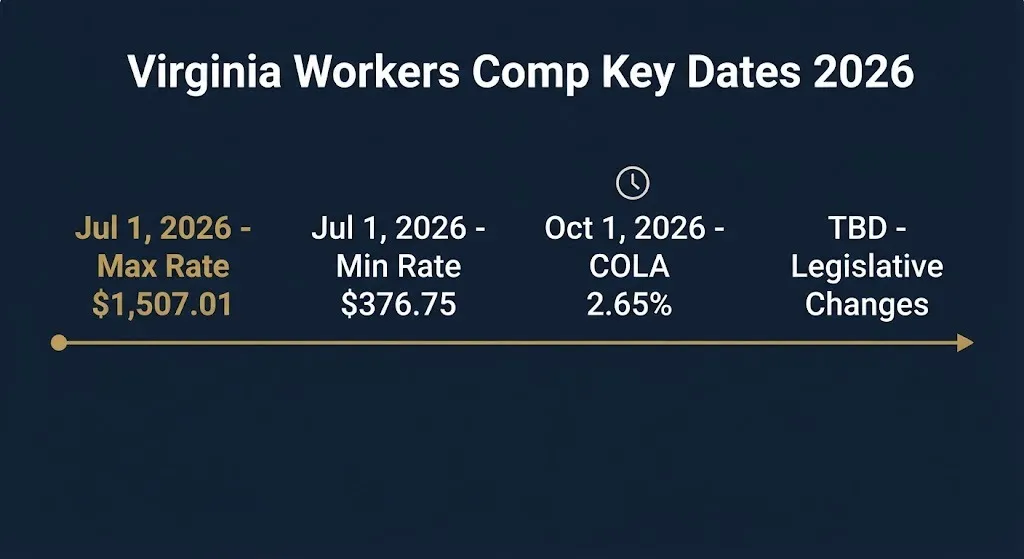
July 1, 2026: The maximum weekly benefit increased to $1,507.01 and the minimum to $376.75 .
October 1, 2026: The COLA rate of 2.65 percent took effect for eligible long-term total disability and death benefit recipients . COLA must be requested, not automatically applied .
Ongoing 2026: The Commission continues processing lump-sum settlement approvals and monitoring the Uninsured Employer’s Fund.
TBD: Any legislative changes to the Workers’ Compensation Act. The 2026 General Assembly session has concluded, and no major rate or coverage changes were enacted beyond the annual adjustments.
Frequently Asked Questions
Do I need workers comp insurance in Virginia if I have one employee?
Yes. Virginia requires workers’ compensation coverage for any employer with employees, regardless of how many you have.
What is the maximum workers comp rate in Virginia for 2026?
The maximum weekly compensation rate for injuries on or after July 1, 2026, is $1,507.01.
How much does workers comp insurance cost in Virginia?
The average rate is approximately $1.00 per $100 of payroll, but your actual rate depends on your industry class code and claims history.
Can I reject workers comp coverage in Virginia?
Executive officers can reject coverage by filing a specific written notice with the Commission, but that rejection does not cover occupational diseases and means proceeding at common law in any injury lawsuit.
What is a Group Self-Insurance Association in Virginia?
A GSIA is a member-owned pool of employers that combines premiums, invests funds, and returns surplus to members as dividends. CCGSIA is the 6th largest workers’ comp writer in Virginia.
Can I settle my Virginia workers comp claim for a lump sum?
Yes. Liability for compensation may be redeemed through a lump-sum payment when the parties agree and the Commission approves it as being in your best interests.
What happens if my employer doesn’t have workers comp insurance in Virginia?
If an employer is uninsured, you may still have a claim. Virginia has an Uninsured Employer’s Fund that can pay benefits in certain circumstances. Consult a licensed attorney for your specific situation.
How long do I have to file a workers comp claim in Virginia?
You should report your injury to your employer immediately. The statute of limitations for filing a claim with the Commission is generally two years from the date of the accident, but specific deadlines can vary.
Your Next Step
If you were injured on the job in Virginia, report it to your employer in writing today. Keep a copy of that notice. Then contact the Virginia Workers’ Compensation Commission to file your claim.
The 2026 maximum weekly rate of $1,507.01 applies to injuries on or after July 1, 2026. If your average weekly wage is high enough, that is the cap on your weekly benefits. If you are considering a lump-sum settlement, remember that it must be approved by the Commission to be binding, and COLA must be requested, not automatically applied.