457(b) Deferred Compensation Plan 2026: What It Is, Limits, and How It Works
Quick Answer
- A 457(b) plan is a deferred compensation retirement plan offered by governments and some tax-exempt employers.
- The 2026 contribution limit is $24,500, with an extra $8,000 catch-up if you are 50 or older.
- Governmental 457(b) plans allow penalty-free withdrawals before age 59½, unlike 401(k) and 403(b) plans.
A 457(b) deferred compensation plan is a retirement savings vehicle that lets you set aside pre-tax income for the future. It is available to employees of state and local governments and to certain tax-exempt organizations. The plan works through salary reduction agreements: you elect to defer a portion of your pay, and that money grows tax-deferred until you withdraw it.
The plan is named after Section 457(b) of the Internal Revenue Code, which sets the rules for eligible deferred compensation arrangements. Unlike a 401(k) or 403(b), a 457(b) plan is technically a deferred compensation arrangement, not a trust-based retirement account.
This article explains the 2026 contribution limits, the difference between governmental and non-governmental plans, how withdrawals work, and what happens when you change jobs. One detail that surprises many people: governmental 457(b) plans are not subject to the 10% early withdrawal penalty that applies to most other retirement accounts.
The Facts
| Case | 457(b) Deferred Compensation Plan (retirement plan) |
|---|---|
| Status | Active federal tax law, available to eligible employers |
| Fund Size | Not applicable |
| Est. Per Person | 2026 contribution limit: $24,500 ($32,500 with age-50 catch-up) |
| Claim Deadline | Not applicable |
| Administrator | Employer plan administrator |
| Proof Needed | Plan documents, salary reduction agreement, W-2 |
Is a 457(b) Deferred Compensation Plan Legit or a Scam?
A 457(b) plan is a legitimate retirement savings vehicle governed by federal tax law. It is not a scam, and it is not a get-rich-quick scheme. The plan exists to help public employees and certain nonprofit workers save for retirement with tax advantages.
The scam risk appears in two forms. First, some marketers pitch “457 plans” as tax-free accounts when they are not. A 457(b) is tax-deferred. You pay ordinary income tax when you withdraw the money.
Second, non-governmental 457(b) plans carry employer creditor risk. If your employer goes bankrupt, the money in a non-governmental 457(b) plan is generally available to the employer’s creditors. Governmental plans do not carry this risk.
Key Takeaway: A 457(b) plan is legitimate. The main risks are misunderstanding the tax treatment and, for non-governmental plans, employer creditor exposure.
How Much Can You Contribute to a 457(b) Plan in 2026?
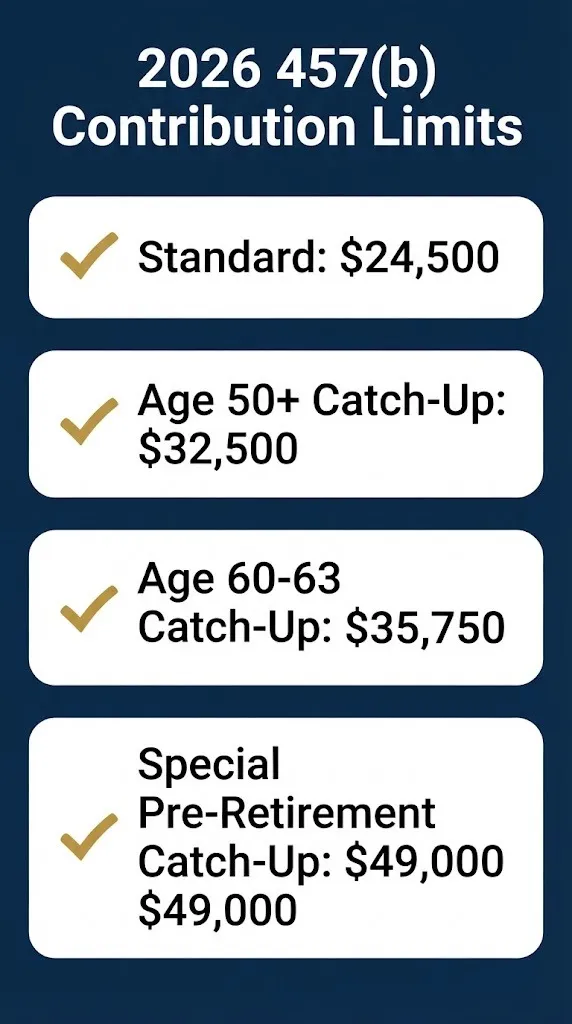
The 2026 contribution limit for a 457(b) plan is $24,500, matching the 401(k) and 403(b) limit for the year. If you are 50 or older, you can contribute an additional $8,000, bringing your total to $32,500.
A special catch-up provision under the SECURE 2.0 Act applies to participants aged 60 through 63. Those workers can contribute an extra $11,250 instead of the standard $8,000, for a total of $35,750 in 2026.
The 457(b) plan also has a unique “special catch-up” rule. If you are within the three years prior to your plan’s normal retirement age, you may be eligible to defer up to double the normal limit, for a total of $49,000 in 2026. This provision is available only once and must be elected in advance.
Here is the 2026 contribution breakdown:
| Category | Maximum Contribution |
|---|---|
| Standard limit | $24,500 |
| Age 50+ catch-up | $32,500 |
| Age 60-63 catch-up | $35,750 |
| Special pre-retirement catch-up | $49,000 |
Key Takeaway: The 2026 standard limit is $24,500. Age-based catch-up provisions can push your total contribution to $32,500 or higher, depending on your age and plan rules.
What Is the Difference Between Governmental and Non-Governmental 457(b) Plans?
The difference between governmental and non-governmental 457(b) plans is enormous, and it affects rollovers, creditor protection, and distribution rules. Governmental plans are offered by state and local government employers. Non-governmental plans are offered by tax-exempt organizations like nonprofit hospitals and universities.
Here is the comparison:
| Feature | Governmental 457(b) | Non-Governmental 457(b) |
|---|---|---|
| Rollover to IRA | Generally allowed | Generally not allowed |
| Creditor protection | Protected from employer creditors | Subject to employer creditors |
| Distribution at separation | Often optional | Often mandatory |
| Roth option | Allowed | Not allowed |
| ERISA coverage | Not subject to ERISA | Subject to top-hat filing |
Non-governmental 457(b) plans are “top-hat” plans, meaning they are reserved for a select group of highly compensated or management employees. They are used as supplemental retirement savings on top of a 403(b) or other plan. Governmental plans can be offered to all employees.
The creditor risk for non-governmental plans is real. Assets are held in a rabbi trust, which means they remain the employer’s property and are available to creditors in bankruptcy.
Key Takeaway: Governmental plans offer rollover flexibility and creditor protection. Non-governmental plans are restricted top-hat plans with employer creditor risk.
How Do 457(b) Plan Distributions Work?
457(b) plan distributions follow rules that depend on whether your plan is governmental or non-governmental. Governmental plans generally allow you to delay distributions and roll the balance into an IRA. Non-governmental plans often require distribution after you leave the employer.
In a non-governmental plan, you typically elect the distribution time and form when you enroll. A common default is a lump-sum payment within 60 days following separation from service. You may have a second opportunity to delay payment between separation and the previously elected payment date, so long as your balance exceeds the plan’s de minimis amount.
Once you set a payment date, you generally cannot accelerate or further delay it. You can change the form of payment (lump sum versus installments) until distributions begin.
Governmental 457(b) plans offer more flexibility. You can often leave the money in the plan after separation, roll it to an IRA, or take distributions on a schedule you choose.
Not yet determined: The exact distribution options in your plan depend on your employer’s plan document. Check with your plan administrator for specifics.
What Happens to a 457(b) Plan When You Change Jobs?
What happens to your 457(b) when you change jobs depends on whether the plan is governmental or non-governmental. Governmental 457(b) plans can generally be rolled into an IRA or another eligible retirement plan. Non-governmental plans typically cannot.
If you have a non-governmental 457(b), you may face a mandatory distribution when you leave. The entire balance could become taxable in a single year, pushing you into a higher tax bracket. That can also increase your Medicare Part B and D premiums through IRMAA.
Here are your options when you leave a job with a 457(b):
- Leave the money in the plan (if allowed). Governmental plans often permit this.
- Roll to an IRA (governmental plans only). This preserves tax deferral.
- Take a lump-sum distribution. The full amount is taxable as ordinary income in that year.
- Elect a multi-year payout. Some plans allow installment distributions over several years.
- Transfer to another 457(b) plan. Plan-to-plan transfers are allowed if both plans permit them.
Key Takeaway: Governmental 457(b) plans can roll to an IRA. Non-governmental plans often require distribution at separation, which can trigger a large tax bill.
How Do You Enroll in a 457(b) Plan?
Enrolling in a 457(b) plan involves signing a salary reduction agreement with your employer. Here are the steps:
- Check your eligibility. Governmental plans are often open to all employees. Non-governmental plans are limited to select management or highly compensated employees.
- Request the plan document. Read the summary plan description to understand contribution limits and distribution rules.
- Decide how much to defer. You can defer a percentage of salary or a fixed dollar amount, up to the annual limit.
- Choose your investments. Options vary by plan and may include mutual funds, annuities, or stable value funds.
- Select your beneficiary. This determines who receives the account if you die before distribution.
- Submit your salary reduction agreement. This authorizes your employer to defer a portion of each paycheck.
The election generally must be made before the first day of the month in which the compensation is paid.
What Happens Next
Annually: Review your contribution election and adjust it to match the new IRS limit. The 2026 limit is $24,500.
Before year-end: Confirm your catch-up eligibility if you are 50 or older. High earners may need to designate catch-up contributions as Roth starting in 2026.
At job change: Determine whether your 457(b) is governmental or non-governmental. That determines your rollover and distribution options.
Before retirement: Review your distribution election. Non-governmental plans often have mandatory payout timelines.
Frequently Asked Questions
What is a 457(b) deferred compensation plan?
A 457(b) plan is a tax-advantaged retirement plan for state and local government employees and certain tax-exempt organization workers. Contributions are made pre-tax and grow tax-deferred.
How much can I contribute to a 457(b) in 2026?
The standard limit is $24,500. If you are 50 or older, you can add $8,000, for a total of $32,500. A special catch-up is available for ages 60-63 and for those near normal retirement age.
Can I roll a 457(b) into an IRA?
Governmental 457(b) plans can generally be rolled into an IRA. Non-governmental 457(b) plans typically cannot be rolled over.
Is there a 10% early withdrawal penalty for 457(b) plans?
No. Governmental 457(b) plans are not subject to the 10% early withdrawal penalty that applies to 401(k) and 403(b) plans.
What happens to my 457(b) if my employer goes bankrupt?
If you have a non-governmental 457(b), your balance is subject to employer creditors. Governmental 457(b) plans are protected from employer creditor claims.
Who can offer a 457(b) plan?
State and local governments and tax-exempt organizations under IRC Section 501(c) can offer 457(b) plans. Non-governmental plans are limited to top-hat arrangements for select employees.
How are 457(b) distributions taxed?
Distributions are taxed as ordinary income. Non-governmental plan distributions are subject to mandatory federal income tax withholding as wages.
Can I contribute to both a 457(b) and a 403(b) or 401(k)?
Yes. If your employer offers both, you can contribute the maximum to each plan separately. The combined limit across a 457(b) and 401(k) or 403(b) allows you to defer up to twice the annual limit.