Workers’ Compensation California 2026: Complete Guide to Rates, Filing, and Benefits
Quick Answer
- California workers’ compensation is mandatory insurance covering nearly all employees for job-related injuries and illness.
- The 2026 maximum weekly disability payment is $1,764.11, and the minimum is $264.61, set by the state DWC.
- You generally have one year from your injury date to file a workers’ comp claim in California.
If you’re searching “workers compensation California,” here’s the direct answer: it’s a no-fault insurance system, mandatory for nearly every employer in the state, that pays medical care and partial wage replacement after a job injury. The Division of Workers’ Compensation set new 2026 rates effective January 1.
This affects nearly every employee in California, since coverage doesn’t depend on immigration status, full-time versus part-time work, or fault for the injury. The single most important 2026 number is the new maximum weekly disability rate of $1,764.11, up from $1,680.29 in 2025.
This article covers how much California workers’ comp pays in 2026, how to file, and what changed this year. One detail worth knowing upfront: California’s permanent disability rate is capped much lower than its temporary disability rate, at just $290 per week for most injuries, a gap that surprises a lot of injured workers.
The Facts
| Case | State of California workers’ compensation system (Labor Code Divisions 4 and 4.5), not a single lawsuit or settlement |
| Status | 2026 temporary disability rates confirmed effective January 1, 2026 |
| Fund Size | Not applicable, this is state-mandated employer insurance, not a lawsuit settlement fund |
| Est. Per Person | TTD ranges $264.61 to $1,764.11 per week; PD ranges $160 to $435 per week depending on rating |
| Claim Deadline | Generally one year from date of injury under Labor Code Section 5405 |
| Administrator | California Division of Workers’ Compensation (DWC), Department of Industrial Relations |
| Proof Needed | Medical documentation from a treating or qualified medical evaluator, plus employer notice within 30 days |
Is California Workers’ Compensation Insurance Mandatory?
Yes, California law requires nearly every employer to carry workers’ compensation insurance, regardless of how many employees they have. Even a business with a single part-time worker generally must carry coverage.
Coverage applies regardless of a worker’s immigration status, full-time or part-time classification, or whether the injury was partly the worker’s own fault. California operates on a no-fault basis, meaning you don’t need to prove your employer did anything wrong to qualify for benefits.

Some limited categories, like certain independent contractors and specific agricultural or domestic work arrangements, follow different rules. Recent legislation, SB 216 and its extension SB 1455, pushed the deadline for certain licensed contractors without employees to carry their own coverage to January 1, 2028.
Key phrase to remember: mandatory coverage means you generally don’t need to sue your employer to get benefits. The tradeoff is that workers’ comp is usually your exclusive remedy against your employer for a workplace injury.
Is Workers’ Compensation the Same as State Disability Insurance in California?
No, workers’ compensation and State Disability Insurance (SDI) are two separate systems in California, and they cover different situations. Workers’ comp pays for job-related injuries specifically, while SDI covers non-work-related illness or injury.
Workers’ comp is funded through employer-purchased insurance, and benefits are tax-free. SDI is funded through employee payroll deductions and administered by the Employment Development Department (EDD), not the DWC.
Some injured workers transition between the two. If your workers’ comp temporary disability benefits run out at the 104-week cap before you reach maximum medical improvement, you may become eligible for up to 52 additional weeks through SDI to avoid a gap in income.
How Much Does Workers’ Compensation Pay in California in 2026?
For 2026 injuries, California temporary total disability (TTD) benefits pay two-thirds of your average weekly wage, ranging from a minimum of $264.61 to a maximum of $1,764.11 per week. These are the rates the DWC announced effective January 1, 2026.
| California 2026 TTD Rate | Amount |
|---|---|
| Minimum weekly TTD | $264.61 |
| Maximum weekly TTD | $1,764.11 |
| 2025 minimum (for comparison) | $252.03 |
| 2025 maximum (for comparison) | $1,680.29 |
| Increase | 4.99%, tied to the State Average Weekly Wage |
If two-thirds of your pre-injury wage falls between those two numbers, that’s your actual weekly benefit. If your wage is high enough that two-thirds would exceed $1,764.11, your check is capped at that maximum regardless of your actual earnings.
Key Takeaway: California’s 2026 TTD maximum rose nearly 5 percent, but the increase only applies to injuries dated on or after January 1, 2026, not to older claims still being paid.
What Is the Maximum California Workers’ Comp Payment in 2026?
The maximum weekly workers’ comp payment for temporary and permanent total disability in California is $1,764.11 for injuries occurring on or after January 1, 2026. This figure also applies to permanent total disability and life pension benefits under Labor Code Section 4659(c).
This maximum is tied directly to the State Average Weekly Wage (SAWW), which increased from $1,704 to $1,789 for the relevant period, a 4.99 percent jump. By law, under Labor Code Section 4453(a)(10), the TTD maximum must rise by the same percentage as the SAWW increase each year.
Not applicable: there is no separate, higher “lump sum maximum” beyond these weekly caps. Total settlement value depends on how many weeks of benefits your specific claim and disability rating generate, not a single flat maximum payout figure.
How Much Does Permanent Disability Pay in California in 2026?
Permanent disability (PD) in California pays a much lower weekly rate than temporary disability, capped at $290 per week for most ratings between 1 percent and 69.75 percent, for injuries occurring in 2026. Workers with a rating of 70 percent or higher receive a higher tier.
| California 2026 PD Rate | Weekly Amount |
|---|---|
| PD rating 1% to 69.75%, maximum | $290 |
| PD rating 1% to 69.75%, minimum | $160 |
| PD rating 70% or above, maximum | $435 |
| PD rating 70% or above, minimum | $240 |
Unlike TTD, the PD rate maximum hasn’t been adjusted by SAWW increases since 2014 for most ratings, since Labor Code Section 4453(b) exempts PD from the same annual formula. That’s why the PD maximum of $290 has stayed flat for years while TTD has climbed steadily.
Reality Check: No text message, email, or online “PD chart lookup service” that asks for a fee before showing you your rating can guarantee your permanent disability payout. Only a treating physician or a qualified medical evaluator can assign your actual impairment rating.
How Is a California Workers’ Comp Settlement Calculated?
A California workers’ comp settlement is calculated using your average weekly wage, your permanent disability rating if applicable, the applicable weekly rate cap, and the number of weeks your rating and injury type generate. There’s no fixed statewide settlement chart with one number per injury.
California uses the 2005 Permanent Disability Rating Schedule (PDRS) combined with the AMA Guides to the Evaluation of Permanent Impairment, 5th Edition. A doctor first assigns a Whole Person Impairment percentage, which then gets adjusted for your age at injury, your occupation, and a Future Earning Capacity factor.
Settlements generally take one of two forms. A Compromise and Release resolves the claim with a lump sum payment. A Stipulated Award continues periodic payments over time, similar to ongoing scheduled benefits, without closing out future medical care the same way a Compromise and Release does.
Key Takeaway: two workers with the same medical impairment rating can receive very different settlement values, since wage history, age, and occupation all factor directly into the final PD calculation.
How Do I File a Workers’ Compensation Claim in California?
You file a California workers’ comp claim by notifying your employer within 30 days of the injury and completing a DWC-1 claim form, which your employer must provide. Missing that initial notice window can put your claim at risk, though exceptions exist.
Here’s the general filing process:
- Report the injury to your employer within 30 days, in writing if possible.
- Request and complete the DWC-1 claim form from your employer.
- Get a written work-status note from your treating doctor.
- If your employer uses a Medical Provider Network (MPN), begin treatment with an in-network doctor.
- Track mileage and travel expenses to medical appointments for reimbursement.
- If no modified work is offered within 60 days of a permanent disability rating, ask about the Supplemental Job Displacement Benefit voucher.
- Keep copies of all medical records, correspondence, and forms you submit.
- Follow up in writing if your employer or insurer doesn’t respond promptly.
The mileage reimbursement rate for medical travel increased to 72.5 cents per mile effective January 1, 2026.
What Is the Deadline to File a Workers’ Comp Claim in California?
The general deadline to file a workers’ compensation claim in California is one year from the date of injury, under Labor Code Section 5405, though the clock can work differently for cumulative trauma or occupational disease claims. Missing this deadline can bar your claim entirely.
| Deadline Type | Timeframe |
|---|---|
| Initial notice to employer | Within 30 days of injury |
| Statute of limitations to file a claim | Generally 1 year from date of injury |
| Third-party civil lawsuit deadline (separate from workers’ comp) | Generally 2 years |
| Petition to reopen a claim for new or worsened disability | Within 5 years of the original injury date |
Not yet determined for your specific case: the exact deadline that applies if your injury involves cumulative trauma or a gradually developing occupational illness, since those cases often use a different discovery-based start date. Confirming your specific deadline with the DWC or a qualified source is the safer path.
How Do I Check the Status of My California Workers’ Comp Claim?
You can check your California workers’ comp claim status by contacting your claims adjuster directly, or by contacting the Division of Workers’ Compensation Information and Assistance unit if you’re not getting responses. The DWC doesn’t operate a public online claim tracker similar to a package delivery system.
If you believe your claim is being mishandled or your benefit checks reflect an outdated rate, you can request a review from DWC’s Information and Assistance officers, who provide free guidance to injured workers navigating the system.
Key Takeaway: insurance adjusters sometimes apply the prior year’s rate cap to a new claim by mistake, so confirming your date of injury matches the correct year’s rate table is worth doing directly.
What Changed in California Workers’ Compensation for 2026?
Two changes stand out for 2026: the temporary disability rate increase to $1,764.11 per week, and a new workplace notice requirement under Senate Bill 294. Both took effect at the start of the year.
| 2026 Change | What It Does |
|---|---|
| TTD/PTD rate increase | Maximum rises to $1,764.11/week, minimum to $264.61/week |
| SB 294, Workplace Know Your Rights Act | Requires employers to give written notice of workers’ comp rights by February 1, 2026 |
| SB 1455 | Extends contractor workers’ comp insurance requirement deadline to January 1, 2028 |
| Mileage reimbursement | Increases to 72.5 cents per mile |
Key Takeaway: the 2026 rate increase only applies to injuries dated on or after January 1, 2026, so an older claim continues under the rate that applied at the time of that earlier injury.
What Is SB 294 and How Does It Affect Workers’ Comp Rights?
SB 294, the Workplace Know Your Rights Act, requires California employers to give every employee a standalone written notice about their workplace rights, including workers’ compensation benefits, by February 1, 2026, and annually after that. This is a new requirement, not previously mandated in this combined form.
The notice must cover information about disability pay, medical care for work injuries, and contact information for the Division of Workers’ Compensation. It also covers unrelated topics bundled into the same law, including immigration-related workplace protections and union organizing rights.
Employers can deliver the notice through whatever method they normally use for employment communications, including email, text message, or personal service, as long as new hires also receive it upon hire going forward.
Who Is Covered by Workers’ Compensation in California?
Nearly all California employees are covered by workers’ compensation, regardless of immigration status, full-time or part-time classification, or length of employment. Coverage begins essentially from your first day on the job.
Some categories fall outside standard coverage or follow different rules, including certain independent contractors, some agricultural workers, and specific volunteer roles. Misclassification as an “independent contractor” when you’re actually functioning as an employee is a common dispute area, and California uses a strict legal test to determine true employment status.
Key Takeaway: your immigration status does not disqualify you from workers’ compensation benefits in California if you were injured while working.
What Benefits Does California Workers’ Compensation Provide?
California workers’ compensation provides five main categories of benefits: medical treatment, temporary disability payments, permanent disability payments, supplemental job displacement benefits, and death benefits for dependents. Not every injured worker qualifies for every category.
| Benefit | What It Covers |
|---|---|
| Medical treatment | Reasonable and necessary care for the work injury, with no copay |
| Temporary Disability (TD) | Wage replacement while recovering, up to 104 weeks (240 for certain severe conditions) |
| Permanent Disability (PD) | Compensation for lasting impairment after maximum medical improvement |
| Supplemental Job Displacement Benefit | A voucher, commonly referenced around $6,000, if no modified work is offered within 60 days |
| Death benefits | Payments to dependents if a work injury results in death |
Workers with especially severe injuries, including certain burns or chronic lung disease, may have their TD benefits extended to 240 weeks instead of the standard 104-week cap.
What Is the Division of Workers’ Compensation (DWC)?
The Division of Workers’ Compensation is the state agency within California’s Department of Industrial Relations that regulates the workers’ comp system, sets annual benefit rates, and provides dispute resolution through the Workers’ Compensation Appeals Board (WCAB). It’s the primary authority injured workers deal with when a claim gets contested.
The DWC publishes annual rate announcements, like the November 2025 notice confirming 2026’s TTD increase, and maintains an Information and Assistance unit specifically to help injured workers who aren’t represented by an attorney understand their rights.
What Happens If My Employer Doesn’t Have Workers’ Comp Insurance in California?
If your employer doesn’t carry required workers’ comp insurance, you may still be able to recover benefits through California’s Uninsured Employers Benefits Trust Fund, and your employer can face separate civil and criminal penalties. This differs sharply from states where an uninsured employer simply leaves an injured worker without recourse.
Operating without required coverage in California is illegal, and the state actively investigates non-compliance. Penalties can include criminal charges against the employer in addition to fund-based recovery for the injured worker.
Not yet confirmed: the exact current penalty schedule for uninsured employers, since these figures are set separately and can change. Confirming current penalty amounts directly with the DWC or the Department of Industrial Relations is the more reliable path than relying on older figures.
How Does Workers’ Compensation for Back Injuries Work in California?
Back injuries in California workers’ comp are typically evaluated using Whole Person Impairment ratings under the AMA Guides, since spinal injuries generally aren’t scheduled to a fixed body-part chart. That makes back injury settlements harder to estimate from a simple lookup table.
A treating physician or qualified medical evaluator assigns a WPI percentage for the spine, which then gets adjusted through California’s PDRS formula for age, occupation, and future earning capacity before it becomes your final PD rating. Surgical back injuries, including those requiring fusion or disc replacement, generally result in higher WPI ratings than injuries treated conservatively.
Because PD’s maximum weekly rate is capped at just $290 for most ratings, even a significant back injury settlement often depends heavily on the total number of weeks the rating generates, not just the weekly rate itself.
What Happens Next
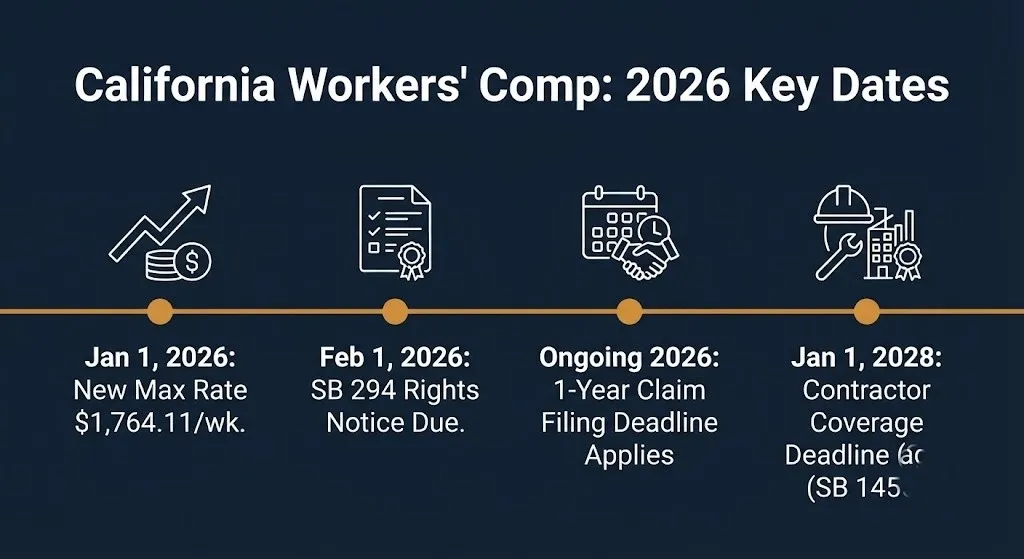
February 1, 2026 (confirmed): Employers must provide the new SB 294 workplace rights notice, covering workers’ comp benefits, to current employees.
Ongoing 2026 (confirmed): The $1,764.11 maximum TTD/PTD rate applies to all injuries dated January 1, 2026, or later.
January 1, 2028 (confirmed, future deadline): Remaining contractor classifications must meet SB 1455’s extended workers’ comp insurance requirement.
Expected, late 2026: The DWC is expected to announce 2027 TTD rate adjustments based on the next State Average Weekly Wage calculation, typically released in November.
Ongoing: SAWW-linked benefits, including life pension and permanent total disability payments, continue receiving annual cost-of-living style adjustments under Labor Code Section 4659(c).
Frequently Asked Questions
How much is the maximum workers’ comp check in California in 2026?
The maximum weekly temporary or permanent total disability payment is $1,764.11 for injuries occurring on or after January 1, 2026.
This figure is set by the DWC and tied to the State Average Weekly Wage.
Is California workers’ compensation mandatory for all employers?
Yes, nearly all California employers must carry workers’ compensation insurance, regardless of company size.
Limited exceptions apply to specific independent contractor and agricultural classifications.
How long do I have to file a workers’ comp claim in California?
You generally have one year from the date of injury to file a claim under Labor Code Section 5405.
You must also notify your employer within 30 days of the injury to start the process.
How much does permanent disability pay in California in 2026?
Permanent disability pays between $160 and $290 per week for most ratings, or up to $435 per week for ratings of 70 percent or higher, for 2026 injuries.
The exact amount depends on your wage, age, occupation, and impairment rating.
Does workers’ compensation cover undocumented workers in California?
Yes, California workers’ compensation coverage does not depend on immigration status.
An injured worker’s status does not disqualify them from receiving benefits.
What if my employer doesn’t have workers’ comp insurance?
You may still recover benefits through California’s Uninsured Employers Benefits Trust Fund.
Employers operating without required coverage also face separate civil and criminal penalties.
What is the difference between temporary and permanent disability in California?
Temporary disability pays while you’re recovering and unable to work, while permanent disability compensates for lasting impairment after your condition stabilizes.
Temporary disability generally lasts up to 104 weeks, while permanent disability payments depend on your final impairment rating.
If you’re filing a new claim, calendar your injury date and confirm the correct 2026 rate applies rather than an outdated figure. The maximum $1,764.11 weekly rate took effect January 1, 2026, and only applies to injuries dated on or after that day.