Workers Compensation Monopolistic States 2026: The Four States That Ban Private Insurance
Quick Answer
- Ohio, North Dakota, Washington, and Wyoming are the only monopolistic workers compensation states in 2026.
- Employers cannot buy workers comp from private insurers in these four states.
- Wyoming charges up to $1,000 and one year in prison for noncompliance.
If you run a business in Ohio, North Dakota, Washington, or Wyoming, you can’t shop around for workers compensation insurance. The state fund is your only option.
That’s what “monopolistic” means in this context. Private carriers like The Hartford, Sentry, and Chubb can’t write workers comp policies in these four states. The state government controls the entire market.
For employers, this creates a simpler but less flexible system. For injured workers, it changes how claims get filed and appealed. This article breaks down exactly how each state’s monopoly works, what it costs, and what happens when you’re not covered.
The Facts
| Case | Monopolistic Workers Compensation States (Ohio, North Dakota, Washington, Wyoming) |
| Status | Active in 2026; no pending legislation to open these markets to private carriers |
| Fund Size | State-administered funds; not a settlement pool |
| Est. Per Person | Not applicable |
| Claim Deadline | Varies by state; Wyoming requires objection within 15 days |
| Administrator | Ohio BWC, North Dakota WSI, Washington L&I, Wyoming DWS |
| Proof Needed | Employer registration and premium payment through state fund |
What are monopolistic states for workers compensation?
Monopolistic states for workers compensation are states where private insurance companies are legally barred from selling workers comp coverage. Employers must buy policies from a state-operated fund .
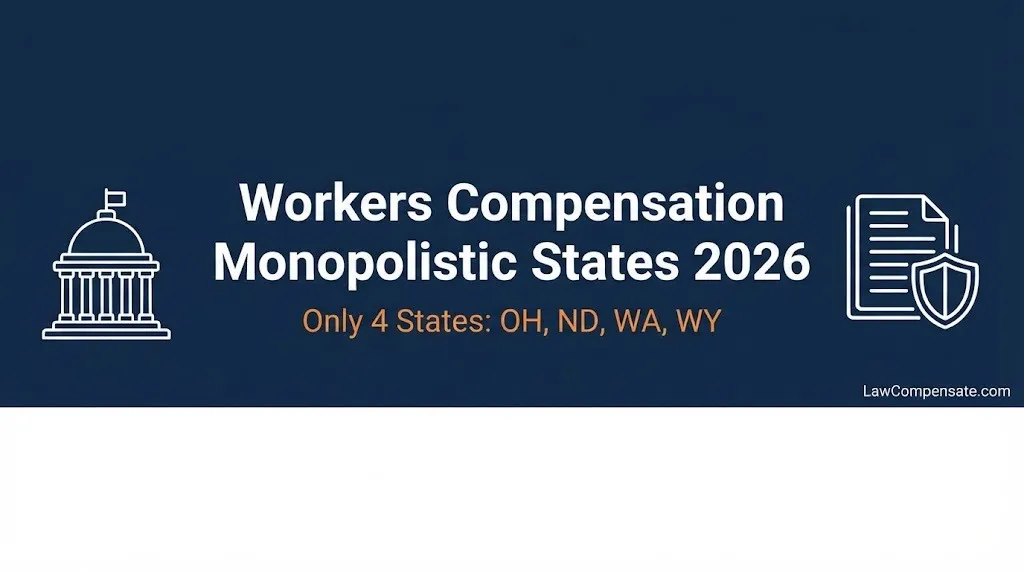
Only four states fit this definition in 2026: Ohio, North Dakota, Washington, and Wyoming .
Puerto Rico and the U.S. Virgin Islands also operate monopolistic funds, but they aren’t states .
The system works differently in each. Ohio requires almost all employers to buy from the Bureau of Workers’ Compensation. North Dakota mandates coverage through Workforce Safety & Insurance. Washington uses the Department of Labor & Industries. Wyoming runs its fund through the Department of Workforce Services.
If you’re an employer in one of these states, you can’t call a broker and compare quotes. There’s one price sheet, one set of rules, and one place to send your premium check.
Key Takeaway: Only four states ban private workers comp insurance: Ohio, North Dakota, Washington, and Wyoming. Everywhere else, you can choose between private carriers and state funds.
Which states require workers comp through a state fund only?
Ohio, North Dakota, Washington, and Wyoming require workers comp coverage exclusively through their state funds. Here’s how each one operates:
| State | State Fund Agency | Self-Insurance Allowed? |
|---|---|---|
| Ohio | Bureau of Workers’ Compensation (BWC) | Yes, with qualifications |
| North Dakota | Workforce Safety & Insurance (WSI) | Yes, limited |
| Washington | Department of Labor & Industries (L&I) | Yes, with certification |
| Wyoming | Department of Workforce Services | Yes, with approval |
Ohio allows self-insurance for employers who meet financial stability requirements and have been in the state fund for at least two years . Washington certifies large employers for self-insurance . North Dakota and Wyoming have more limited self-insurance options.
The practical effect is the same in all four states: if you’re not approved to self-insure, the state fund is your only source of coverage.
What are the penalties for not having workers comp in monopolistic states?
Penalties for not having workers comp in monopolistic states range from $100 per day in North Dakota to criminal misdemeanor charges in Wyoming with up to one year in prison .
North Dakota imposes a $10,000 one-time penalty plus $100 per day for continued noncompliance. Falsifying payroll information can trigger a penalty of up to 10 times the premium owed .
Wyoming treats noncompliance as a misdemeanor with a fine up to $1,000 and up to one year in prison .
Ohio charges a $30 fee for late premium payments plus up to 15% of the premium depending on how late it is. Late payroll reports trigger a penalty of 1% of premium due, minimum $3, maximum $15 .
Washington allows penalties up to $1,000 for failure to pay a claim, $500 for recordkeeping violations, and $1,000 for failure to comply with statutory provisions .
The daily accrual in North Dakota makes it the most aggressive penalty structure. A month of noncompliance adds $3,000 on top of the $10,000 base fine.
How do you appeal a workers comp decision in a monopolistic state?
You appeal a workers comp decision in a monopolistic state by filing a written request within the state’s deadline, which ranges from 14 days in Ohio to 60 days in Washington .
Each state has its own process:
Ohio: You have 14 calendar days from receiving the BWC order to file an appeal with the Industrial Commission. You can file online through the I.C.O.N. system, by fax, or by mail .
North Dakota: You can request assistance from the Decision Review Office within 45 days of the order. DRO reviews the claim and issues a Certificate of Completion. If you still disagree, you have 30 days from that certificate to request a hearing .
Washington: You must file your appeal within 60 days of receiving the decision. You can file online through the Claim and Account Center, by mail to L&I, or with the Board of Industrial Insurance Appeals .
Wyoming: You must object to a final determination within 15 days of the mailing date. A timely written request for hearing is required before any review .
How does Wyoming’s workers comp appeal process work?
Wyoming’s workers comp appeal process requires you to file a written objection within 15 days of the Division’s final determination. Miss that deadline, and the decision becomes final .
The Division issues a final determination within 15 days of receiving a completed injury report or claim. If more information is needed, the Division has 45 days from the request to make its determination .
Once you file a timely objection, the matter goes to a hearing. The Division can also issue a redetermination within one year if new information establishes compensability, but not if the information comes more than a year after the denial .
The 15-day window is tight. Compared to Ohio’s 14-day window, Wyoming gives you one extra day. Compared to Washington’s 60 days, it’s four times shorter.
How does North Dakota’s WSI Decision Review Office work?
North Dakota’s WSI Decision Review Office provides a free, independent review of claim decisions before you request a formal hearing. The DRO must receive your written request within 45 days of the order date .
A decision review specialist reviews your claim file, may gather more information, and contacts the WSI Claims Department. Most reviews are completed within 30 days. The DRO can revise the decision, offer an alternative resolution, or maintain the original order .
If you still disagree, you can request an administrative hearing. You can also bypass the DRO and go straight to a hearing .
One notable benefit: if you meet with an attorney, WSI will pay up to $500 for a legal consultation. If you win at any stage, WSI pays attorney fees up to statutory limits .
How does Washington’s L&I appeal process work?
Washington’s L&I appeal process gives you 60 days from receiving a decision to file a written appeal. That’s the longest deadline among the four monopolistic states .
You can file your appeal through the Claim and Account Center online, by mail to L&I, or directly with the Board of Industrial Insurance Appeals .
Once L&I receives your appeal, your claim manager reviews the file and either revises the decision, affirms it, or requests more information. If L&I affirms the decision, you can appeal to the BIIA .
The review can take 30 to 60 days or longer depending on whether more information is needed. If you don’t hear back within 30 days, you should contact your claim manager .
What is stop gap coverage in monopolistic states?
Stop gap coverage is additional employer’s liability insurance that fills a gap in monopolistic state workers comp policies. State fund policies in these states typically don’t include employer’s liability coverage, which protects against lawsuits related to workplace injuries .
In competitive states, a standard workers comp policy bundles two coverages: workers comp benefits and employer’s liability. In monopolistic states, the state fund provides only the benefits portion. The employer’s liability piece is missing.
To fill that gap, employers buy stop gap coverage as an endorsement to their general liability policy .
Without stop gap coverage, an employer in a monopolistic state could face a lawsuit from an injured worker with no insurance protection. The state fund pays benefits but doesn’t defend the employer in court.
Reality Check: The state fund monopoly doesn’t mean employers are fully protected. Without stop gap coverage, a lawsuit from an injured worker can hit your business directly.
What are the differences between monopolistic and competitive state funds?
Monopolistic state funds are the only option for workers comp coverage in their states. Competitive state funds operate alongside private insurers, giving employers a choice .
In a competitive state, you can buy coverage from a private carrier like The Hartford or Sentry, or from the state fund if one exists. You can compare prices, coverage options, and service quality.
In a monopolistic state, there’s no comparison shopping. The state sets the rates, handles the claims, and controls the entire process.
The trade-off is consistency versus flexibility. Monopolistic systems offer uniform pricing and standardized coverage. Competitive systems offer choice and the ability to negotiate.
For small employers, monopolistic systems can be simpler. For large employers with complex risk profiles, competitive markets usually work better.
How do I file a workers comp claim in a monopolistic state?
You file a workers comp claim in a monopolistic state by submitting the claim directly to the state fund, not to a private insurance carrier. The process varies by state.
Here’s a numbered checklist for Ohio, which is representative of the process :
- Register with the state fund before your first payroll.
- Report the injury to the state fund as soon as possible.
- Submit the claim online through the state portal if available.
- Get a claim number and acknowledgment letter.
- Use approved medical providers from the state network.
- Track the claim status through the state’s online system.
- Appeal within the deadline if the claim is denied.
In Ohio, claims can take up to 30 days to process. If denied, you have 14 days to appeal .
North Dakota requires employers to report injuries within 24 hours of the incident . That’s the tightest reporting deadline among the four states.
What Happens Next
- Ongoing 2026: No pending legislation in any of the four monopolistic states to open workers comp markets to private carriers.
- January 2026: Ohio’s premium rates and payroll reporting requirements remain in effect for the policy year.
- Expected 2027: Annual premium rate adjustments in each state fund based on loss experience and payroll trends.
- Expected 2028: Wyoming and North Dakota may review self-insurance qualification standards, though no formal proposals are pending.
Frequently Asked Questions
What are the monopolistic states for workers compensation?
Ohio, North Dakota, Washington, and Wyoming are the four monopolistic workers compensation states. Private insurers cannot sell workers comp policies in these states.
Can I buy workers comp from a private insurer in Ohio?
No. Ohio employers must buy coverage from the Ohio Bureau of Workers’ Compensation. Private carriers cannot issue workers comp policies in the state.
What happens if I don’t have workers comp in a monopolistic state?
Penalties range from $100 per day in North Dakota to misdemeanor charges with jail time in Wyoming. Ohio and Washington impose fines and premium assessments.
How long do I have to appeal a workers comp denial in Ohio?
You have 14 calendar days from receiving the BWC order to file an appeal with the Ohio Industrial Commission.
Does Washington state allow private workers comp insurance?
No. Washington employers must buy coverage from the Department of Labor & Industries, though certain large employers can self-insure with state certification.
What is stop gap coverage?
Stop gap coverage is employer’s liability insurance that fills the gap in monopolistic state workers comp policies. State fund policies typically don’t include this coverage.
How long does North Dakota have to report a workplace injury?
Employers in North Dakota must report workplace injuries within 24 hours of the incident. That’s the shortest deadline among monopolistic states.
Can employers self-insure in monopolistic states?
Yes, but with qualifications. Ohio, Washington, and North Dakota allow self-insurance for employers who meet financial stability and other requirements.