Lawyer Car Accident Settlement 2026: How Payouts Work and What to Expect
Quick Answer
- Is it legit? Yes. Lawyers negotiate settlements with insurance companies to resolve injury claims without trial.
- How much? Minor crashes average $10,000-$25,000. Moderate injuries reach $30,000-$100,000.
- Key deadline? California gives you two years from the crash date to file a personal injury lawsuit.
A lawyer car accident settlement is the money you receive when an attorney negotiates a resolution with the at-fault driver’s insurance company on your behalf. That’s the direct answer. Instead of accepting the insurer’s first offer, your lawyer builds evidence, calculates full damages, and pushes for the maximum the policy will pay.
The numbers vary wildly because every crash is different. A fender-bender with whiplash might settle for $15,000. A crash causing a herniated disc that requires surgery can settle for six figures. The injury is the single biggest driver of value.
This guide breaks down how lawyer-negotiated settlements work in 2026, what different injuries are worth, how long the process takes, and what you can do to protect your claim.
The Facts
| Case Type | Personal injury claim from car accident |
|---|---|
| Typical Settlement Range | $10,000 to $25,000 for minor injuries; $100,000+ for serious |
| California Filing Deadline | 2 years from accident date |
| Minimum Insurance (CA) | $30,000 per person / $60,000 per accident |
| Fee Structure | Contingency, typically 33% to 40% of recovery |
| Average Timeline | Several months to 2 years if lawsuit filed |
| Key Evidence | Medical records, police report, photos, wage loss documentation |
How Much Is My Car Accident Settlement Worth in 2026?
Your car accident settlement is worth the total of your economic damages plus a multiplier for pain and suffering, reduced by your percentage of fault. There is no single average, but injury severity gives you a realistic range.

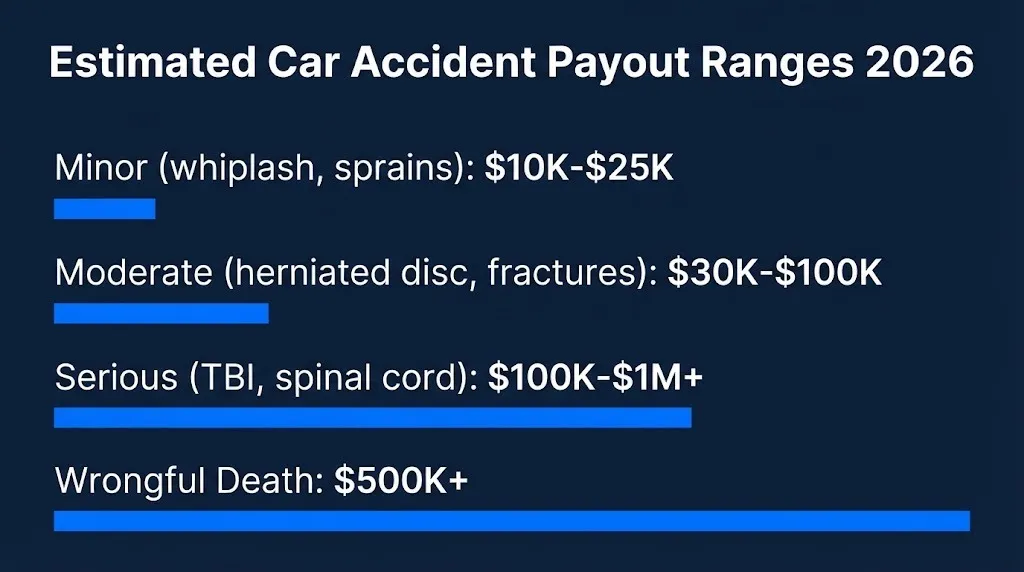
Settlement values break down into recognizable tiers. Minor soft tissue injuries like whiplash and sprains typically settle between $10,000 and $25,000. Moderate injuries including herniated discs, fractures, and concussions that require surgery or extended treatment often reach $30,000 to $100,000. Serious injuries like traumatic brain injury, spinal cord damage, or multiple fractures can exceed $100,000 and climb into the millions.
Estimated Settlement Ranges by Injury Type
| Injury Severity | Typical Settlement Range | Key Factors |
|---|---|---|
| Minor (whiplash, sprains) | $10,000 – $25,000 | Treatment duration, MRI findings |
| Moderate (herniated disc, fractures) | $30,000 – $100,000 | Surgery, lost wages, recovery time |
| Serious (TBI, spinal cord) | $100,000 – $1,000,000+ | Permanent impairment, lifetime care |
| Wrongful death | $500,000 – millions | Dependents, income, circumstances |
A recent Missouri case shows how policy limits cap recovery. A woman injured in a gas station parking lot crash settled for the defendant’s $100,000 policy limits after initially facing a liability dispute. The insurer tendered limits within 30 days of the demand once property damage evidence proved fault.
Key Takeaway: Injury severity drives settlement value more than any other factor, but the at-fault driver’s insurance policy limits set the ceiling for what you can recover from them directly.
What Damages Can You Recover in a Car Accident Settlement?
You can recover economic damages, non-economic damages, and in rare cases punitive damages in a car accident settlement. Each category serves a different purpose and requires different proof.
Economic damages are your measurable financial losses. Medical expenses (past and future) form the largest category in serious injury cases. Lost wages and reduced earning capacity replace income you lost. Property damage covers your vehicle repair or replacement.
Non-economic damages compensate for what money can’t fully replace. Pain and suffering, emotional distress, loss of enjoyment of life, and loss of consortium are recoverable in California. California uses two methods to calculate these: the multiplier method (economic damages times 1.5 to 5) and the per diem method (daily value times days affected).
Punitive damages apply only when the at-fault driver’s conduct was especially reckless. Drunk driving, street racing, or deliberately running a red light at high speed can trigger punitive damages in California.
Documentation matters enormously. Medical records must clearly link your injuries to the crash. Gaps in treatment invite arguments that you weren’t really hurt or that something else caused the pain.
How Does a Lawyer Increase Your Car Accident Settlement?
A lawyer increases your car accident settlement by building evidence the insurance company can’t ignore and negotiating from a position of strength. The difference between a DIY claim and attorney representation is often tens of thousands of dollars.
Insurance adjusters are trained to minimize payouts. They assign fault aggressively, often without strong evidence, because even a 10% fault assignment saves them money. They also interpret gaps in medical records as proof your injuries weren’t serious.
An experienced lawyer pushes back on those tactics. They gather evidence from accident reconstruction experts, medical experts, and wage loss documentation. They know which arguments work and which don’t. And they signal to the insurer that they’re willing to take the case to trial if the offer is unfair.
Lawyers also identify additional liable parties. If the at-fault driver was working at the time, their employer may share liability. If a vehicle defect contributed to the crash, the manufacturer might be responsible. If road conditions were dangerous, a government agency could be liable. Each additional party brings additional insurance coverage into play.
Reality Check: No one from an insurance company will call and offer you a fair settlement first. Their initial offer is a starting point designed to close your claim cheaply. Accepting it waives your right to pursue more.
What Is Comparative Negligence and How Does It Affect Your Settlement?
Comparative negligence is a legal rule that reduces your settlement by your percentage of fault for the accident. California follows pure comparative negligence, meaning you can recover even if you were 99% at fault, but your recovery is cut proportionally.
If you were found 20% at fault and your damages total $200,000, you recover $160,000. Insurance adjusters aggressively assign fault to claimants because every percentage point they shift saves them money. An attorney’s job is to challenge those assignments and minimize the percentage attributed to you.
In contested liability cases, this negotiation alone can be worth tens of thousands of dollars. Property damage evidence often proves fault when witness statements are unclear. A recent Missouri case resolved a liability dispute by using the location of initial impact to show the other vehicle caused the crash.
Some states follow modified comparative negligence, which bars recovery if you were 51% or more at fault. California’s pure rule is more favorable to injured people.
How Long Does It Take to Get a Car Accident Settlement?
A car accident settlement typically takes several months to two years from the date of the crash. Cases that settle pre-suit move faster. Cases that require filing a lawsuit take longer.
The timeline depends on several factors. Treatment duration matters because you shouldn’t settle until you’ve reached maximum medical improvement. The insurance company’s willingness to negotiate affects speed. Court dockets and scheduling add time if litigation becomes necessary.
Pre-suit settlement usually happens within 3 to 9 months of the crash. This involves gathering medical records, sending a demand letter, and negotiating with the adjuster. If the insurer refuses a fair offer, your lawyer files suit.
Post-filing settlement typically takes 12 to 24 months. Discovery, depositions, and motion practice add months. Mediation often resolves cases before trial. If mediation fails, trial adds more time.
A delayed tax refund is a rough comparison. You file, you wait, and complications extend the timeline. Accident settlements work similarly, except the “refund” is your compensation and the “audit” is the insurer’s defense team.
What Happens Next: The Settlement Process Timeline
Immediate (Days 1-30): Medical treatment begins; evidence preserved; insurance notified.
Months 1-3: Treatment continues; medical records gathered; wage loss documented.
Months 3-6: Demand letter sent; negotiations begin; pre-suit settlement attempt.
Months 6-12: Lawsuit filed if no fair offer; discovery begins; depositions taken.
Months 12-24: Mediation; expert reports; trial or settlement.
Frequently Asked Questions
How much is a car accident settlement with a lawyer?
It depends on your injuries and the available insurance. Minor cases settle for $10,000-$25,000, moderate for $30,000-$100,000, serious for $100,000+.
How long do I have to file a car accident lawsuit?
In California, two years from the accident date for personal injury claims. Other states have different deadlines.
What percentage do car accident lawyers take?
Most work on contingency, typically taking 33% to 40% of the settlement. The percentage often increases if the case goes to trial.
Can I get a settlement if I was partially at fault?
In California, yes. Under pure comparative negligence, your recovery is reduced by your percentage of fault, but you can still recover.
What if the at-fault driver has minimum insurance?
California requires $30,000 per person and $60,000 per accident. If that’s not enough, your underinsured motorist coverage can bridge the gap.
How long does it take to get a settlement check?
After settlement agreement, payment typically arrives within 2 to 6 weeks. It can take longer if liens need to be resolved.
Do I need a lawyer for a minor car accident?
Not always, but minor claims often settle for more with representation. Insurance companies know which claimants have lawyers and adjust offers accordingly.
What evidence do I need to maximize my settlement?
Medical records linking injuries to the crash, police reports, photos of damage and injuries, wage loss documentation, and a journal of how injuries affect daily life.