Mass Tort Lawsuits in 2026: How They Work, Who Qualifies, and What Payouts Look Like
Quick Answer
- What is a mass tort? A mass tort combines many individual lawsuits against the same defendant for similar injuries, but each claim stays separate.
- How much can you get? Payouts vary widely by case and injury. No standard amount exists. Amounts depend on diagnosis, exposure, and proof.
- Key deadline: Each mass tort has its own filing deadline. Missing it can bar your claim permanently. Check the specific case docket.
What Are Mass Tort Lawsuits?
Mass tort lawsuits are individual legal claims grouped together because many people suffered similar injuries from the same product, drug, device, or event. Unlike a class action, each plaintiff keeps their own case and must prove their own damages. The court consolidates pretrial work to save time and money, but your claim remains yours alone.
This distinction matters for your payout. In a class action, everyone typically gets the same share from a single fund. In a mass tort, your recovery depends on your specific injury, medical costs, lost wages, and evidence. A person with advanced cancer after years of exposure may receive far more than someone with an early diagnosis.
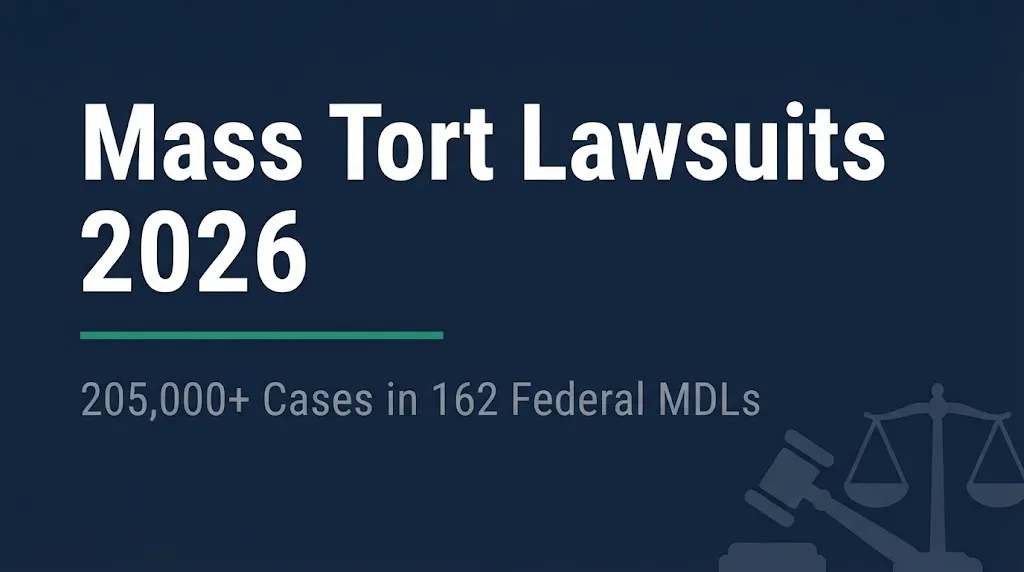
The system handles enormous volume. As of August 2026, 162 active federal multidistrict litigations held more than 205,000 pending cases, with 21 MDLs containing at least 1,000 cases each. The talc powder MDL alone had over 67,000 active cases as of May 2026, making it the largest mass tort docket in the country.
This article explains how mass torts work, how settlements get divided, how to join an active case, and what realistic timelines look like in 2026.
The Facts
| Case Detail | Information |
|---|---|
| What It Is | Many individual lawsuits against the same defendant for similar injuries, coordinated for pretrial efficiency |
| Key Difference | Each plaintiff keeps a separate case and must prove their own damages, unlike a class action |
| Federal MDLs | 162 active MDLs with 205,000+ pending cases as of August 2026 |
| Largest Active MDL | Talc powder (MDL 2738) with 67,000+ cases as of May 2026 |
| Average Timeline | 2 to 5 years from filing to settlement, longer for complex cases |
| Payout Structure | Settlement matrix with tiers based on injury severity, exposure, and proof |
| Current Status | Active litigation across pharmaceuticals, medical devices, toxic exposure, and consumer products |
How Much Can You Get From a Mass Tort Lawsuit?
There is no standard mass tort payout amount. What you receive depends entirely on the specific case, your injury, and how settlements are structured. Anyone quoting a flat number for a mass tort is guessing.
Drug and device mass torts typically use a settlement matrix. Base amounts are set by injury tier, then adjusted up or down based on several factors:
| Factor | How It Affects Your Payout |
|---|---|
| Diagnosis and stage | More severe or advanced disease moves you to a higher tier |
| Treatment burden | Chemotherapy, surgery, or ongoing care increase value |
| Exposure duration | Longer use of the product before diagnosis raises the award |
| Economic loss | Medical bills and lost wages are factored in |
| Proof quality | Strong medical records and pathology reports help your claim |
| Timing | Claims filed inside the deadline carry full weight |
For example, in the Dupixent litigation (MDL 3180), no settlement program exists and no bellwether verdict has been returned as of September 2026. Any website quoting an “average Dupixent settlement” is describing other cases or inventing numbers. The same logic applies across mass torts: without a settlement fund or verdict, no per-person amount is real.
Key Takeaway: Mass tort payouts are individualized, not uniform. Your recovery depends on your specific injury, proof, and the case’s settlement structure, not a flat rate.
How Does a Mass Tort Settlement Work?
A mass tort settlement is a negotiated resolution between defendants and plaintiff groups that creates a framework for paying individual claims. It is rarely one lump sum split evenly. Instead, the settlement establishes a claims process with eligibility rules, documentation requirements, and a grid that assigns values based on injury severity.
Here is how the process typically unfolds:
- Global deal reached: Defendants agree to a total fund to resolve all or most claims.
- Claims period opens: Plaintiffs submit documentation proving injury and exposure.
- Individual valuation: Each claim is scored against the settlement grid.
- Liens resolved: Medicare, Medicaid, and private insurers get repaid from gross awards.
- Fees deducted: Attorney contingency fees and case expenses come out next.
- Net payment: What remains goes to you.
The distribution is not automatic. Even after a settlement is announced, expect six to twelve months or more before money reaches you. Claims are processed individually, liens must be cleared, and payments often release in waves.
Some modern settlements now pay in stages rather than lump sums. The Boy Scouts of America bankruptcy, for instance, distributed an initial 1.5% of proposed claim amounts to abuse survivors between 2024 and 2026, with additional distributions as funds became available. This approach gets some money to claimants faster while the full asset picture remains uncertain.
Who Qualifies to File a Mass Tort Claim?
You may qualify for a mass tort if you suffered a specific injury after using a particular product, taking a specific drug, or being exposed to a toxic substance. The exact criteria depend on the individual litigation. Generic “I got hurt” claims do not qualify.
Each mass tort defines its own eligibility rules. In the hair relaxer litigation (MDL 3060), for example, claims can generally proceed if you used chemical relaxers or straighteners regularly over multiple years and later developed uterine, ovarian, or endometrial cancer. You do not need to identify a specific brand if you used multiple products.
For the spinal cord stimulator cases (MDL 3181), qualifying problems include lead migration or fracture, unexpected shocks, loss of relief after a successful trial, battery heat or pain, infection, and revision or removal surgery. The device must be from Boston Scientific, Abbott, Medtronic, or Nevro.
What does NOT qualify: General dissatisfaction, injuries without medical documentation, or claims outside the litigation’s defined scope. If your injury differs from the consolidated claims, you may still be able to file an individual lawsuit outside the MDL.
Reality Check: No one texts you mass tort settlement money first. Legitimate claims require documentation, medical records, and proof of product use. If anyone contacts you promising a payout without paperwork, it is a scam targeting real litigation.
How Do You Join an Ongoing Mass Tort Case?
Joining a mass tort is not like signing up for a class action settlement. There is no online form to add your name. You must file your own lawsuit, and a lawyer must represent you in the MDL proceedings.
Here are the steps to join:
- Confirm you have a qualifying injury and product use. Match your situation to the specific MDL’s criteria.
- Gather available records. Implant cards, operative reports, prescriptions, and diagnosis paperwork.
- Request a free case review. Most mass tort firms offer this at no cost and no obligation.
- Sign a medical authorization. This lets your lawyer request records and device tracking data.
- Review the engagement agreement. It sets the contingency fee and expense handling. Read it before signing.
- Your lawyer files a complaint in your name. The case then transfers into the MDL.
- Complete a Plaintiff Fact Sheet. This documents your product use, injury, and damages.
Records requests typically take two to eight weeks. Case acceptance depends on whether your facts fit the filed claims. If they do not fit, you should be told plainly why not.
How Long Does a Mass Tort Lawsuit Take to Settle?
A mass tort lawsuit typically takes two to five years from filing to settlement, though complex cases can stretch past a decade. The timeline depends on how many plaintiffs are involved, whether the science is disputed, and whether the defendant fights every step.
Real examples show the range:
- Vioxx (Merck): About 2 to 3 years from consolidation to a $4.85 billion settlement.
- 3M Combat Arms earplugs: About 4 years to reach a roughly $6 billion deal.
- Johnson & Johnson talc: Consolidated in 2016, still contested in 2026, a decade and counting.
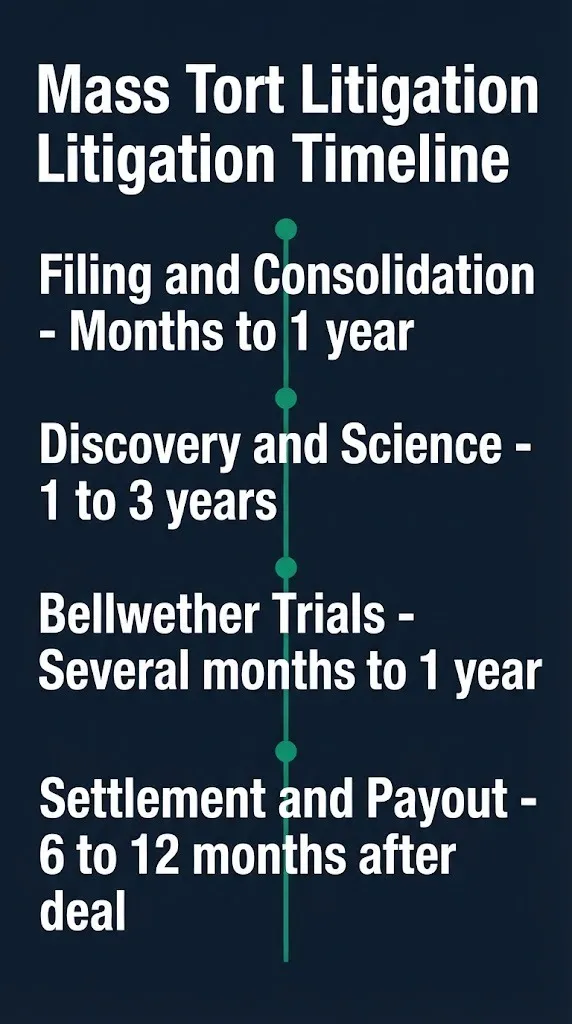
Most mass torts follow a structured sequence. Filing and consolidation takes several months to a year. Discovery and scientific disputes run one to three years or more. Bellwether trials add several months to a year. Settlement and claim processing add another six to twelve months after a deal is announced.
Mass Tort vs Class Action: What Is the Difference?
A mass tort keeps each plaintiff’s case separate, while a class action combines everyone into one representative lawsuit. This is the single most important distinction, and it determines how you get paid and how much control you have.
| Feature | Mass Tort | Class Action |
|---|---|---|
| Plaintiffs | Many individual lawsuits | Few class representatives |
| Class certification | Not required | Required |
| Court approval of settlement | Not required | Required |
| Attorney fees | Per individual agreement | Awarded by court |
| Damages | Individualized | Typically uniform or formula-based |
| Examples | Toxic torts, pharmaceutical injuries | Consumer products, false advertising |
Mass torts work better for personal injury cases because each person’s damages differ. Class actions work better when harm is similar and individual damages are small, like a hidden fee on a bank statement or a data breach. Some products generate both: a defective drug might create mass tort claims for injured patients and a separate class action for consumers seeking refunds.
What Happens Next in Mass Tort Litigation
2026-2027: Bellwether trials in hair relaxer litigation (MDL 3060) potentially begin, setting settlement ranges.
2026-2027: Daubert rulings on expert testimony in PFAS litigation (MDL 2873) will shape the personal injury track.
Ongoing: Talc powder MDL (MDL 2738) settlement negotiations continue with court-appointed mediator.
Expected 2027+: Spinal cord stimulator MDL (MDL 3181) moves toward bellwether selection.
Continuous: New mass torts form as product liability patterns emerge.
Frequently Asked Questions
What is a mass tort lawsuit in simple terms?
A mass tort is many individual lawsuits against the same company for similar injuries, grouped together for efficiency but kept separate for payment purposes.
Do I need a lawyer to join a mass tort?
Yes. Mass torts require filing your own lawsuit, and a lawyer must represent you in the multidistrict litigation process.
How much does it cost to join a mass tort?
Most mass tort lawyers work on contingency, meaning no upfront costs and no fee unless you recover. Case expenses are advanced by counsel.
Can I join a mass tort if I already settled my claim?
No. Once you settle an individual claim, you give up the right to pursue the defendant further for that injury.
How are mass tort settlement amounts calculated?
Settlements use a grid or matrix with injury tiers. Diagnosis severity, treatment burden, exposure duration, and proof quality adjust each award up or down.
What happens if I miss the mass tort filing deadline?
You lose the right to file that claim. Statutes of limitations vary by state and case, but missing the deadline is usually permanent.
Are mass tort payouts taxable?
Personal injury settlements for physical injuries are generally not taxable, but punitive damages and emotional distress awards may be. Consult a tax professional.
How do I check if a mass tort settlement is real?
Verify through the official court docket, the Judicial Panel on Multidistrict Litigation website, or a court-appointed settlement administrator. Never rely on unsolicited calls or texts.