Slip and Fall Cases Settlement Amounts in 2026: Real Payout Ranges, Verdict Data, and What Drives Case Value
Quick Answer
- Most slip and fall settlements fall between $15,000 and $50,000, with a median around $26,000 for minor to moderate injuries.
- Serious injury cases settle much higher. A Kansas worker received $1.7 million in 2026, and a Florida jury awarded $3.97 million against Publix.
- Your settlement depends on your medical bills, lost wages, injury severity, and how clearly you can prove the property owner knew about the hazard.
Slip and fall cases don’t have an “average” that means anything. A bruised tailbone and a fractured hip are not the same claim, and no single number describes both.
What actually determines your payout is straightforward: your total damages, the strength of your liability evidence, and whether comparative fault reduces your recovery. The published numbers from 2026 settlements and verdicts show the full spectrum.
This guide breaks down real settlement amounts by injury type, recent verdicts, and the specific evidence that pushes a case from five figures to seven.
The Facts
| Item | Detail |
|---|---|
| Typical Settlement Range | $15,000 to $50,000 |
| Median Settlement | Approximately $26,000 |
| Minor Injury Range | $5,000 to $15,000 |
| Serious Injury Range | $100,000 to $1,000,000+ |
| Largest 2026 Verdict | $3,967,000 (Publix, Florida) |
| Largest 2026 Settlement | $1,700,000 (Kansas) |
| Commercial vs. Private Property | Commercial averages higher due to insurance limits |
| Trial Rate | About 95% of cases settle |
What Is the Average Settlement for a Slip and Fall?
The average slip and fall settlement ranges from $15,000 to $50,000, with a median around $26,000 for cases involving minor to moderate injuries . But that range collapses when you look at serious injuries.
Commercial premises cases average approximately $345,000 nationally, according to one research compilation. Private property cases average approximately $105,000. The gap exists because commercial property owners carry larger liability policies and leave more documented evidence of inspection failures .
The honest answer is that “average” is misleading. No government agency tracks national slip and fall settlement averages. Most settlements stay private and confidential. Law firm pages that quote averages are working from their own cases or picking numbers that draw calls .
What matters more is your specific damages calculation. Here’s how the math works.
How Are Slip and Fall Settlement Amounts Calculated?
Slip and fall settlements are calculated using the multiplier method: add your economic damages, then multiply by a factor based on injury severity .
Your economic damages include medical bills, lost wages, out-of-pocket costs, and estimated future care. The multiplier ranges from 1.5x to 5x depending on how serious your injury is and how long recovery takes.
Here’s a real example. A broken ankle at a grocery store with $18,000 in ER and surgery costs, $6,400 in physical therapy, $800 in prescriptions, and $7,200 in lost wages totals $32,400 in economic damages. With a 3.0x multiplier, the estimated settlement is $97,200 .
A hip fracture at an apartment complex with $45,000 in hip replacement surgery, $15,000 in rehab, $12,000 in physical therapy, $8,000 in home health care, and $16,000 in lost wages totals $96,000. With a 4.0x multiplier, the estimated value is $384,000 .
The multiplier isn’t arbitrary. It reflects pain and suffering, emotional distress, and the permanent impact on your life. Surgery cases settle at roughly 3.2x higher than non-surgical cases because surgical records provide objective proof of severity that insurers can’t easily contest .
What Are Slip and Fall Settlement Ranges by Injury Type?
Settlement ranges vary dramatically by injury. Minor soft tissue injuries settle low. Spinal cord injuries and traumatic brain injuries settle in the millions.
Here’s the breakdown based on published 2026 data:
| Injury Type | Typical Settlement Range |
|---|---|
| Bruises, minor sprains | $5,000 to $15,000 |
| Torn ligaments (ACL, MCL) | $20,000 to $60,000 |
| Broken wrist or ankle | $25,000 to $75,000 |
| Broken arm or leg | $30,000 to $90,000 |
| Back/spinal disc injury | $50,000 to $150,000 |
| Hip fracture | $75,000 to $250,000 |
| Traumatic brain injury | $150,000 to $1,000,000+ |
| Spinal cord injury/paralysis | $300,000 to $2,000,000+ |
Sources:
Hip fractures are disproportionately expensive because they affect older adults severely. A 70-year-old who breaks a hip in a grocery store faces surgery, months of rehab, and a permanently changed quality of life. Those cases settle high for good reason .
Lumbar or cervical disc herniation with surgery can reach $200,000 to $750,000. Traumatic brain injury with neuroimaging documentation can reach $2,000,000 or more .
Key Takeaway: The single biggest driver of settlement value is injury severity, specifically whether you had surgery and whether objective imaging documents your injury.
What Are the Biggest Slip and Fall Verdicts in 2026?
The largest slip and fall verdict in 2026 was $3,967,000 against Publix Super Markets in Osceola County, Florida. Victoria Marcano, a 30-year-old mother of three, slipped on liquid in a beverage aisle and underwent three spinal surgeries .
Publix denied liability throughout litigation and argued Marcano wasn’t injured. Their last settlement offer before trial was $600,000. The jury found Publix 100% responsible and awarded nearly $4 million .
A Kansas worker received a $1.7 million settlement in May 2026 after slipping on wet paint and suffering serious back injuries requiring surgery .
In Georgia, the Court of Appeals upheld a $1.8 million jury award against QuikTrip Corporation in a slip and fall case. The trial court had refused to cap damages at $75,000 .
A Nevada casino was hit with a $3.4 million verdict after a man slipped on a liquid puddle on the marble floor. The plaintiff’s past and future medical expenses were estimated to exceed $2 million .
These verdicts show that juries are increasingly willing to award large sums in premises liability cases. A Marsh McLennan report notes that “nuclear verdicts” above $10 million are becoming more common, driven partly by juror distrust of corporations .
What Evidence Proves a Slip and Fall Case?
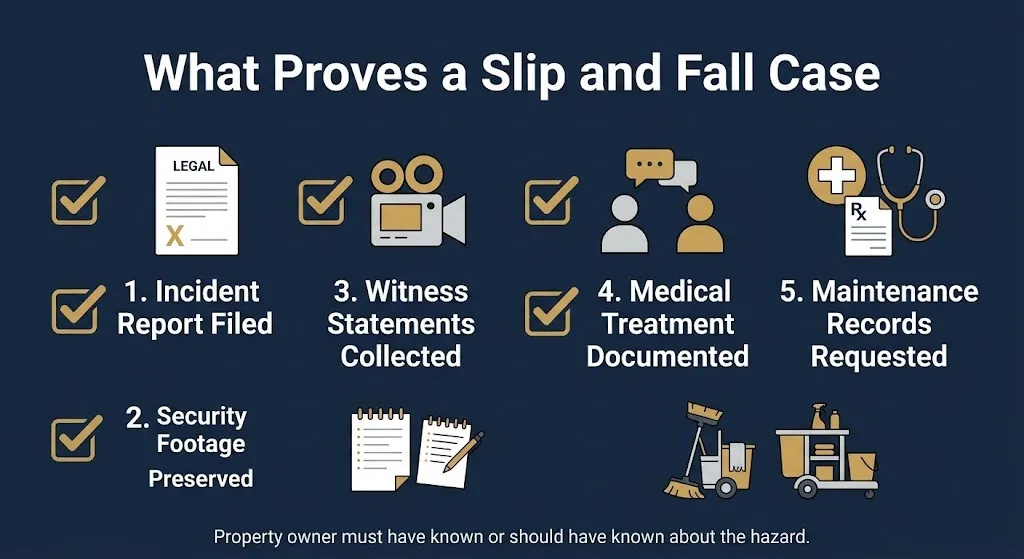
The strongest evidence in a slip and fall case is proof that the property owner knew or should have known about the hazard and failed to fix it or warn you. This is called actual or constructive notice .
A puddle that sat for hours with no cleanup points to notice. A spill that appeared seconds before you slipped usually does not. Security camera footage, witness statements, and maintenance records all help establish how long the hazard existed.
Here’s what to gather:
- Incident report: File one with the property owner immediately.
- Photographs: Take photos of the hazard, your injuries, and the scene.
- Witness information: Get names and contact details.
- Security footage: Request preservation of any video.
- Medical records: Seek treatment promptly and document everything.
- Maintenance logs: Your attorney can request these in discovery.
In the Publix case, evidence showed employees had previously cleaned liquid in the same aisle before Marcano’s fall. That established notice and supported the full liability finding .
How Does Comparative Fault Affect Your Slip and Fall Settlement?
Your own share of blame reduces your payout under comparative negligence rules. Most states use this system.
If your damages total $60,000 and you’re found 25% at fault, you collect $45,000. A few states bar recovery entirely once you pass a 50 or 51 percent threshold. Four states and the District of Columbia still follow strict contributory negligence, where any fault at all can end the claim .
Real cases show how this plays out. A McDonald’s customer slipped on water near a restroom. Her damages were assessed at $24,000, but she was found 40% responsible. Her final recovery dropped to $14,400 .
What counts as fault? Wearing inappropriate footwear, ignoring visible warning signs, running, or being distracted by your phone can all reduce your recovery. The property owner’s attorney will look for these factors.
Reality Check: No one is going to call you offering money for a slip and fall you haven’t reported. Property owners and insurers don’t proactively pay claims. You have to document the incident, seek medical treatment, and pursue compensation. And if someone contacts you claiming you’re owed a settlement from a fall you never filed a claim for, that’s a scam.
How Do You File a Slip and Fall Claim?
Filing a slip and fall claim starts with reporting the incident and seeking medical treatment. Most cases settle within six months to two years, but you need to act quickly to preserve evidence.
Here’s the process:
- Report the incident to the property owner or manager immediately.
- Seek medical treatment the same day if possible. Gaps in treatment hurt your case.
- Document everything: Photos, witness names, incident report number.
- Preserve evidence: Send a spoliation letter requesting security footage be saved.
- Consult a personal injury attorney. Most work on contingency, meaning no upfront cost.
- Send a demand letter after your treatment is complete or you reach maximum medical improvement.
- Negotiate or litigate. Most cases settle. If not, your attorney files suit.
The statute of limitations for slip and fall varies by state. Most give you two to three years from the date of injury. Some states give less for claims against government entities.
What Happens Next: Slip and Fall Claim Timeline
Immediately after the fall: Report the incident, seek medical treatment, and document the scene.
Within days to weeks: Preserve evidence. Send a spoliation letter to the property owner.
During treatment: Follow your doctor’s orders. Gaps in care reduce settlement value.
When treatment ends: Your attorney sends a demand letter with your medical records and damages calculation.
Negotiation phase: The insurer responds with an offer. Most cases settle here.
If no settlement: Your attorney files a lawsuit and the case moves toward trial.
Frequently Asked Questions
What is the average settlement for a slip and fall?
Most slip and fall settlements range from $15,000 to $50,000, with a median around $26,000. Serious injury cases settle much higher, often $100,000 to over $1 million.
How much can I get for a slip and fall with surgery?
Surgical cases settle at roughly 3.2x higher than non-surgical cases. A back surgery case might settle for $200,000 to $750,000 depending on your damages and liability evidence.
Do most slip and fall cases go to trial?
No. About 95% of slip and fall cases settle out of court. Trials are rare and usually happen when the insurer refuses to offer fair compensation.
What if I was partially at fault for my fall?
Your recovery is reduced by your percentage of fault under comparative negligence. If you’re 25% at fault and your damages are $60,000, you receive $45,000.
How long does a slip and fall settlement take?
Most cases settle within six months to two years. Simple cases with clear liability resolve faster. Complex cases with disputed fault or serious injuries take longer.
What evidence do I need for a slip and fall claim?
You need proof the property owner knew or should have known about the hazard. Security footage, maintenance records, witness statements, and incident reports all help establish notice.
Can I sue if I slipped on private property?
Yes. You can sue private property owners, but their insurance limits may be lower than commercial policies. Private property claims average $105,000 versus $345,000 for commercial premises.
What is the deadline to file a slip and fall lawsuit?
Most states give you two to three years from the date of injury. Claims against government entities often require notice within six months to one year. Don’t wait.
The Bottom Line
Slip and fall settlement amounts range from a few thousand dollars for minor injuries to millions for catastrophic harm. The number that matters is your number, built from your medical bills, lost wages, and the strength of your liability evidence.
The biggest mistake people make is waiting. Evidence disappears. Security footage gets overwritten. Witnesses forget. If you’ve been injured in a fall, document everything and talk to an attorney before the deadline runs out.