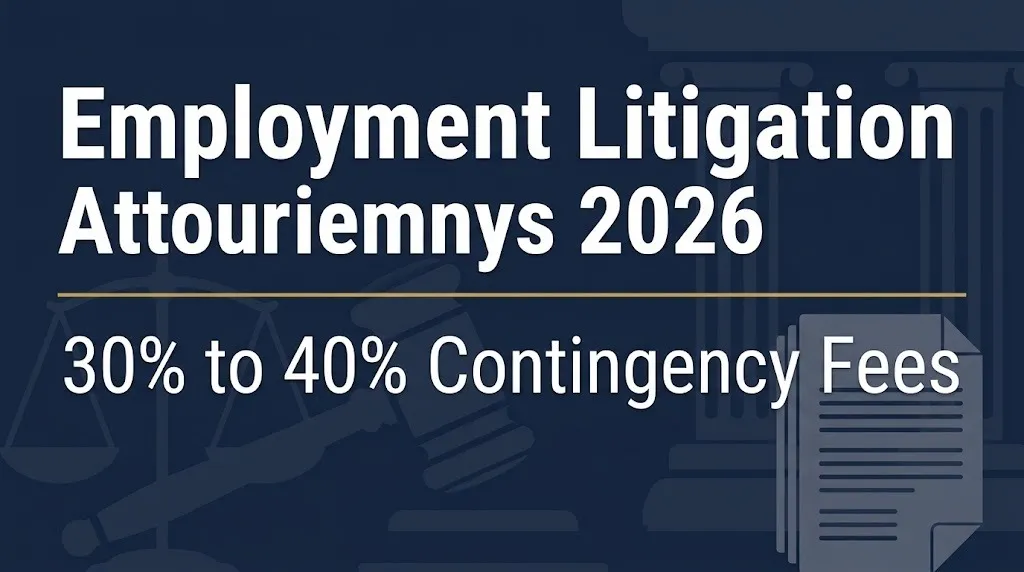
Employment Litigation Attorneys in 2026: Costs, Contingency Fees, and What You Actually Recover
Quick Answer
- Employment litigation attorneys are real lawyers who handle wrongful termination, discrimination, retaliation, and wage disputes, often on contingency.
- Most workers pay nothing upfront; the attorney takes 30% to 40% of whatever settlement or verdict you recover.
- The EEOC charge deadline is 180 days from the discriminatory act, or 300 days in states with their own anti-discrimination agencies.
What Do Employment Litigation Attorneys Actually Do?
Employment litigation attorneys represent workers and employers in disputes arising from the workplace. For employees, they handle wrongful termination, discrimination, harassment, retaliation, and unpaid wage claims. They file lawsuits, negotiate settlements, and take cases to trial when needed.
The job starts long before a lawsuit. Most employment attorneys begin with a demand letter or an EEOC charge. That charge is a required first step for federal discrimination claims.
Think of it like filing an insurance claim before you can sue the insurer. You must exhaust the administrative process first.
Retaliation is now the most frequently cited basis for an adverse employment action and the most common theory of liability, according to EEOC data cited in a 2026 insurance industry report . Disability discrimination is the most frequently cited type of discrimination, followed by race and sex .
Employment litigation is also one of the fastest-growing legal practice areas. Labor and employment disputes are a primary driver of legal hiring in 2026, with firms prioritizing attorneys who can handle AI-based employment litigation and pay transparency claims .
How Much Do Employment Litigation Attorneys Cost in 2026?
Most employment litigation attorneys representing workers charge contingency fees of 30% to 40% of the recovery, with nothing paid upfront and no fee if you lose. Hourly billing is uncommon on the employee side, but where it is used, rates run $200 to $600 per hour against a retainer .
| Fee Structure | Typical Cost | When It Applies |
|---|---|---|
| Contingency | 30% to 40% of recovery | Wrongful termination, discrimination, unpaid wages |
| Hourly | $200 to $600 per hour | Contract review, severance negotiation, advice |
| Flat fee | $500 to $2,000 | Severance agreement review |
| Retainer | $2,000 to $15,000 | Hourly matters, drawn down as work proceeds |
The contingency percentage often rises by stage. A typical agreement charges around 33% if the case settles before a lawsuit is filed, 40% after litigation starts, and up to 45% if the case goes through appeal . Case costs are separate from attorney fees. Filing fees, depositions, and expert witnesses can reach thousands of dollars and are typically deducted from your share .
Some employment attorneys charge $200 to $550 per hour for litigation matters, with simple cases costing $3,000 to $5,000 and complex cases exceeding $20,000 .
Key Takeaway: For most workers, employment litigation costs nothing upfront, but the attorney takes 30% to 40% of whatever you recover, and case costs come out of your share.
Do You Need an Employment Litigation Attorney to File an EEOC Charge?
You do not need an attorney to file an EEOC charge, but having one helps you avoid missing deadlines and building a record that supports your case. The charge is the required first step for federal discrimination claims under Title VII, the ADA, and the ADEA.
The deadline is strict. You must file within 180 days of the discriminatory act. In states with their own anti-discrimination agency, the deadline extends to 300 days . Federal employees must contact an EEO counselor within 45 days .
The filing deadline applies to each discriminatory event separately. If you were demoted and then fired a year later, you must have filed a charge challenging the demotion within 180 or 300 days of that demotion. Only the discharge claim would be timely if you waited .
The clock does not stop while you try to resolve things internally. Internal grievances, union processes, or mediation do not extend the deadline .
Once the EEOC completes its investigation, it sends a right-to-sue letter. You then have 90 days to file a lawsuit in court .
How Do You Choose the Right Employment Litigation Attorney?
Choose an employment litigation attorney with specific experience in your type of claim and a clear fee structure. Ask about case outcomes, billing transparency, and communication style before you sign anything.
Here is a checklist:
- Ask how many cases like yours they have handled.
- Confirm whether they charge contingency or hourly.
- Ask whether the contingency percentage is calculated on gross or net recovery.
- Find out who pays case costs if you lose.
- Ask how often they will update you.
- Request a written fee agreement before signing.
- Check whether the initial consultation is free.
Red flags include attorneys who overpromise results, avoid discussing fees upfront, or lack transparency about timelines .
A 2026 employment settlement case from Rhode Island shows why attorney review matters. An employee settled his discrimination case for $45,000 at mediation, then tried to back out. A federal judge enforced the settlement, finding the employee signed a binding term sheet while represented by counsel . The lesson: once you sign, you are usually locked in.
How Long Does an Employment Lawsuit Take?
An employment lawsuit commonly takes 18 months to 3 years from filing through trial, depending on court backlog, jurisdiction, and case complexity. Settlements or mediation can resolve cases much sooner .
Discovery is the biggest source of delay. Personnel files, emails, performance reviews, and witness depositions all take time. If the employer files a motion for summary judgment, that adds months.
Cases that go to trial are significantly more expensive than those settled through negotiation. The longer your case takes, the more it costs in attorney fees and case expenses .
Reality Check: No legitimate employment attorney texts you first and demands payment to “process your case.” Consultations are usually free, and contingency means you pay nothing unless you win. If someone asks for money upfront without a written fee agreement, walk away.
What Types of Employment Claims Lead to Litigation?
Wrongful termination and breach of employment agreement remain the largest category of employment claims. Harassment, discrimination, and retaliation round out the core types.
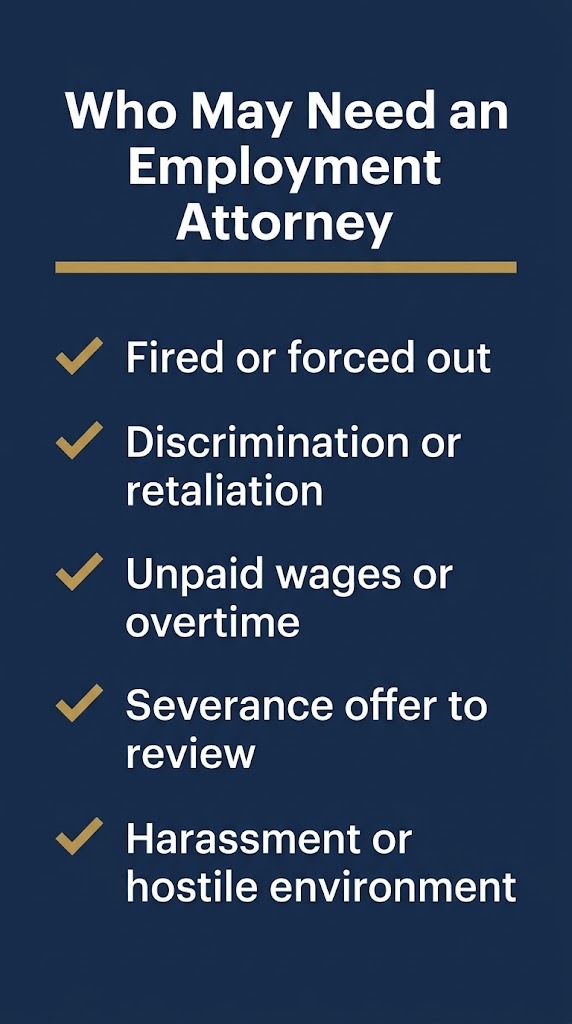
Retaliation claims are especially common. They can arise from whistleblower complaints, workers compensation claims, leave requests, or cooperation in workplace investigations. Even innocent employer behavior may be construed as retaliation to an employee who just made a complaint .
Disability accommodation requests are another major exposure area. According to EEOC data, disability discrimination is the most frequently cited type of discrimination in employment claims .
New risks are emerging in 2026. Artificial intelligence tools used for hiring and employee evaluation are generating algorithmic bias claims. California now treats AI vendors as agents of employers, requiring anti-bias testing and record retention. Illinois requires employers to notify employees when AI is used for hiring, promotion, or termination decisions .
What Happens Next in Your Employment Case
Here is the expected timeline if you are considering or pursuing an employment claim:
Immediately: Document everything. Save emails, performance reviews, and any evidence of discriminatory remarks or unequal treatment.
Within 45 to 300 days (depending on your situation): File an EEOC charge or contact an EEO counselor. Do not miss this deadline.
Within 90 days of receiving a right-to-sue letter: File your lawsuit in court if you have not settled.
6 to 18 months after filing: Discovery phase. Depositions, document production, and expert reports.
12 to 36 months after filing: Trial or settlement. Most cases settle before trial.
Frequently Asked Questions
How much does an employment litigation attorney cost?
Most workers pay nothing upfront. Employment attorneys typically charge contingency fees of 30% to 40% of any settlement or verdict. If you lose, you owe no attorney fee.
Do I need a lawyer to file an EEOC charge?
No, you can file the charge yourself. But a lawyer helps you meet deadlines and build a stronger record. The charge is the required first step before filing a federal discrimination lawsuit.
What is the deadline to file an EEOC charge?
You must file within 180 days of the discriminatory act, or 300 days in states with their own anti-discrimination agency. Federal employees have 45 days to contact an EEO counselor.
Can I sue my employer without filing an EEOC charge?
No, for most federal discrimination claims. You must file a charge with the EEOC or a state agency first and receive a right-to-sue letter. The charge-filing requirement is a claim-processing rule, not a jurisdictional bar, but defendants can raise it if you skip it .
How long does an employment lawsuit take?
Most employment lawsuits take 18 months to 3 years from filing to trial. Settlement or mediation can resolve cases in a few months. Discovery is the biggest source of delay.
What percentage do employment lawyers take?
Most charge 30% to 40% of the recovery. The percentage often rises by stage: about 33% if settled before filing, 40% after a lawsuit is filed, and up to 45% if appealed.
Do I pay case costs if I lose?
Case costs are separate from attorney fees. Whether you owe them after a loss depends on your fee agreement. Ask before signing.
Can I negotiate a severance agreement without a lawyer?
You can, but having an attorney review it is wise. Severance agreement review typically costs $500 to $2,000 flat fee. If you are 40 or older and waiving age discrimination claims, federal law gives you 21 days to consider the agreement.
Check Your Deadline and Document Everything
If you believe you have an employment claim, check the EEOC deadline first. The 180-day clock is the single most important date in your case. Call the EEOC or a local employment attorney this week, not next month.
Gather your documents. Write down what happened and when. Then decide whether to file a charge on your own or hire an attorney on contingency.