Camp Lejeune Water Contamination Compensation 2026: Liver Cancer Claims, Payouts and Deadlines
Quick Answer
- The Camp Lejeune Justice Act of 2022 lets people harmed by the base’s water sue the federal government.
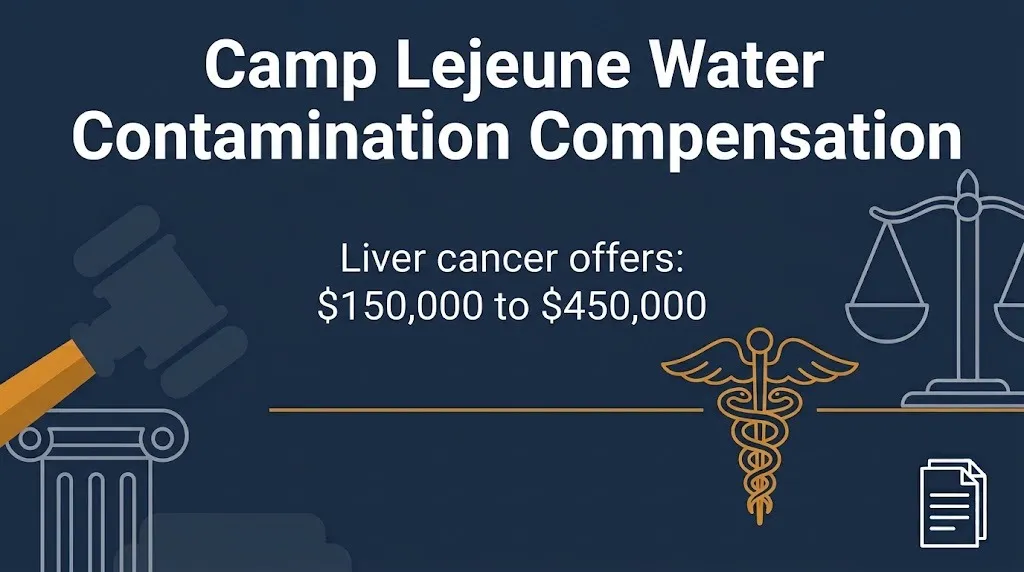
- Liver cancer settlement offers run $150,000, $300,000, or $450,000 by exposure time. No global deal exists yet.
- Judges expect a global settlement framework by October 30, 2026. The Navy claim window has already closed.
Camp Lejeune water contamination compensation is real, but only some people are being paid today. A September 14, 2026 Justice Department filing says $872 million has been paid to 2,822 claimants.
You may qualify if you spent at least 30 days at the base between 1953 and 1987 and later developed a covered illness, such as liver cancer. The Navy claim window closed in August 2024, so the date that matters now is October 30, 2026.
This guide covers liver cancer, payout tiers, trial dates, and proof. One surprise: liver cancer is a Tier 1 disease for settlement offers, yet it sits outside the first trial group.
The Facts
| Case | In re: Camp Lejeune Water Litigation, U.S. District Court, Eastern District of North Carolina (case number not yet confirmed) |
| Status | Settlement talks and first bench trials. No global settlement announced |
| Fund Size | Not yet confirmed. No global fund exists. $872 million paid so far through offers |
| Est. Per Person | Elective Option offers of $100,000 to $550,000. Liver cancer: $150,000 to $450,000 |
| Claim Deadline | Navy claim window closed August 2024. Settlement framework target: October 30, 2026 |
| Administrator | Navy JAG Tort Claims Unit handles claims. Court-appointed Settlement Masters handle talks |
| Proof Needed | Records showing 30+ days at the base, 1953 to 1987, plus a medical diagnosis |
Is Camp Lejeune water contamination compensation real?
Yes, Camp Lejeune water contamination compensation is real and comes from a federal law. Congress passed the Camp Lejeune Justice Act in 2022 as part of the PACT Act, creating a new federal claim for people harmed by the base’s water.
It isn’t a typical class action. Each person files an individual claim with the Navy. If nothing is resolved in six months, claimants can sue in federal court in the Eastern District of North Carolina.
No single fund exists, and no claims administrator is mailing checks. The Navy and the Department of Justice make offers one claimant at a time.
Here’s what’s verified as of today:
- 408,500 claims filed with the Navy, per a September 14 DOJ filing
- 3,796 lawsuits filed in federal court, with 181 dismissed
- October 30, 2026: judges’ target for a global settlement framework
Be skeptical of any page promising you can “join” a settlement. Nothing like that is open.
Is liver cancer covered by the Camp Lejeune Justice Act?
Liver cancer sits on the government’s Tier 1 list, which means it can draw a settlement offer. The five Tier 1 diseases are kidney cancer, liver cancer, non-Hodgkin’s lymphoma, leukemia, and bladder cancer.
The law doesn’t limit you to that list. Other illnesses can still be claimed, but you must prove the water likely caused them.
The legal test is lower than in a normal injury case. Claimants must show the link is strong enough to conclude causation is at least as likely as not.
That’s a roughly 50-50 standard, not “more likely than not.” Still, courts want proof on two levels: that the chemicals can cause liver cancer, and that they caused yours.
Who may qualify for Camp Lejeune compensation?
You may qualify if you were at Camp Lejeune for at least 30 days between August 1953 and December 1987 and developed a qualifying illness. The screening also covers Marine Corps Air Station New River.
Here’s the checklist:
- Documented time at the base or New River for 30 days or more
- Exposure window between August 1953 and December 1987
- A diagnosed illness that you can link to the water
- A Navy claim filed before the window closed
- For Elective Option offers, a diagnosis within 35 years of exposure
That last rule matters. DOJ guidelines require the diagnosis within 35 years of exposure, which excludes some victims.
One example: a man born at the base in 1968 and diagnosed with male breast cancer 39 years later is ineligible for the Elective Option. His lawsuit is still pending.
Key Takeaway: Camp Lejeune compensation is a real federal claim, liver cancer is on the Tier 1 list, and you must show 30 days of exposure between 1953 and 1987.
How much is Camp Lejeune water contamination compensation per person?
Per-person compensation is not yet determined for lawsuits, but Elective Option offers range from $100,000 to $550,000. The maximum authorized in any single Elective Option settlement is $550,000.
The government set those amounts, not a court. Offers depend on your disease tier and how long you were exposed.
| Exposure | Tier 1 offer | Tier 2 offer |
|---|---|---|
| 30 to 364 days | $150,000 | $100,000 |
| 1 to 5 years | $300,000 | $250,000 |
| Over 5 years | $450,000 | $400,000 |
Tier 2 covers multiple myeloma, Parkinson’s disease, kidney disease, and systemic sclerosis. The same source says the government adds $100,000 in cases of premature death from the disease.
Critics call the numbers one-sided. A claimant who was born at the base says the government picked its own eligibility rules and values without input from scientists or plaintiff lawyers.
Lawsuit amounts could differ. One plaintiff attorney expects a payment grid for the court case that looks similar to the Elective Option but with different criteria.
How much can you get for a Camp Lejeune liver cancer lawsuit?
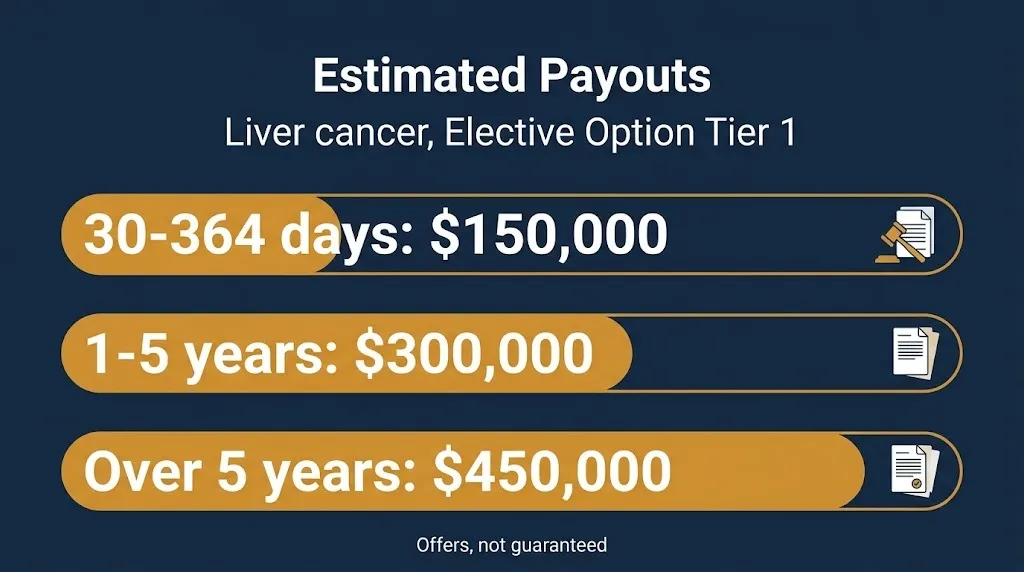
A Camp Lejeune liver cancer claim may receive an Elective Option offer of $150,000, $300,000, or $450,000, depending on your exposure time. A court-awarded amount for liver cancer is not yet determined.
| Time at Camp Lejeune | Liver cancer (Tier 1) offer |
|---|---|
| 30 to 364 days | $150,000 |
| 1 to 5 years | $300,000 |
| More than 5 years | $450,000 |
No liver cancer verdict exists yet. The first trial is a kidney cancer case, so judges haven’t ruled on liver cancer value at all.
The Elective Option also carries a waiver. That means accepting an offer likely ends your right to claim more, so read the terms with an attorney before signing.
Fees take a bite too. One reported claimant who accepted a $400,000 death settlement said she’d pay a 20 percent legal fee. Your fee agreement may differ.
Reality Check: Nobody legitimate texts you first offering Camp Lejeune money. Offers come through the Navy and DOJ process tied to a claim you already filed. Anyone charging an upfront fee to “unlock” a payment is a red flag.
How much has the government paid so far in Camp Lejeune settlements?
The government has paid $872 million to 2,822 claimants, according to the September 14, 2026 DOJ filing. It also reports 3,637 offers worth $1.08 billion, between $100,000 and $550,000 each.
| Metric | Figure |
|---|---|
| Navy claims filed | 408,500 |
| Settlement offers made | 3,637 |
| Total value of offers | $1.08 billion |
| Claimants paid | 2,822 |
| Total paid | $872 million |
Now put that in proportion. Under 1 percent of claims have been paid, by our calculation (2,822 of 408,500). The average payment works out to about $309,000, also our calculation.
Payments have grown. One law firm tracker reported passing $801 million in July 2026, so roughly $71 million more has gone out since.
The government touts the paid total. The numbers say most claimants are still waiting.
Key Takeaway: The government has paid $872 million to 2,822 claimants, but more than 400,000 claims remain unresolved.
Can you still file a Camp Lejeune claim in 2026?
No, the Navy claim window has closed, so new administrative claims aren’t being accepted. The two-year window closed in August 2024.
Your path depends on what you already did. If you filed a Navy claim on time, you may still have options. A lawsuit requires that earlier claim.
No verified proposal to reopen the window exists. Bills in Congress focus on jury trials and moving cases outside North Carolina, and they remain stalled.
If you filed on time, take these steps:
- Find your Navy claim number and filing confirmation.
- Check whether the Navy has answered or made an offer.
- Note the date six months after you filed, when a lawsuit becomes possible.
- Ask your attorney whether your case is already in federal court.
- Gather your medical and service records now.
- Keep every letter from the Navy or DOJ.
If you never filed, be wary of anyone saying they can still file for you.
How do you accept or reject a Camp Lejeune Elective Option offer?
You accept an Elective Option offer by agreeing to the government’s terms, which include a waiver of further claims. The Elective Option comes with a waiver.
That makes the decision permanent. Treat it like signing a final release on an insurance claim.
Follow these steps:
- Read the full offer and the dollar amount tied to your tier.
- Confirm your exposure length matches the Navy’s record.
- Confirm your diagnosis date fits the 35-year rule.
- Read the waiver language line by line.
- Compare the offer to what you could get by waiting.
- Talk to an attorney about fees and timing.
- Decide before any stated response deadline on your offer.
Attorneys are split. One plaintiff lawyer told his clients to take offers now because he doesn’t expect a mass settlement soon. Other critics say the Elective Option undervalues claims.
Your offer letter, not this article, sets your deadline. Check it.
What proof do you need for a Camp Lejeune liver cancer claim?
You need proof you were at the base for 30 days and medical proof of liver cancer. Think of it like returning a product with no receipt: without paperwork, your word alone rarely carries the claim.
Build your file with this checklist:
- Military records, housing records, or pay records showing time at Camp Lejeune or New River.
- Medical records confirming liver cancer and your diagnosis date.
- Pathology reports that identify the cancer type.
- A timeline of where and when you lived or worked on base.
- Records of other health factors, since courts weigh other risk factors.
Courts require proof that the water exposure likely caused your illness, considering other risk factors you may have.
Dates matter most. The 1953 to 1987 window, the 30-day minimum, and the 35-year diagnosis rule all turn on documents.
Key Takeaway: Your claim lives or dies on records, so gather service proof and medical files before any offer or deadline arrives.
When will the Camp Lejeune lawsuit be settled?
No settlement date is confirmed, but judges expect a global settlement framework by October 30, 2026. A June 30, 2026 order signed by all four district judges set that target.
Judges also required weekly meetings with court-appointed Settlement Masters. After October 30, the court will reassess how the litigation is managed, including which firms lead for plaintiffs.
Read that date correctly. It’s a target for a framework, not a payment date. Think of it like a tax filing deadline: it tells you when paperwork is due, not when money lands.
Even optimists warn of delay. One plaintiff attorney with 9/11 fund experience doesn’t expect a mass settlement soon. Attorneys say total payouts could reach or exceed the 9/11 fund, which has topped $18 billion.
That’s speculation from lawyers, not a government figure.
What happens at the first Camp Lejeune trial on October 26?
The first Camp Lejeune trial begins October 26, 2026, and it’s a kidney cancer case, not liver cancer. Judge Terrence Boyle scheduled the Mousser kidney cancer trial for October 26 and the Fancher kidney cancer trial for November 9.
| Date | Event |
|---|---|
| October 16 | Amended pretrial materials due |
| October 26 | Mousser kidney cancer trial |
| October 30 | Settlement framework target |
| November 9 | Fancher kidney cancer trial |
Judges, not juries, will decide these cases because the court held the statute gives no jury right.
The government is fighting hard. It’s challenging plaintiffs’ experts on differential etiology, Bradford Hill analysis, and the statutory burden of proof.
Why should liver cancer claimants care? Verdicts will give the first real price tags. They’ll shape the settlement grid even for illnesses not yet tried.
How many Camp Lejeune lawsuits and claims are pending now?
More than 400,000 Navy claims and 3,796 lawsuits are pending. The latest status report counts 3,796 lawsuits filed in federal court with 181 dismissed.
| Item | Figure | Source date |
|---|---|---|
| Lawsuits filed | 3,796 | Early October 2026 |
| Lawsuits dismissed | 181 | Early October 2026 |
| Navy claims filed | 408,500 | September 14, 2026 |
Counts differ across pages because they update at different times. Earlier 2026 tallies showed 3,744 and 3,773 lawsuits, and 3,784 appeared in September.
Some sites still cite about 180,000 claims. The DOJ filing says 408,500, so treat the smaller number as outdated.
Documentation is a recurring problem. Plaintiff-side trackers note that proof of service and residence remains a hurdle for many claimants.
Key Takeaway: Lawsuit counts are growing slowly, but Navy claims dwarf them, so most people are still on the administrative track.
Why is liver cancer treated differently in the settlement and the trials?
Liver cancer is Tier 1 for settlement offers but not in the court’s first trial group. That mismatch is the detail most competing pages miss.
The Elective Option lists liver cancer alongside kidney and bladder cancer. The court’s Track 1 group is different. Track 1 covers kidney cancer, bladder cancer, leukemia, non-Hodgkin’s lymphoma, and Parkinson’s disease.
In February 2024, the court classified prostate cancer, kidney disease, lung cancer, liver cancer, and breast cancer as Track 2 illnesses.
What does it mean for you? Liver cancer plaintiffs don’t get an early trial benchmark. Their value will probably come from the settlement grid.
A 2023 plaintiff filing argued the government had acknowledged strong links for several illnesses, including liver cancer. That’s the plaintiffs’ framing, so check the court record.
What was in the water at Camp Lejeune?
The water at Camp Lejeune contained industrial solvents and fuel chemicals. Plaintiffs point to TCE, PCE, and benzene that leaked into base groundwater.
Vinyl chloride is also named in legal commentary on the case. Federal health agencies have reviewed how these compounds relate to cancer.
Contamination was at its worst in the late 1970s and early 1980s, according to reporting on the case. The law covers exposure from 1953 through 1987.
Why does this matter to claimants? Exposure length drives your offer tier, and the chemicals drive the causation fight.
Experts will argue over doses and timing. Your own residence dates help tie you to the contaminated periods.
Why can’t Camp Lejeune plaintiffs get a jury trial?
Camp Lejeune plaintiffs can’t get a jury because the court ruled the statute doesn’t provide one. The Eastern District of North Carolina interprets the law as giving no right to a jury trial.
In May 2024, judges rejected a motion for immediate appellate review of that decision. Two plaintiffs have argued the ruling violates their constitutional jury rights. The outcome of that challenge is not yet confirmed.
Victims took the fight to Washington. Dozens rallied on Capitol Hill, demanding jury trials and cases in courts outside North Carolina.
Those bills are stalled. Action looks unlikely before the midterm elections, per reporting from September 22, 2026.
For you, that means a judge decides unless you settle first.
Will a Camp Lejeune settlement affect your VA benefits?
It may, and the government is fighting to reduce damages by VA and other payments. One active dispute is whether damages can be offset by VA, Medicare, and Medicaid payments.
That offset fight could shrink awards. It hasn’t been resolved.
VA benefits run on a separate track. A VA Board decision notes that liver cancer carries a presumption of service connection tied to Camp Lejeune water, though the VA can rebut it.
Don’t assume claiming one cuts off the other. Don’t assume they’re free of each other either.
Before accepting any offer, ask your attorney how your VA payments and the Elective Option waiver interact. Get the answer in writing.
Key Takeaway: Liver cancer is Tier 1 for offers but Track 2 in court, and VA offsets are still being fought.
What Happens Next
October 26, 2026: The Mousser kidney cancer bench trial begins before Judge Boyle.
October 30, 2026: Judges’ target for a global settlement framework from DOJ and plaintiffs’ leadership.
November 9, 2026: The Fancher kidney cancer trial is scheduled.
Expected after October 30: The court reassesses case management and which firms lead plaintiffs.
Expected, not confirmed: A payment grid for lawsuits, likely modeled on Elective Option tiers.
Frequently Asked Questions
How much is the Camp Lejeune liver cancer settlement?
Elective Option offers for liver cancer are $150,000, $300,000, or $450,000.
The amount depends on how long you were at the base.
A court-awarded liver cancer amount is not yet determined.
Is there a Camp Lejeune liver cancer lawsuit?
Yes, liver cancer claims are being pursued under the Camp Lejeune Justice Act.
The court placed liver cancer in Track 2, so it isn’t in the first trials.
Settlement talks cover it.
Can I still file a Camp Lejeune claim in 2026?
No, the Navy claim window closed in August 2024.
If you filed on time, you may still have a lawsuit or offer path.
No verified reopening exists.
When will Camp Lejeune settlement checks be mailed?
No global payment date exists.
Judges want a settlement framework by October 30, 2026.
Elective Option payments are already going out to some claimants.
Who qualifies for Camp Lejeune compensation?
You may qualify with 30 or more days at the base between 1953 and 1987 and a qualifying illness.
Elective Option offers also require diagnosis within 35 years of exposure.
Records decide it.
Should I take the Elective Option offer?
That’s a personal and legal decision, and this site can’t advise you.
The offer includes a waiver of further claims.
Review it with an attorney first.
Is Camp Lejeune compensation taxable or reduced by VA benefits?
Not yet confirmed. The government is contesting offsets for VA, Medicare, and Medicaid payments.
Ask your attorney and a tax professional before you accept.
Closing
Pull your records today. Find your Navy claim number, your service or housing proof, and your diagnosis paperwork, then read any offer letter line by line.
Watch the court for news after the October 26 trial. The date to calendar is October 30, 2026, when judges expect a global settlement framework.