When a Litigation Hold Is Received, Management in 2026: What to Do, Who to Call, and Why “Preserve” Is the Only Answer
Quick Answer
- Management must preserve all potentially relevant documents, emails, and electronic data immediately upon receiving a litigation hold notice.
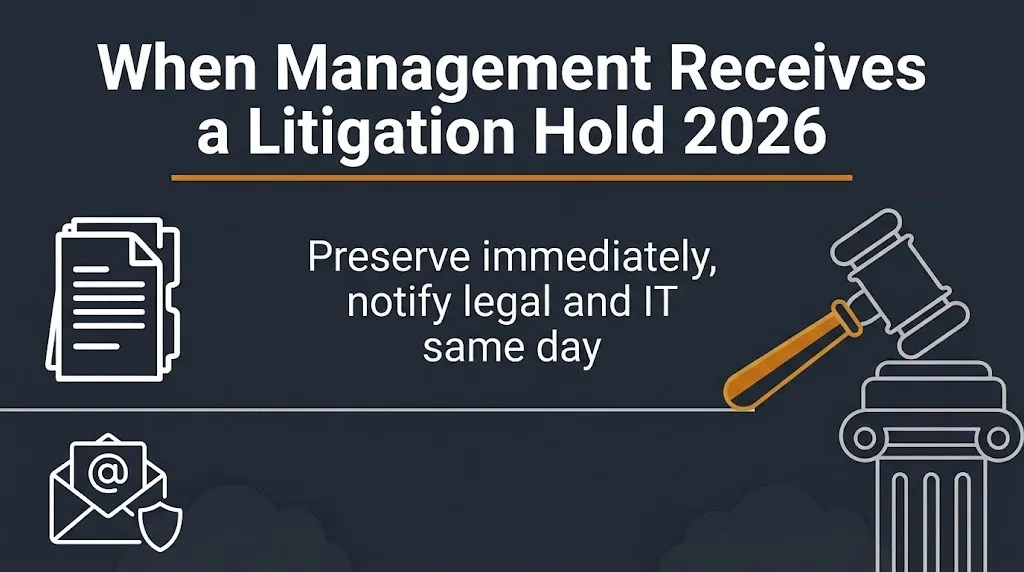
- Notify legal counsel and IT the same day so automatic deletion and retention schedules are suspended.
- Failure to preserve can lead to court sanctions, adverse inference instructions, and financial penalties for the organization.
When a litigation hold lands on your desk, the answer to what management should do is not complicated, but the execution is. You must preserve everything that could relate to the matter, and you must do it now. A litigation hold, also called a legal hold, is a directive that suspends normal document destruction until the legal matter is fully resolved .
If you are a manager, an HR lead, or an operations executive who just opened an envelope or an email containing a hold notice, you are the first line of defense. The legal team will handle strategy. IT will handle the technical preservation. Your job is to make sure neither of them finds out too late.
This article covers the exact steps management should take, who must be notified, what information needs preserving, and the mistakes that turn a routine hold into a sanctions motion. One detail that matters more than most managers realize: the hold does not end when the case settles. It ends when legal formally releases it in writing, and not a day before .
The Facts
| Item | Verified Detail |
|---|---|
| Core Duty | Preserve all potentially relevant information immediately |
| First Notifications | Legal counsel and IT, same day |
| Key IT Action | Suspend automatic deletion and retention schedules |
| Key Legal Action | Issue written hold notice to custodians and track acknowledgments |
| Key Management Action | Communicate the hold, monitor compliance, and escalate questions |
| Duration | Until legal formally releases the hold in writing |
| Risk of Failure | Court sanctions, adverse inference, financial penalties, spoliation claims |
Is a litigation hold something management can ignore?
No, management cannot ignore a litigation hold. Ignoring it is the fastest path to spoliation sanctions, and courts do not accept “I didn’t understand the notice” as a defense .
A litigation hold is not a suggestion. It is a legal directive triggered by actual litigation or the reasonable anticipation of it. Once it arrives, the organization has a duty to preserve evidence, and that duty flows through management to every employee who might hold relevant information .
The consequences are concrete. Courts can impose sanctions under Federal Rule of Civil Procedure 37(e), including orders to cure prejudice, cost shifting, adverse inference instructions that tell the jury to assume the lost evidence was unfavorable, or in severe cases, dismissal of claims or default judgment . Management’s role is to prevent that outcome by acting immediately.
Who should management notify first when a litigation hold arrives?
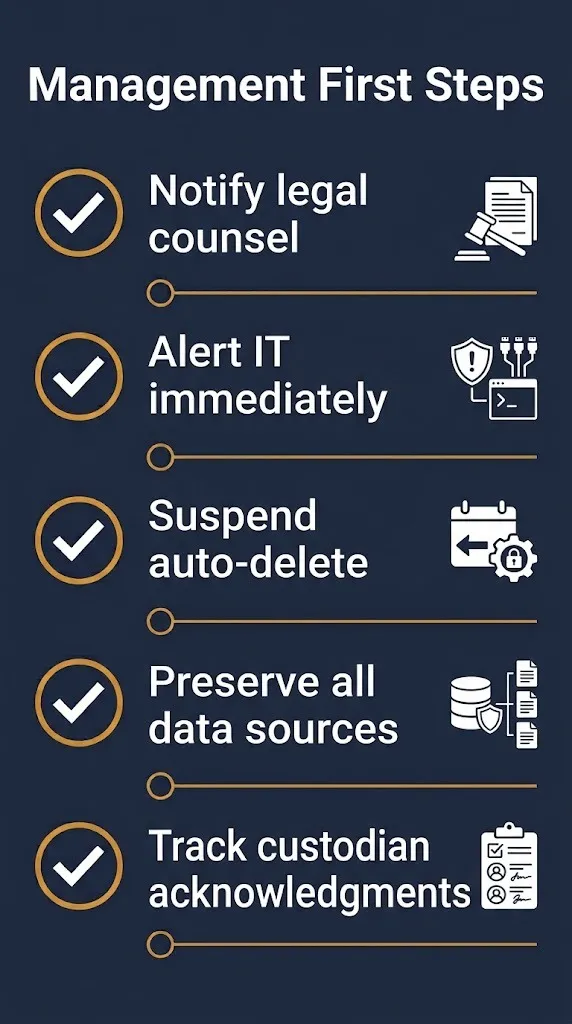
Management should notify legal counsel and IT first, and both should hear from you the same day the hold is received. Legal needs to confirm the scope and issue the formal notices. IT needs to stop the deletion clock before it runs.
The Connell Foley employment newsletter puts it plainly: best practice is to act quickly once the letter is received, put management and IT on notice, and have IT suspend automatic deletion policies, preserve backup data, and secure relevant devices and accounts .
Here is the notification order that works:
- Legal counsel or general counsel: Confirm receipt and ask for the formal hold notice and scope.
- IT and information governance: Request immediate suspension of auto-delete rules and retention schedules.
- Records management: Flag any retention schedules that might conflict with the hold.
- Human resources: If the matter involves personnel, preserve HR files and identify custodians.
- Affected department heads: Once legal approves the communication, brief them on their preservation duties.
Skipping IT is the most common management failure. Retention policies keep running in the background while everyone assumes the hold is “handled” .
What information must management preserve when a hold arrives?
Management must preserve all documents, communications, and data that could be relevant to the matter, including email, text messages, chat platforms, shared drives, databases, voicemail, drafts, backup tapes, and paper files. The scope is broader than what will eventually be produced in court .
The practical question is not “what is evidence?” It is “what might someone argue is relevant?” A deleted Slack message about a project, a draft memo that was never sent, a text from a personal phone used for work: these all fall within the preservation duty if they touch the dispute.
Common data sources management must flag for IT:
- Email accounts and archives, including personal accounts used for work
- Chat and collaboration tools such as Slack, Teams, and Google Chat
- Shared drives and cloud storage
- Local files on laptops and desktops
- Mobile devices, including text messages and messaging apps
- Backup tapes and legacy archives
- Paper files, notebooks, and physical documents
- Voicemail systems
Over-preserving is far safer than under-preserving at the initial stage. A blanket approach can be narrowed later. A deleted file cannot be undeleted .
Key Takeaway: Management’s job is not to decide what is evidence. It is to make sure nothing is deleted while legal and IT figure out what needs to be kept.
How should management communicate the hold to employees?
Management should communicate the hold in writing, track acknowledgments, and remind custodians periodically that the obligation remains in effect. Verbal instructions and hallway reminders do not create the record a court will look for.
The hold notice should go to every custodian who might hold relevant information, and it should be sent by email or through a legal hold platform that captures receipt . The notice should explain the matter in neutral terms, describe the types of information to preserve, state that normal deletion policies are suspended, and tell recipients what to do if they have questions .
Management’s role in communication is to reinforce, not replace, the legal notice. When employees hear from their manager that the hold is serious, compliance improves. When they hear nothing, they assume the notice was routine and keep deleting .
Periodic reminders matter. A hold that sits in an inbox for six months gets forgotten. A quarterly reminder, or a reminder triggered by new custodians joining the matter, keeps the obligation visible .
What happens if management fails to preserve data?
If management fails to preserve data, the organization faces court sanctions, adverse inference instructions, financial penalties, and damage to its credibility in the litigation. The individual manager may also face scrutiny, depending on the court and the facts.
Rule 37(e) governs lost electronically stored information in federal court. If a court finds prejudice from the loss, it can order curative measures. If it finds intent to deprive the other side of the evidence, it can instruct the jury to presume the lost information was unfavorable, or even enter judgment against the responsible party .
The Zubulake line of cases is the cautionary tale. Employees deleted emails after a hold went out, follow-up never happened, and the court sanctioned the company. The failure was not a single rogue employee. It was a management failure to monitor and enforce the hold .
Reality Check: A litigation hold does not enforce itself, and signing an acknowledgment form does not mean the data is actually preserved. Management has to verify that IT suspended the deletion rules, that custodians understand their obligations, and that no one is quietly cleaning up their inbox because the hold notice felt like a formality. The only safe assumption is that any relevant data not actively protected is at risk.
Does management need to collect the data or just preserve it?
Management generally needs to preserve the data and facilitate access, not collect it personally. Collection is usually handled by IT, outside counsel, or an eDiscovery vendor, depending on the size and complexity of the matter .
The preservation obligation is about making sure the data still exists when collection happens. Management’s role is to identify where the data lives, who controls it, and whether there are obstacles to accessing it. If an employee has left the company, management should flag that the departing employee’s devices and accounts need to be secured before offboarding deletes them .
When legal and IT ask for cooperation, management should provide it quickly. Delays in identifying custodians or data sources are one of the most common ways preservation efforts fail .
What is the difference between a litigation hold and a document retention policy?
A litigation hold overrides the normal document retention and destruction policy. The retention policy tells the organization what to keep and for how long under ordinary circumstances. The litigation hold tells the organization to stop destroying certain information because it is relevant to a legal matter .
This distinction matters for management because the hold notice should explicitly state that the retention policy is suspended for the covered data. If managers and employees do not understand that the hold takes precedence, they may continue following the retention schedule and destroy relevant records .
Once the hold is formally released, the retention policy resumes. The data does not get automatically deleted. It returns to the normal schedule, and whatever remains subject to other retention obligations stays .
What happens next after management receives a hold?
The next stages follow a predictable sequence, though timing depends on the matter.
Same day: Notify legal and IT. Suspend deletion. Secure devices and accounts if urgent.
Within days: Legal issues the formal hold notice to custodians. Management reinforces the message.
Ongoing: Custodians acknowledge the hold. IT confirms preservation controls are active.
Periodically: Legal sends reminders. Management monitors compliance and escalates questions.
At resolution: Legal authorizes release. IT reinstates retention schedules. Management informs custodians the hold has ended.
The final stage is the one most organizations skip. A hold that is never formally released becomes a “zombie hold,” accumulating data, increasing costs, and undermining the credibility of future holds . Management should follow up with legal to confirm the hold has been released when the matter resolves.
Frequently Asked Questions
What should management do first when a litigation hold is received?
Preserve all potentially relevant information and notify legal counsel and IT the same day. Suspend automatic deletion before anything else.
Can management delete documents after receiving a litigation hold?
No. Deleting or altering potentially relevant documents after a hold is received can lead to spoliation sanctions, adverse inference instructions, and financial penalties.
Who is responsible for enforcing a litigation hold?
Legal counsel authorizes and oversees the hold, IT implements the technical preservation, and management ensures employees comply and data is not lost.
How long does a litigation hold last?
A litigation hold lasts until legal counsel formally releases it in writing. Settlement or dismissal of a case does not automatically end the hold.
What happens if an employee deletes data despite a hold?
The organization can face court sanctions. The employee may face discipline. The court may instruct the jury to assume the deleted information was unfavorable to the organization.
Does a litigation hold cover text messages and chat apps?
Yes. Litigation holds cover all forms of potentially relevant information, including text messages, Slack and Teams chats, voicemail, and cloud storage.
Your next step is to forward the hold notice to legal and IT with a timestamp, then ask IT in writing to confirm that auto-delete has been suspended for the named custodians. That written confirmation is the first piece of the paper trail that protects your organization if the hold is ever challenged.