DUI Defense Lawsuit 2026: What a DUI Case Actually Costs, What Defenses Work, and Why There Is No Settlement Fund
Quick Answer
- A DUI defense lawsuit is a criminal case against you, not a settlement you can claim money from.
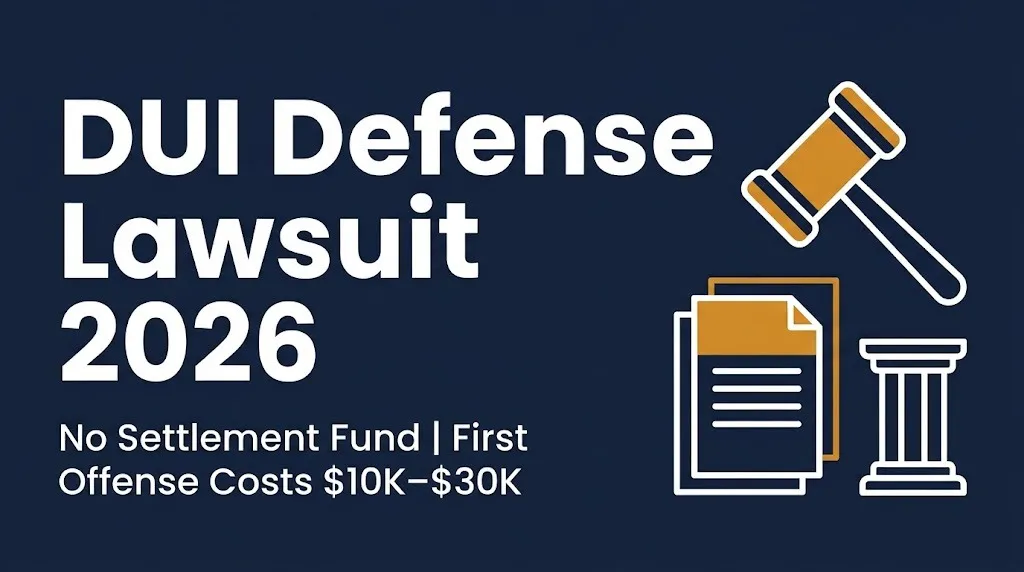
- Total first-offense costs run about $10,000 to $30,000, with attorney fees commonly $1,500 to $6,000.
- The most important deadline is your first court appearance, which can set license and bail consequences.
You searched for “DUI defense lawsuit” because you or someone close to you was charged, or you are trying to understand what a defense costs before hiring a lawyer. The direct answer is that this is not a lawsuit you file for compensation. It is a criminal charge you defend against, and the money flows out, not in.
The number that matters most is not a settlement figure. It is the total cost of a conviction, and published 2026 estimates place a first offense at $10,000 to $30,000 once insurance surcharges are counted . Attorney fees are only one line on that bill.
This article breaks down what a DUI defense actually costs in 2026, which legal defenses have a real basis, how long a conviction follows you, and why no settlement administrator exists for this charge. One detail surprises most readers: the insurance increase often costs more than the fine, the lawyer, and the court fees combined .
The Facts
| Item | Verified Detail |
|---|---|
| Case Type | Criminal defense matter (DUI/DWI), not a class action or settlement |
| Settlement Fund | None. No fund exists. |
| Estimated Payout | Not applicable. Defendants pay costs, they do not receive them. |
| Typical Attorney Fee | $1,500 to $6,000 for first offense; higher for trial or felony |
| Total First-Offense Cost | Roughly $10,000 to $30,000 |
| Biggest Hidden Cost | Auto insurance increase, often $7,500 to $15,000 over three to five years |
| Claim Deadline | Not applicable. Court dates and license hearing deadlines apply instead. |
| Administrator | Not applicable. |
Is a DUI Defense Lawsuit Real or a Scam?
A DUI defense lawsuit is real in the sense that DUI charges are real criminal cases with real court dockets. It is not a lawsuit you file to receive money, and there is no settlement fund, no claims administrator, and no payout deadline. The phrase confuses search engines because “lawsuit” usually suggests a civil claim for damages.
The scam risk is separate. Websites promising to “register” you for a DUI settlement or charging a fee to “unlock compensation” are selling something that does not exist. A DUI charge is resolved in criminal court, through a defense attorney and a prosecutor, not through a class action settlement.
Your real options are a public defender if you qualify financially, a private defense attorney, or representing yourself. None of those options involve a settlement payout.
How Much Does a DUI Defense Cost in 2026?
A DUI defense costs between $1,500 and $6,000 in attorney fees for a typical first offense, according to 2026 cost reports . Flat fees are common. One Colorado firm publishes misdemeanor DUI fees starting at $6,000, with felony DUI starting at $12,500 . A San Diego firm lists DUI flat fees from $3,000 to $15,000 .
The table below shows the full cost picture for a first offense, drawn from published 2026 estimates.
| Cost Category | Typical Amount |
|---|---|
| Attorney fees | $1,500 to $6,000 |
| Court fines and fees | $500 to $2,000 |
| Bail | $150 to $2,000 |
| Ignition interlock device | $900 to $1,300 |
| DUI education program | $500 to $1,800 (varies by state and BAC) |
| License reinstatement | Around $125 |
| Insurance increase over 3 years | $7,500 to $15,000 |
| Total first-offense range | Roughly $10,000 to $30,000 |
Not yet determined does not apply to this question. The ranges are published, but your exact number depends on your state, your BAC, whether you hire a private attorney, and whether the case goes to trial.
What Defenses Actually Work in a DUI Case?
The defenses that work depend on your facts, and no attorney can guarantee an outcome. The verified strategies fall into four categories: challenging the stop, challenging the arrest, challenging the tests, and challenging the evidence’s reliability. A DUI defense attorney reviews the traffic stop first, because an illegal stop can make everything that follows inadmissible .
Stop and seizure challenges
- Did the officer have reasonable suspicion to pull you over?
- Was the stop based on a valid traffic violation or an anonymous tip?
- Did the officer illegally search you or your vehicle?
Field sobriety test challenges
- Were you told the tests were voluntary?
- Were you overweight, over 60, or physically limited in a way that affected performance?
- Was the ground uneven, poorly lit, or covered in debris?
Chemical test challenges
- Was the breathalyzer calibrated and maintained according to state standards?
- Was the required observation period followed before the breath test?
- Could mouth alcohol, GERD, or dental work have skewed the reading?
Rising BAC defense
- Your BAC at the time of driving may have been below the limit even if it was above the limit when tested later .
A plea bargain is also a legal option, and it can reduce charges or penalties. That is a decision to make with an attorney who has seen the evidence.
Key Takeaway: A DUI defense is built on procedure, not on a single magic argument, and the strongest cases usually start with a flawed stop or a flawed test.
How Long Does a DUI Stay on Your Record?
A DUI stays on your record for years, and in some states for life. California uses a 10-year lookback period for both the DMV and the courts . Minnesota keeps DUI convictions on the driving record permanently unless expunged, and uses them for sentencing enhancement for ten years .
The lookback period matters because a second offense inside the window is punished more severely than a first. Most states use a 5-year or 10-year window, while a few, including Colorado and New Mexico, have lifetime lookback provisions for sentencing .
| State Example | Lookback Period |
|---|---|
| California | 10 years |
| Minnesota | Permanent record, 10 years for enhancement |
| Florida | 5 years for second offense, 10 years for third |
| Colorado | Lifetime for sentencing |
How Do You Defend Against a DUI Charge?
You defend against a DUI charge by hiring counsel, reviewing the evidence, and challenging the state’s case at every stage. The steps below are the general sequence, not legal advice for your specific situation.
- Write down everything you remember about the stop, the tests, and the arrest.
- Contact a DUI defense attorney or apply for a public defender before your first court date.
- Request the police report, body camera footage, and calibration records for any testing device.
- Check your license suspension timeline, which often runs separately from the criminal case.
- Do not miss any court date, because a failure to appear can add charges.
- Discuss plea options and trial risks with your attorney before deciding.
- Complete any required classes or assessments early if your attorney advises it.
The first court appearance is usually the arraignment, where you enter a plea. That date is the one deadline that matters most early on.
Reality Check: No one texts you money for a DUI charge. No court-appointed administrator is holding a settlement fund for impaired driving cases. If a website asks for an upfront fee to “claim” DUI compensation, it is not legitimate.
What Is the Best DUI Defense?
The best DUI defense is the one that fits your specific facts, not a generic script. A defense that works for one driver may be unavailable to another because the evidence, the stop, and the test results differ. Attorneys who practice in this area consistently say the same thing: there are many variables, and the defense must match the process .
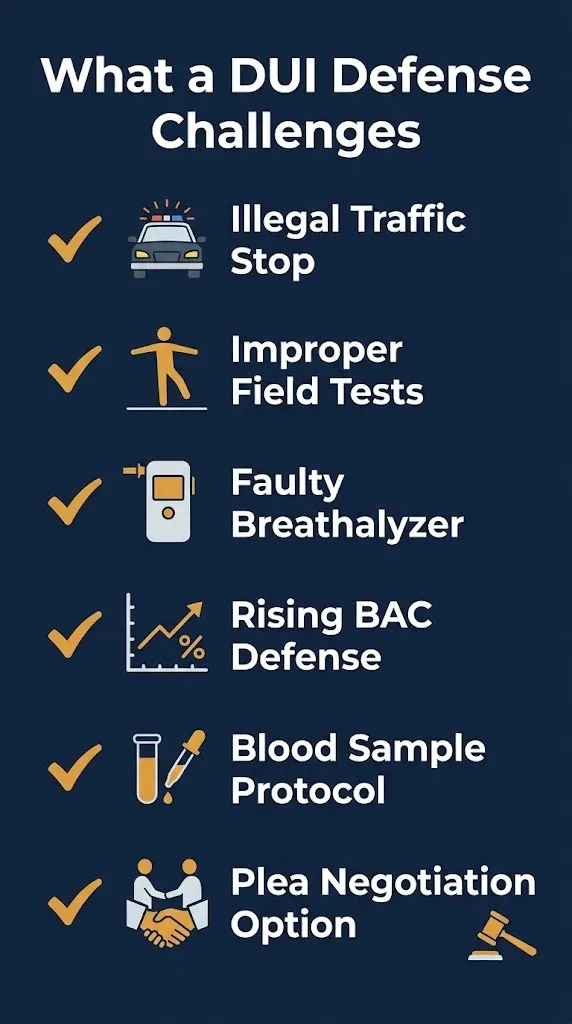
The strongest starting points are usually procedural. An unlawful stop can suppress the evidence. An improperly calibrated breath machine can undermine the test result. A blood sample drawn without proper protocol can be challenged . A rising BAC argument can create reasonable doubt about your level at the time of driving .
What does not work is assuming you have no defense. The prosecution carries the burden of proof beyond a reasonable doubt, and you do not have to prove your innocence . That distinction is the foundation of every DUI defense.
What Happens Next
- Within days of arrest: Your arraignment date is set, and your license suspension clock starts.
- Before arraignment: Hire an attorney or apply for a public defender. Gather your own notes and any witnesses.
- At arraignment: Enter a plea and get the police report and discovery timeline.
- Expected within 30 to 90 days: Pre-trial motions and negotiations, depending on your jurisdiction.
- If no resolution: Trial date, which your attorney will quote separately from the flat fee .
Frequently Asked Questions
Is there a DUI defense settlement fund?
No. A DUI charge is a criminal case, not a class action. There is no fund, no administrator, and no payout.
How much does a DUI lawyer cost in 2026?
Most first-offense DUI attorney fees run $1,500 to $6,000, with flat fees common. Felony and trial cases cost more .
What is the total cost of a first DUI conviction?
Published 2026 estimates put the total at $10,000 to $30,000, with insurance increases often the largest single component .
Can a DUI charge be dismissed?
Yes, but only if the defense finds a legal or procedural problem with the stop, the arrest, or the evidence. No outcome is guaranteed.
What is the rising BAC defense?
It argues your BAC was below the legal limit while you were driving and rose above it by the time you were tested .
How long does a DUI stay on my record?
That depends on your state. California uses 10 years, Minnesota keeps it permanently unless expunged, and some states have lifetime lookback for sentencing .
Do I need a lawyer for a first DUI?
You are not required to hire one, but DUI cases involve scientific evidence and procedural rules that are difficult to challenge without training. A public defender is an option if you cannot afford private counsel.