Attorneys for Lawsuits 2026: How to Hire, What They Charge, and Free Options
Quick Answer
- Attorneys for lawsuits usually charge contingency, hourly, or flat fees. Contingency means no fee unless you recover money.
- Typical injury contingency fee: 33.33% before suit, 40% if litigation begins, per Texas LawHelp. Amounts depend on your agreement.
- Key deadline: your state’s filing deadline, which varies. ABA Model Rule 1.5(c) requires contingency terms in a signed writing.
Attorneys for lawsuits get paid in one of three main ways: a percentage of what you recover, an hourly rate, or a flat fee. In injury cases, the percentage model is the most common.
This guide applies if you’re thinking about suing, got sued, or saw a class action notice. The number that matters most is time, because your state’s filing deadline can end a claim before a lawyer ever reads it.
This article covers fees, hiring steps, fee agreements, class action fees, and 2026 legal aid limits. One surprising detail: in one federal class settlement, a court affirmed $1 million in attorney fees against a $550,000 settlement fund.
The Facts
| Item | Detail |
|---|---|
| Case | Not a single case. A guide to hiring attorneys for lawsuits |
| Status | Evergreen guide, verified October 19, 2026 |
| Fund Size | Not applicable |
| Est. Per Person | Not applicable |
| Claim Deadline | None here. Your state’s filing deadline varies |
| Administrator | Not applicable |
| Proof Needed | Varies by case. Gather records and any court papers |
How do you know if an attorney for a lawsuit is legit?
Check that the attorney holds an active license with your state bar before you sign anything. State bar associations license practicing lawyers, and they can discipline those who break professional rules.
Referral service profiles are often self-reported. One consumer guide says to treat them as a starting point and verify credentials through your state bar’s public attorney search tool.
Use this short checklist:
- Confirm the license is active in your state.
- Look for any discipline history.
- Ask whether the lawyer handles your type of case.
- Get the fee terms in writing.
- Ask about your filing deadline on the first call.
A flashy ad proves nothing. A license record does.
Do attorneys for lawsuits really work for free?
Not exactly. A contingency lawyer waits for the fee until you recover money, but you can still owe case costs. A Nevada State Bar guide says that in most cases, the client pays costs whatever the outcome.
Fees and costs are different things. The fee is the lawyer’s share of the recovery. Costs are the expenses of running the case.
ABA Model Rule 1.5(c) tells lawyers to spell out which expenses come out of your recovery. It also says whether they’re deducted before or after the fee. That order changes your take-home amount.
| Term | Meaning |
|---|---|
| Attorney’s fee | The lawyer’s agreed percentage of the recovery |
| Case costs | Litigation and other expenses listed in your agreement |
| “No win, no fee” | Usually covers the fee, not necessarily the costs |
Are lawyer referral services free?
Some are free, and some charge a small consultation fee. One consumer guide puts that fee at roughly $25 to $50 for services that charge.
Every state has a bar association, and most run referral services. The American Bar Association keeps a list of referral services that meet its certification requirements.
For-profit matching services work differently. Lawyers who join may pay for participation, per referral, or a share of fees from referred clients. Confidentiality is a known concern with online matching.
Ask any service three things before you share details. What does it cost you? Is it bar certified? Does the lawyer pay to be listed?
Key Takeaway: Verify the license, ask what you’ll owe in costs, and know who pays for the referral before you share case details.
How much do attorneys for lawsuits charge?
It depends on the fee type: contingency percentage, hourly rate, flat fee, or a mix. The right one depends on your kind of case.
| Fee type | How it works | Where it’s common |
|---|---|---|
| Contingency | Percentage of the recovery, paid if you recover | Personal injury cases |
| Hourly | Billed for time spent | Family law and criminal defense, per one law firm guide |
| Flat fee | One set price, whatever the time | Criminal defense, some civil cases, routine matters |
| Mixed | Contingency combined with hourly or flat fees | Allowed in some states, such as Colorado |
Hourly averages change every year. Clio’s annual Legal Trends Report publishes average rates by state and practice area, so check the current figure for your state.
I couldn’t verify a single national hourly number for 2026. Any page giving one should name its source.
How much does a contingency fee actually cost you?
A typical injury contingency fee is 33.33% before a lawsuit is filed and 40% once litigation begins, according to Texas LawHelp. The American Bar Association describes the range as often one-third to 40%, as reported by consumer sources.
Here’s the math on one published example. A $90,000 settlement reached before suit yields a $30,000 fee at one-third. At 40%, the same amount would be $36,000.
These are illustrations, not quotes. Your agreement controls.
| Stage | Typical percentage | On a $90,000 recovery (illustration only) |
|---|---|---|
| Settles before suit | 33.33% | $30,000 |
| After a suit is filed | 40% | $36,000 |
One sample retainer in a public reference goes up to 45% if the case goes to trial. Some states cap certain fees, so check your state’s rules.
Who pays attorney fees in a class action?
In a class action, the court approves class counsel’s fees, and they’re usually paid from the settlement fund. Federal Rule of Civil Procedure 23(h) governs those awards.
In the Ninth Circuit, 25% of the fund is the benchmark when courts use the percentage method. Courts can depart from it. In the Juul consumer settlement, class counsel asked for 30% of a $255 million fund, or $76.5 million.
The court granted final approval on September 19, 2023, and deferred the fee decision.
Fees can outrun payouts. In the Ferrero Nutella case, the Ninth Circuit affirmed $1 million in attorney fees against a $550,000 fund. The district court had used the lodestar method.
If a class notice reaches you, read the fee request. It’s printed in the notice, and you can object.
Reality Check: No legitimate class action asks you to pay a fee to file a claim, and no attorney text message releases settlement money. Class counsel is paid from the fund, subject to court approval. Anyone demanding money up front to “unlock” your payout isn’t part of the process.
Key Takeaway: Class action lawyers are paid from the fund with court approval, and you can read the fee request before you decide anything.
How do you find attorneys for lawsuits near you?
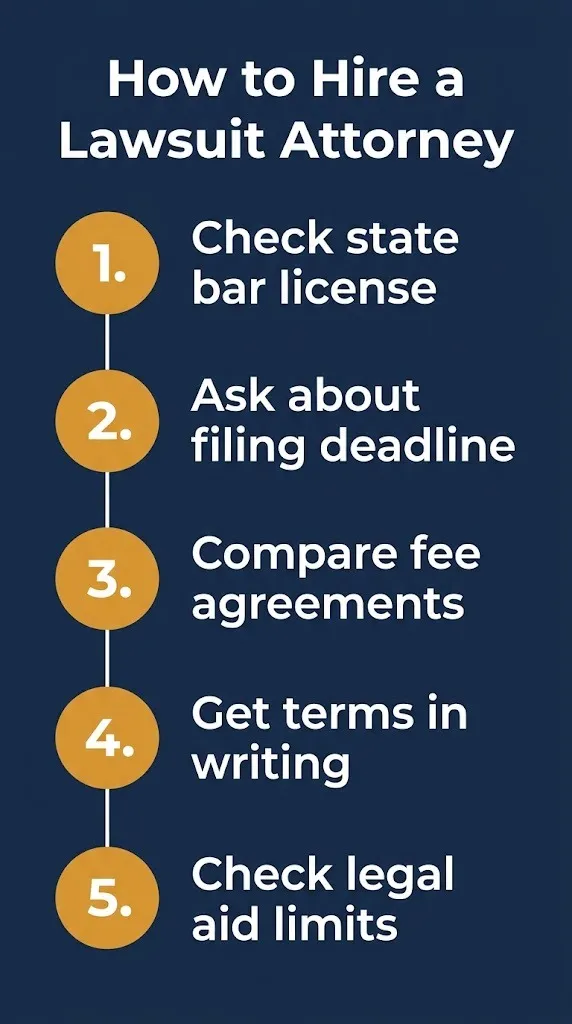
Start with your state or local bar association’s referral service, then verify every name you get. These are the steps most consumer guides recommend.
- Name your case type, such as injury, employment, or consumer.
- Contact your state or local bar referral service.
- Check the American Bar Association’s list of certified referral services.
- Verify each lawyer’s license in your state bar’s public search.
- Ask friends or relatives for recommendations.
- Contact two or three attorneys, not just one.
- Compare fee agreements side by side.
- Ask about your filing deadline before the call ends.
Step 8 matters most. A lawyer can’t fix a missed deadline.
What should you ask before you hire an attorney for a lawsuit?
Ask about the percentage at each stage, the costs you’ll owe, and your filing deadline. These questions come from consumer guides and the ABA fee rule.
- What’s your fee at settlement, at trial, and on appeal?
- Which costs will I owe, even if I lose?
- Are costs deducted before or after your fee?
- Will I get a written closing statement at the end?
- Who will actually work on my case?
- What’s my filing deadline?
- What happens if I end the relationship early?
Write down the answers. Compare them across two or three lawyers.
What must an attorney fee agreement include?
A contingent fee agreement must be a writing signed by you, under ABA Model Rule 1.5(c). It has to state how the fee is determined and which expenses come out of your recovery.
The model rule requires these items:
- The percentage or percentages for settlement, trial, or appeal
- Litigation and other expenses to be deducted
- Whether expenses come out before or after the fee
- A written statement at the end showing the outcome and your payout
States adopt their own versions. Colorado’s rule, for example, requires both lawyer and client signatures and says the lawyer keeps a copy for seven years.
A handshake isn’t an agreement. If a lawyer won’t put terms on paper, move on.
Key Takeaway: A contingency deal should be a signed writing that states percentages by stage and who pays costs before or after the fee.
Can you get a free attorney for a lawsuit if you can’t afford one?
You may qualify for free civil legal aid if your household income is at or below 125% of the federal poverty guidelines. That’s the standard for Legal Services Corporation funded programs.
- Count everyone in your household.
- Compare your income to the 2026 table in the next section.
- Contact a legal aid program in your state.
- Tell them your case type and any court date.
- If they can’t take it, ask for a referral and try a bar referral service.
Eligibility is not a promise of representation. Programs set priorities and may be full.
What are the 2026 legal aid income limits?
For a one-person household in the 48 contiguous states, the 2026 limit is $19,950. For a family of four, it’s $41,250. These are 125% of the federal poverty guidelines.
LSC published the figures January 26, 2026, based on HHS guidelines issued January 15, 2026.
| Household size | 125% limit (48 states and D.C.) | 200% reference chart |
|---|---|---|
| 1 | $19,950 | $31,920 |
| 2 | $27,050 | $43,280 |
| 3 | $34,150 | $54,640 |
| 4 | $41,250 | $66,000 |
| 5 | $48,350 | $77,360 |
The 200% chart is a reference for applicants above 125% who may qualify under exceptions. Alaska and Hawaii have higher figures. Programs not funded by LSC may use different limits, and I didn’t verify those.
What happens if you miss your state’s filing deadline?
A late claim can be dismissed no matter how strong the facts are. Filing deadlines vary by state, and your lawyer can’t undo the calendar.
I covered one example in a separate report. In Douglass v. NTI-TSS, Inc., a federal court in Maryland applied the state’s three-year limit. It held the claims time-barred as of December 31, 2007, and the suit was filed December 31, 2008.
It’s like filing a warranty claim after the warranty expired. The product may still be broken, but the window is shut.
| Question | Why it matters |
|---|---|
| When did you learn about the injury or loss? | Some states start the clock then |
| What’s your state’s deadline? | It varies and I didn’t verify each state |
| Did you contact a lawyer promptly? | Delay can cost you the claim |
Key Takeaway: Hiring a lawyer won’t help if the filing deadline has already passed, so ask about it first.
Which lawsuits can’t be handled on contingency?
A contingent fee for representing a defendant in a criminal case is barred under the ABA Model Rule. Contingency is most common in personal injury, while other practice areas tend to use hourly or flat fees.
| Case type | Common fee model |
|---|---|
| Personal injury | Contingency |
| Criminal defense | Flat or hourly. Contingency barred under the model rule |
| Family law | Hourly or flat retainer, per one law firm guide |
| Routine uncontested matters | Flat fee |
If your case has no money to recover, a contingency lawyer has nothing to take a percentage of. Expect hourly or flat fees there.
Can you negotiate an attorney’s fee?
Sometimes. Nolo says contingency percentages aren’t set by state law, and many attorneys will adjust the rate if the economics work.
A law firm guide says fees are sometimes negotiable in high-value or very clear-cut cases. Some states do cap certain fees, so the ceiling may be lower where you live.
Ask these in plain terms:
- Can the percentage be lower if the case settles before suit?
- Can costs come out after the fee is calculated?
- Is the rate the same on appeal?
You may hear no. Asking is free.
Who regulates attorneys for lawsuits?
State bars regulate lawyers, set codes of conduct, and can take disciplinary action. The ABA Model Rules are a template that states adapt, so your state’s rule may differ.
ABA Model Rule 1.5(a) bars unreasonable fees. It lists factors, including the fee customarily charged in the locality and whether the fee is fixed or contingent.
South Carolina and Colorado, for example, each adopt versions that differ from the model. That’s why your state’s rule matters more than a national summary.
If you think a lawyer overcharged you, your state bar is where complaints go. Keep your fee agreement and closing statement.
Key Takeaway: Your state’s version of the fee rule controls, so check it before you rely on any national summary.
What Happens Next
There’s no case timeline here, so these are your practical next stages.
- Today: Write down your case type, key dates, and any court papers you’ve received.
- This week: Contact a bar referral service or a legal aid program, and verify any lawyer’s license.
- Before signing: Get the fee agreement in writing with percentages by stage and cost terms.
- Expected after hiring: Receive a written closing statement when the matter ends, as the model rule requires for contingency cases.
Frequently Asked Questions
How much does a lawyer take from a settlement?
A typical injury contingency fee is 33.33% before suit and 40% in litigation.
That range comes from Texas LawHelp.
Your signed agreement sets the real number.
Do I pay a lawyer if I lose my lawsuit?
Under a contingency agreement, you usually owe no fee if you don’t recover.
You may still owe case costs.
Check the agreement for which costs apply.
Can I find a lawsuit attorney for free?
You may qualify for free civil legal aid at 125% of poverty guidelines or below.
For one person in the 48 contiguous states, that’s $19,950 in 2026.
Programs may be full.
How do I check a lawyer’s license?
Use your state bar’s public attorney search tool.
State bar associations license practicing lawyers.
Treat referral profiles as a starting point.
Is a lawyer referral service free?
Some are free, and some charge a small consultation fee.
One guide puts that fee at about $25 to $50.
Ask before you share details.
Do class action lawyers take money from my payout?
Class counsel is usually paid from the settlement fund with court approval.
The 25% benchmark applies in the Ninth Circuit.
Read the fee request in the class notice.
What’s the legal aid income limit for a family of four?
It’s $41,250 in the 48 contiguous states for 2026.
That’s 125% of federal poverty guidelines.
Alaska and Hawaii have higher limits.
Before you call any lawyer, find your state’s filing deadline and write it down. Then verify the license, ask for the fee terms in writing, and compare at least two offers.
Your deadline comes first, because no fee agreement can revive a claim that’s already expired.