Workers’ Compensation Law Firm 2026: What a Lawyer Actually Costs, When You Need One, and the Fake Hearing Scam
Quick Answer
- A workers’ compensation law firm represents injured workers on contingency. You typically pay nothing upfront, and the fee comes out of your recovery.
- Typical attorney fees run 10% to 25%, but state law caps them and a judge or board must approve the amount. California’s range is roughly 9% to 15%.
- No legitimate workers’ compensation court or attorney will ever ask you to pay a fee upfront to release a settlement. That is the 2026 scam pattern.
A workers’ compensation law firm is a legal practice that represents injured workers in claims against employers and their insurance carriers. The fee structure is the first thing to understand: you do not pay hourly, you do not pay a retainer, and you do not owe anything if the case produces no recovery. The lawyer takes a percentage of what you win.
This matters because the system is not designed to hand you a fair number automatically. Insurers work for your employer, not for you. Studies cited by practitioners show that injured workers with attorneys recover substantially more than those without, even after the fee is deducted .
This article covers what a workers’ compensation law firm actually costs, the state caps that protect you, the questions that reveal real litigation experience, the 2026 fake hearing scam, and the deadlines that decide whether you have a case at all. One detail worth knowing upfront: some states let a judge order the insurer to pay your attorney fees if the insurer wrongly denied a valid claim.
The Facts
| Item | Verified Detail |
|---|---|
| Typical Fee Structure | Contingency, paid from recovery only |
| Common Fee Range | 10% to 25% of benefits recovered |
| California Fee Range | Roughly 9% to 15%, set by judge |
| Pennsylvania Fee Cap | 20%, requires judicial approval |
| 2026 Scam Losses | At least $30,000 lost by four Wisconsin victims |
| Average Settlement | National average around $47,300, ranging widely |
| Claim Filing Deadlines | Vary by state, often 30 days to report, longer to file formally |
Is a workers’ compensation law firm legit or a scam?
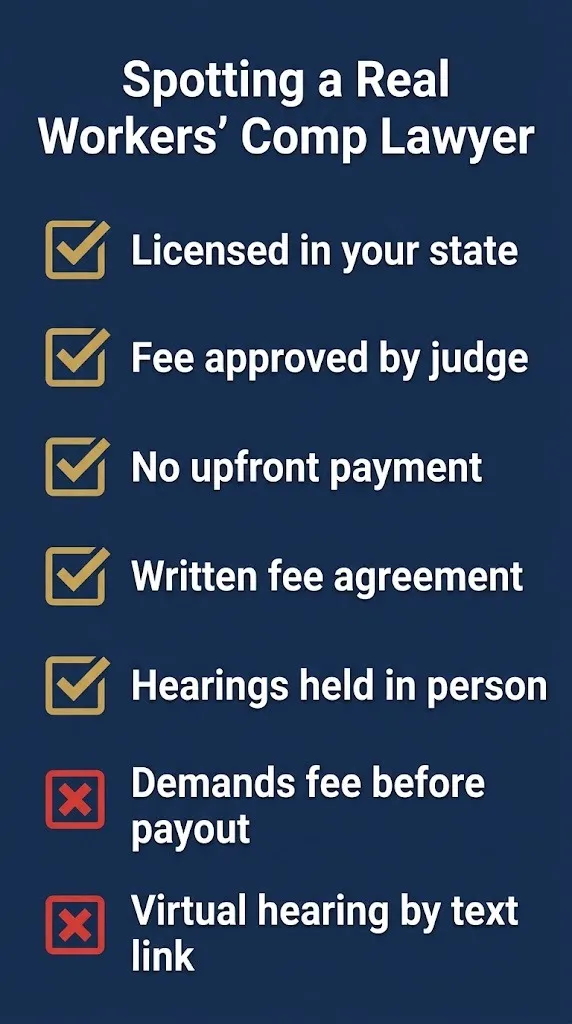
A workers’ compensation law firm is legitimate when it is licensed in your state, subject to bar discipline, and paid through a court-approved contingency fee. It is a scam when someone claiming to be your attorney demands upfront payment to release a settlement you never filed.
The 2026 scam is specific and documented. The Oklahoma Workers’ Compensation Commission issued a fraud alert in May 2026 describing callers, texters, and social media contacts who claim the worker “won” a large settlement and must pay a tax or case fee before the money is released . Some victims were sent links to fake virtual hearings with people posing as judges and bailiffs.
Wisconsin’s Department of Workforce Development reported at least four victims who paid a combined $30,000 in sham legal fees . The scam primarily targeted Spanish-speaking injured workers in multiple states.
The legitimate version looks different. Your lawyer does not call you demanding money. The fee comes out of the recovery at the end, and a judge or board approves it. The Oklahoma Commission’s own alert states plainly that no legitimate agency or court will ask for upfront payment to release benefits .
Key Takeaway: The scam is not the existence of workers’ compensation lawyers. The scam is anyone demanding money before a recovery. Real fees come out of the award, after a judge approves them.
How much does a workers’ compensation lawyer cost?
A workers’ compensation lawyer costs a percentage of what you recover, not an hourly rate or upfront retainer. The typical range is 10% to 25%, but state law caps it and a judge or board must approve the final number .
Here is how the fee works in real dollars:
| Settlement Amount | Attorney Fee | You Receive |
|---|---|---|
| $20,000 | 15% ($3,000) | $17,000 |
| $30,000 | 20% ($6,000) | $24,000 |
| $50,000 | 15% ($7,500) | $42,500 |
| $100,000 | 12% ($12,000) | $88,000 |
The percentages above are illustrative. Your actual fee depends on your state’s rules. California generally allows 9% to 15%, and the Appeals Board’s guidance puts a typical case at 9% to 12% . Pennsylvania caps fees at 20% and requires a Workers’ Compensation Judge to approve the agreement in writing . Virginia commonly uses 20% for lump sum settlements .
Some states also allow a judge to shift the fee to the insurer. If the insurer wrongly denied a valid claim and forced you to hire a lawyer to reverse the denial, the judge can order the insurer to pay your attorney fees . That is a real protection, not a marketing promise.
Key Takeaway: Your lawyer does not set the fee alone. State law caps it, and a judge or board must approve it. The fee comes from your recovery, not your pocket.
What does a workers’ compensation law firm actually do?
A workers’ compensation law firm handles the parts of your claim that insurers and employers are not motivated to handle fairly. That includes securing medical treatment, calculating wage loss, disputing unfavorable impairment ratings, and representing you at hearings if the claim is contested.
The work breaks down into several stages:
- Claim filing and documentation: Collecting medical records, wage statements, and incident reports to establish that the injury was work-related and within the filing deadline.
- Benefit calculation: Verifying that temporary disability payments equal the correct percentage of your average weekly wage, typically two-thirds in most states, capped at a state maximum .
- Medical management: Challenging insurer-directed treatment denials and independent medical exam findings that understate your impairment.
- Impairment rating disputes: The permanent impairment rating assigned by a doctor directly drives the settlement value. A lawyer reviews the rating and challenges it if it is low.
- Settlement negotiation: Insurers typically open at a fraction of the claim’s true value. Representation changes the negotiation.
- Hearings and appeals: If the claim is denied or benefits are cut off, the lawyer appears before a workers’ compensation judge.
A study cited by Gammon & Grange found that attorney-represented workers received substantially higher awards than unrepresented claimants . The reason is not that lawyers perform magic. It is that the insurer is a repeat player with a financial interest in minimizing the payout.
Key Takeaway: A workers’ compensation firm exists to level a negotiation where the other side has more information and more experience. The work is documentation, dispute, and negotiation.
How do you choose the right workers’ compensation law firm?
You choose a workers’ compensation law firm by checking its license, asking who will actually handle your case, and confirming the fee structure in writing. Advertising and awards matter less than whether the lawyer litigates cases like yours.
Here are the questions that reveal real experience, drawn from practitioner guidance :
- What percentage of your practice is workers’ compensation? You want a lawyer who works in that system daily, not a generalist who takes occasional claims.
- Who will handle my file if the claim is disputed? Some firms advertise a senior attorney but assign an associate to the hearing. Ask for names.
- How often do you appear before workers’ compensation judges? Experience in front of judges matters more than jury trial experience in this field.
- What is your fee, and does it change if the claim is denied? The fee should be disclosed in writing and subject to board approval.
- Who is my point of contact and how often will I hear updates? A high-volume firm can serve you well, but only if it is upfront about communication.
- What challenges do you expect in a case like mine? A lawyer who promises an easy result is not being honest about the insurer’s likely defenses.
- Are you licensed in this state and in good standing? Check the state bar’s public profile for license status and discipline history .
Board certification is a real credential where it exists. California, for example, certifies legal specialists in workers’ compensation, requiring an exam, at least five years of practice, and a minimum percentage of time spent in the specialty . A certified specialist is not automatically the best choice for you, but the certification is a verifiable fact, not a marketing claim.
Reality Check: No lawyer can promise you a specific settlement amount before reviewing your medical records and the insurer’s file. Any firm that guarantees a dollar figure before you sign is selling you something other than legal representation. The Oklahoma scam alert describes fraudsters who tell workers they “won” a case the worker never filed . Real lawyers start with an evaluation, not a victory announcement.
What is the workers’ compensation scam targeting injured workers in 2026?
The 2026 scam is a staged fraud that mimics the workers’ compensation system closely enough to fool injured workers under financial pressure. Scammers contact targets by phone, text, or social media, claim the worker has won a settlement, and direct them to a fake virtual hearing.
The fake hearing is the detail that makes this scam effective. Victims in Wisconsin joined video calls on Zoom, WhatsApp, or Teams and saw people posing as judges, bailiffs, and attorneys . The staged hearing ended with a ruling in the worker’s favor. Then the scammer demanded a fee to “finalize” the case and release the money.
At least four Wisconsin victims paid a combined $30,000 before realizing the hearing was fake . Some also shared Social Security numbers, creating identity theft risk.
Here are the warning signs the Oklahoma Commission published :
- The workers’ compensation commission holds hearings in person, not by phone or video.
- Official notices do not arrive by text message or social media.
- No legitimate agency asks for payment by phone, text, wire transfer, gift card, or payment app.
- Real communications do not pressure you to act immediately.
- The scam may include a fake judge in robes and people posing as court officials.
If you receive this type of contact, do not send money and do not share personal information. Verify through the official commission phone number or your own attorney’s office using a number you looked up independently.
Key Takeaway: The 2026 scam works because it imitates the real system’s language and authority. The tell is the demand for payment before any money moves. Real hearings happen in person, and real fees come out of the recovery.
How long does a workers’ compensation claim take?
A workers’ compensation claim takes anywhere from a few weeks to several years, depending on whether the insurer accepts or disputes it. Straightforward claims with accepted injuries can resolve in weeks or months. Contested claims that require hearings and appeals can take much longer.
The state deadlines for the insurer to accept or deny a claim set the early pace. Some examples from 2026 state guides:
| State | Insurer Accept/Deny Deadline |
|---|---|
| Florida | 14 days |
| Illinois | 30 days to decide after notice |
| California | 14 days to begin treatment, up to 90 days for final decision |
| New York | 18 days from claim filing |
| Pennsylvania | 21 days |
| Texas | 15 days from notice |
Source: WorkCompCalc state deadline guide .
If the insurer misses the deadline in some states, the claim can be deemed accepted by operation of law. A lawyer who tracks those deadlines can enforce automatic acceptance when the insurer fails to respond in time .
The reporting deadline for you is separate and stricter. Many states require you to report the injury to your employer within 30 days, though the range varies: Illinois allows 45 days, Pennsylvania allows 120 days for reporting . Missing the reporting deadline can jeopardize the claim regardless of how valid the injury is.
Key Takeaway: The insurer’s response deadline is not the same as your reporting deadline. Report the injury immediately, and track whether the insurer responds within its state-mandated window.
What happens next if you are considering a workers’ compensation law firm?
Here is the timeline of steps to take:
- Now: Report the injury to your employer in writing and keep a copy. Do not wait to see if it gets better.
- Within days: Document everything. Photograph the injury and the worksite. Save pay stubs, medical records, and any communication from the insurer.
- Before the insurer denies or delays: Consult a workers’ compensation lawyer. Consultations are typically free, and the fee comes from the recovery, not your pocket .
- When you hire: Confirm the fee percentage in writing and verify that a judge or board must approve it.
- If contacted by anyone demanding upfront payment: Do not pay. Verify through the state commission’s official phone number. Report the contact to your state attorney general’s consumer protection unit.
Frequently Asked Questions
How much does a workers’ compensation lawyer cost?
Workers’ compensation lawyers typically charge a contingency fee of 10% to 25% of the recovery. State law caps the fee, and a judge or workers’ compensation board must approve it before the lawyer collects anything.
Do I need a lawyer for a workers’ compensation claim?
You may not need one for a simple, accepted claim with straightforward medical treatment. You likely need one if the insurer denies the claim, cuts off benefits, disputes the impairment rating, or pressures you to settle before you understand the value.
Can I get fired for hiring a workers’ compensation lawyer?
Retaliation for filing a workers’ compensation claim is illegal in most states. If you are fired or disciplined after reporting an injury or hiring a lawyer, document the timing and contact an employment attorney or your state’s labor agency.
What is the average workers’ compensation settlement?
National data puts the average total incurred cost per claim around $47,300, combining medical and indemnity payments . Individual settlements range from a few thousand dollars for minor injuries to hundreds of thousands for catastrophic injuries.
Is it true that a judge can order the insurer to pay my lawyer?
In some states, yes. If the insurer wrongfully denies a valid claim and forces you to hire a lawyer to reverse the denial, the judge can order the insurer to pay your attorney fees . This varies by state.
What is the 2026 workers’ compensation scam?
Scammers contact injured workers claiming they won a settlement, stage fake virtual hearings with people posing as judges, and demand an upfront fee to release the money. At least four Wisconsin victims lost a combined $30,000 .
How long do I have to report a workplace injury?
Reporting deadlines vary by state. Many require reporting within 30 days, but Illinois allows 45 days and Pennsylvania allows 120 days . Report immediately regardless of the deadline.
Do workers’ compensation lawyers require a retainer?
No. The standard model is contingency, meaning no upfront payment. The lawyer advances case costs in most arrangements, and those costs are reimbursed from the recovery if there is one.
The fee is the first thing to verify and the last thing to worry about. Workers’ compensation lawyers are paid from the recovery, not from your pocket, and a judge approves the number. If anyone asks you to pay first, you are not talking to a real law firm. Report the injury now, document everything, and check your state’s reporting deadline before anything else.