Reasonable Compensation in 2026: The IRS Rule That Decides What S-Corp Owners Must Pay Themselves
Quick Answer
- Reasonable compensation is the salary an S-corp must pay an owner who works in the business. The IRS requires wages before distributions.
- There is no percentage rule. The 60/40 split and similar formulas have no legal footing and get rejected in audits.
- The penalty for underpaying is reclassification. The IRS can treat distributions as wages, triggering back payroll taxes, interest, and penalties.
If you own an S-corp and pay yourself mostly through distributions, the IRS has a number in mind for your salary. It just will not tell you what it is.
That is the trap. The agency defines reasonable compensation as what a similar business would pay for similar services under similar circumstances . No safe harbor exists. No published ratio gets you off the hook.
This guide covers what the IRS actually checks in 2026, the three methods that hold up in court, the real cases where owners lost, and the documentation that separates a defensible salary from an audit bill. The rules are facts-and-circumstances. The outcomes are not random.
The Facts
| Item | Verified Detail |
|---|---|
| Standard | Wages equal to what similar businesses pay for similar services |
| Governing guidance | IRS FS-2008-25, S Corporation Audit Technique Guide, Rev. Rul. 74-44 |
| Key court case | Watson v. Commissioner, $24,000 salary reclassified to $91,044 |
| Second key case | Radtke v. United States, zero salary meant tax on everything |
| Common myth | 60/40 or 50/50 salary-to-distribution split |
| Audit trigger | Low or zero W-2 wages relative to distributions and profit |
| Fix for past years | None retroactive. Correct prospectively through payroll |
| Documentation that matters | Contemporaneous memo, market wage data, job description |
Is reasonable compensation a real IRS rule or just a guideline?
Reasonable compensation is a real IRS requirement, not a suggestion. S-corp shareholder-employees who perform more than minor services must receive wages before taking distributions .
The rule exists because S-corp distributions escape the 15.3% self-employment tax that applies to wages. Without the reasonable compensation requirement, every S-corp owner could zero out payroll tax by calling all profit a distribution.
The IRS does not define the number. It defines the standard: the value that would ordinarily be paid for like services by like enterprises under like circumstances . Courts apply that standard to your facts.
How much should an S-corp owner pay themselves in 2026?
There is no fixed dollar amount or percentage that satisfies the IRS. The answer depends on your role, your industry, your location, and what comparable businesses pay for the work you actually perform.
The three methods that hold up are:
| Method | What It Does | Best For |
|---|---|---|
| Market approach | Compares your role to published wage data for similar positions | Owners with one primary role |
| Cost approach | Breaks your week into functions and prices each at market rate | Owners wearing multiple hats |
| Income approach | Tests whether an outside investor would accept the return after your salary | High-profit businesses with hard-to-benchmark roles |
The market approach carries the most weight in tax court . Pull data from Bureau of Labor Statistics wage surveys, industry compensation reports, and job postings for your role in your region.
Key Takeaway: The IRS does not care about a ratio. It cares whether the salary you took matches what the market would pay someone else to do your job, and whether you documented that reasoning before an audit started.
What is the Reality Check on the 60/40 reasonable compensation rule?
Reality Check: The 60/40 rule is not real. No tax code section, revenue ruling, or court decision endorses paying 60% of profit as salary and 40% as distributions. The IRS has never published a safe harbor percentage. An S-corp owner who sets salary by ratio is guessing with payroll tax exposure, and the guess gets tested in audits.
What happens if the IRS decides your salary is too low?
The IRS reclassifies distributions as wages, then assesses the employment taxes that should have been paid, plus interest and penalties. The assessment reaches back across open tax years, so the bill compounds .
The Watson case is the clearest example. An accountant paid himself $24,000 in salary while taking roughly $203,000 in distributions. The court found reasonable compensation was $91,044. The difference became wages, and the employment tax followed .
The Radtke case is worse. An attorney took no salary at all and treated everything as distribution. The court held employment tax applied to the full amount .
The lesson is not that $24,000 is always too low. The lesson is that no analysis behind the number is what loses. A documented salary that turns out conservative is a better position than a confident guess with no file behind it.
How do you document reasonable compensation to survive an audit?
Documentation is the difference between a defensible salary and a reclassification. The IRS expects a contemporaneous record showing the method, the data, and the reasoning you used when you set the number.
The file should include:
- A written job description listing your actual duties and hours
- Wage data from BLS, industry surveys, or compensation reports for your role and region
- A memo explaining which method you used and why
- Payroll records showing consistent W-2 wages through the year
- Annual review notes if your role or the market changed
The memo does not need to be elaborate. It needs to exist before the audit notice, not after .
A store return without a receipt depends on the manager’s discretion. An S-corp salary defense depends on a file you built before anyone asked. The file is the receipt.
What is a reasonable compensation report and do you need one?
A reasonable compensation report is a formal document that applies the valuation methods to your specific role and produces a salary figure with supporting data. It is not an IRS form. It is a defensive record.
Reports vary in cost and depth. A basic market analysis using published wage data is cheaper than a full income-approach appraisal, which can run into thousands of dollars and take weeks .
Most solo S-corp owners do not need the expensive version. They need a market approach analysis with two or three credible data points, a written explanation, and an annual review. The report matters most when your salary is low relative to profit, when your role is unusual, or when your industry has wide pay ranges.
What are the steps to set a defensible salary for 2026?
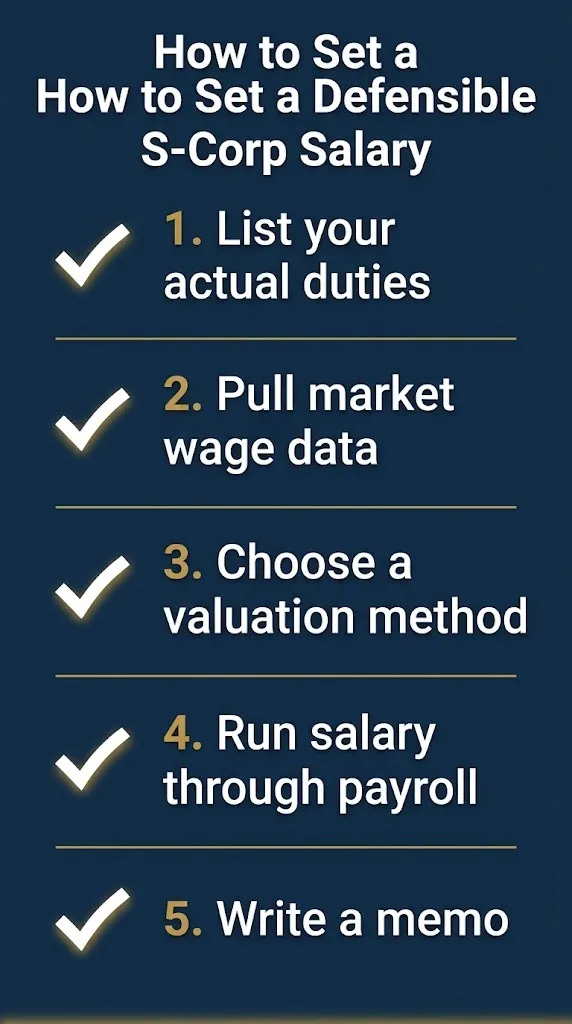
- List what you actually do. Write down your duties, the hours you spend on each, and the decisions you make.
- Pull market wage data. Use BLS occupational wage statistics, industry salary surveys, and job postings for your role and region.
- Choose a method. Market approach for one role, cost approach for multiple roles, income approach only if the first two cannot produce a number.
- Set the salary before you take distributions. Wages must be paid through payroll during the year, with withholding and a W-2.
- Write a memo. Record the method, sources, and reasoning. Date it when you set the salary.
- Run payroll consistently. Monthly or semi-monthly, not a year-end lump sum labeled as salary.
- Review annually. If your role, revenue, or the market changes, revisit the number and document the review.
What happens next in the reasonable compensation audit cycle?
Expected timing depends on your filing position:
- If you set salary correctly: No action. Keep the documentation file current.
- If you underpaid in a prior year: You cannot retroactively reclassify distributions as wages. Correct prospectively through payroll starting now .
- If you receive an IRS notice: The examination typically begins with a request for payroll records, the S-corp return, and your compensation analysis.
- If the IRS proposes reclassification: You can respond with your documentation. The quality of the file determines whether the adjustment shrinks or stands.
- If you agree or lose: The assessment includes both employee and employer FICA shares, FUTA where applicable, interest, and penalties. Corrections run through Form 941-X .
Frequently Asked Questions
What is reasonable compensation for an S-corp?
Reasonable compensation is the salary an S-corp must pay an owner-employee for services performed, measured by what similar businesses pay for similar work under similar circumstances.
Is there a minimum salary requirement for an S-corp?
No fixed minimum exists. The IRS requires a salary that reflects the market value of your services, and zero or near-zero wages while taking distributions is the most audit-prone position.
Does the 60/40 rule work for S-corp salary?
No. The 60/40 split has no legal basis. Courts and the IRS reject mechanical ratios and require a facts-and-circumstances analysis tied to market wage data.
What happens if I pay myself too little from my S-corp?
The IRS can reclassify distributions as wages, assess back payroll taxes, add interest and penalties, and apply the adjustment across open tax years.
Can I fix a low salary from last year?
No. You cannot retroactively reclassify prior-year distributions as wages or issue a late W-2 to fix it. The correction is prospective, through payroll going forward.
Do I need a professional reasonable compensation report?
Not always. A market analysis with credible wage data and a written memo is sufficient for many solo owners. A formal report helps when your role is unusual or your salary is far below market.
What wage data should I use for reasonable compensation?
Bureau of Labor Statistics occupational wage data, industry compensation surveys, and job postings for your role and region are the standard sources that hold up in audits.
Closing
The number on your W-2 is the one the IRS checks first. Set it with market data, write down why, and run it through payroll all year.
If you have been taking distributions with little or no salary, correct it prospectively before an examiner does it for you. The file you build now is the defense you will need later.