Virginia Workers Compensation Attorney in 2026: Deadlines, Fees, and What the State Actually Pays
Quick Answer
- Is it legit? Yes. Virginia workers’ comp is a real, state-run no-fault system, not a lawsuit against your boss.
- How much? Wage-loss benefits pay two-thirds of your average weekly wage, capped at $1,507.01 per week for 2026 injuries.
- Most important deadline? You generally must file a formal claim with the Virginia Workers’ Compensation Commission within two years of the accident.
If you were hurt on the job in Virginia, you’re probably getting conflicting advice. Your employer says they’ll handle it. A coworker says you need a lawyer yesterday. The insurance adjuster sounds helpful.
Here’s what the statute actually says. Virginia’s workers’ comp system is not a lawsuit. It’s a state-administered benefit program with firm deadlines, and the biggest risk to your claim is missing one.
This article walks through the real rules, the real deadlines, and the real numbers. It also explains when a Virginia workers compensation attorney earns their fee and when you can probably handle it yourself.
The Facts
| The Facts | |
|---|---|
| System | Virginia Workers’ Compensation Commission (VWC), state agency |
| Claim Deadline | Generally two years from the accident date |
| Employer Notice | 30 days from injury, in writing |
| Max Weekly Benefit | $1,507.01 for injuries July 1, 2026 through June 30, 2027 |
| Wage Replacement Rate | 66 2/3 percent of average weekly wage |
| Attorney Fees | Subject to VWC approval; contingency fees often 20 to 25 percent |
| Pain and Suffering | Not available under Virginia workers’ comp |
Do You Need a Virginia Workers Compensation Attorney?
You don’t need one to file a claim, but you may need one if your claim is denied, your benefits are cut off, or the insurer disputes your injury. The Virginia Workers’ Compensation Commission is designed to let workers file claims without a lawyer.

The claim form is available online through the VWC’s WebFile portal, by mail, or in person at a Commission office . Filing it costs nothing.
Where a lawyer earns their keep is in the disputes. Insurers deny claims regularly. They argue the injury didn’t happen at work. They argue it’s a pre-existing condition. They argue you missed a deadline.
A 2026 analysis of Virginia workers’ comp practice puts it plainly: the insurance company has trained adjusters who have handled thousands of cases, and you have likely never filed one . That imbalance is the argument for hiring counsel.
The other trigger is a settlement offer. Virginia allows compromise and release agreements that close your claim permanently. Once you sign, you generally cannot reopen it . An attorney can tell you whether the number covers your future medical needs.
How Much Does a Virginia Workers Compensation Lawyer Cost?
Virginia workers’ comp attorney fees are not set by the free market alone. The Virginia Workers’ Compensation Commission must approve them . That’s a consumer protection most people don’t know about.
Contingency fees in Virginia workers’ comp typically run 20 to 25 percent of the recovery . That means the attorney takes a cut of what you win, not an hourly bill upfront.
Hourly rates exist too. One Virginia workers’ comp attorney lists rates of $250 to $275 per hour . That structure is more common in complex disputes or when the fee comes from a specific fund rather than your benefits.
The VWC has power to order repayment of any fee it finds excessive . If you think you were overcharged, you have a forum.
| Fee Type | Typical Range | Who Approves |
|---|---|---|
| Contingency | 20 to 25 percent | VWC |
| Hourly | $250 to $275 | VWC review on request |
| Flat fee | Varies by case | VWC |
How Much Are Virginia Workers Comp Settlements?
There is no official average settlement figure for Virginia workers’ comp, and anyone quoting one is guessing. The VWC doesn’t publish a settlement database. What exists are reported case outcomes and modeled estimates.
One 2026 analysis lists recent Virginia workers’ comp outcomes including a $2.8 million settlement for a truck driver with partial quadriplegia and a $2.4 million settlement for a 25-year-old HVAC technician with paraplegia . Those are catastrophic injury cases, not typical ones.
For more routine injuries, settlement value depends on your average weekly wage, your impairment rating, and whether you have future medical needs. A shoulder injury at 20 percent impairment does not pay the same as a back fusion.
One important limit: Virginia caps most workers’ comp awards at 500 weeks total . The cap does not apply if you’re found permanently and totally incapacitated, which the statute defines narrowly.
Reality Check: No one texts you workers’ comp money first. The VWC doesn’t call you asking for a filing fee. If a “claims helper” wants payment to “unlock” your settlement, it’s a scam. Filing a claim with the Commission is free .
What Is the Deadline to File a Virginia Workers Comp Claim?
The deadline is generally two years from the date of your accident, and it is filed with the Virginia Workers’ Compensation Commission, not your employer . Reporting the injury to your boss does not satisfy this deadline.
The VWC is explicit about this. Notifying your employer is not the same as filing a claim . You can tell your supervisor the day it happens, get medical treatment, receive voluntary wage payments, and still lose your rights if no claim form reaches the Commission within two years.
There are exceptions for occupational diseases. For most occupational diseases, the deadline runs two years from when a doctor told you the disease was work-related, and within five years of your last workplace exposure .
If your claim was accepted and you later become disabled again after returning to work, a new deadline can apply. You generally must file within two years of the last date you were paid compensation under the award .
What Is the 30-Day Rule for Reporting a Virginia Work Injury?
You must report your injury to your employer within 30 days, and you should do it in writing . Verbal notice to a supervisor is better than nothing, but a written report with a copy you keep is the version that survives a dispute.
The VWC’s own guidance says to report immediately, and no later than 30 days from the injury date . Miss it and you risk losing your right to benefits.
What should the report include? The date, time, and place. How it happened. What body part was hurt. Send it by email or text if that’s how your workplace communicates, and save the sent copy.
This is the step where injured workers most often hurt themselves. They assume the accident report their supervisor filed counts. Sometimes it does. Sometimes it doesn’t describe the injury accurately. You want your own record.
How Do You File a Workers Comp Claim in Virginia?
Filing a claim means submitting a Claim Form to the Virginia Workers’ Compensation Commission. It does not mean telling your employer. Those are two separate acts, and only one protects your legal rights .
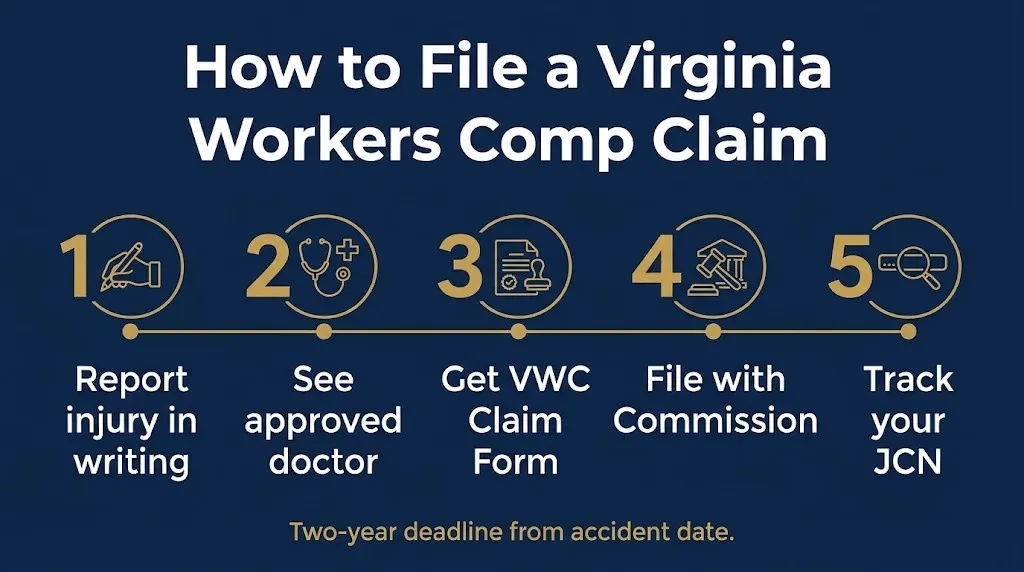
Here are the steps:
- Report the injury to your employer in writing within 30 days, keeping a copy.
- Get medical treatment from a doctor on your employer’s panel, or emergency care if urgent.
- Obtain the Claim Form from the VWC website or a Commission office.
- Complete the form with your injury details, employer information, and wage information.
- File it with the Commission by WebFile, mail, fax, or in person .
- Keep your JCN and PIN once assigned, which let you track the claim online.
- Follow your doctor’s restrictions and send work notes to your employer.
- Watch for a denial letter, which must include your right to dispute the decision .
The claim form is free. The Commission does not charge a filing fee .
What Happens If Your Virginia Workers Comp Claim Is Denied?
A denial is not the end. It means the insurer is refusing to pay voluntarily, and you have the right to dispute it through the Commission . The denial letter is required by law to tell you that.
Virginia Code § 65.2-601.3 requires insurers to include specific language in denial letters: you have the right to file a Request for a Hearing with the VWC, and your claim may be lost if you don’t file within the time limit, typically two years after the injury .
The hearing happens before a deputy commissioner. You present medical records, testimony, and evidence that the injury happened at work. The Commission does not charge for the hearing .
If you lose at that level, you can appeal to the Full Commission within 30 days of the deputy commissioner’s decision . The Full Commission reviews the written record, not new testimony. After that, the Virginia Court of Appeals is the next step, with a narrow standard of review .
Most denials are fought and won at the deputy commissioner level or resolved by settlement before a hearing.
How Long Does a Virginia Workers Comp Case Take?
Most contested cases take months, not weeks. A hearing before a deputy commissioner is typically scheduled within three to six months of filing your Request for Hearing, though docket times vary by district .
A Full Commission review adds more months after the deputy commissioner rules. A Court of Appeals proceeding can take a year or more .
Accepted claims with no dispute move faster. If the insurer voluntarily pays medical bills and wage loss, you may never need a hearing. But you still must file the claim form to protect your rights, even if the insurer is paying .
Settlement timelines vary wildly. A straightforward compromise and release can close in weeks once both sides agree. A disputed catastrophic injury case can run for years.
What Happens Next
October 2026: Maximum weekly benefit of $1,507.01 applies to injuries occurring July 1, 2026 through June 30, 2027 .
January 1, 2028: Burial expenses and transportation expense caps adjust annually for inflation under 2026 legislation .
Ongoing: The two-year claim deadline runs from your accident date, so calendar it the day you’re hurt.
Ongoing: The 30-day employer notice deadline runs from the injury date, so write the report immediately.
Frequently Asked Questions
How long do I have to file a workers comp claim in Virginia?
Generally two years from the date of your accident.
That deadline is filed with the Virginia Workers’ Compensation Commission, not your employer.
Do I have to hire a lawyer for workers comp in Virginia?
No, you can file a claim without one.
A lawyer becomes important if your claim is denied, your benefits stop, or you’re offered a settlement.
How much does a Virginia workers comp lawyer charge?
Contingency fees typically run 20 to 25 percent.
The Virginia Workers’ Compensation Commission must approve the fee.
What is the maximum weekly workers comp benefit in Virginia for 2026?
$1,507.01 per week for injuries occurring July 1, 2026 through June 30, 2027.
The minimum is $376.75 per week.
Can I sue my employer instead of filing workers comp?
Generally no.
Workers’ comp is the exclusive remedy against your employer in Virginia, with narrow exceptions.
What if my employer didn’t report my injury?
Your employer’s failure doesn’t excuse your deadline.
You must still file a Claim Form with the Commission within two years.
Can I pick my own doctor for a Virginia work injury?
Usually no for initial treatment.
Your employer provides a panel of approved doctors, and you choose from that list.
What if I miss the 30-day reporting deadline?
You may lose your right to benefits.
The VWC says failure to report within 30 days could result in losing workers’ compensation benefits.
The One Thing to Do Now
Write down the date of your injury and count forward 30 days and two years. Put both dates in your phone calendar today.
If the 30-day mark is close, send a written report to your employer before you do anything else. The Virginia Workers’ Compensation Commission’s two-year deadline is the one that ends claims permanently.