Workers Compensation Coverage 2026: What Is Covered, State Rules, and Employer Requirements
Quick Answer:
- Workers compensation coverage is mandatory employer-paid insurance that covers medical care and partial wage replacement for job-related injuries.
- Coverage requirements vary by state; New York and California have specific mandates, while Texas allows employers to opt out.
- There is no single deadline for coverage, but employers face daily fines for noncompliance, and injured workers must report injuries within state deadlines, typically 30 days.
You got hurt at work. Or you are an employer trying to figure out whether you need workers compensation insurance and what it covers. Either way, you are dealing with a system that is mandatory in 49 states, expensive for businesses, and, for injured workers, often harder to navigate than the injury itself. This article explains what workers compensation covers, what it does not cover, how New York and California handle it differently, and what happens when coverage is missing.
Workers compensation is not a single federal program. It is fifty separate state systems, each with its own rules, benefit levels, and enforcement mechanisms. The basic tradeoff is the same everywhere: the employer pays for insurance, and in exchange, the employee cannot sue the employer for a workplace injury. The employee gets medical treatment and partial wage replacement without proving fault. The employer gets immunity from personal injury lawsuits.
One fact that surprises many injured workers: workers compensation does not cover pain and suffering. The tradeoff for the no-fault system is that non-economic damages, the largest component of many personal injury settlements, are off the table. You get your medical bills paid and a portion of your lost wages. Nothing more.
| The Facts | |
|---|---|
| Governing Law | State workers compensation statutes; federal programs for specific employee groups |
| Federal Oversight | OSHA for workplace safety; Department of Labor OWCP for federal employees, longshore workers, and coal miners |
| Coverage Requirement | Mandatory in 49 states for most employers; Texas allows opt-out |
| Covered Injuries | Job-related injuries and occupational diseases arising out of and in the course of employment |
| Benefits Provided | Medical care, temporary disability, permanent disability, vocational rehabilitation, death benefits |
| Wage Replacement | Typically 66.67% of average weekly wage, subject to state maximums |
| Employee Cost | Zero; employer pays all premiums, and deducting from wages is illegal in all states |
| Statute of Limitations | Varies by state; typically 1 to 3 years from injury date or discovery |
What Is Covered by Workers Compensation?
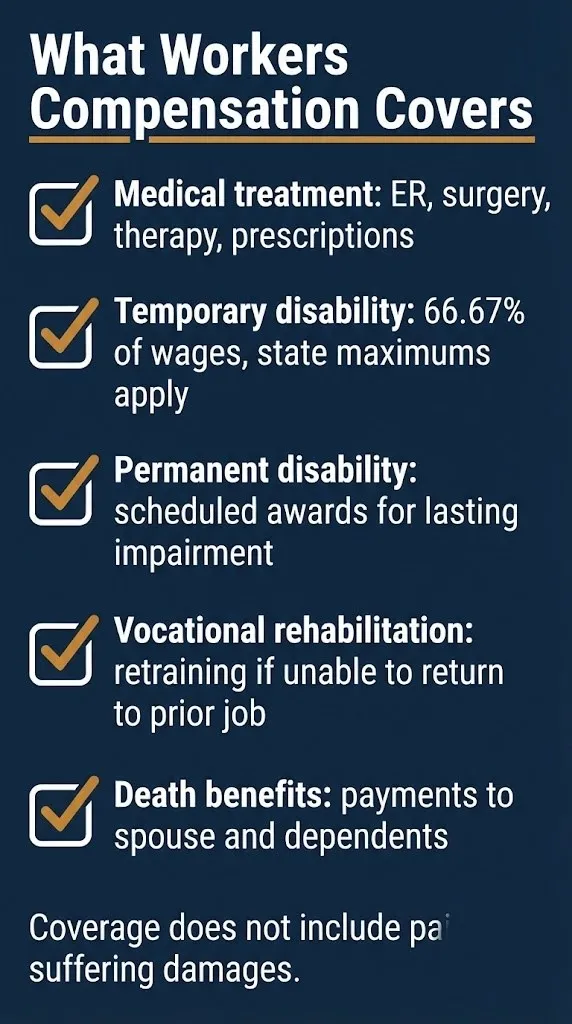
Workers compensation covers medical treatment, partial wage replacement, permanent disability benefits, and vocational rehabilitation for injuries and illnesses that arise out of and in the course of employment. The injury must be work-related. This is the fundamental eligibility requirement.
Medical treatment covered under workers compensation includes emergency room visits, hospital stays, surgery, prescription medications, physical therapy, chiropractic care, and medical equipment. In most states, the employer or its insurance carrier chooses the treating physician, at least initially. This is a frequent source of frustration for injured workers who prefer their own doctor.
Temporary disability benefits replace a portion of lost wages while the injured worker cannot work. The standard rate is two-thirds of the average weekly wage, subject to a state maximum. In New York, the maximum weekly benefit for 2026 is not yet confirmed from the Workers’ Compensation Board but is adjusted annually. In California, the maximum temporary total disability rate for 2026 is tied to the state average weekly wage and adjusted each January.
Permanent disability benefits apply when the injury results in lasting impairment. Permanent partial disability compensates for impairment that does not prevent all work. Permanent total disability compensates for injuries that prevent any gainful employment. The amount and duration depend on the body part injured, the impairment rating assigned by a physician, and the state’s benefit schedule.
Death benefits provide payments to the dependents of a worker killed on the job. These typically include funeral expenses and ongoing payments to a surviving spouse and children. The amount and duration vary by state.
Key Takeaway: Workers compensation covers medical bills and partial wages for work-related injuries; it does not cover pain and suffering, and the no-fault system means you cannot sue your employer regardless of who caused the injury.
What Is Not Covered by Workers Compensation?
Workers compensation is not health insurance. It is not general disability insurance. The injury must be work-related, and several categories of harm are excluded even if they occur at work.
Injuries caused by intoxication or drug use are excluded in every state. If a drug or alcohol test shows intoxication at the time of injury, the claim will likely be denied. The burden is on the employer or insurer to prove intoxication was the cause of the injury.
Self-inflicted injuries are excluded. This includes injuries from fights the employee started, unless the nature of the job required confrontation, as in security work. The line between self-inflicted and work-caused can become blurry in high-stress occupations, but the statutory exclusion is clear.
Injuries occurring off the clock are generally excluded. The injury must arise out of and in the course of employment. Commuting to and from work is typically not covered under the going and coming rule. There are exceptions for travel required by the job, injuries on the employer’s premises, and special missions performed for the employer.
Idiopathic injuries, those caused by a personal condition unrelated to work, may not be covered. A heart attack at a desk job may not be compensable if the work did not contribute to the event. If the same heart attack occurred while operating heavy machinery, the work connection might be clearer.
Stress-related claims without physical injury are treated differently by state. Some states allow psychiatric injury claims without physical harm. Others require a physical injury as a predicate. California allows pure psychiatric claims if the stress is predominantly work-related. New York requires a physical injury in most cases.
Workers Compensation Insurance in New York
New York requires workers compensation insurance for virtually all employers. The New York Workers’ Compensation Law is one of the most comprehensive in the country. There is no minimum number of employees. Even a single part-time employee triggers the requirement.
The New York State Workers’ Compensation Board oversees the system. Employers must obtain coverage through a private insurance carrier, the New York State Insurance Fund, or self-insurance for large, financially qualified employers. Failure to carry coverage is a criminal misdemeanor, and penalties include fines of up to $2,000 per ten-day period of noncompliance, plus potential personal liability for the employer.
New York’s benefit levels are among the highest nationally. Temporary disability benefits are two-thirds of the average weekly wage, up to a statutory maximum that is adjusted annually. The maximum has historically been higher than most states. Permanent disability classifications include scheduled loss of use awards for specific body parts, with values set by statute. A total loss of an arm, for example, carries a specified number of weeks of benefits at the temporary disability rate.
New York uses a durational limit on temporary disability benefits. Benefits are paid for the duration of the disability, subject to a cap on the number of weeks based on the injury classification. For permanent partial disability, benefits may continue for up to 525 weeks for certain classifications, less for others.
The claim filing process in New York requires the employee to notify the employer within 30 days of the injury. The employer must file a C-2 form with the Workers’ Compensation Board within ten days of learning of the injury. The employee files a C-3 form to formally initiate the claim. The statute of limitations is two years from the date of injury or from the date the employee knew or should have known the injury was work-related.
Workers Compensation Insurance in California
California requires all employers with one or more employees to carry workers compensation insurance. There is no exception for small businesses, family members, or part-time workers. The Division of Workers’ Compensation, part of the California Department of Industrial Relations, administers the system.
California’s maximum temporary total disability benefit for 2026 is tied to the state average weekly wage. The benefit is two-thirds of the worker’s average weekly wage, subject to a statutory maximum and minimum. The maximum adjusts annually based on wage data.
California uses the American Medical Association Guides to the Evaluation of Permanent Impairment, combined with a formula that considers the worker’s occupation and age, to determine permanent disability ratings. The rating is expressed as a percentage of total disability, which is then converted to a dollar amount and paid in weekly installments.
A unique feature of California workers compensation is the utilization review process. Medical treatment requests are subject to prospective review by the insurer, which can approve, modify, or deny treatment based on medical necessity guidelines. This system has been controversial, with critics arguing it delays or denies necessary care.
California employers must post a notice of workers compensation coverage in the workplace. The notice must include the name of the insurance carrier and instructions for reporting an injury. Employees must report injuries within 30 days. The statute of limitations for filing a claim is one year from the date of injury or the date the employee knew or should have known the injury was work-related.
California Workers Compensation Verification
California provides a public verification system that allows anyone to check whether an employer has workers compensation coverage. This tool is used by employees, contractors, and other businesses to verify compliance before working with a company.
The coverage verification tool is maintained by the Workers’ Compensation Insurance Rating Bureau, or WCIRB. It requires the employer’s legal name or federal employer identification number. The search returns the insurance carrier name, policy number, and effective dates of coverage. This information is public record.
Verification matters for several reasons. An uninsured employer is personally liable for all the benefits an injured worker would have received under a valid policy. The employer also faces penalties from the Division of Workers’ Compensation, including stop-work orders and fines of up to $10,000 per employee. In serious cases, uninsured employers can face criminal charges.
For workers, verification is a way to confirm coverage before an injury happens. If you work in an industry with high injury rates, construction, agriculture, manufacturing, checking your employer’s coverage is a simple step that can prevent a financial disaster later. If the employer has no coverage, the worker can file a claim with the Uninsured Employers Benefits Trust Fund, or UEBTF, which pays benefits and then pursues reimbursement from the employer.
For independent contractors and subcontractors, verifying the hiring party’s coverage protects against misclassification. If an uninsured contractor is injured, the general contractor or property owner may be liable. California’s presumption of employment in construction means a worker is presumed to be an employee unless specific criteria are met, making verification even more important.
What Are Workers Compensation Insurance Coverages?
Workers compensation insurance policies contain several standard coverage components. Understanding what your policy covers helps employers avoid gaps that can become personal liability.
Part A, the statutory coverage, is the core of the policy. It pays whatever benefits the state workers compensation law requires for a covered injury, without dollar limits per injury or per employee. The insurer agrees to pay all benefits mandated by law. This is the coverage that satisfies the employer’s legal obligation.
Part B, employers liability coverage, protects the employer from lawsuits that fall outside the exclusive remedy of workers compensation. These are rare but can include claims by third parties who seek contribution from the employer, claims by the injured worker’s spouse for loss of consortium, and claims by employees who can sue because the employer failed to carry coverage. Employers liability limits are typically $100,000 per accident, $100,000 per employee for disease, and $500,000 policy aggregate for disease.
Other states coverage is an endorsement that extends coverage to states where the employer does business but has not separately insured. If a New York employer sends an employee to California for a project and the employee is injured there, other states coverage provides the California benefits. This is critical for businesses that operate across state lines.
Federal coverage endorsements apply to employees covered by federal workers compensation programs, including the Longshore and Harbor Workers’ Compensation Act, the Jones Act for maritime workers, and the Federal Employees’ Compensation Act. These endorsements are necessary only for employers with workers in those specific categories.
Key Takeaway: A workers compensation policy has two core parts: statutory coverage that pays benefits required by state law, and employers liability coverage that protects against lawsuits; gaps in either can expose the employer to catastrophic personal liability.
Workers Compensation Insurance for Employers
Employers have legal obligations that go beyond simply buying a policy. The obligations start before the first employee is hired and continue after the last employee leaves.
The first obligation is to obtain coverage from a licensed carrier, a state fund, or through approved self-insurance. In monopolistic states, North Dakota, Ohio, Washington, Wyoming, employers must buy from the state fund. In other states, the private market is available. The cost of coverage depends on the employer’s industry classification, payroll, and claims history, known as the experience modification factor.
The second obligation is to post required notices. Every state requires a workplace poster that explains workers compensation rights, lists the insurance carrier, and provides instructions for reporting an injury. The poster must be visible to all employees. Failure to post can extend the time an employee has to report an injury.
The third obligation is to report injuries promptly. When an employer learns of a workplace injury, it must report it to its insurance carrier and, in most states, to the state workers compensation agency, within a specified timeframe. In New York, the C-2 form must be filed within ten days. In California, the DWC-1 claim form must be provided to the employee within one working day of learning of the injury.
The fourth obligation is to not retaliate. Every state prohibits retaliation against an employee who files a workers compensation claim. Retaliation claims are one of the few exceptions to the exclusive remedy rule, meaning an employee can sue the employer directly for retaliatory discharge or demotion, and damages can include emotional distress and punitive damages, which workers compensation does not cover.
What Happens If an Employer Has No Workers Compensation Coverage?
An uninsured employer faces consequences that range from expensive to ruinous. The legal system takes coverage lapses seriously because the entire workers compensation bargain depends on employers holding up their end.
The most immediate consequence is personal liability for the injured worker’s benefits. The employer must pay out of pocket for medical care, wage replacement, and disability benefits, amounts that can exceed $100,000 for a serious injury. Unlike an insurance policy with statutory limits, there is no cap on the employer’s liability. The employer pays every dollar the worker would have received under a valid policy.
Administrative penalties vary by state. In New York, the Workers’ Compensation Board can impose fines of up to $2,000 per ten days of noncompliance and issue a stop-work order that shuts down the business until coverage is obtained. In California, the Division of Workers’ Compensation can fine up to $10,000 per employee and issue a stop-work order. The Uninsured Employers Benefits Trust Fund pays the injured worker and then sues the employer for reimbursement.
Criminal liability is possible for willful noncompliance. In New York, failure to secure workers compensation coverage is a misdemeanor for a first offense and a felony for subsequent offenses. In California, it is a misdemeanor punishable by up to one year in jail and a fine.
The exclusive remedy defense is lost. An uninsured employer can be sued directly by the injured employee in a personal injury lawsuit. The employee can recover full damages, including pain and suffering, which workers compensation does not provide. This is the nuclear option for an injured worker and the worst-case scenario for an uninsured employer.
Reality Check: Workers compensation coverage is not optional in 49 states. The cost of the policy is a fraction of the cost of one serious injury without it. If you are an employer considering going without coverage, the math does not work. One back surgery, one fracture, one head injury, and the financial consequences will exceed years of premium payments.
What Happens Next
Workers compensation coverage rules are stable in 2026. No major federal legislation is pending. State benefit maximums adjust annually for inflation, and the trend toward slightly higher benefits continues as wages rise. The most significant regulatory activity involves independent contractor classification, as states continue to tighten rules around who qualifies as an employee for coverage purposes.
For injured workers, the next step after an injury is to report it immediately, seek medical attention through the employer’s designated provider if required, and document everything. The reporting deadline is short, typically 30 days, and a missed deadline can bar the claim even if the injury is severe.
For employers, the next step is to audit your coverage. Verify that your policy covers all locations, all employees, and all states where you do business. Check that your experience modification factor is accurate. A single misclassified employee or an uncovered state can undo years of careful risk management.
Frequently Asked Questions
Does workers compensation cover all employees?
Not exactly. Independent contractors are generally excluded, though misclassification is common.
Domestic workers, agricultural workers, and casual labor have different coverage rules by state.
Corporate officers and LLC members can often opt out, but the rules vary by state and entity type.
Can I see my own doctor for a work injury?
It depends on your state. Most states allow the employer or insurer to choose the initial treating physician.
Some states allow a change of physician after a specified period or with insurer approval.
California and New York have pre-designation rules that let employees name a personal physician in advance.
How long do workers compensation benefits last?
Temporary disability benefits last until you return to work or reach maximum medical improvement.
Permanent partial disability benefits are paid for a fixed number of weeks based on the impairment rating.
Permanent total disability benefits may continue for life in some states.
What if my workers compensation claim is denied?
You have the right to appeal the denial through your state workers compensation board or commission.
The appeal process typically involves a hearing before an administrative law judge.
Most states require appeals to be filed within a strict timeframe, often one to two years from the denial.
Can I sue my employer for a work injury?
Generally no. Workers compensation is the exclusive remedy for workplace injuries.
Exceptions include intentional harm by the employer, failure to carry coverage, and retaliation for filing a claim.
If a third party caused your injury, you can sue them separately while receiving workers compensation benefits.
How are workers compensation premiums calculated?
Premiums are based on the employer’s industry classification code, total payroll, and experience modification factor.
Higher-risk industries pay higher rates per $100 of payroll.
The experience modification compares the employer’s claims history to similar businesses in the same industry.
Does workers compensation cover remote work injuries?
Yes, if the injury arises out of and in the course of employment.
The injury must be work-related, not from a personal activity during work hours.
Home office ergonomic injuries are increasingly recognized as compensable claims.
What is an independent medical examination?
An IME is a medical evaluation conducted by a doctor chosen by the insurance carrier.
The purpose is to assess the injury, treatment necessity, and disability status.
The IME physician’s opinion carries significant weight in claim decisions and benefit determinations.
What You Should Do Now
If you are an injured worker, report your injury to your employer immediately, in writing if possible. The clock on your claim starts the day your employer learns of the injury. If your employer has no coverage or denies your claim, contact your state workers compensation board for guidance on filing a claim with the uninsured employers fund or appealing the denial.
If you are an employer, verify your coverage is current and covers all employees. Post the required notice where your employees can see it. If an injury occurs, file the required forms with your carrier and the state within the mandated timeframe. The single most expensive mistake an employer makes is delaying the report and giving the insurer grounds to dispute the claim.