Personal Injury Lawsuit 2026: How It Works, What You Can Recover, and How to Fight One
Quick Answer:
- A personal injury lawsuit is a civil case filed by an injured person seeking money from the party responsible for their injuries.
- Compensation ranges from thousands to millions depending on injury severity, available insurance, and the defendant’s assets.
- The most critical deadline is the statute of limitations, typically 1 to 3 years from the injury date depending on your state.
You searched this because you got hurt, or someone you know got hurt, and you need to understand what a personal injury lawsuit actually involves. Maybe an insurance adjuster just called and offered a number. Maybe you received a letter saying you are being sued. Maybe you are trying to decide whether hiring a lawyer is worth it. You want the straight answer, not a sales pitch from a billboard attorney.
This affects anyone injured in a car crash, a slip and fall, a defective product incident, a dog bite, a medical mistake, or any other situation where someone else’s actions or negligence caused harm. Millions of personal injury claims are filed each year. The vast majority settle. A tiny fraction go to trial. The system is designed to resolve cases through negotiation and settlement, not courtroom drama. Understanding that reality is the first step to navigating it.
This article covers how a personal injury lawsuit works in 2026, what kinds of compensation you can realistically expect, how long the process takes, what it costs, how to defend yourself if you are the one being sued, and the mistakes that destroy otherwise valid claims. One fact that surprises most people: even if you win at trial, collecting the judgment is a separate battle, and roughly 80 percent of uninsured-defendant judgments are never collected in full.
The Facts
| Detail | Information |
|---|---|
| Annual Filings | Over 300,000 tort cases filed in U.S. federal and state courts annually |
| Settlement Rate | 95 to 97 percent of cases settle before trial |
| Average Duration | 12 to 24 months from filing to settlement for typical cases. 2 to 4 years if trial is required |
| Contingency Fee Range | 25 to 40 percent of the recovery, depending on case stage and jurisdiction |
| Statute of Limitations | Typically 1 to 3 years from injury date. Varies by state and claim type |
| Tax Treatment | Compensatory damages for physical injury are generally not taxable. Punitive damages and interest are taxable |
| Insurance Role | The defendant’s insurance typically pays. Personal assets are at risk only if insurance limits are exceeded |
What Is a Personal Injury Lawsuit?
A personal injury lawsuit is a civil legal action filed by an injured person, called the plaintiff, against the person or entity they claim caused the injury, called the defendant. The plaintiff seeks money, called damages, to compensate for medical bills, lost income, pain and suffering, and other losses caused by the injury. The lawsuit is based on the legal theory of negligence, strict liability, or intentional wrongdoing depending on how the injury occurred.
Negligence is the most common basis. It requires proving four elements: the defendant owed the plaintiff a duty of care, the defendant breached that duty, the breach caused the injury, and the plaintiff suffered actual damages. A driver has a duty to obey traffic laws. Running a red light breaches that duty. If the breach causes a crash that injures another driver, the elements are satisfied. The injured driver has a personal injury claim.
Strict liability applies in specific circumstances, primarily defective products and certain abnormally dangerous activities. The plaintiff does not need to prove negligence. Only that the product was defective, the defect caused the injury, and damages resulted. Intentional torts cover assault, battery, false imprisonment, and other deliberate harms. These cases often include claims for punitive damages designed to punish the wrongdoer, in addition to compensatory damages for the injury itself.
Key Takeaway: A personal injury lawsuit is a demand for money based on someone else’s legal responsibility for your injury. Fault is not enough. You need fault plus damages. An injury without damages is not a case. Damages without fault is not a case either.
How Much Is a Personal Injury Lawsuit Worth?
Personal injury lawsuit values in 2026 range from a few thousand dollars for minor injuries with quick recovery to seven figures or more for catastrophic injuries involving permanent disability, severe scarring, or death. The most common cases, car accidents with soft-tissue injuries and full recovery within months, typically settle for $3,000 to $25,000. Cases involving surgery, broken bones, or permanent limitations can reach low six figures. Cases involving brain injury, spinal cord damage, amputation, or death can reach high six figures or millions.
The value of a case is driven by three factors: the severity of the injury, the clarity of fault, and the amount of available insurance or assets. A clear-liability case against a defendant with a $1 million insurance policy and a plaintiff with a herniated disc requiring surgery is worth far more than a disputed-liability case against an uninsured defendant with no assets, even if the injury is identical. The law values your injury. The insurance policy and the defendant’s wallet determine what you can actually collect.
Here are typical settlement ranges for common injury types in 2026, based on insurance industry data and legal reporting:
| Injury Type | Typical Settlement Range | Factors That Increase Value |
|---|---|---|
| Minor soft tissue (whiplash, strain) | $3,000 to $15,000 | Lengthy treatment, lost work time |
| Fractures (simple, no surgery) | $15,000 to $75,000 | Surgery required, permanent hardware |
| Herniated disc (with surgery) | $75,000 to $500,000 | Multiple surgeries, chronic pain, disability |
| Traumatic brain injury (mild) | $50,000 to $250,000 | Cognitive deficits, work restrictions |
| Traumatic brain injury (severe) | $500,000 to $5,000,000+ | Lifelong care, total disability |
| Spinal cord injury (paralysis) | $1,000,000 to $10,000,000+ | Lifetime medical care costs |
| Wrongful death | $500,000 to $5,000,000+ | Lost income, dependents, egregious conduct |
Reality Check: The billboard ads promising million-dollar settlements are describing the rarest outcomes. Most cases settle for far less. The insurance company is not writing you a blank check. They are calculating what a jury in your jurisdiction would likely award, discounting for risk, and offering that number minus a margin. The more you understand about how your case is valued, the less likely you are to leave money on the table.
How Does a Personal Injury Lawsuit Work Step by Step?
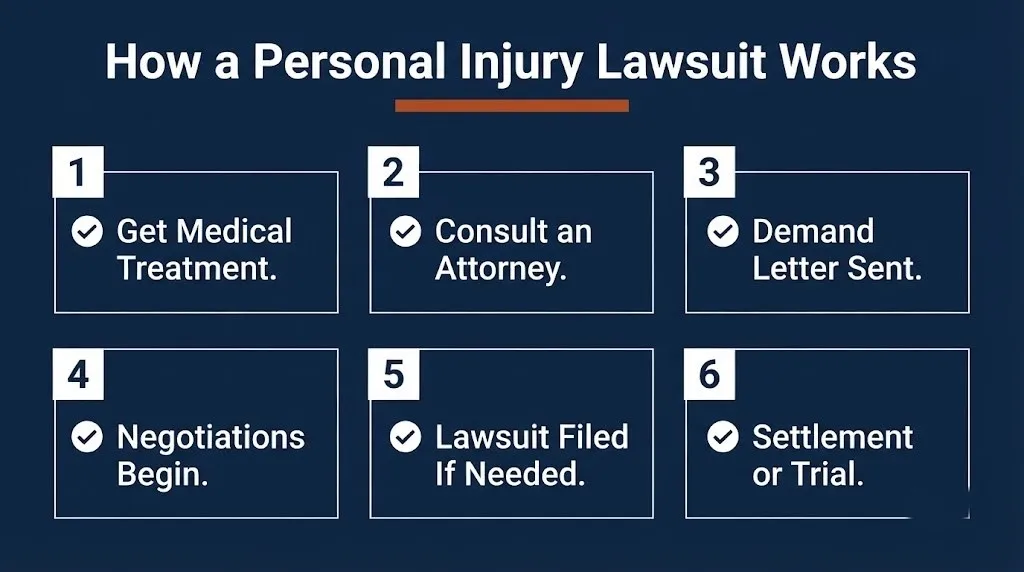
A personal injury lawsuit follows a structured process that takes months or years from start to finish. The Hollywood version, dramatic trial with surprise witnesses and courtroom confessions, almost never happens. The real process is methodical, document-intensive, and ends in settlement more than 95 percent of the time. Here is how it works:
- You seek medical treatment immediately after the injury. This creates the medical records that are the foundation of your claim.
- You consult a personal injury attorney, usually on a free initial consultation. The attorney evaluates your case.
- If the attorney takes your case, you sign a contingency fee agreement. The attorney sends a demand letter to the defendant’s insurance company.
- The insurer investigates. The adjuster reviews medical records, police reports, witness statements, and photographs.
- Negotiations begin. The insurer may make a settlement offer. Your attorney may counter. Most cases settle at this stage.
- If negotiations fail, your attorney files a complaint in court, starting the formal lawsuit.
- Discovery begins. Both sides exchange documents, answer interrogatories, and sit for depositions.
- The defendant may file a motion for summary judgment asking the judge to dismiss the case without trial.
- If the case survives summary judgment, the parties typically engage in mediation, a structured settlement negotiation with a neutral third party.
- If mediation fails, the case proceeds to trial. A jury or judge decides fault and damages.
- If the plaintiff wins, the defendant may appeal. The appeal process can add 12 to 24 months before the plaintiff sees any money.
This is not like filing a tax return where you submit forms and wait for a check. It is a protracted adversarial process where the other side is actively trying to pay you as little as possible, or nothing. The attorney’s job is to build leverage by preparing the case for trial while remaining open to a fair settlement. The more prepared the case is to try, the better the settlement offers tend to be.
What Is Bodily Injury Liability?
Bodily injury liability is the portion of an insurance policy that pays for injuries the policyholder causes to someone else. It is the primary source of compensation in most personal injury cases. If a driver runs a stop sign and hits you, the driver’s bodily injury liability coverage pays your medical bills, lost wages, and pain and suffering, up to the policy limit. The driver’s personal assets are not reached unless the damages exceed the policy limit and the driver has assets to collect.
Bodily injury liability coverage is mandatory in most states for auto insurance, though minimum limits vary. States requiring $25,000 per person and $50,000 per accident are common. That means if you are injured by a driver with minimum coverage, the most the insurance company will pay for your injuries is $25,000, regardless of how badly you are hurt. If your medical bills alone are $50,000, the $25,000 policy limit creates a significant shortfall.
This is why underinsured motorist coverage on your own policy matters. It covers the gap between the at-fault driver’s policy limit and your actual damages, up to your own UIM limit. If the defendant has a $25,000 policy and you have $100,000 in UIM coverage, your own insurance pays up to $75,000 after the defendant’s policy is exhausted. Many people decline UIM coverage to save on premiums without understanding what they are giving up.
What Damages Can You Recover in a Personal Injury Case?
You can recover two categories of damages in a personal injury case: economic damages and non-economic damages. Economic damages are the specific, quantifiable financial losses caused by the injury. Non-economic damages compensate for the human experience of injury, pain, disability, and loss of enjoyment. A small number of cases include punitive damages, which are not compensation for loss but punishment for egregious conduct.
Economic damages include past and future medical expenses, past and future lost income, loss of earning capacity, property damage, rehabilitation costs, and out-of-pocket expenses related to the injury. These are calculated by adding up bills, pay stubs, and expert projections. A life care planner may estimate future medical needs. A vocational expert may calculate lost earning capacity over a lifetime. Economic damages are objective, or at least grounded in data, which makes them easier to negotiate.
Non-economic damages include pain and suffering, emotional distress, loss of consortium, disfigurement, and loss of enjoyment of life. These are subjective. There is no receipt for suffering. Juries and adjusters calculate non-economic damages using multipliers, typically 1.5 to 5 times the economic damages depending on injury severity, or per diem formulas assigning a daily dollar value to the period of recovery. The more serious and permanent the injury, the higher the multiplier.
How Do You Prove a Personal Injury Claim?
Proving a personal injury claim requires evidence of liability, causation, and damages. Liability evidence shows the defendant was at fault. Police reports, witness statements, photographs of the scene, surveillance video, accident reconstruction reports, and admissions by the defendant all serve this purpose. Causation evidence connects the defendant’s conduct to your specific injuries, typically through medical records and expert testimony. A doctor must state, within a reasonable degree of medical certainty, that the crash caused the herniated disc.
Damages evidence quantifies your losses. Medical bills, treatment records, diagnostic imaging, prescription records, and physical therapy notes establish the economic impact. Pay stubs, tax returns, and employer statements establish lost income. A personal injury journal documenting your daily pain levels, activities you can no longer perform, and the emotional toll of the injury supports non-economic damages. The more contemporaneous the documentation, the more credible it is.
Gaps in treatment are the single most common way defendants attack damages. If you stop treating for three months between the emergency room and physical therapy, the defense will argue your injury must not have been that serious, or that something else happened during the gap to cause your ongoing pain. Continuous, consistent treatment builds causation. Gaps create doubt.
How Long Does a Personal Injury Lawsuit Take?
A personal injury lawsuit takes 12 to 24 months on average from filing to resolution, with straightforward cases settling in months and complex cases taking three to four years if trial is required. The timeline depends on four factors: the complexity of the medical issues, the clarity of liability, the court’s docket congestion, and the willingness of both sides to negotiate reasonably.
Pre-litigation settlement can happen in weeks or months. If the insurer accepts liability and the medical treatment is complete with clear documentation, a demand letter can produce a settlement offer within 30 to 60 days. Cases that require litigation follow a slower path. Filing the complaint takes a month. Discovery takes 6 to 12 months. Mediation adds 1 to 3 months. Trial preparation takes 3 to 6 months. Trial itself is typically a week or less. Appeals add 12 to 24 months.
The plaintiff’s medical condition drives much of the timeline. Settling before reaching maximum medical improvement is risky because you do not yet know the full extent of your damages. Settling a case with a herniated disc before knowing whether surgery is necessary means giving up the right to compensation for that surgery. Your attorney will typically recommend waiting until you have reached MMI, or at least until the future treatment picture is clear, before engaging in serious settlement negotiations.
Key Takeaway: The insurance company wants you to settle fast, before you know the full extent of your injuries. Your attorney wants you to wait until the medical picture stabilizes. The tension between these two positions is why cases take as long as they do.
How Are Personal Injury Settlements Paid?
Personal injury settlements are paid as a lump sum from the insurance company or defendant to you, less attorney fees, case costs, and any outstanding liens. The settlement check is typically made payable to your attorney’s trust account. The attorney deposits the check, deducts the agreed-upon contingency fee, reimburses case expenses, pays any medical liens or subrogation claims, and disburses the remaining balance to you. You receive a single check for your net share and a detailed settlement statement showing every deduction.
Medical liens are the most common surprise for first-time plaintiffs. Your health insurance company, Medicare, Medicaid, or a hospital may have a lien on your settlement for medical bills they paid related to the injury. These liens must be satisfied from the settlement proceeds before you receive anything. Your attorney can often negotiate liens down, reducing the amount the lienholder takes and increasing your net recovery. This is a standard part of personal injury practice and a reason to hire an attorney rather than negotiating directly with the insurer.
Structured settlements are an alternative to lump-sum payments in larger cases. Instead of receiving the entire settlement in one payment, you receive a stream of payments over time, often with a large initial payment and monthly or annual installments thereafter. Structured settlements can provide tax advantages and protect against spending the money too quickly. They are common in cases involving minors, catastrophic injuries, and wrongful death. Once accepted, a structured settlement generally cannot be changed, so the decision requires careful financial planning.
How Do You Fight a Personal Injury Lawsuit Against You?
Fighting a personal injury lawsuit as a defendant requires immediate action, insurance notification, and an understanding that your insurance company controls the defense. If you are sued, do not ignore the complaint. Turn it over to your insurance company immediately. The insurer has a duty to defend you, which means it hires a lawyer and pays the legal fees. If you do not notify the insurer promptly and a default judgment is entered against you, the insurer may deny coverage.
The defense attorney assigned by your insurer represents you, but the insurer pays the bills and makes settlement decisions. This creates a potential conflict. The insurer may settle a case you want to fight, or refuse to settle a case you want resolved, because the insurer’s financial interests are not perfectly aligned with yours. In most cases this tension does not cause problems. In cases where the damages exceed your policy limits, it can. If the plaintiff offers to settle for your $100,000 policy limit and the insurer unreasonably refuses, and a jury later awards $500,000, you are personally on the hook for the $400,000 excess. This is a bad-faith claim against your own insurer, and it happens more often than most policyholders realize.
If you are sued and you have no insurance, or the claim exceeds your coverage, hire your own attorney. Do not try to defend yourself. Personal injury litigation is procedurally complex and the rules are not forgiving of mistakes by self-represented litigants. A missed discovery deadline can result in evidence being excluded or a default judgment being entered. The cost of a lawyer is almost always less than the cost of a judgment entered because you mishandled the defense.
What Are the Most Common Mistakes That Hurt a Personal Injury Case?
The most common mistakes that hurt a personal injury case happen in the first 48 hours after the injury. Delaying medical treatment is the costliest error. The defense will argue that a gap between the accident and the first doctor visit means you were not really hurt, or that something else happened in the gap to cause your pain. Go to the doctor immediately. Describe every symptom. Do not minimize your pain to be polite. The medical record created on day one is the foundation of your case.
Giving a recorded statement to the insurance adjuster without an attorney is the second most common mistake. The adjuster is not calling to help you. The adjuster is calling to lock you into a version of events that minimizes the defendant’s fault and the severity of your injuries. Anything you say can and will be used to reduce or deny your claim. Politely decline to give a statement. Refer the adjuster to your attorney. If you do not have an attorney yet, say nothing beyond the basic facts of the accident and your contact information.
Posting on social media about the accident, your injuries, or your activities while your case is pending is a self-inflicted wound. The defense will find your posts. If you claim a disabling back injury and post a photo of yourself on a hike, your case is over. If you post about the accident and say “I’m fine, just a little sore,” and later claim serious injury, the defense will use your own words to paint you as exaggerating. Stay off social media entirely while your case is pending. This is the advice every personal injury attorney gives. Most clients ignore it. Many regret it.
Key Takeaway: The defense is looking for reasons to pay you less. Do not hand them the evidence. Go to the doctor immediately. Decline recorded statements. Stay off social media. Tell the truth but do not volunteer information beyond what is asked.
What Happens Next
The personal injury litigation landscape in late 2026 and into 2027 is shaped by several trends: increased use of AI in claims evaluation, continued pressure on insurance defense costs, and a plaintiff-side bar increasingly selective about which cases to file. Here is what to expect:
Ongoing 2026: Courts continue to clear pandemic-era backlogs. Trial dates in some jurisdictions are being set 18 to 24 months out, pushing parties toward settlement.
Late 2026 to 2027: Insurance companies expand use of AI-driven claims valuation tools, potentially reducing settlement offers in cases with algorithmic risk scores unfavorable to plaintiffs.
2027: Several states considering legislation to increase minimum auto insurance limits, which would increase available compensation for injured plaintiffs in those states.
Watch for: Any Supreme Court decision on the tax treatment of contingency-fee portions of settlements, which could affect net recovery for plaintiffs nationwide.
Frequently Asked Questions
What Is the Difference Between a Personal Injury Claim and a Lawsuit?
A claim is a demand for compensation made to an insurance company before any court filing.
A lawsuit is a formal legal action filed in court after settlement negotiations fail.
Most cases start as claims, settle as claims, and never become lawsuits.
How Much Does a Personal Injury Lawyer Cost?
Personal injury lawyers work on contingency, taking 25 to 40 percent of the recovery.
You pay nothing upfront. The attorney is paid only if you recover money.
Case expenses are typically advanced by the attorney and reimbursed from the settlement.
How Long Do I Have to File a Personal Injury Lawsuit?
The deadline is your state’s statute of limitations, typically 1 to 3 years from the injury date.
Claims against government entities often have shorter deadlines, sometimes 6 months or less.
Missing the statute of limitations bars your claim permanently.
What Happens If I Am Partly at Fault for My Injury?
Most states follow comparative fault rules, reducing your recovery by your percentage of fault.
In a pure comparative fault state, you can recover even if you are 99 percent at fault, though your recovery is reduced accordingly.
In a modified comparative fault state, you recover nothing if you are 51 percent or more at fault.
Can I Sue If the Person Who Hurt Me Has No Insurance?
Yes, but collecting may be difficult. A judgment against an uninsured individual with no assets is often uncollectible.
Your own uninsured motorist coverage, if you have it, can provide compensation.
An attorney can advise whether pursuing an uninsured defendant is worth the cost.
Do Personal Injury Settlements Get Taxed?
Compensatory damages for physical injury are generally not taxable under IRS rules.
Emotional distress damages are taxable unless they flow from a physical injury.
Punitive damages and interest on settlements are taxable regardless of the claim type.
How Do I Know If My Settlement Offer Is Fair?
Compare the offer to your economic damages, apply a reasonable multiplier for non-economic damages, and discount for liability risk and collectibility.
An experienced personal injury attorney can evaluate whether a specific offer is fair for your case.
Do not rely on settlement calculators or formulas you find online.
What Should I Do Immediately After an Injury?
Seek medical attention. Document everything. Take photos of the scene and injuries.
Get contact information for witnesses. File a police report if applicable.
Contact a personal injury attorney before speaking with any insurance adjuster.
Your next move depends on where you are in the process. If the injury just happened, get medical care and document everything. If you are negotiating with an insurance adjuster, stop. Consult an attorney before saying anything else. If you have been sued, notify your insurer immediately. If you are waiting for a settlement check, understand the deductions that will come out of it. If you are considering filing, know your statute of limitations. The calendar is the one thing in a personal injury case that cannot be fixed once it runs out.
Personal injury law in 2026 is stable, rule-driven, and tilted toward settlement over trial. The system compensates real injuries. It rewards preparation and documentation. It punishes delay, gaps in treatment, and social media carelessness. Know the rules, follow them, and get professional help if the stakes are more than you can afford to lose.