Viatical Settlement 2026: What It Means, How It Works, and How to Find a Legitimate Broker
Quick Answer:
- A viatical settlement is the sale of a life insurance policy by a terminally ill policyholder to a third party for an immediate cash payment.
- Sellers typically receive 40 to 80 percent of the policy’s face value depending on life expectancy, policy premiums, and market conditions.
- Using a licensed viatical settlement broker is required or strongly recommended in most states to ensure fair pricing and regulatory compliance.
You searched this because you or someone you know is facing a terminal diagnosis and looking for financial options, or because you heard the term and want to understand what it means. A viatical settlement is not a lawsuit settlement. It is not a class action. It is a financial transaction that converts a life insurance policy into immediate cash while the insured person is still alive. The money comes from investors who buy the policy, pay the premiums, and collect the death benefit when the original policyholder passes away.
This option matters for people with life insurance policies and terminal illnesses who need money for medical care, living expenses, or end-of-life arrangements. The tradeoff is straightforward: you get cash now, often substantially more than the policy’s cash surrender value but less than the full death benefit your beneficiaries would receive. The investors take on the risk and the premium payments. They profit if you pass away sooner than projected. They lose if you live longer than expected.
This article covers what a viatical settlement is in 2026, how the transaction works, how much you can expect to receive, how to find a legitimate viatical settlement broker, the tax implications, and the risks and scams to avoid. One fact that surprises most people: viatical settlement proceeds are generally tax-free at the federal level if the seller has a certified terminal illness, a benefit that life settlements for non-terminal policyholders do not enjoy.
The Facts
| Detail | Information |
|---|---|
| Transaction Type | Sale of a life insurance policy by a terminally ill insured to a third-party investor |
| Typical Payout | 40 to 80 percent of the policy’s face value, depending on life expectancy and other factors |
| Tax Treatment | Generally tax-free at the federal level for certified terminally ill sellers under IRS Code Section 101(g) |
| Regulation | Regulated by state insurance departments. Most states require viatical settlement providers and brokers to be licensed |
| Typical Qualification | Life expectancy of 24 months or less (definition varies by state; some use 48 months) |
| Broker Role | Represents the seller, shops the policy to multiple buyers to obtain the best offer, and manages the transaction |
| Broker Commission | Typically 5 to 10 percent of the settlement amount, paid from the buyer’s proceeds, not directly by the seller in most arrangements |
What Is a Viatical Settlement?
A viatical settlement is the sale of an existing life insurance policy by a terminally ill policyholder to a third party. The buyer pays the seller an immediate lump sum, takes over premium payments, and receives the death benefit when the seller passes away. The transaction allows someone with a terminal diagnosis to access the value of their life insurance while they are still alive, rather than leaving the full death benefit to beneficiaries after death.
The word “viatical” comes from the Latin word for provisions for a journey. The concept emerged during the AIDS epidemic in the 1980s, when people with terminal illnesses often held life insurance policies but needed money immediately for medical care and living expenses. The viatical settlement industry grew out of that need and has since expanded to cover a range of terminal conditions including cancer, ALS, end-stage organ failure, and other life-limiting illnesses.
A viatical settlement differs from a life settlement, which is the sale of a policy by a senior who is not terminally ill but may have a reduced life expectancy. Life settlements are for policyholders typically over age 65. Viatical settlements are specifically for those with a certified terminal condition. The distinction matters for tax purposes. Viatical settlements receive tax-free treatment under federal law. Life settlements do not automatically qualify for the same treatment.
Key Takeaway: A viatical settlement turns a death benefit into a living benefit. It provides cash when the policyholder needs it most, in exchange for giving up the full payout beneficiaries would receive.
What Is the Viatical Settlement Meaning?
The viatical settlement meaning is the conversion of a life insurance policy’s death benefit into an immediate cash payment for a terminally ill policyholder. The meaning extends beyond the financial mechanics. A viatical settlement represents a choice: the policyholder prioritizes their own immediate needs over the future inheritance of their beneficiaries. It is a deeply personal financial decision that involves weighing the value of money now against the value of leaving more money later.
In legal terms, a viatical settlement is a contract between the policyholder, called the viator, and the purchaser, typically an institutional investor or a viatical settlement company. The contract transfers all rights and obligations under the life insurance policy to the purchaser. The viator receives cash. The purchaser assumes premium payments and receives the death benefit upon the viator’s death. The contract is regulated by state law, and in most states, the viator has a rescission period, typically 15 days, during which they can cancel the transaction.
The meaning also encompasses the regulatory framework. Viatical settlements are not unregulated speculation. They are governed by state insurance codes, the National Association of Insurance Commissioners Viatical Settlements Model Act, and federal tax law. The regulated status distinguishes legitimate viatical settlements from unlicensed stranger-originated life insurance schemes, which are illegal in most states.
How Does a Viatical Settlement Work?
A viatical settlement works by connecting a terminally ill policyholder who wants cash now with investors who are willing to buy the policy for less than the death benefit, wait for the policy to mature, and collect the difference. The process involves several steps and multiple parties: the policyholder, the viatical settlement broker, the viatical settlement provider, and the investors who ultimately fund the purchase.
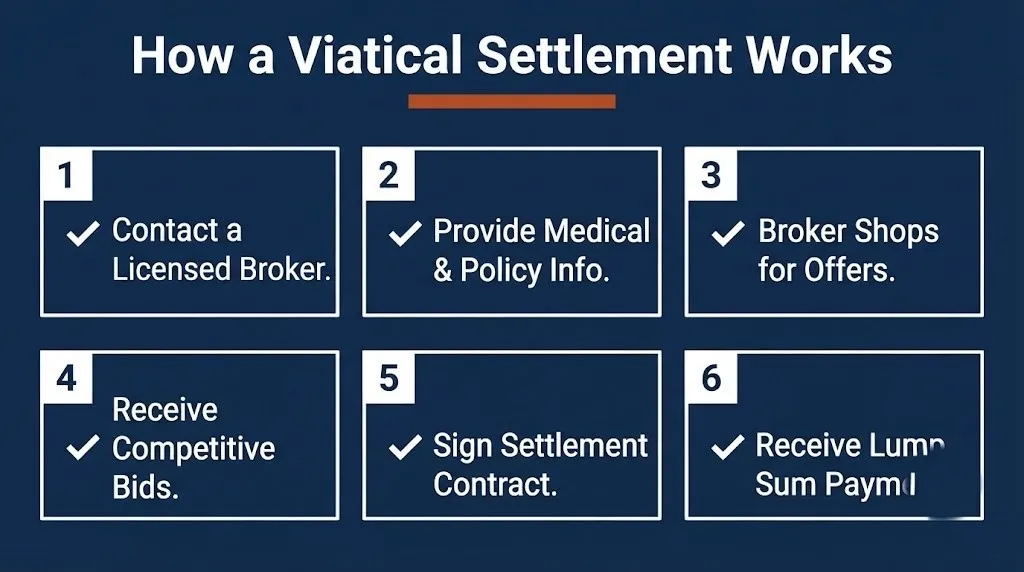
Here is the process from start to finish:
- The policyholder receives a terminal diagnosis and determines they want to sell their life insurance policy.
- The policyholder contacts a licensed viatical settlement broker. The broker explains the process and the alternatives.
- The broker collects the policyholder’s medical records, life insurance policy details, and authorizations.
- The broker shops the policy to multiple viatical settlement providers, obtaining competing offers.
- Each provider evaluates the policy based on the face value, the premiums, and the policyholder’s projected life expectancy.
- The provider makes an offer, typically expressed as a percentage of the policy’s face value.
- The broker presents the offers to the policyholder, who can accept or reject.
- If accepted, the parties execute a viatical settlement contract. The policyholder has a rescission period to change their mind.
- The provider places funds in escrow. The policyholder signs an absolute assignment transferring policy ownership.
- The escrow agent disburses funds to the policyholder. The provider begins paying premiums and files change of ownership with the insurer.
The entire process typically takes 60 to 120 days from initial contact to funding. The timeline depends on how quickly medical records and policy information are obtained, how many providers are solicited, and the complexity of the policy and the medical condition.
How Much Money Can You Get From a Viatical Settlement?
You can typically receive 40 to 80 percent of your life insurance policy’s face value from a viatical settlement, with the exact percentage depending primarily on your projected life expectancy, the policy’s ongoing premium costs, and current market conditions. A shorter life expectancy produces a higher offer because the investor expects to collect the death benefit sooner. A longer life expectancy produces a lower offer because the investor must pay premiums for a longer period before collecting.
The calculation works like this. An investor evaluating a $100,000 policy on someone with a 12-month life expectancy must consider the cost of premiums for roughly 12 months, the time value of money, and the desired return. If premiums are $200 per month, the investor pays $2,400 in premiums over a year. If the investor wants a 15 percent return, the offer might be in the range of $80,000 to $85,000. If the same policy has a 24-month life expectancy, premiums double, the waiting period doubles, and the offer might drop to $65,000 to $70,000.
Several factors influence the offer beyond life expectancy. The policy type matters. Universal life policies with flexible premiums may be valued differently than term policies approaching conversion deadlines. The insurer’s financial strength rating matters because the death benefit is only as secure as the company paying it. The policy’s contestability period matters. If the policy is less than two years old, it is in the contestability period during which the insurer can investigate and potentially rescind the policy for misrepresentation. Investors discount policies in this period.
| Life Expectancy | Typical Payout Range | Example on $100,000 Policy |
|---|---|---|
| 6 months or less | 70 to 80 percent | $70,000 to $80,000 |
| 12 months | 55 to 75 percent | $55,000 to $75,000 |
| 18 months | 45 to 60 percent | $45,000 to $60,000 |
| 24 months | 40 to 55 percent | $40,000 to $55,000 |
| Over 24 months | May not qualify for viatical. Life settlement may apply | Varies |
What Is a Viatical Settlement Broker?
A viatical settlement broker is a licensed professional who represents the policyholder in the sale of a life insurance policy to a third party. The broker’s job is to obtain the highest possible offer by shopping the policy to multiple viatical settlement providers, managing the transaction process, and ensuring compliance with state regulations. The broker owes a fiduciary duty to the policyholder, not to the buyer.
A broker differs from a viatical settlement provider. The provider is the company or investor group that buys the policy. The broker represents the seller. In many states, the broker must be licensed by the state insurance department and must disclose their commission, which is typically 5 to 10 percent of the settlement amount and paid by the provider from the purchase price. The broker’s commission is baked into the offer. The seller does not write a separate check.
Using a broker is not legally required in every state, but it is almost always advisable. A policyholder who goes directly to a single provider has no way to know whether the offer is competitive. The broker creates competition among providers, which drives up offers. A broker can also identify providers that specialize in particular medical conditions, policy types, or face value ranges. The broker’s market knowledge is the policyholder’s leverage.
How Do I Find a Legitimate Viatical Settlement Broker?
Finding a legitimate viatical settlement broker requires verifying licensing, checking references, and understanding the fee structure before signing anything. The viatical settlement industry is regulated but attracts bad actors because it involves vulnerable people and large sums of money. A legitimate broker will be licensed by the state insurance department, will provide clear disclosures about commissions and the transaction process, and will never pressure you into a decision.
Here is how to find and vet a broker:
- Check your state insurance department’s website for a list of licensed viatical settlement brokers.
- Verify the broker’s license is active and in good standing. Look for disciplinary actions.
- Ask the broker how many viatical settlements they have facilitated and request references.
- Confirm the broker shops policies to multiple providers, not just one affiliated company.
- Require written disclosure of all commissions, fees, and compensation before proceeding.
- Ask about the rescission period. In most states, you have at least 15 days to cancel the transaction after receiving the funds.
- Consult an independent financial advisor or attorney before signing. The broker should encourage this, not discourage it.
A legitimate broker will not ask for upfront fees from you. Broker commissions are typically paid by the provider from the settlement proceeds. If a broker demands payment before the transaction closes, walk away. If a broker guarantees a specific offer before seeing your medical records and policy details, walk away. No legitimate offer can be made without full underwriting.
Reality Check: Stranger-originated life insurance, known as STOLI, is illegal in most states. STOLI involves someone encouraging you to buy a life insurance policy you do not need with the pre-arranged plan of selling it to investors. If anyone suggests you buy a policy specifically to sell it, that is a red flag. Legitimate viatical settlements involve existing policies you bought for legitimate insurance purposes.
Are Viatical Settlement Proceeds Taxable?
Viatical settlement proceeds are generally not taxable at the federal level if the seller has been certified as terminally ill or chronically ill by a licensed physician. This tax exclusion is provided by Internal Revenue Code Section 101(g), which treats qualified viatical settlement proceeds as amounts paid by reason of death, the same tax treatment given to life insurance death benefits. The exclusion applies regardless of whether the seller uses the money for medical care or any other purpose.
To qualify for the tax exclusion, the viatical settlement provider must be licensed in the state where the policyholder resides, and the policyholder must have a life expectancy of 24 months or less, or meet the statutory definition of chronically ill. The certification must be provided by a licensed physician. If the seller does not meet the terminally ill or chronically ill standard, the transaction may be treated as a life settlement rather than a viatical settlement, and different tax rules may apply.
The tax treatment of viatical settlements is more favorable than the treatment of life settlements, which are generally taxable to the extent the proceeds exceed the policy’s adjusted basis, typically the total premiums paid. This tax advantage is one reason the distinction between viatical settlements and life settlements matters. Consult a tax professional before completing a transaction to confirm your specific tax situation.
What Are the Alternatives to a Viatical Settlement?
A viatical settlement is one of several ways to access the value of a life insurance policy before death. The alternatives include accelerated death benefits, policy loans, cash surrender, and life settlements. Each has different eligibility requirements, costs, and consequences.
An accelerated death benefit is a provision in many life insurance policies that allows the policyholder to receive a portion of the death benefit while still living if diagnosed with a terminal illness. The advance reduces the death benefit paid to beneficiaries. Accelerated death benefits are typically limited to 25 to 95 percent of the face value, depending on the policy. They are generally tax-free if the policyholder is terminally ill. This is the simplest and least costly option if available, but it pays less than a viatical settlement in most cases.
Policy loans allow the policyholder to borrow against the cash value of a permanent life insurance policy. Loans accrue interest and reduce the death benefit if not repaid. Cash surrender is the option to cancel the policy and receive the accumulated cash value. Surrender values are typically much lower than viatical settlement offers, often 10 to 30 percent of the face value for policies that have been in force for many years. Life settlements, as distinct from viatical settlements, are available to seniors who do not have a terminal diagnosis. They typically pay less than viatical settlements because the investor’s waiting period is longer.
Key Takeaway: Before pursuing a viatical settlement, check whether your policy includes an accelerated death benefit. If it does, you may be able to access cash quickly and at lower cost without involving third-party investors.
What Happens Next
The viatical settlement industry in 2026 continues to be shaped by regulatory oversight, medical advances that extend life expectancies, and the growing secondary market for insurance products. Here is what to expect:
Ongoing 2026: State insurance departments continue to update licensing requirements for viatical settlement brokers and providers in line with NAIC model regulations.
2026 to 2027: Life expectancy projections become more accurate with AI-driven underwriting, which may narrow the range between high and low offers for the same policy.
Watch for: Any change to the federal tax treatment of viatical settlements. The current exclusion is well-established but could be subject to modification in future tax legislation.
Frequently Asked Questions
What Is the Difference Between a Viatical Settlement and a Life Settlement?
A viatical settlement is for terminally ill policyholders with a life expectancy of 24 months or less.
A life settlement is for seniors, typically over 65, who do not have a terminal diagnosis.
Viatical settlements receive more favorable tax treatment under federal law.
How Long Does a Viatical Settlement Take?
The process typically takes 60 to 120 days from initial contact to funding.
Timelines depend on how quickly medical records and policy information are provided.
Expedited processing may be available for very short life expectancies.
Can I Sell a Term Life Insurance Policy?
Yes, if the policy is convertible to a permanent policy or if the viatical settlement provider is willing to purchase a term policy.
Most viatical settlements involve permanent policies because term policies expire and have no cash value.
Convertibility is a key factor in whether a term policy can be viaticated.
What Happens to My Beneficiaries After a Viatical Settlement?
Your beneficiaries receive nothing from the policy after you sell it.
The investor who bought the policy receives the full death benefit.
You can set aside a portion of the settlement proceeds for your beneficiaries if you wish.
Do I Need a Lawyer for a Viatical Settlement?
A lawyer is not legally required but is strongly recommended.
The transaction involves complex contracts and significant financial consequences.
An independent attorney can review the settlement agreement and explain the terms before you sign.
How Are Viatical Settlement Offers Calculated?
Offers are based on the policy’s face value, projected life expectancy, ongoing premium costs, and the investor’s required return.
Shorter life expectancies produce higher offers.
Longer life expectancies and higher premiums produce lower offers.
Is a Viatical Settlement the Same as an Accelerated Death Benefit?
No. An accelerated death benefit is a provision within your existing policy that advances a portion of the death benefit.
A viatical settlement is a sale of the entire policy to a third party.
Accelerated death benefits are generally simpler and cheaper but pay less than viatical settlements.
How Do I Know If a Viatical Settlement Broker Is Legitimate?
Verify the broker’s license with your state insurance department.
Check for disciplinary actions or complaints.
A legitimate broker will encourage you to consult an independent advisor and will never pressure you to decide quickly.
Your next move is to gather information. If you have a life insurance policy and a terminal diagnosis, start by checking whether your policy includes an accelerated death benefit. If it does, contact your insurer to understand the terms. If it does not, or if the accelerated benefit is inadequate, contact a licensed viatical settlement broker to explore your options. Get multiple offers. Consult a financial advisor or attorney. Take the full rescission period to consider your decision.
A viatical settlement is not right for everyone. It trades a larger future benefit for a smaller immediate payment. But for someone facing terminal illness with pressing financial needs, it can provide resources when they are needed most.