Class Action Lawyer 2026: Costs, How to Find One, and How the Process Actually Works
Quick Answer
- A class action lawyer takes your case on contingency and gets paid only if the case wins or settles, typically 20% to 40% of the fund, set or approved by a judge.
- How much you personally could get depends entirely on the case: some consumer settlements pay $5 to $50 per person, others pay thousands, and there is no fixed number for “a class action lawyer.”
- There is no single deadline here because this is a guide to the process, not one case: each settlement has its own claim deadline, so you check the official site for that specific case.
You do not need a law degree to understand the basics, but you do need straight facts before you sign anything or click a link that says you are “owed money.” This guide breaks down what a class action lawyer actually does, what they cost, how to find one who is real, and how to tell a legitimate settlement notice from a scam.
Millions of people get texts, emails, or postal notices every year claiming they qualify for a class action payout. Only a small share of recipients ever file a claim, and the single most important number in that decision is zero: legitimate class counsel never charges you a fee to join or to consult.
This article covers how class action lawyers get paid, how to find and vet one, what the actual legal process looks like from filing to payout, and the specific red flags that separate a real settlement notice from a phishing attempt. One detail worth sitting with: attorneys’ fees in a class action are not negotiated privately between you and the lawyer. A federal judge has to approve them.
The Facts
| Topic | Class action lawyers: cost, process, how to find one |
| Typical fee structure | Contingency, court-approved, no upfront cost to you |
| Typical fee range | 20% to 40% of the settlement fund, most often 25% to 33% |
| Filing cost to you | Zero, the firm advances court and case costs |
| Consultation cost | Free at most firms; state bar referral services charge $20 to $45 for a first half-hour |
| Claim filing rate | Roughly 4% of eligible people file a claim, per FTC-cited research |
| Individual case tracked | Not applicable, this is a process guide, not one settlement |
| Where to verify a specific case | The official settlement website named in your notice, or your state’s court docket search |
Is a Class Action Lawsuit Notice Actually Legit?
A class action notice is legit if it names a real court, a real case number, and a settlement website you can independently confirm, not one you reach only through a link in the message. Fake notices are a documented and growing problem.
Consumer protection groups warn that scammers are exploiting real class-action settlement notices to harvest personal data, sending emails and texts that claim recipients are eligible for a payout. The Better Business Bureau has gone further, noting these scams specifically target people who already know about real settlements, which makes the fakes harder to spot.
Here is the test that actually works. Do not click the link in the notice. Instead, open a browser and search the company name plus “class action settlement.” If it is real, you’ll find it on a court docket, a settlement administrator’s own site, or coverage from an established legal news outlet.
Signs a notice is legitimate:
- Names a specific court and case number
- Comes from a claims administrator with an independently searchable website
- Never asks for your full Social Security number or bank login
- Charges you nothing to file
Signs it’s a scam:
- Asks for an upfront “processing” or “release” fee
- Wants your full nine-digit SSN or bank credentials
- Promises payment within days
- Has typos, generic greetings, or a link that doesn’t match the company or court name
How Much Does a Class Action Lawyer Cost?
A class action lawyer costs you nothing directly. They work on contingency and collect their fee only out of the settlement fund, after a judge signs off on the amount.
Most class action attorneys work on contingency, meaning their fee comes out of whatever amount the judge awards or the settlement fund created for all plaintiffs, and those fees typically range from 20% to 35%. On a straightforward consumer case, lawyers typically take 25% to 33% of the total settlement fund as their fee, and that fee comes only if the case succeeds.
Judges do not just rubber-stamp these numbers. A judge determines the fee case by case, weighing the amount of work required, the nature of the case, the amount recovered, and the risk the firm took on. Some courts also use a second method as a cross-check.
| Fee Method | How It Works |
|---|---|
| Percentage-of-fund | Lawyer gets an agreed share (often 25-33%) of the total settlement, court-approved |
| Lodestar | Court multiplies reasonable hours worked by a reasonable hourly rate, sometimes with a multiplier |
| Hybrid | Court uses percentage as the base figure, then checks it against lodestar math |
Key Takeaway: A class action lawyer’s fee is set or approved by a federal judge, not privately negotiated, and it comes out of the settlement fund, never your pocket, upfront.
Do You Have to Pay Anything Upfront to Join or File?
No. You do not pay a retainer, an hourly rate, or a filing fee to join an existing class action, and you don’t pay one to have a firm evaluate whether you have a case.
Starting a class action in the U.S. rarely costs plaintiffs anything upfront, since most class action lawyers work on contingency and cover initial expenses themselves, getting paid only if the case succeeds. That includes the mundane costs nobody thinks about.
Filing a lawsuit requires a federal court filing fee of roughly $400, plus process server charges and administrative costs, and in class actions the law firm almost always advances these so plaintiffs never have to pay out of pocket. If a case loses, you owe nothing. That’s the actual bargain of contingency: the firm absorbs the financial risk, not you.
A quick comparison: this works something like a home warranty claim where the contractor eats the cost of a wasted service call if nothing’s actually broken. You only “pay” through your share of a recovery, and only if there is one.
Reality Check
Nobody legitimate will text you out of the blue and ask you to pay a fee to claim settlement money you’re “owed.” Filing a claim in a real class action is always free, and a real class action lawyer never asks for payment before doing any work. If a message asks for money, a gift card, or your full Social Security number to “release” your payout, it’s a scam, not a settlement.
How Much Can You Actually Get From a Class Action Lawsuit?
There is no fixed payout for “a class action lawsuit” because the amount depends entirely on the fund size, the number of people who file, and the type of harm claimed. Per-person amounts swing from single dollars to thousands.
Individual payouts can range from under $10 to several thousand dollars, and when a $50 million settlement gets split among 2 million class members, each person gets around $25 before attorney fees are deducted. Consumer product cases tend to sit at the low end. Consumer product and advertising class actions, covering things like misleading marketing or “all natural” labeling claims, usually pay a flat $5 to $50 per person, with no-proof claims allowed for the lower amounts.
Real examples from active 2026 cases show the range: a $197.5 million ATM fees class action settlement and a separate $5 million Grubhub delivery fees settlement illustrate how fund size and class size together, not the “type” of case alone, drive what lands in your account. A $240 million SunTrust overdraft fees settlement paid up to $1,000 to some members, while a $50 million Google discrimination settlement allocated a large share to legal fees before distributing the rest.
What actually determines your payout:
- Total size of the settlement fund
- How many class members file a valid claim
- Whether your claim requires documentation or is a flat no-proof amount
- The court-approved attorney fee percentage
- Whether the case uses payment tiers based on severity of harm
Key Takeaway: The single biggest factor in what you personally receive is how many other people file a claim, not the headline size of the settlement fund.
How to Find a Class Action Lawyer Near You
Start with a plain search rather than assuming you need someone local, since most class action firms sign up clients nationwide regardless of where the client lives.
A search for “class action lawyer near me” or simply “find a class action lawyer” is often the fastest route to a direct, relevant law firm, and you don’t necessarily need a lawyer within driving distance, since firms sign up consumers from across the country. That’s because class action cases often aim to represent large groups of people nationwide, so distance matters far less than it would for, say, a divorce lawyer.
If you’d rather go through a vetted channel, every state bar runs its own referral service.
| State/Group | First Consult Cost |
|---|---|
| California | Reduced fee or free, per State Bar rules |
| Florida | Up to $25 for 30 minutes |
| Texas (statewide) | $20 for 30 minutes |
| New York (NYSBA) | $35 for 30 minutes |
| Nevada | $45 for 30 minutes |
| Michigan | Free for 25 minutes |
You can contact a lawyer referral service through your state or local bar association, and you may qualify for free legal services through legal aid depending on income. California’s certified referral services require that any lawyer you’re matched with be in good standing with the State Bar, hold professional liability insurance, and offer an initial consultation at reduced or no cost, with no obligation to hire them.
How to Hire an Attorney for a Class Action Lawsuit
Hiring a class action attorney starts with a free case evaluation, not a signed contract, so treat the first call as information-gathering on both sides.
Steps to hire a class action attorney:
- Document everything: receipts, emails, screenshots, account statements, dates of harm
- Search for firms already litigating your type of case, not just generalists
- Book a free consultation and describe the harm plainly
- Ask directly what percentage they take and whether it’s contingency-only
- Ask if they are already class counsel in a filed case or building a new one
- Get the fee arrangement and scope of representation in writing
- Confirm they cover filing and litigation costs upfront
Individual consumers rarely initiate class actions alone; plaintiffs’ law firms typically identify patterns of corporate misconduct first, then find affected people to serve as lead plaintiffs and build the case from there. That means in many situations, you’re not “hiring” a lawyer to start a case from scratch so much as joining one already in motion, or signing on as a potential lead plaintiff if you were an early, well-documented victim.
How to File a Class Action Lawsuit Yourself
You cannot file a class action without an attorney representing the class, since certification and procedure require a licensed lawyer acting as class counsel.
That said, “filing” breaks into two very different tasks people confuse. Filing a brand-new class action means finding a firm to build a case around a harm affecting many people. Filing a claim in an existing settlement is a separate, much simpler process, usually a short online form on the official settlement site plus supporting documents if required.
To pursue a new class action:
- Confirm the harm affected many people, not just you
- Gather proof: contracts, statements, correspondence
- Contact a firm experienced in that specific claim type
- Let counsel evaluate class certification requirements
- Sign a contingency agreement before anything is filed
To file a claim in an existing settlement:
- Find the official settlement website (search, don’t click notice links)
- Confirm the deadline listed on that specific site
- Complete the claim form with required proof
- Choose your payment method
- Save your confirmation number
How to Check if You’re Already Part of a Class Action
You check by searching the company name plus “class action” or “settlement,” not by waiting for a notice, since class members are often included automatically without ever being told in advance.
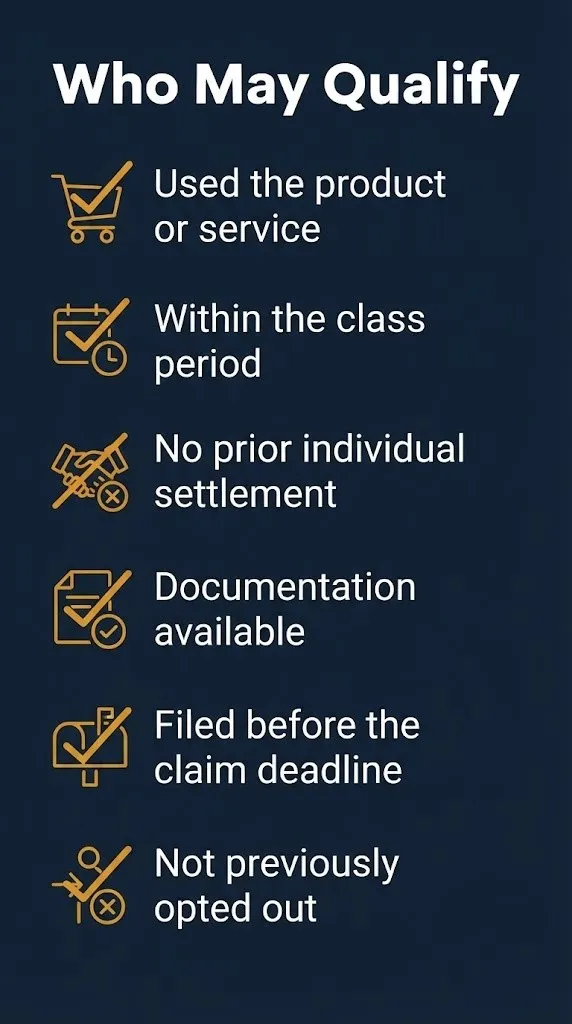
A class action attorney’s job includes tracking deadlines and representing the entire certified class through settlement or trial, and depending on how the class is defined, you may be a member simply by having used a product or held an account during a certain window, whether or not you ever receive a notice. Court dockets, state attorney general press releases, and established settlement-tracking sites are the most reliable ways to confirm status on a specific case.
Key Takeaway: You do not need to receive a notice to be part of a class, so if you suspect a company you’ve dealt with is facing a case, search for it directly rather than waiting for mail.
What’s Happening With Class Action Lawyers and Scams in 2026
The biggest shift this year isn’t in how class action lawyers operate, it’s in how sophisticated fake settlement notices have become, closely mimicking real cases.
Fake notice emails now follow real class action headlines within days, addressed to real people, referencing real company names, and linking to fake settlement websites built to steal data. Genuine payouts, meanwhile, move slower than most people expect. Real settlement payments can take anywhere from several months to over a year after a claim deadline closes, since courts must grant final approval and administrators must process and distribute funds, so any notice promising payment within days is almost certainly fake.
There’s also a persistent participation gap worth knowing about before you assume a settlement is worthless. Only about 4 percent of people who receive class action settlement notices actually file a claim, according to the FTC, which experts partly attribute to scam fatigue making people distrust real notices too.
What Is a Class Action Lawsuit and How Does It Work?
A class action is a lawsuit filed by one or a few people on behalf of a much larger group who suffered the same type of harm from the same defendant, letting everyone’s claims proceed in one case instead of thousands of separate ones.
One or more lead plaintiffs file a complaint in federal or state court naming the defendant and describing the conduct that harmed a proposed class of similarly situated people, and class counsel takes the case on contingency so lead plaintiffs pay nothing out of pocket. From there, a judge decides whether the case can even proceed as a class.
Under Federal Rule 23(a), the proposed class must show numerosity, meaning too many members to sue individually, commonality of legal or factual questions, typicality of the lead plaintiffs’ claims, and adequacy of representation, and the class must also fit one of Rule 23(b)’s categories. Most consumer damages classes are certified under Rule 23(b)(3), which requires that common questions predominate over individual ones and that a class action is the superior method of resolving the dispute.
Think of it like a store-wide product recall crossed with a single group refund request: instead of every unhappy customer filing their own return separately, one case represents everyone at once.
What Does a Class Action Lawyer Actually Do?
A class action lawyer, formally “class counsel,” investigates the alleged harm, files and litigates the case on behalf of the entire class, negotiates any settlement, and manages the claims and distribution process, all while a judge supervises key decisions.
Their job doesn’t end at filing. They must track procedural deadlines across potentially years of litigation, respond to the defendant’s motions, negotiate a fair fund if the case settles, and justify their own fee request to the court with time records or a percentage rationale. If the case doesn’t settle, they take it to trial, still on contingency, still fronting the costs.
Class Action Lawsuit vs. Mass Tort: Which Lawyer Do You Need?
You need a class action lawyer for a shared harm with similar damages across everyone affected, and a mass tort lawyer when injuries from the same product or conduct differ significantly person to person, like differing severities of a defective drug’s side effects.
Class actions group people whose losses look basically the same, a flat overcharge, an identical hidden fee, a uniform mislabeling. Mass torts, most often seen in defective drug, medical device, and product injury cases, keep each person’s claim individually valued because injuries vary too much to lump into one flat payout. The two use overlapping vocabulary, contingency fees, common funds, court oversight, but the payout structures diverge sharply.
What Is an Opt-Out and Should You Use It?
An opt-out is your right to leave a certified class action and pursue your own separate claim instead, and you generally use it only if your individual damages are large enough that a solo lawsuit is likely to pay more than your share of the group settlement.
If you do nothing when a class notice arrives, you typically stay in the class automatically, receive your share of any settlement, and give up the right to sue that same defendant separately over that same conduct. Opting out flips that: you lose the guaranteed group payout but keep your own legal options open, usually in small claims or individual court, which takes more time and offers no guarantee.
Key Takeaway: Doing nothing after a real notice usually keeps you in the class and eligible for a payout, while opting out only makes sense if your individual losses are unusually large.
What Happens Next: The Typical Class Action Timeline
Filing: A firm identifies the harm and files the initial class complaint in federal or state court.
Certification decision: A judge rules on whether the case can proceed under Rule 23, which can take months to years.
Settlement or trial: The parties either negotiate a settlement fund or proceed to trial, with settlement far more common.
Preliminary and final approval: A judge approves the deal, notices go out, and a final approval hearing is scheduled, usually with an opt-out and objection deadline before it.
Claims processing and payout: After final approval, the administrator processes claims and issues payments, a process that commonly runs several months to over a year.
Frequently Asked Questions
Do I need a lawyer to join a class action lawsuit?
No, you generally do not need your own lawyer to join an existing certified class action.
Class counsel already represents the entire class, and you typically just need to file a claim form on the settlement website.
You’d only hire a separate lawyer if you’re considering opting out to pursue an individual claim.
How much does a lawyer take from a class action settlement?
Class action lawyers typically take 20% to 40% of the total settlement fund, most often 25% to 33%, as a court-approved contingency fee.
The exact number is set or reviewed by a judge, not privately agreed with class members.
You never pay this fee directly; it comes out of the fund before distribution.
Is it safe to give my information to a class action settlement website?
It’s safe only if you found the site through an independent search, not through a link in an unsolicited text or email.
Legitimate sites ask for basic identifying information and sometimes proof of purchase, never your full Social Security number or bank login.
If a site asks for payment to “release” your funds, close the page.
Can I be part of a class action without knowing about it?
Yes, you can be an automatic member of a certified class simply by having used a product or account during the defined class period.
Notice isn’t always guaranteed to reach every class member.
Search the company name plus “class action” periodically if you suspect this applies to you.
How long does it take to get paid after a class action settles?
Payment commonly takes several months to over a year after the claim deadline closes.
Courts must grant final approval, and only then does the administrator begin processing and issuing payments.
Any message promising a payout within days of filing is a scam signal, not a good sign.
What’s the difference between a class action attorney and a personal injury attorney?
A class action attorney represents a group with shared, similar-value claims against one defendant, while a personal injury attorney typically handles one client’s individual, often more severe, injury claim.
Some firms handle both, especially in mass tort work that blends group litigation with individually valued injuries.
Which one you need depends on whether your damages look like everyone else’s in the group or stand apart.
Do class action lawyers really work for free upfront?
Yes, the overwhelming majority work purely on contingency, advancing filing fees, expert costs, and case expenses themselves.
If the case loses, you owe the firm nothing.
If it settles or wins, their fee comes only from the recovery, subject to court approval.
How do I know if a class action settlement notice about a company I’ve used is real?
Search the company name plus “class action settlement” independently rather than clicking any link in the notice.
Real notices trace back to a specific court, case number, and an administrator site you can verify separately.
If you can’t find independent confirmation anywhere, treat the notice as suspicious and don’t respond.
If you got a notice, the single move that protects you is the same every time: verify the case independently before you click anything or hand over information. Calendar the deadline listed on the official site the moment you confirm it’s real, since that date, not this article, controls your claim.
Whether you’re evaluating a lawyer for a brand-new case or a claim form for one already underway, the rule holds: legitimate class action representation costs you nothing upfront, and any request for advance payment is the clearest sign something is wrong.