Illinois Workers Compensation 2026: Benefits, Deadlines, and How to File a Claim
Quick Answer:
- Illinois workers compensation is real, mandatory for nearly all employers, and pays medical bills plus wage replacement for work injuries.
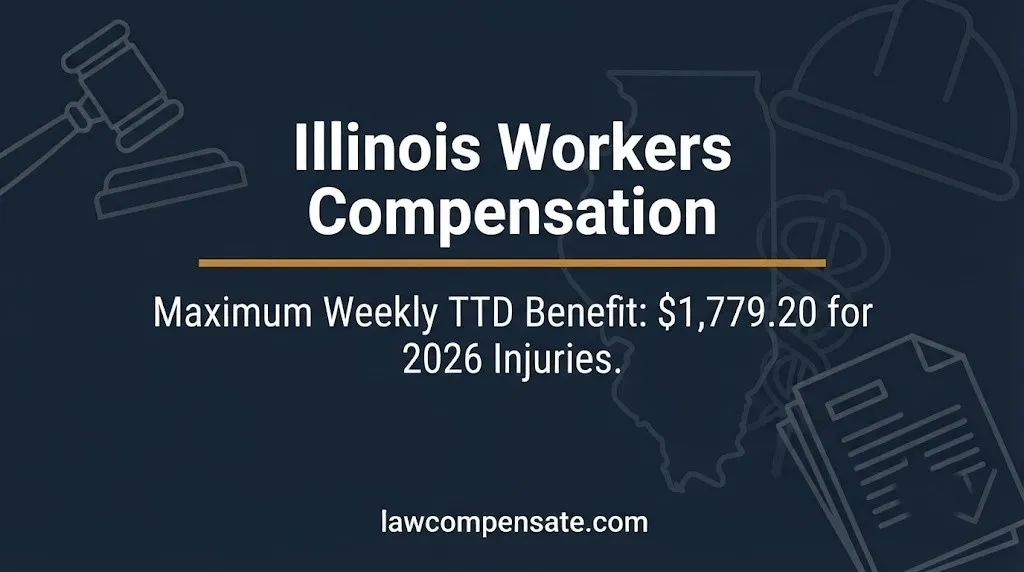
- The maximum weekly TTD benefit in Illinois for 2026 is $1,779.20, set by the Illinois Workers Compensation Commission.
- Injured workers must notify their employer within 45 days and file a claim with the Commission within 3 years.
If you got hurt on the job in Illinois, you are likely searching for answers about what the system owes you, how long it takes, and whether you need a lawyer to get what you are entitled to. Illinois has one of the more worker-protective compensation systems in the country, but it is also complex, with strict deadlines, specific benefit formulas, and an insurance industry that fights claims every day.
This guide covers every verified fact about Illinois workers compensation in 2026. That includes the exact benefit rates, how to file a claim, what to do if your claim is denied, and the rules that are unique to this state. One fact most people do not realize: Illinois is one of the few states that allows employees to choose their own doctor with limited restrictions, a right that can significantly affect the course of a claim.
The Facts
| Detail | Value |
|---|---|
| Governing Body | Illinois Workers Compensation Commission |
| Governing Law | Illinois Workers Compensation Act (820 ILCS 305) |
| Employer Coverage | Almost all employers, including those with one part-time employee |
| Maximum TTD Rate (2026) | $1,779.20 per week |
| Minimum TTD Rate (2026) | Based on average weekly wage, subject to statutory floor |
| Injury Reporting Deadline | 45 days to notify employer |
| Claim Filing Deadline | 3 years from date of injury (2 years for occupational diseases) |
| Attorney Fee Cap | 20% of recovered benefits, subject to Commission approval |
| Doctor Choice | Employee may choose one provider and one referral chain |
| Waiting Period | 3 working days before TTD begins, retroactive if disability exceeds 14 days |
Is the Illinois Workers Comp System Legitimate?
The Illinois workers compensation system is legitimate, established by state law, and administered by the Illinois Workers Compensation Commission, an independent state agency with arbitrators and commissioners who adjudicate disputes. It is not optional. It is not a scam. Nearly every employer in Illinois with even a single part-time employee is required to carry workers compensation insurance or obtain approval for self-insurance.
The system operates as a no-fault replacement for lawsuits. You do not need to prove your employer was negligent. You only need to prove the injury arose out of and in the course of your employment. In exchange for giving up the right to sue, you receive guaranteed benefits: medical treatment, temporary disability payments while you recover, and compensation for permanent impairment if you do not fully recover.
The Illinois Workers Compensation Act has been in place for over a century. It has survived multiple reform efforts, including significant changes in 2011 that reduced some benefits. The system is real, it is binding, and employers who fail to carry insurance face significant penalties, including fines of $500 per day and potential criminal liability for knowing noncompliance.
How to Verify Your Employer Has Coverage
The Illinois Workers Compensation Commission maintains a public online coverage verification tool. You can search by employer name to confirm active coverage. If your employer does not appear, or if coverage has lapsed, report it to the Commission immediately. Uninsured employers are a serious problem in Illinois, particularly in construction, restaurants, and small manufacturing. The Commission’s Insurance Compliance Division investigates these cases.
Key Takeaway: The Illinois workers comp system is real, legally binding, and covers virtually every employee. If you get hurt at work, the system owes you benefits. The question is not whether you are covered. It is whether your claim is filed correctly and whether the insurer plays fair.
How Much Does Illinois Workers Comp Pay in 2026?
Illinois workers comp pays specific categories of benefits, each calculated by statutory formulas. The amounts are not negotiable. What an attorney negotiates is whether you receive the correct category, duration, and settlement value based on the full extent of your injury.
Temporary total disability (TTD) is the wage replacement benefit paid while you are completely unable to work. For 2026, the maximum TTD rate is $1,779.20 per week, which is 133.33 percent of the state’s average weekly wage. The rate for an individual worker is two-thirds of that worker’s average weekly wage over the 52 weeks before the injury, subject to the maximum. If you earned $900 per week, your TTD rate is $600. If you earned $2,800 per week, your rate is capped at $1,779.20.
TTD has a three-working-day waiting period. You do not receive benefits for the first three days of disability. However, if your disability continues for 14 or more calendar days, the waiting period is paid retroactively.
Temporary partial disability (TPD) applies if you return to light-duty work at reduced wages. The benefit is two-thirds of the difference between your pre-injury and post-injury wages. If you earned $1,000 per week before the injury and now earn $700 on light duty, TPD pays $200 per week.
Permanent partial disability (PPD) compensates you for permanent impairment after you reach maximum medical improvement. Illinois uses a schedule of benefits for specific body parts. For example, loss of a hand is worth 205 weeks of PPD benefits. Loss of a thumb is 70 weeks. The weekly PPD rate is 60 percent of your average weekly wage, subject to a maximum. For injuries not on the schedule, including back injuries, PPD is calculated based on the percentage of permanent impairment as a whole person.
2026 Illinois Workers Comp Benefit Rates Table
| Benefit Type | Formula | 2026 Maximum |
|---|---|---|
| Temporary Total Disability (TTD) | Two-thirds of AWW | $1,779.20/week |
| Temporary Partial Disability (TPD) | Two-thirds of wage difference | $1,779.20/week minus current earnings |
| Permanent Partial Disability (PPD) | 60% of AWW | Varies by body part and impairment |
| Permanent Total Disability (PTD) | Two-thirds of AWW for life | $1,779.20/week |
| Medical Benefits | All reasonable and necessary | No dollar cap |
| Vocational Rehabilitation | Job retraining costs | Reasonable expenses covered |
| Death Benefits | Two-thirds of AWW to dependents | 25 years or $500,000, whichever is greater |
Key Takeaway: The weekly TTD cap in Illinois rises annually. For 2026, it is $1,779.20. Your actual rate depends on your pre-injury wages, not on what the insurer offers.
What Is the Illinois Workers Compensation Commission?
The Illinois Workers Compensation Commission, often abbreviated IWCC, is the state agency that administers the workers compensation system. It is not an insurance company. It is a neutral adjudicative body with arbitrators who hear disputed cases and commissioners who review those decisions on appeal.
The IWCC does not pay benefits. The employer’s insurance carrier or self-insured employer pays benefits. The Commission’s job is to resolve disputes when the parties cannot agree. That includes disputes about whether the injury is work-related, what medical treatment is reasonable, what the disability rate should be, and what permanent impairment rating applies.
The Commission has hearing sites across the state, including Chicago, Peoria, Springfield, Collinsville, Rockford, and Herrin. Most cases are assigned to an arbitrator who holds a hearing, takes evidence, and issues a written decision. That decision can be appealed to a three-commissioner panel and ultimately to the Illinois Appellate Court.
How the IWCC Claim Process Works
Think of the IWCC like a small claims court for work injuries. You file a claim. The insurer responds. If they agree on everything, the case settles and the Commission reviews the settlement contract for fairness. If they disagree, an arbitrator hears the case and decides. The process is less formal than civil court but still involves evidence, testimony, and legal argument. Most cases settle before an arbitration hearing, but the hearing date creates a deadline that drives settlement.
Who Needs Illinois Workers Compensation Insurance?
Nearly every Illinois employer must carry workers compensation insurance, regardless of the number of employees. Illinois is one of the strictest states on employer coverage requirements. There is no exemption for employers with fewer than a certain number of workers. A business with one part-time employee must carry coverage.
Sole proprietors, partners, and corporate officers can opt out of coverage for themselves but must provide coverage for all employees. Independent contractors are generally not covered, but Illinois uses a strict test for independent contractor status. If the employer controls the manner and means of the work, the worker is an employee regardless of what the contract says. Misclassification is a significant enforcement issue in Illinois, particularly in construction and trucking.
Employers can obtain coverage through a private insurance carrier or, if they meet financial requirements, can self-insure. The Illinois Department of Insurance regulates carriers. If a carrier becomes insolvent, the Illinois Insurance Guaranty Fund provides a safety net for covered claims.
Penalties for Uninsured Employers
An employer that fails to carry workers compensation insurance faces penalties including fines of $500 per day of noncompliance, up to $10,000. In cases of willful noncompliance, the employer can face criminal misdemeanor charges. An injured worker whose employer is uninsured can file a claim with the IWCC and also sue the employer in civil court, where the employer loses the normal protections of the Workers Compensation Act, including the exclusive remedy defense and the bar on pain and suffering damages.
How to File a Workers Comp Claim in Illinois
Filing a workers compensation claim in Illinois involves specific steps and strict deadlines. Missing a deadline can bar your claim permanently. Here is the step-by-step process.
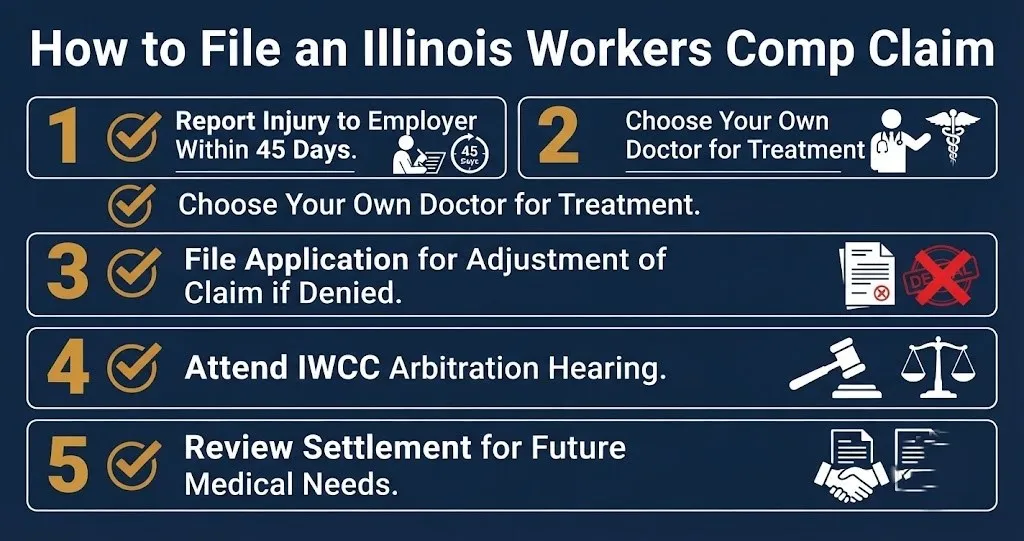
- Report the injury to your employer within 45 days. Provide written notice if possible. The 45-day clock starts from the date of injury or the date you reasonably should have known the injury was work-related.
- Seek medical treatment. Illinois allows you to choose your own doctor. You may select one provider and one chain of referral. If your employer participates in a Preferred Provider Program, you must choose from the program list, but you still have a choice within that list.
- Your employer or its insurer must file an accident report with the IWCC if you miss more than three days of work. Ask for a copy.
- If the insurer denies your claim or fails to pay benefits, file an Application for Adjustment of Claim with the IWCC. This is the formal document that starts a case at the Commission. The filing deadline is three years from the date of injury or two years from the last payment of compensation, whichever is later.
- The Commission assigns an arbitrator and schedules a status call. Both sides appear, typically with attorneys, to discuss settlement or set a hearing date.
- If the case does not settle, an arbitration hearing is held. The arbitrator issues a decision within 60 days.
- Either side may appeal to a panel of three commissioners, and from there to the circuit court and appellate court.
Critical Illinois Deadlines
| Deadline | Requirement |
|---|---|
| 45 days | Notify employer of injury |
| 3 years | File Application for Adjustment of Claim (traumatic injury) |
| 2 years | File Application for Adjustment of Claim (occupational disease) |
| 3 working days | Waiting period before TTD begins |
| 60 days | Arbitrator must issue decision after hearing |
Key Takeaway: Report the injury immediately. File the Application for Adjustment of Claim if benefits are denied or delayed. The three-year filing deadline is generous compared to many states, but do not wait three years. Evidence disappears. Witnesses forget. File as soon as a dispute arises.
What Benefits Are Available for Workers Comp in Chicago?
Workers compensation benefits in Chicago are the same as in the rest of Illinois. The law is statewide. There is no separate Chicago workers comp system. The distinction matters because some workers assume Chicago has its own rules. It does not. A claim filed by a Chicago construction worker follows the same process and the same benefit formulas as a claim filed by a farmer in rural southern Illinois.
Chicago does have a higher concentration of certain industries with high injury rates, including construction, manufacturing, warehousing, and hospitality. The IWCC Chicago hearing site handles a significant volume of the state’s disputed claims. Chicago-based workers also have access to more workers comp attorneys and medical providers, which can affect the practical dynamics of a claim even though the law is the same.
The IWCC Chicago office is located at 160 North LaSalle Street. Hearings for Cook County cases are typically held there or at the Daley Center. If you work in Chicago and need to attend an arbitration hearing, plan for downtown traffic and parking.
Reality Check: No workers comp insurer in Illinois will send you a large settlement check without you asking. The initial offer is almost always lower than the full value of your claim. An attorney can negotiate that number higher, but the benefit rate itself is set by law. The negotiation is over the duration of benefits, the impairment rating, and the settlement of future medical rights, not the weekly rate.
Can You Choose Your Own Doctor Under Illinois Workers Comp?
Yes, Illinois gives injured workers meaningful choice in medical providers. You may choose one doctor, surgeon, or hospital and one chain of referral. Your choice must be reasonable given the nature of the injury. The employer or insurer cannot force you to see a company doctor, though they may request an independent medical examination at their expense.
This right is more expansive than in many states, where the employer controls the choice of physician. In Illinois, the ability to select your own treating doctor means your medical evidence is developed by a physician you trust, not one selected by the insurer for its history of favorable defense opinions.
There are exceptions. If your employer participates in an IWCC-approved Preferred Provider Program, you must choose from the program’s list of providers. The program must offer a reasonable number of choices and cannot be structured to steer you toward doctors who routinely minimize work injuries. Even within a PPO, you still choose your specific doctor from the list. You are not assigned one.
Why Your Doctor Choice Matters
The doctor you choose becomes your treating physician. That doctor diagnoses your condition, prescribes treatment, sets work restrictions, and ultimately assigns an impairment rating at maximum medical improvement. That rating directly determines your permanent partial disability benefits. A doctor selected and trusted by you is more likely to document the full extent of your injury and its impact on your life. A doctor selected by the insurer may downplay the injury, release you to work prematurely, or assign a lower impairment rating.
How Are Workers Comp Settlements Structured in Illinois?
Illinois workers comp settlements fall into two categories: contract settlements that leave future medical benefits open and full and final settlements that close all aspects of the claim forever. The distinction is the single most important concept to understand before signing anything.
A settlement contract under Section 8 of the Act pays a lump sum for the disability component, typically permanent partial disability, while keeping the insurer responsible for future medical treatment related to the injury. This is the most common structure. You receive money for your impairment. The insurer stays on the hook for future surgeries, medication, and medical care. This structure protects you if your injury worsens over time.
A full and final settlement closes everything. You receive a larger lump sum, but you give up the right to any future medical treatment at the insurer’s expense. If you need surgery in five years, you pay for it yourself. This structure should only be accepted when you have fully recovered and your doctor confirms no future treatment is anticipated, or when the settlement is large enough to cover expected future medical costs with a margin of safety.
All settlements must be approved by an IWCC arbitrator. The arbitrator reviews the settlement for fairness and ensures you understand what you are giving up. This judicial oversight protects workers from signing away rights they do not fully understand.
Settlement Approval Hearing
When a settlement is presented for approval, the arbitrator will ask you, under oath, whether you understand the terms, whether anyone pressured you to settle, and whether you are satisfied with your attorney’s representation. Answer truthfully. If you do not understand something, say so. The arbitrator can refuse to approve a settlement that appears unconscionable or that you do not genuinely understand.
Key Takeaway: A settlement leaving medical open is safer for most workers. A full settlement is riskier. The difference is not just dollars. It is who pays for your future medical care.
What to Do If Your Illinois Workers Comp Claim Is Denied
A denial is not the end of the road. It is the beginning of the dispute resolution process. Illinois law gives you the right to a hearing before an IWCC arbitrator. You do not need to accept the insurer’s decision.
When a claim is denied, the insurer must provide a written explanation. Common reasons include the injury not being reported within 45 days, a dispute over whether the injury is work-related, a pre-existing condition argument, or a positive drug or alcohol test at the time of injury. Some denials are valid. Some are not. The only way to find out is to file an Application for Adjustment of Claim and present your evidence to an arbitrator.
The denial triggers specific timeframes. You should file the Application as soon as possible after denial. The insurer’s failure to pay benefits without a good faith basis can result in penalties of up to 50 percent of the benefits owed, plus attorney fees. This penalty provision gives the insurer a financial incentive to pay meritorious claims rather than risk a penalty finding at arbitration.
Steps After a Denial
- Read the denial letter carefully. Note the specific reason given.
- Gather your evidence: medical records, incident reports, witness statements, and any correspondence with the employer or insurer.
- Consult a workers comp attorney. Denied claims are the strongest case for representation.
- File an Application for Adjustment of Claim with the IWCC.
- Attend all scheduled status calls and hearings. Failure to appear can result in your case being dismissed.
What Is the Illinois Workers Comp Statute of Limitations?
The statute of limitations for traumatic injuries in Illinois is three years from the date of injury. For occupational diseases caused by repetitive trauma or exposure over time, the deadline is two years from the date you knew or reasonably should have known the condition was work-related.
The three-year rule has an important exception. If the employer or insurer paid any compensation, including medical benefits or TTD payments, the statute resets. The new deadline is two years from the date of the last payment. This means a claim that seemed old can still be timely if the insurer paid for treatment within the last two years.
Do not rely on the long statute of limitations as a reason to delay. Evidence degrades. Witnesses move. Surveillance footage is overwritten. The sooner you file, the stronger your case. The statute is a backstop, not a strategy.
What Happens Next: The Illinois Workers Comp Timeline
- Day 1: Report injury to employer. Seek medical treatment from your chosen doctor.
- Days 1 to 45: Employer files accident report with IWCC if required. Insurer begins investigation.
- Weeks 1 to 12: If claim is accepted, TTD payments begin after the three-day waiting period. Medical treatment proceeds.
- Months 3 to 12: You reach maximum medical improvement or continue treatment. A permanent impairment rating is assigned.
- Months 12 to 24: Settlement negotiations occur. If the claim was denied, an arbitration hearing is scheduled and held.
- Year 3: If no claim has been filed and no benefits paid, the statute of limitations expires for traumatic injuries. File before this deadline.
This timeline assumes a claim that is initially disputed and requires arbitration. Straightforward claims with prompt acceptance and recovery can resolve in months. Complex claims with surgeries and permanent disability take longer.
Frequently Asked Questions
Does my employer have to hold my job while I am off on workers comp in Illinois?
No. The Workers Compensation Act does not require job protection.
The federal Family and Medical Leave Act may protect your job for up to 12 weeks if your employer is covered.
If you are fired while on workers comp, your medical and disability benefits continue.
Can I get workers comp if the accident was my fault?
Yes. Illinois workers comp is a no-fault system.
Your own negligence does not bar your claim unless you were intoxicated or engaging in horseplay.
Even a serious mistake on your part does not automatically defeat the claim.
What if my employer does not have workers comp insurance?
You can file a claim with the IWCC and also sue your employer in civil court.
You may be able to recover from the Illinois Insurance Guaranty Fund if the employer was supposed to have coverage.
Report uninsured employers to the IWCC Insurance Compliance Division.
How long do I have to report a work injury in Illinois?
You have 45 days from the date of injury or knowledge of the injury.
Report immediately. Waiting serves no purpose and can weaken your claim.
Written notice is better than verbal, but verbal notice satisfies the law.
Can I see my own doctor for a work injury in Illinois?
Yes. Illinois allows you to choose your own doctor.
You get one choice of provider and one chain of referral.
If your employer has an approved PPO, you must choose from that list, but you still choose your specific doctor.
What is the waiting period for workers comp benefits in Illinois?
You must miss three working days before TTD begins.
If your disability continues for 14 or more calendar days, the three-day waiting period is paid retroactively.
Medical benefits have no waiting period and begin immediately.
What is the maximum workers comp settlement in Illinois?
There is no statutory maximum on settlement amounts.
Settlement value depends on the severity of the injury, the impairment rating, and future medical needs.
Permanent total disability can result in lifetime benefits with a total value exceeding $1 million.
Can I sue my employer instead of filing workers comp in Illinois?
Generally no. Workers comp is the exclusive remedy for work injuries.
There are narrow exceptions for intentional torts.
You can sue a third party, such as an equipment manufacturer, while still receiving workers comp benefits.
The Illinois workers compensation system covers nearly every worker in the state, but getting the full benefits you are owed requires knowing the rules and acting on them. Report your injury immediately. Choose your doctor carefully. File the Application for Adjustment of Claim if the insurer disputes anything. The three-year filing deadline is generous, but delay is the enemy of a strong claim.
The single most important number to know is your weekly TTD rate, which is two-thirds of your average weekly wage, capped at $1,779.20 for 2026 injuries. That number belongs to you by law. Everything else, the duration of benefits, the impairment rating, and the settlement value, depends on the facts of your case and the quality of the evidence you present.