Workers’ Comp Settlement Chart California 2026: Body Parts Payouts, Surgery Values, and What to Expect
Quick Answer
- California workers’ comp settlements are real. The state uses a standardized rating system to calculate payouts.
- Body part payouts range from roughly $2,000 for minor injuries to over $300,000 for severe permanent disabilities.
- There is no single claim deadline. You must report your injury within 30 days and file a claim within one year.
If you were injured at work in California, you are not searching for a class action settlement with a claim form. You are looking for information on how the state calculates what your injury is worth. The numbers in this article come from the California Permanent Disability Rating Schedule, the state’s workers’ compensation laws, and data published by the California Division of Workers’ Compensation.
This guide explains the 2026 settlement landscape in plain terms. You will find payout ranges by body part, how surgery affects settlement value, how the rating formula works, and what a realistic timeline looks like from injury to check in hand.
The Facts
| System | California workers’ compensation (individual claims) |
| Governing Law | California Labor Code, Permanent Disability Rating Schedule |
| Payout Range | $2,000 to over $300,000 depending on impairment |
| Average Settlement | Varies widely by injury type and disability rating |
| Claim Deadline | 30 days to report injury; 1 year to file claim (from date of injury) |
| Administrator | Employer’s insurance carrier or third-party administrator |
| Proof Needed | Medical records, doctor’s impairment rating, work status reports |
Are California Workers’ Comp Settlement Charts Real?
Yes. The California workers’ compensation system uses a published, standardized schedule to calculate permanent disability payments. The numbers are not secret. They are written into state law.
The Permanent Disability Rating Schedule assigns a percentage to every type of injury. That percentage is then converted into a dollar amount using a formula that accounts for your average weekly wage and your impairment level.

The charts you see online are summaries of this schedule. They are not settlement offers. They are starting points for negotiation. The actual settlement you receive may be higher or lower depending on your specific facts, your attorney, and the insurance carrier.
These charts apply only to permanent disability, which is the lasting impairment after you reach maximum medical improvement. Temporary disability benefits, which pay while you recover, are calculated separately and are not part of the settlement chart.
Key Takeaway: The charts reflect real state-mandated formulas. Your actual settlement depends on your individual impairment rating, wages, and negotiation.
How Does the California Workers’ Comp Settlement Formula Work?
The formula starts with your permanent disability rating, a percentage assigned by a doctor using the American Medical Association Guides to the Evaluation of Permanent Impairment.
That percentage is then adjusted by your occupation and age at the time of injury. A back injury rated at 20% permanent disability might be worth more to a construction worker than to a desk worker because the future earning capacity impact is greater.
The adjusted rating is then multiplied by the number of weeks assigned to that rating on the state schedule. Each week has a dollar value set by law. For 2026, the maximum weekly permanent disability rate is $290. The minimum is $160.
Here is a simplified view of the formula.
| Step | What Happens |
|---|---|
| Step 1 | Doctor assigns a whole person impairment percentage using AMA Guides |
| Step 2 | Rating is adjusted for occupation and age under the 2005 Permanent Disability Rating Schedule |
| Step 3 | Adjusted rating is converted to a number of weeks on the state schedule |
| Step 4 | Weeks are multiplied by the weekly PD rate (min $160, max $290) |
| Step 5 | Future medical care is valued separately and added to the settlement if settled by Compromise and Release |
The formula is mechanical. The art of settlement is in the adjustments and in the valuation of future medical care.
Workers’ Comp Settlement Chart by Body Part
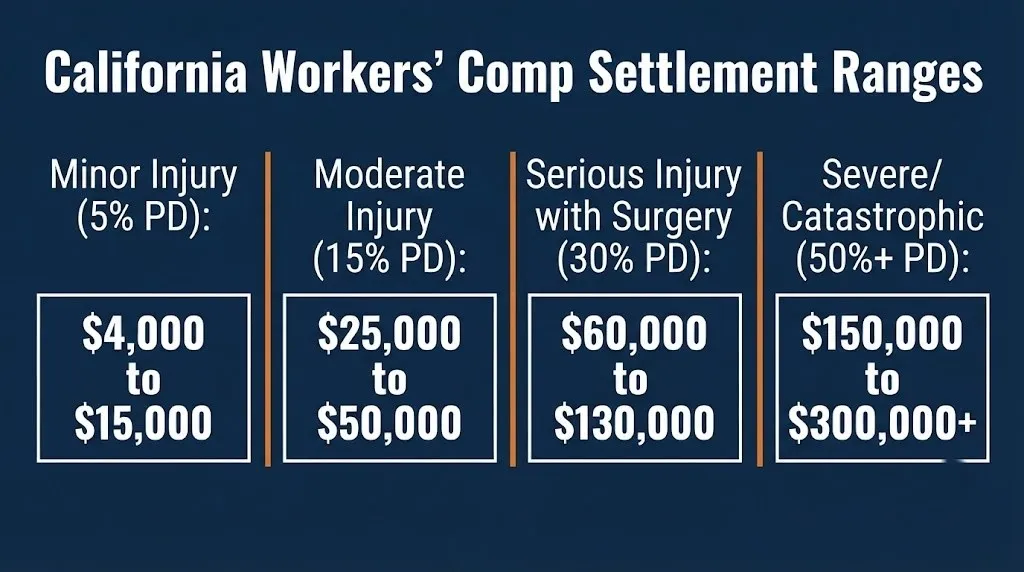
The chart below shows typical permanent disability rating ranges and corresponding dollar ranges for common injuries. These are estimates based on the 2005 rating schedule and the 2026 weekly rate maximums. Your actual rating depends on objective medical findings.
| Body Part | Typical PD Rating Range | Estimated Settlement Range |
|---|---|---|
| Shoulder | 5% to 30% | $8,000 to $90,000 |
| Knee | 5% to 35% | $8,000 to $110,000 |
| Back (lumbar) | 8% to 50% | $15,000 to $160,000 |
| Back (cervical/neck) | 10% to 55% | $18,000 to $175,000 |
| Hand / Wrist | 3% to 25% | $4,000 to $75,000 |
| Foot / Ankle | 5% to 30% | $8,000 to $90,000 |
| Hip | 8% to 40% | $15,000 to $130,000 |
| Elbow | 3% to 20% | $4,000 to $60,000 |
| Head (concussion/TBI) | 10% to 70%+ | $20,000 to over $250,000 |
| Psychiatric (compensable) | 10% to 70%+ | $20,000 to over $250,000 |
These ranges are for permanent disability only. They do not include future medical care, which can add substantial value when a case settles by Compromise and Release. They also do not include temporary disability benefits already paid during recovery.
Key Takeaway: The body part chart is a starting point. Your rating depends on objective medical findings, not pain level.
How Much Does a Workers’ Comp Surgery Settlement Add in California?
Surgery increases settlement value in two ways. First, it can increase the permanent disability rating because surgical procedures often leave residual impairment. Second, it demonstrates the severity of the injury to the insurance carrier.
A worker who had a spinal fusion will typically receive a higher rating than a worker with the same back injury treated conservatively. The fusion itself generates a base impairment under the AMA Guides. The scar, the hardware, and the reduced range of motion all add percentage points.
Here are typical settlement ranges for common surgical injuries.
| Surgery Type | Typical PD Rating Range | Estimated Settlement Range |
|---|---|---|
| Knee arthroscopy (meniscectomy) | 8% to 20% | $14,000 to $60,000 |
| Knee replacement | 25% to 40% | $80,000 to $130,000 |
| Shoulder arthroscopy (rotator cuff) | 10% to 25% | $18,000 to $75,000 |
| Shoulder replacement | 25% to 40% | $80,000 to $130,000 |
| Carpal tunnel release | 3% to 10% | $4,000 to $18,000 |
| Lumbar laminectomy or discectomy | 15% to 35% | $45,000 to $110,000 |
| Spinal fusion (lumbar) | 25% to 50% | $80,000 to $160,000 |
| Spinal fusion (cervical) | 25% to 55% | $80,000 to $175,000 |
| Hip replacement | 20% to 40% | $65,000 to $130,000 |
Again, these ranges are for permanent disability only. Future medical care is separate. A spinal fusion case that settles by Compromise and Release might include $100,000 to $300,000 or more for future medical care on top of the permanent disability payout.
What Is the Difference Between Stipulated Award and Compromise and Release?
California workers’ comp settlements come in two forms. The one you choose determines how much you receive and what rights you give up.
A Stipulated Award pays the permanent disability amount in weekly installments over time. The insurance carrier remains responsible for all future medical care related to the injury. You keep the right to treat. You do not get a lump sum for medical.
A Compromise and Release is a lump sum buyout. You receive one check. In exchange, you give up all rights to future benefits, including medical care. The insurance carrier closes its file forever.
Most injured workers who settle by Compromise and Release do so because they want finality or because they have returned to work with employer-provided health insurance. The lump sum for future medical care is negotiated based on what treatments you are likely to need, what they cost, and how long you are likely to need them.
Here is a comparison.
| Feature | Stipulated Award | Compromise and Release |
|---|---|---|
| PD payment | Weekly over time | Lump sum |
| Future medical | Carrier pays forever | You pay from settlement |
| Finality | No, medical stays open | Yes, full closure |
| Lump sum amount | Lower (no medical buyout) | Higher (includes medical buyout) |
| Medicare set-aside | Not usually required | Often required |
Key Takeaway: Compromise and Release pays more upfront but closes your case forever. A Stipulated Award keeps medical open but pays less now.
What Is the Average Workers’ Comp Settlement in California?
There is no single average that applies to every injury. The data that exists comes from insurance industry reports and studies published by the California Workers’ Compensation Institute.
According to the most recent available data, the average permanent disability settlement in California (not including future medical) falls between $20,000 and $40,000. That average is misleading because it lumps together a 5% wrist strain with a 50% back injury.
Cases involving surgery, especially spinal surgery, settle for well above the average. A lumbar fusion case with a 35% permanent disability rating might settle for $90,000 in PD plus $150,000 in future medical buyout for a total Compromise and Release of $240,000.
Cases without surgery and with low impairment ratings settle below the average. A 5% knee strain with no surgery and a full return to work might settle for $8,000 in PD with no Compromise and Release component.
The most valuable cases involve catastrophic injuries: traumatic brain injuries, severe burns, amputations, and spinal cord damage. These can produce life pension payments rather than standard permanent disability, with total case values exceeding $500,000.
What Factors Increase a California Workers’ Comp Settlement?
The base rating formula is just the floor. Several factors push the settlement higher during negotiation.
Severity of the impairment is the biggest driver. Higher ratings mean more weeks and more dollars. Objective findings matter more than subjective complaints. An MRI showing a herniated disc is worth more than a report of back pain with normal imaging.
Whether you had surgery matters. Surgical cases rate higher because the surgery itself creates impairment and because the fact of surgery proves the injury was serious.
Your pre-injury wages matter. Higher average weekly wages produce higher temporary disability payments and can affect the settlement value indirectly, though permanent disability uses fixed weekly rates.
Your age and occupation matter. A younger worker in a physically demanding job receives a higher future earning capacity adjustment, which increases the rating.
Whether you have an attorney matters. Represented workers consistently receive higher settlements than unrepresented workers. The insurance industry’s own data confirms this.
Whether you can return to your old job matters. If your injury prevents you from ever doing your prior work, the case is worth more than if you return to the same job at the same pay.
Reality Check: The single biggest mistake injured workers make is accepting the first settlement offer without understanding what their case is worth. Insurance adjusters are not paid to maximize your settlement. They are paid to close files for the lowest defensible amount. An attorney who regularly handles California workers’ comp cases knows what similar injuries settle for in your venue. The consultation is free. The fee comes only from what the attorney recovers. If you are unrepresented, the insurance company knows it and prices your case accordingly.
How Long Does a California Workers’ Comp Settlement Take?
The timeline from injury to settlement typically ranges from 12 to 24 months for cases that reach maximum medical improvement without complications. Cases involving multiple surgeries or disputes take longer.
Here is the typical sequence.
- Day 1 to 30: Report the injury to your employer. Failure to report within 30 days can bar your claim.
- Day 1 to 90: Medical treatment begins. The insurer accepts or denies the claim within 90 days.
- Months 3 to 12: Active treatment. Physical therapy, injections, possible surgery.
- Month 12 to 18: You reach maximum medical improvement. The doctor issues a permanent and stationary report with an impairment rating.
- Month 18 to 24: Settlement negotiations. If you and the insurer agree, the settlement is documented and submitted to a workers’ comp judge for approval.
- Post-approval: Stipulated Award payments begin within 30 days. Compromise and Release lump sum check arrives within 30 days of judge approval.
Disputed claims take longer. If the insurer denies your injury, you will need a hearing before a workers’ compensation judge. That adds months to the timeline.
How Do I File a Workers’ Comp Claim in California?
The claim process has specific deadlines. Missing a deadline can forfeit your rights.
- Report the injury to your employer immediately. You have 30 days, but report it now.
- Complete a DWC-1 claim form. Your employer must provide this within one working day of notice.
- Return the completed DWC-1 to your employer. Keep a copy for your records.
- Your employer submits the claim to their insurance carrier.
- The insurer has 90 days to accept or deny the claim. If accepted, treatment begins.
- If denied, you have the right to a hearing before a workers’ compensation judge.
- Treat with the doctor the insurer authorizes. In most cases, the insurer controls medical treatment for the first 30 days.
- After 30 days, you may be able to switch to your own doctor if you predesignated one before the injury.
- Follow all treatment recommendations. Gaps in treatment hurt your case.
- When you reach maximum medical improvement, request a permanent and stationary evaluation.
- The doctor issues a report with an impairment rating. Review it carefully.
- Your attorney negotiates a settlement based on the rating, your wages, your occupation, and your future medical needs.
- The settlement is submitted to a workers’ comp judge for approval.
- If approved, payment follows within 30 days.
The process works best with an attorney. The forms are not complicated. The strategy of when to settle, what to include in the medical buyout, and how to handle Medicare’s interests is complicated.
What Is a Qualified Medical Evaluator and Why Does It Matter?
If you and the insurer disagree on your impairment rating, either side can request a Qualified Medical Evaluator. A QME is a state-certified doctor who provides an independent opinion.
The QME examines you, reviews your medical records, and issues a report. That report carries significant weight with the workers’ compensation judge. The QME’s rating often becomes the basis for settlement because both sides know the judge will rely on it.
You can also use an Agreed Medical Evaluator, which is a doctor both sides agree to use instead of fighting over a QME.
The choice of QME or AME is one of the most consequential decisions in a workers’ comp case. The doctor’s specialty, reputation, and history of ratings all affect the outcome. Your attorney should guide this selection. An unrepresented worker who walks into a QME evaluation without preparation often leaves money on the table.
Can I Settle My Workers’ Comp Case While Still Working?
Yes. Many workers settle their permanent disability claim while still employed. You do not have to quit your job to receive permanent disability benefits.
If you return to work at the same wages, your permanent disability is still compensable. The impairment exists regardless of your work status. You can settle the permanent disability portion and continue working.
If you return to work at lower wages, you may also be entitled to a Supplemental Job Displacement Voucher, which provides up to $6,000 for retraining.
If you cannot return to any work, you may receive permanent disability plus potential eligibility for Social Security Disability Insurance or state disability benefits. The workers’ comp settlement may need to account for Medicare’s interests through a Medicare Set-Aside arrangement.
Are Workers’ Comp Settlements Taxable in California?
No. Workers’ compensation settlements are not taxable at the state or federal level. This is one of the significant advantages of workers’ comp over other forms of compensation.
The IRS does not treat workers’ comp as income. California follows the same rule. You do not report the settlement on your tax return.
If your settlement includes interest on delayed payments, the interest portion may be taxable. If a portion of your settlement is allocated to lost wages under a separate employment claim, that portion may be taxable. But a standard permanent disability or Compromise and Release settlement is tax-free.
This is general information, not tax advice. Confirm with a tax professional based on the specific structure of your settlement.
What Happens After a Workers’ Comp Settlement Is Approved?
The settlement does not become final when you sign it. It must be approved by a workers’ compensation judge.
The judge reviews the settlement to ensure it is adequate and that you understand what you are giving up. If the settlement is a Compromise and Release, the judge will ask you directly whether you understand that you are giving up all future rights, including medical care.
Once the judge approves the settlement, the insurance carrier has a set time to issue payment. For a Compromise and Release, the check usually arrives within 30 days. For a Stipulated Award, the weekly payments begin within 30 days.
After a Compromise and Release, your case is closed forever. You cannot reopen it if your condition worsens. You cannot ask for more money. You are responsible for your own medical care going forward.
After a Stipulated Award, the insurance carrier remains responsible for medical care related to the injury. You can seek treatment as needed. The permanent disability payments continue on schedule until the award is fully paid.
Frequently Asked Questions
How much is a workers’ comp settlement for a back injury in California?
Permanent disability for a back injury ranges from roughly $15,000 to $160,000.
Surgical back cases settle higher. Spinal fusion cases can exceed $200,000 with medical buyout.
Does surgery increase my workers’ comp settlement?
Yes. Surgery increases the impairment rating and demonstrates injury severity.
A surgical case typically settles for significantly more than a non-surgical case with the same diagnosis.
How long does it take to get a settlement check in California?
After judge approval, the check usually arrives within 30 days.
Approval itself takes one to two months after you and the insurer agree on terms.
Can I settle my California workers’ comp case without a lawyer?
Yes. You can settle directly with the insurance carrier.
Represented workers consistently receive higher settlements. The consultation to learn your case value is free.
What is the highest workers’ comp settlement in California?
Catastrophic injury cases with life pensions can exceed $500,000 in total value.
Cases involving traumatic brain injury, paralysis, or severe burns are the highest-value claims.
Do I have to pay taxes on my workers’ comp settlement?
No. Workers’ comp settlements are tax-free at both the state and federal level.
Confirm with a tax professional for settlements with unusual structures.
What if my employer says I cannot file a claim?
Your employer cannot legally prevent you from filing. Report the injury and complete a DWC-1 form.
If your employer refuses to provide the form, contact an attorney or the Division of Workers’ Compensation.
How many weeks does permanent disability pay in California?
It depends on your rating. A 10% rating pays for 30.25 weeks of permanent disability.
A 50% rating pays for 302.5 weeks. A 100% rating pays for life.
The California workers’ compensation settlement system is formula-driven at its base and negotiation-driven at its margins. The charts in this article give you a starting point. Your actual settlement depends on your specific impairment rating, your occupation, your age, whether you had surgery, and whether you have an attorney who knows what your case is worth in your local venue.
If you were injured at work, report the injury now. Complete the DWC-1. Get treated. When you reach maximum medical improvement, have your case evaluated by a qualified workers’ comp attorney before you accept any settlement offer. The consultation is free. The difference between an unrepresented settlement and a represented one is often tens of thousands of dollars.