Nonemployee Compensation in 2026: What It Means for Your 1099 and Your Taxes
Quick Answer
- Nonemployee compensation is payment for services performed by someone who is not your employee, reported in Box 1 of Form 1099-NEC.
- The 2026 reporting threshold is $2,000, up from $600 for prior tax years, and will adjust for inflation starting in 2027.
- Businesses must send 1099-NEC forms for 2026 payments by February 1, 2027, to both the IRS and the recipient.
You got a 1099-NEC, or you’re a business trying to figure out who needs one, and the term “nonemployee compensation” is doing a lot of work in a small box. Here’s the direct answer: it’s the IRS label for money paid to a contractor, freelancer, or vendor for services, not wages paid to an employee.
This matters right now because the reporting threshold just jumped. Payments made in 2026 don’t require a 1099-NEC until they hit $2,000, a change from the $600 threshold that applied for years before it.
This guide covers what counts as nonemployee compensation, how it’s taxed, how to report it with or without a form in hand, and what changed for 2026. One detail that trips people up: getting paid under the new $2,000 threshold does not make the income tax-free, it just means the payer isn’t required to report it.
The Facts
| Category | What’s Verified for 2026 |
|---|---|
| Definition | Payment for services by a nonemployee, reported in Box 1 of Form 1099-NEC |
| 2026 reporting threshold | $2,000 (raised from $600 under the One Big Beautiful Bill Act) |
| Threshold going forward | Adjusted for inflation starting in tax year 2027 |
| Reporting deadline | February 1, 2027, for 2026 tax year payments |
| Backup withholding trigger | Required regardless of threshold if federal tax was withheld |
| Self-employment tax threshold | $400 or more in net self-employment earnings |
| Where reported by recipient | Schedule C, then Schedule SE for self-employment tax |
| Governing form | IRS Form 1099-NEC (Nonemployee Compensation), Instructions for Forms 1099-MISC and 1099-NEC |
Not everyone paid for services gets a form under the new rules. That doesn’t change whether the income itself is taxable, only whether the payer had to report it.
What is nonemployee compensation on a 1099?
Nonemployee compensation is payment made to an individual or business for services performed, when that person is not on the payer’s payroll as an employee. The IRS reports this specific category in Box 1 of Form 1099-NEC.
This includes fees, commissions, prizes, and awards paid for services, whether the recipient is a sole proprietor, an independent contractor, a freelancer, or another small business. The defining feature isn’t the job title, it’s the working relationship: no withholding, no employer-side payroll taxes, and no employee benefits.
Commonly reported as nonemployee compensation:
- Freelance and contract work fees
- Independent contractor payments for services
- Professional fees paid to consultants
- Sales commissions paid to non-employees
- Fees paid for parts and materials that were part of a service job
Nonemployee compensation is different from wages reported on a W-2, and it’s also different from other payment categories like rent or prizes that get reported on Form 1099-MISC instead.
Is nonemployee compensation the same as being self-employed?
Not exactly, receiving nonemployee compensation usually signals you were treated as self-employed for that specific work, but the form itself doesn’t determine your legal classification. Worker classification depends on the actual working relationship, not just which form arrives in your mailbox.
The IRS generally defines a nonemployee as someone operating an independent trade, business, or profession who provides services to another business. This includes freelancers, gig workers, consultants, and vendors, regardless of whether they have a formal business entity.
What typically points to nonemployee status:
- You control how and when the work gets done.
- You use your own tools or equipment.
- You can work for multiple clients at once.
- No taxes were withheld from your payment.
If you believe you were actually treated as an employee but got a 1099-NEC instead of a W-2, that’s a worker misclassification issue worth raising with a tax professional, since it can affect what taxes you actually owe.
How much nonemployee compensation triggers a 1099-NEC in 2026?
The 2026 reporting threshold is $2,000 or more paid to a single nonemployee during the calendar year, up from $600 in prior years. This change comes from the One Big Beautiful Bill Act and applies specifically to payments made starting in 2026.
Threshold comparison:
| Tax Year | Nonemployee Compensation Threshold |
|---|---|
| 2025 and earlier | $600 or more |
| 2026 | $2,000 or more |
| 2027 and beyond | $2,000, adjusted annually for inflation |
There’s one important exception that doesn’t move: if a business withheld federal income tax from a payment, a 1099-NEC is still required regardless of the dollar amount. The direct sales checkbox rule, tied to a separate $5,000 threshold, also remains unchanged by this update.
Key Takeaway: The $2,000 threshold for 2026 changes when a business must report a payment, but it does not change whether that payment counts as taxable income to the person who received it.
How much tax do you pay on nonemployee compensation?
Nonemployee compensation is taxed as ordinary self-employment income, subject to both federal income tax and a 15.3% self-employment tax if net earnings reach $400 or more. There’s no separate flat tax rate for this category of income.
The 15.3% self-employment tax covers Social Security and Medicare, and it applies on top of your regular federal income tax bracket. This is the tax that a traditional employer would otherwise split with you through payroll withholding.
How the tax burden breaks down:
- Federal income tax: Based on your total taxable income and filing status, same brackets as any other income.
- Self-employment tax: 15.3% of net self-employment earnings, triggered once net earnings reach $400.
- Estimated quarterly payments: Often required since no employer is withholding tax throughout the year.
Reality Check: Getting paid under the new $2,000 reporting threshold does not make that income tax-free or exempt from filing. Every dollar of self-employment income is still reportable, whether or not a 1099-NEC ever shows up.
Where does nonemployee compensation go on your tax return?
Nonemployee compensation is reported on Schedule C as business income, then flows to Schedule SE to calculate self-employment tax owed. This is different from W-2 wage income, which gets reported directly on Form 1040.
Basic reporting flow for a typical contractor:
- Total your nonemployee compensation from all 1099-NEC forms received.
- Add any nonemployee compensation you received without a form.
- Report gross income and deductible business expenses on Schedule C.
- Calculate net profit or loss from Schedule C.
- Use Schedule SE to calculate self-employment tax if net earnings reach $400 or more.
- Transfer the net profit and self-employment tax figures to Form 1040.
Multiple 1099-NEC forms from different clients all get combined into your total Schedule C income, not reported as separate line items on your return.
What deductions can you take against nonemployee compensation?
Ordinary and necessary business expenses directly tied to earning that income are generally deductible on Schedule C, reducing your taxable net profit. This is one of the real advantages of nonemployee status compared to W-2 wage income.
Commonly deductible expenses against nonemployee compensation:
- Supplies and materials used for the work
- A portion of home office expenses, if you qualify
- Business-related mileage or vehicle expenses
- Professional fees, like accounting or legal costs tied to the business
- Health insurance premiums, in some self-employment situations
Not yet determined for your specific situation: exactly which deductions apply, since eligibility depends heavily on your individual business structure and expense documentation. A tax professional can confirm what applies to your circumstances.
How do you report nonemployee compensation if you didn’t get a 1099?
You must still report nonemployee compensation as taxable income even if the payer never sent a 1099-NEC, since the reporting obligation belongs to the payer, not the requirement to report income. This is one of the most misunderstood rules in this entire area.
Under the new 2026 threshold, more people will legitimately receive no form at all, since payments under $2,000 no longer trigger a mandatory 1099-NEC. That doesn’t erase the income from your tax obligation.
Steps if you didn’t receive an expected 1099-NEC:
- Total your own payment records, invoices, or bank deposits from the client.
- Report the full amount as gross receipts on Schedule C, with or without a form.
- Keep your own documentation in case of an IRS inquiry later.
- Contact the client directly if you believe a 1099-NEC should have been issued.
- File on time regardless of whether the form ever arrives.
Key Takeaway: Whether or not a business sends you a 1099-NEC, self-employment income remains fully taxable and must be reported on your return.
How do you file taxes with a 1099-NEC for nonemployee compensation?
You file a 1099-NEC by reporting the Box 1 amount as gross income on Schedule C, then completing Schedule SE if net earnings reach $400 or more. The form itself isn’t filed with your return, but the income it reports absolutely is.
Steps to file with one or more 1099-NEC forms:
- Gather every 1099-NEC form received for the tax year.
- Confirm the amounts match your own records of payments received.
- Combine all nonemployee compensation with any unreported payments below the threshold.
- Complete Schedule C to calculate net profit after business expenses.
- Complete Schedule SE if net earnings reach $400 or more.
- Make estimated quarterly tax payments going forward if this is ongoing income.
- File your Form 1040 with Schedule C and Schedule SE attached.
Because no taxes are typically withheld from nonemployee compensation, many self-employed individuals owe a larger balance at filing time than W-2 employees, or face an underpayment penalty if they didn’t make estimated payments during the year.
When is the 1099-NEC deadline for nonemployee compensation in 2026?
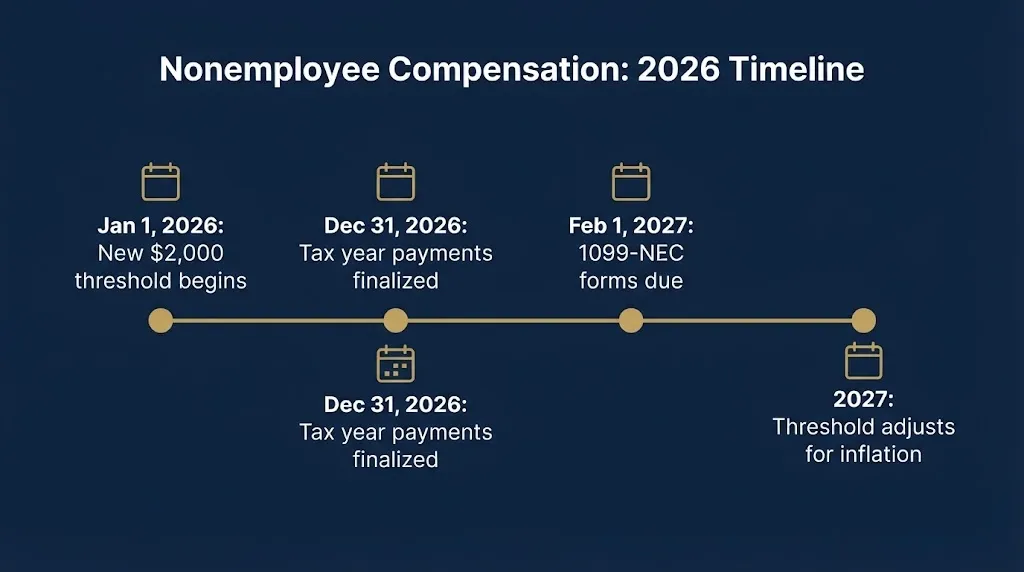
Businesses must send 1099-NEC forms for 2026 tax year payments to both the recipient and the IRS by February 1, 2027. This deadline applies to both copies at the same time, unlike some other information returns with staggered dates.
Key filing dates for 2026 payments:
- February 1, 2027: Deadline for businesses to furnish 1099-NEC to recipients and file with the IRS.
- Ongoing: Backup withholding rules apply if federal tax was withheld, regardless of the payment amount.
This deadline lands on a Monday because January 31, 2027 falls on a Sunday, pushing the due date to the next business day, consistent with how the IRS has handled weekend deadlines for this form in prior years.
What happens if a business doesn’t send you a 1099-NEC?
Missing a 1099-NEC does not remove your obligation to report the income, and you should still file based on your own payment records. This is worth repeating because the confusion around it is common every filing season.
Some businesses simply fail to file on time, others may be following the new $2,000 threshold correctly if your total payments fell below it. Either way, the burden of accurate income reporting sits with you as the taxpayer.
If you’re concerned a form was missed:
- Reach out to the paying business directly to ask about their filing status.
- Keep invoices, contracts, and bank records as your own proof of income.
- Report the income on Schedule C regardless of whether a form arrives before you file.
What’s changing with the nonemployee compensation reporting threshold in 2026?
The most significant 2026 change is the reporting threshold increase from $600 to $2,000, enacted under the One Big Beautiful Bill Act. This is the first major adjustment to this specific threshold in decades.
Additional 2026 changes to the surrounding 1099 system:
- Three new boxes added to Form 1099-NEC: cash tips, the Treasury Tipped Occupation Code, and overtime compensation.
- Excess golden parachute payments moved from Form 1099-MISC onto Form 1099-NEC.
- The $2,000 threshold will be indexed for inflation automatically starting with the 2027 tax year.
What has not changed:
- The $5,000 direct sales checkbox threshold remains separate and unchanged.
- Backup withholding still triggers a filing requirement regardless of the payment total.
- Self-employment tax still applies once net earnings reach $400.
Nonemployee compensation vs wages: what’s the difference?
Nonemployee compensation is paid to independent contractors with no tax withholding, while wages are paid to employees with income tax, Social Security, and Medicare withheld directly by the employer. This distinction drives which tax form applies and who’s responsible for paying employment taxes upfront.
| Factor | Nonemployee Compensation | Employee Wages |
|---|---|---|
| Reporting form | 1099-NEC | W-2 |
| Tax withholding | None by the payer | Withheld by employer |
| Employer-side payroll tax | Not paid by the payer | Paid by employer |
| Self-employment tax | Paid entirely by the worker | Split between employer and employee |
| Benefits eligibility | Generally none | Often eligible under employer plans |
Key Takeaway: The tax burden for nonemployee compensation falls entirely on the worker, since no employer is splitting payroll taxes or withholding income tax throughout the year.
Nonemployee compensation vs Box 3 other income: what’s the difference?
Nonemployee compensation specifically covers payment for services and goes in Box 1 of Form 1099-NEC, while Box 3 “other income” on Form 1099-MISC covers non-service payments like prizes or certain awards not tied to work performed. Mixing these up changes how the income gets taxed.
Payments that are genuinely for services performed generally belong in nonemployee compensation, which is subject to self-employment tax. Payments that aren’t tied to services, like certain damage awards or prizes unrelated to work, may be reported as other income instead, without the self-employment tax component.
This distinction matters because self-employment tax adds 15.3% on top of income tax, a difference that can be significant depending on the payment size.
Who counts as a nonemployee for 1099 purposes?
A nonemployee is generally anyone operating an independent trade, business, or profession who performs services for a payer without being on that payer’s payroll. This includes a wide range of working arrangements.
Typically classified as nonemployees:
- Independent contractors and freelancers
- Gig economy workers
- Consultants and professional service providers
- Vendors paid for services, including parts and materials tied to that service
Generally not covered under nonemployee compensation reporting:
- W-2 employees, who are reported separately
- Most payments to corporations, with specific exceptions for legal services
- Payments made through credit cards or third-party payment processors, which fall under Form 1099-K instead
Do gross proceeds paid to attorneys count as nonemployee compensation?
Attorney fees for legal services generally do count as nonemployee compensation under the new $2,000 threshold, while gross proceeds paid to an attorney in connection with legal services follow a separate $600 threshold on Form 1099-MISC. This is one of the more confusing carve-outs in the current rules.
Two different attorney-related reporting categories:
- Attorney fees for services rendered: Reported as nonemployee compensation in Box 1 of Form 1099-NEC, now under the $2,000 threshold.
- Gross proceeds paid to an attorney: Reported in Box 10 of Form 1099-MISC, still at the $600 threshold, unaffected by the 2026 change.
This means a single settlement payment routed through an attorney can trigger different reporting rules depending on which portion is a fee for services versus gross proceeds passed through to a client.
What penalties apply for missing a 1099-NEC filing?
Penalties for late or missing 1099-NEC filings can reach up to $340 per form for standard late filing, with penalties rising to $660 per form for intentional disregard of the requirement. These figures apply to the business responsible for filing, not the individual receiving the income.
Penalty structure for businesses:
- Standard late filing penalty: up to $340 per form.
- Intentional disregard of the filing requirement: up to $660 per form.
- Businesses can request a 30-day filing extension using Form 8809.
For the person receiving nonemployee compensation, there’s no direct penalty tied to the payer’s late filing. Your own obligation to report the income on time remains separate and unaffected by whether the payer met their deadline.
What happens next
Now through December 31, 2026: Businesses track total payments to each nonemployee against the new $2,000 threshold for the year.
January 2027: Businesses finalize 1099-NEC forms for all qualifying 2026 payments.
February 1, 2027: Deadline for businesses to send 1099-NEC copies to recipients and file with the IRS.
April 2027 (expected): Individuals report all 2026 nonemployee compensation, with or without a form, when filing their 2026 tax return.
Frequently Asked Questions
What is nonemployee compensation on a 1099-NEC?
It’s payment for services performed by someone who is not your employee, reported in Box 1 of the form.
This includes fees, commissions, and payments to independent contractors or freelancers.
It does not include wages reported on a W-2.
What is the 1099-NEC threshold for 2026?
The threshold is $2,000 for payments made during 2026, up from $600 in prior years.
This change came from the One Big Beautiful Bill Act.
The threshold will adjust for inflation starting in 2027.
Do I have to pay taxes on nonemployee compensation if I didn’t get a 1099?
Yes, all self-employment income is taxable whether or not a 1099-NEC was issued.
The reporting requirement belongs to the payer, not your obligation to report income.
Keep your own payment records in case a form is missing.
How is nonemployee compensation taxed differently from wages?
Nonemployee compensation has no tax withheld and is subject to a 15.3% self-employment tax on top of income tax.
Wage income has taxes withheld directly by the employer throughout the year.
Self-employed workers often need to make estimated quarterly tax payments instead.
When is the 1099-NEC deadline for 2026 payments?
Businesses must send and file 1099-NEC forms by February 1, 2027.
This deadline covers both the recipient copy and the IRS copy.
The date shifts from January 31 because that day falls on a Sunday in 2027.
Does nonemployee compensation mean I’m self-employed?
It usually means you were treated as self-employed for that specific work.
Your actual worker classification depends on the working relationship, not just the form received.
Misclassification concerns should be raised with a tax professional.
What deductions can reduce my nonemployee compensation tax bill?
Ordinary and necessary business expenses tied to earning that income are generally deductible.
This can include supplies, a portion of home office costs, and business mileage.
Specific eligibility depends on your individual business situation.
What penalty applies if a business is late filing my 1099-NEC?
Late filing penalties can reach up to $340 per form, or $660 for intentional disregard.
These penalties apply to the business, not to you as the income recipient.
Your own filing deadline and tax obligation remain separate regardless of the payer’s compliance.
Track every payment you make or receive against the new $2,000 threshold for 2026, since it changes who gets a form without changing what’s taxable. The date to calendar: businesses must send 2026 nonemployee compensation forms by February 1, 2027.