When Will Workers’ Comp Offer a Settlement in 2026? A Timeline Guide
Quick Answer
- Workers’ comp settlements usually come after you reach maximum medical improvement, typically 6 to 18 months post-injury.
- The insurer rarely offers a settlement until your treatment stabilizes and your permanent disability rating is set.
- No single deadline applies; your state’s workers’ comp board sets the schedule and approval process.
If you were injured at work and are waiting for a settlement offer, you are asking the question every injured worker asks: when will the insurance company offer money to close my case? The answer depends on a specific milestone called maximum medical improvement, often shortened to MMI.
Maximum medical improvement is the point where your doctor says your condition has stabilized. Further treatment will not make you better. Once you reach MMI, the insurer can evaluate your permanent limitations and assign a disability rating. That rating drives the settlement value.
This guide explains the workers’ comp settlement timeline, what triggers an offer, how much you might receive, and what steps speed up or slow down the process.
The Facts
| Case | General workers’ compensation process, no single case |
| Status | Ongoing state-level process for every injured worker |
| Fund Size | Varies by case, state, and insurance policy limits |
| Est. Per Person | Typically 50 to 100 percent of your weekly wage for lost time, plus medical costs |
| Claim Deadline | State-specific; report injuries within 30 days in most states |
| Administrator | State workers’ compensation board or commission |
| Proof Needed | Medical records, incident reports, wage statements, disability rating |
What Is Maximum Medical Improvement and Why Does It Matter?
Maximum medical improvement is the medical milestone that triggers settlement discussions. Your doctor declares MMI when your condition has stabilized and no further improvement is expected.
MMI matters because it converts your claim from ongoing medical care into a fixed value. Before MMI, the insurer pays weekly benefits and medical bills without knowing the total cost. After MMI, the insurer can calculate your permanent disability rating and offer a lump sum to close the claim.

The timing varies by injury. A simple fracture may reach MMI in three to six months. A spinal injury may take a year or more. A traumatic brain injury may never fully stabilize, though doctors still assign MMI at some point.
Reaching MMI does not mean you are healed. It means your condition has reached a plateau. Further treatment may continue, but your permanent limitations are now measurable.
Key Takeaway: Maximum medical improvement is the medical milestone that allows the insurer to value and settle your workers’ comp claim.
When Does the Insurance Company First Offer a Workers’ Comp Settlement?
The insurance company rarely offers a settlement before you reach maximum medical improvement. A first offer may come shortly after your MMI evaluation and permanent disability rating are completed.
The timeline from injury to first offer typically runs 6 to 18 months. Minor injuries settle faster. Severe injuries take longer because treatment, rehabilitation, and rating all add time.
Some insurers send early settlement offers before MMI. These offers are usually low. The insurer wants to close the claim before the full cost of your injury is known. Accepting an early offer often leaves money on the table.
The better approach is to wait until your doctor declares MMI and your permanent disability rating is set. That way, any settlement offer reflects the true long-term impact of your injury.
Key Takeaway: First settlement offers usually arrive after MMI, not before; early offers are often lowball tactics.
What Is a Permanent Disability Rating in Workers’ Comp?
A permanent disability rating is a percentage that measures how much your injury permanently limits your ability to work. The rating is assigned by a physician, often a qualified medical evaluator or an agreed medical examiner.
The rating drives settlement value. A 10 percent permanent disability rating means your injury permanently limits you by 10 percent compared to your pre-injury capacity. A 100 percent rating means total permanent disability.
Each state uses its own rating schedule. Some states base ratings on the American Medical Association guides. Others use state-specific schedules. The same injury can produce different ratings in different states.
Your rating is negotiable. You can challenge a rating you believe is too low. An independent medical evaluation can produce a different number, which often leads to a higher settlement.
Key Takeaway: The permanent disability rating is the number that determines most workers’ comp settlement values.
How Much Is a Workers’ Comp Settlement Worth?
Workers’ comp settlement values vary widely based on your state, your average weekly wage, your disability rating, and your future medical needs. A rough range for many cases is $10,000 to $100,000.
The calculation starts with your average weekly wage. Most states pay disability benefits at 66.67 percent of your average weekly wage, subject to state maximums. That weekly amount is multiplied by the number of weeks assigned to your disability rating.
A worker earning $800 per week with a 20 percent permanent disability rating might receive a lump sum in the range of $30,000 to $60,000, depending on the state’s schedule. Higher earners and higher ratings produce larger settlements.
Future medical care adds value. If your injury requires ongoing treatment, the insurer may add a separate amount for future medical costs. That amount can exceed the disability portion of the settlement.
| Injury Type | Typical Settlement Range |
|---|---|
| Minor sprain or strain | $5,000 to $20,000 |
| Fracture with surgery | $20,000 to $75,000 |
| Spinal injury | $50,000 to $200,000+ |
| Traumatic brain injury | $75,000 to $300,000+ |
| Total permanent disability | $200,000 to $500,000+ |
Key Takeaway: Workers’ comp settlements range from $10,000 to $100,000 for many cases, with severe injuries exceeding $200,000.
What Factors Speed Up a Workers’ Comp Settlement?
Several factors speed up a workers’ comp settlement. The most important is reaching MMI quickly. Injuries that stabilize in six months or less can settle within a year.
Cooperation with medical treatment matters. Missing appointments, skipping physical therapy, or refusing recommended care delays recovery and settlement. Insurers use your treatment record to assess your credibility.
A clear disability rating also speeds things up. If your doctor and the insurer’s doctor agree on your rating, the settlement moves forward. Disputes over the rating add months of negotiation or litigation.
Having an experienced workers’ comp attorney helps. Attorneys know the state-specific process, can negotiate effectively, and can push the insurer toward a fair offer faster than you can alone.
- Reaching MMI quickly
- Consistent attendance at medical appointments
- Agreement on the permanent disability rating
- Experienced legal representation
- No disputes over causation or employment status
Key Takeaway: Reaching MMI quickly and agreeing on your disability rating are the two biggest settlement accelerators.
What Factors Delay a Workers’ Comp Settlement?
Several factors delay a workers’ comp settlement. Disputes are the biggest cause. If the insurer disputes whether your injury is work-related, settlement stalls until that issue resolves.
Medical complications also delay settlement. If your recovery plateaus, then worsens, then stabilizes again, MMI gets pushed further out. Multiple surgeries extend the timeline.
Rating disputes cause major delays. If your doctor assigns a 30 percent rating and the insurer’s doctor assigns 10 percent, the case may go to a hearing. The hearing process can take six months or more.
Changing attorneys, missing deadlines, and incomplete medical records all add delay. The more organized your case, the faster it resolves.
Reality Check: No legitimate workers’ comp settlement requires you to pay a fee upfront. Attorneys work on contingency and collect a percentage only if you win. Any settlement service that demands payment is not legitimate.
Key Takeaway: Disputes over causation, ratings, and medical recovery are the main reasons workers’ comp settlements drag on.
Should You Accept the First Workers’ Comp Settlement Offer?
Accepting the first workers’ comp settlement offer is usually a mistake. First offers are typically low. The insurer wants to close the claim for the least money possible.
Before accepting any offer, you need three things: your MMI declaration, your permanent disability rating, and a clear understanding of your future medical needs. If any of those are missing, the offer is premature.
Compare the offer to your state’s benefit schedule. Calculate what your disability rating should produce over time. Add future medical costs. If the offer is close to that number, it may be fair. If it is far below, negotiate or reject.
An attorney can evaluate the offer against comparable cases in your state. That analysis is worth more than guessing.
Key Takeaway: Never accept a first offer without knowing your MMI, your disability rating, and your future medical costs.
How Long Does a Workers’ Comp Settlement Take After Agreement?
Once you and the insurer agree on a settlement amount, the approval process takes 30 to 60 days in most states. Some states are faster. Some require a hearing.
The settlement must be submitted to the state workers’ compensation board or commission. A judge or commissioner reviews the agreement to ensure it is fair and voluntary. If approved, the insurer issues payment.
Payment usually arrives within 30 days after approval. Some insurers pay faster. Some states allow structured payments over time instead of a lump sum.
The total time from agreement to payment is typically 45 to 90 days. Your attorney can confirm the specific timeline for your state.
Key Takeaway: After you agree to a settlement, expect payment within 30 to 60 days after state approval.
Can You Settle Workers’ Comp Without a Lawyer?
You can settle workers’ comp without a lawyer, but you probably should not. The process is complicated, the insurer has lawyers, and the value of your claim depends on details you may not know.
Workers’ comp attorneys work on contingency. They collect a percentage of your settlement, typically 15 to 25 percent depending on the state. You pay nothing upfront.
An attorney handles the rating disputes, the paperwork, the negotiations, and the hearing if needed. The value they add usually exceeds their fee, especially in cases involving permanent disability.
If your case is simple, your injury minor, and your MMI reached quickly, you may do fine without a lawyer. But any case involving permanent disability deserves legal representation.
Key Takeaway: You can settle alone, but an attorney usually increases the settlement enough to justify the contingency fee.
What Happens After You Accept a Workers’ Comp Settlement?
After you accept a workers’ comp settlement, the case closes. You give up your right to future workers’ comp benefits for that injury in exchange for the lump sum.
The settlement is final. You cannot reopen the case later if your condition worsens. That is why understanding your future medical needs before signing is critical.
The insurer sends payment after state approval. Your attorney deducts their fee and any outstanding medical liens. You receive the remainder.
The case is over. You no longer receive weekly benefits. Your medical care becomes your responsibility, paid from the settlement funds.
Key Takeaway: Accepting a settlement closes your workers’ comp case forever; weigh future medical costs carefully.
What Happens Next in Your Workers’ Comp Case?
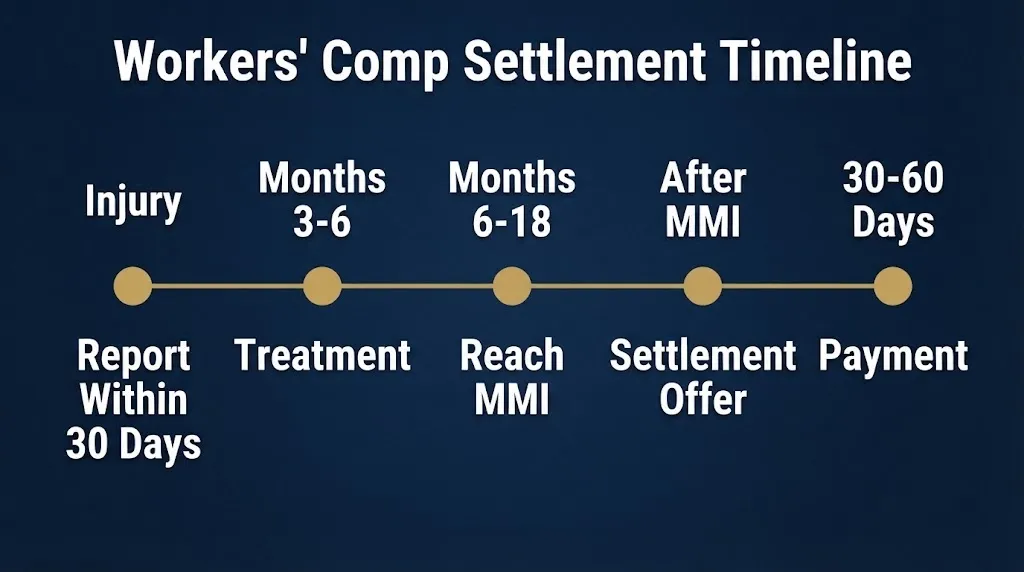
The path forward depends on where you are in the process. Each stage has its own timeline.
Within 30 days of injury: Report the injury to your employer and file a claim with your state board.
3 to 6 months after injury: Continue treatment and work toward MMI.
6 to 18 months after injury: Reach MMI and receive your permanent disability rating.
After MMI: The insurer may offer a settlement; negotiate or reject as needed.
After agreement: State approval and payment within 30 to 60 days.
Frequently Asked Questions
When will the workers’ comp insurance company offer me a settlement?
Usually after you reach maximum medical improvement.
That typically happens 6 to 18 months after your injury.
The insurer needs your permanent disability rating before making an offer.
How much will my workers’ comp settlement be?
The amount depends on your disability rating, average weekly wage, and future medical needs.
Many cases settle between $10,000 and $100,000.
Severe injuries can exceed $200,000.
Can I get a settlement before my treatment ends?
Yes, but early offers are usually low.
The insurer wants to close the claim before knowing your full costs.
Accepting early often leaves money on the table.
Do I need a lawyer for a workers’ comp settlement?
You are not required to have a lawyer.
But an attorney usually increases your settlement enough to justify their fee.
Contingency fees mean you pay nothing upfront.
What if I disagree with my permanent disability rating?
You can challenge the rating through an independent medical evaluation.
A hearing may be scheduled if the dispute continues.
Your attorney can help you navigate the process.
How long after settlement do I get paid?
Payment usually arrives 30 to 60 days after state approval.
The total time from agreement to payment is typically 45 to 90 days.
Your attorney can confirm your state’s timeline.
Is a workers’ comp settlement taxable?
Most workers’ comp settlements are not taxable at the federal or state level.
Exceptions exist for certain offsets.
Consult a tax professional for your specific situation.
Workers’ comp settlements follow a predictable timeline. You reach maximum medical improvement, get your permanent disability rating, receive an offer, negotiate, and close the case. The process takes months, not weeks.
The single most important fact is this: do not settle before MMI. Wait until your medical condition stabilizes and your disability rating is set. That is when the real money is on the table.