Probate Litigation 2026: When Estates End Up in Court, Costs, and How to Protect Yourself
Quick Answer
- Probate litigation is a court fight over a deceased person’s will, trust, or estate assets.
- Attorney fees range from $300 to $700 per hour, with retainers of $5,000 to $25,000 typical.
- Deadlines vary by state, but contesting a will often has a strict window of months, not years.
Probate litigation is the legal process of resolving disputes over a dead person’s estate. That includes fights over whether a will is valid, whether an executor is doing the job, and whether someone manipulated the person before death. It is not a class action and it never involves a claim form or a settlement administrator.
The people searching this term are usually grieving, confused, and sometimes betrayed by a family member. They want to know if they can fight, what it will cost, and whether it is worth it.
This article covers the verified process, the costs, the timelines, and the warning signs. One surprising fact: most probate disputes settle before trial, but only after both sides spend real money on lawyers and evidence.
The Facts
| Item | Verified Details |
|---|---|
| Practice Area | Probate and estate litigation |
| Typical Hourly Rate | $300 to $700 per hour |
| Typical Retainer | $5,000 to $25,000 |
| Contingency Fees | Rare, some cases may allow hybrid |
| Case Duration | 6 months to 3 years |
| Will Contest Deadline | Often 30 to 120 days after probate opens |
| Settlement Rate | High, most settle before trial |
What is probate litigation?
Probate litigation is a lawsuit filed in probate court over a dead person’s estate. It covers will contests, trust disputes, executor misconduct, and claims of financial exploitation.
The probate court handles the legal transfer of assets after death. When someone objects to that process, the dispute becomes litigation.
Common parties include siblings fighting over a parent’s estate, a second spouse clashing with adult children, or a beneficiary accusing an executor of stealing.
These cases are emotional. The legal issues are often tangled with family history, old resentments, and grief. That makes settlement harder, not easier.
What are the most common probate disputes in 2026?
The most common probate disputes remain will contests, undue influence claims, and executor or trustee misconduct. Each has its own legal standard.
A will contest challenges whether the document is valid. The person filing may argue the signature was forged, the person lacked mental capacity, or the will was not properly witnessed.
Undue influence claims argue that someone pressured the dead person into changing the will. This often happens when a caregiver, new partner, or one child isolates the person before death.
Executor misconduct claims accuse the person in charge of mismanaging assets, failing to distribute property, or taking money for themselves.
| Dispute Type | Core Claim | Typical Evidence |
|---|---|---|
| Will contest | Invalid signature or capacity | Handwriting experts, medical records |
| Undue influence | Coercion or isolation | Witness testimony, communications |
| Executor misconduct | Theft or mismanagement | Bank records, accounting |
| Trust dispute | Breach of fiduciary duty | Trust documents, distributions |
| Creditor claim | Unpaid debts | Contracts, invoices |
How much does probate litigation cost?
Probate litigation is expensive. Attorneys charge $300 to $700 per hour in most U.S. markets, with higher rates in major cities.
Retainers typically start at $5,000 and can reach $25,000 or more for complex estate fights. The total cost depends on how far the case goes.
A simple settlement after one or two court appearances might cost $10,000 to $20,000. A full trial with expert witnesses can cost $100,000 to $300,000 or more.
Contingency fees are rare in probate cases. Most lawyers bill hourly. Some may offer a hybrid arrangement where part of the fee is contingent on recovery.
| Fee Structure | How It Works | Common Use |
|---|---|---|
| Hourly | Pay for time worked | Most probate litigation |
| Retainer plus hourly | Upfront deposit, then hourly | Standard engagement |
| Flat fee | Fixed price for a defined task | Demand letters, simple motions |
| Contingency | Percentage of recovery | Rare, some fraud cases |
| Hybrid | Reduced hourly plus success fee | Negotiated in some cases |
Key Takeaway: Probate litigation is one of the most expensive legal fights a family can have. Legal fees often come out of the same estate everyone is fighting over.
Can I get probate litigation funding?
Some people use litigation funding for probate cases. Litigation funders advance money for legal fees in exchange for a share of any recovery.
This is not available in every state or for every case. Funders look for cases with clear value and a likely recovery.
A simpler option is to ask the probate court for attorney fees to be paid from the estate. In some cases, if you are fighting to protect the estate, the court may allow your lawyer to be paid from estate assets.
This is not automatic. The court must find that your litigation benefited the estate as a whole, not just you.
Borrowing against an inheritance is another option, but it is expensive. Inheritance advance companies charge high fees and should be a last resort.
Reality Check: No one can guarantee a probate outcome. Watch out for lawyers who promise a win, pressure you to file quickly without explaining the risks, or ask for a large retainer with no written fee agreement. A good probate litigator tells you the truth, even when it hurts.
When can I contest a will?
You can contest a will only if you have legal standing and a valid reason. Standing usually means you are a beneficiary under the current will, a beneficiary under a prior will, or an heir who would inherit if there were no will.
Valid reasons include lack of capacity, undue influence, fraud, forgery, or improper execution. Simply disliking the terms is not enough.
The deadline is short. Most states require a will contest to be filed within 30 to 120 days after the will is admitted to probate. Some states allow a few months, but the window is almost always measured in months, not years.
If you miss the deadline, you lose the right to contest. That is why immediate action matters when you learn of a suspicious will.
How do I challenge an executor?
You challenge an executor by filing a petition in probate court. The petition asks the court to remove the executor or to order an accounting.
Valid grounds include theft, mismanagement, conflict of interest, failure to distribute assets, or failure to follow court orders.
The court will hold a hearing. You must present evidence of misconduct. An executor is presumed to act in good faith unless proven otherwise.
If the court removes the executor, it appoints a replacement. That person may be a family member, a neutral professional, or a public administrator.
What is undue influence in probate?
Undue influence means someone used pressure, manipulation, or fraud to make the dead person change their estate plan. It is one of the most common claims in probate litigation.
The classic pattern is a caregiver or new partner who isolates an elderly person, controls their communication, and arranges for a new will or deed.
Proving undue influence requires showing the person was susceptible, the influencer had opportunity, and the result is unnatural or suspicious. Medical records, witness statements, and phone records all help.
Undue influence cases are hard to win without strong evidence. Courts are reluctant to overturn a signed document without clear proof of manipulation.
What is a fiduciary duty in probate?
A fiduciary duty is the legal obligation of an executor or trustee to act in the best interests of the estate and its beneficiaries. It is the highest standard under the law.
Executors must manage assets prudently, avoid conflicts of interest, keep accurate records, and distribute property according to the will or trust.
When an executor fails in that duty, beneficiaries can sue. Claims include self-dealing, commingling funds, failing to file tax returns, or selling assets below value.
The court can order the executor to repay losses, remove the executor, or reduce their compensation.
Key Takeaway: Undue influence and executor misconduct are the two most common probate claims, and both require strong documentary evidence, not just suspicion.
How long does probate litigation take?
Most probate litigation takes six months to three years. The timeline depends on the complexity of the estate, the number of parties, and whether the case settles.
A straightforward will contest might resolve in six to twelve months if the parties settle early. A contested trust with multiple beneficiaries and experts can take two to three years or more.
Trials add time. Appeals add another six to eighteen months. The more contested the case, the longer it runs.
Grief and family conflict make these cases slower. Parties often refuse reasonable settlements because of anger, not logic.
What is the probate litigation process?
The process follows the same general path as other civil litigation, but in a specialized court.
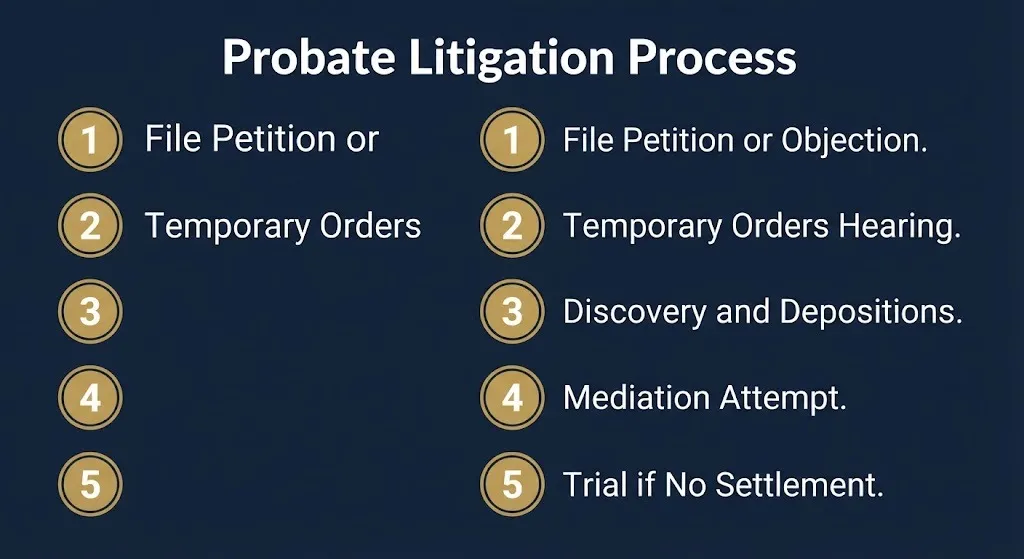
First, someone files a petition or objection in probate court. The other side responds. The court may set a hearing on temporary issues, like who controls the estate during the fight.
Discovery follows. Both sides exchange documents, take depositions, and hire experts. Medical experts are common in capacity and undue influence cases.
Most probate cases go to mediation. A neutral third party helps the family reach a settlement. Many cases settle at or after mediation.
If mediation fails, the case goes to trial. A judge, not a jury, decides most probate cases.
| Stage | What Happens | Typical Duration |
|---|---|---|
| Filing and response | Petition, objection, answer | 1 to 3 months |
| Temporary orders | Who controls assets during fight | 1 to 3 months |
| Discovery | Documents, depositions, experts | 6 to 18 months |
| Mediation | Settlement attempt | 1 to 3 months |
| Trial | Judge decides | 1 to 4 weeks |
| Appeal | Higher court review | 6 to 18 months |
How do I find a probate litigation attorney?
Finding the right probate litigator takes more than a Google search. These cases need someone who knows both litigation and estates.
Start with referrals from estate planning attorneys. A lawyer who drafted wills and trusts usually knows which litigators are effective in court.
State bar association directories verify licensing and disciplinary history. Use them to check any lawyer you are considering.
Court records are another tool. Look up recent probate cases in your county and note which lawyers appeared. That tells you who actually handles these disputes.
Interview at least two or three attorneys. Ask about their trial experience, their familiarity with your local probate judges, and their honest assessment of your case.
What should I do before hiring a probate litigator?
Gather every document related to the estate before your first meeting. The lawyer needs to see the full picture.
Here is a checklist:
- The will, trust, or codicil at issue.
- Any prior wills or estate planning documents.
- Death certificate and probate court filings.
- Correspondence between family members and the executor.
- Bank statements, property records, and tax returns.
- A written timeline of events, with dates and names.
The more organized you are, the less time the attorney spends sorting through papers. That saves money and gets you a faster assessment.
What is the difference between probate and trust litigation?
Probate litigation involves assets that go through the probate court after death. Trust litigation involves assets held in a trust, which may avoid probate.
Trusts are often used to avoid probate, but they create their own disputes. Trust litigation involves claims against trustees for breach of fiduciary duty.
Probate is public. Court filings are generally accessible. Trust litigation can be private, depending on the trust terms and state law.
Both require specialized attorneys. A lawyer who handles probate but not trusts may not be the right fit for a trust dispute.
Can probate litigation be avoided?
Some probate litigation can be avoided with better estate planning. Clear documents, neutral trustees, and family communication reduce the risk.
A will or trust that is properly executed, witnessed, and updated is harder to challenge. A person who explains their plan to the family reduces the shock that fuels lawsuits.
But no plan is foolproof. Greed, grief, and mental decline create disputes even in well-planned estates.
If you are concerned about a potential fight, an estate planning attorney can help you build a plan that resists challenge.
Key Takeaway: Better estate planning reduces probate litigation risk, but it cannot eliminate it. Family conflict and money are a dangerous mix.
What should I do if I suspect estate fraud?
If you suspect estate fraud, act quickly. Time is not on your side.
First, document everything. Save emails, texts, bank statements, and any evidence of suspicious transfers or changes to the will.
Second, contact a probate litigation attorney immediately. The lawyer can advise whether you have a case and what deadlines apply.
Third, do not confront the suspected person directly. Confrontation often leads to destroyed evidence or accelerated transfers.
Let the attorney guide the investigation. Probate lawyers often work with forensic accountants and investigators.
Frequently Asked Questions
Do I need a probate litigation attorney to contest a will?
Yes, almost always. Will contests are procedurally complex and deadlines are unforgiving.
A lawyer can assess your standing, gather evidence, and file before the deadline expires.
How much does it cost to contest a will?
Costs vary widely. A simple contest that settles early may cost $10,000 to $25,000.
A full trial with experts can cost $100,000 or more.
What is the deadline to contest a will?
Most states require a contest within 30 to 120 days after probate opens.
The exact deadline varies by state and is strictly enforced.
Can I sue an executor for stealing?
Yes. Beneficiaries can file a petition to remove the executor and recover stolen assets.
You will need evidence like bank records, accounting, or witness testimony.
What is undue influence in probate?
Undue influence is pressure or manipulation that caused the person to change their estate plan.
It often involves isolation, dependency, and a new beneficiary.
Can probate litigation be settled?
Yes. Most probate cases settle before trial.
Mediation is common and often leads to a family agreement.
Who pays the attorney fees in probate litigation?
Fees are usually paid by each side initially.
The court may order the estate to pay fees if the litigation benefited the estate.
What happens if I lose a will contest?
You may lose your right to inherit and may have to pay some costs.
Some cases require the losing party to pay the other side’s fees, but that is not automatic.
Probate litigation is expensive, slow, and emotionally draining. But sometimes it is the only way to protect what a loved one intended, or to stop someone from stealing an estate.
If you are facing a will contest, an executor dispute, or a trust fight, do not wait. The deadlines are short, the evidence disappears, and the legal bills only grow.