How Does Workers Compensation Work in 2026: Claim Process, Pros and Cons, and Legal Rights
Quick Answer
- Workers compensation is a state-mandated insurance system that pays medical bills and partial lost wages after a work injury.
- Benefits typically cover medical care, temporary disability payments, and permanent impairment awards, but not pain and suffering.
- Most states require injury reporting within 30 days, and claim filing deadlines range from one to three years.
If you were hurt on the job, you are probably asking one question: who pays for this? Workers compensation is the system built to answer that. It is a no-fault insurance program that covers medical treatment and a portion of your lost income after a workplace injury or occupational illness.
The system affects nearly every employed person in the United States. About 140 million workers are covered by state workers compensation programs. The most important number to remember is your state’s reporting deadline, which is often 30 days but can be shorter in some states.
This guide explains how the claim process works, what benefits you may receive, the real pros and cons of filing, and when you might need a lawyer. One detail surprises most people: you cannot sue your employer for a workplace injury in most cases, even if the employer was careless.
| The Facts | |
|---|---|
| System | State-mandated no-fault workplace injury insurance |
| Coverage | Medical care, partial wage replacement, disability benefits |
| Excluded | Pain and suffering, punitive damages |
| Reporting Deadline | Usually 30 days, varies by state |
| Claim Filing Deadline | Typically 1 to 3 years from injury date |
| Employer Retaliation | Illegal in all 50 states |
| Legal Representation | Optional but recommended for denied claims |
Is Workers Compensation a Government Program or Private Insurance?
Workers compensation is a state-mandated system delivered through private insurance carriers, state funds, or employer self-insurance. It is not a single federal program like Social Security disability.
Each state runs its own workers compensation system with its own rules, deadlines, and benefit levels. A worker in California faces different timelines and payment caps than a worker in Texas or Florida.
Most states require employers to buy coverage from a private insurance company or a state-operated fund. Some large employers are approved to self-insure, meaning they pay claims directly from their own reserves.
The federal government only covers specific groups, including federal employees, longshore workers, and coal miners with black lung disease. Everyone else falls under their state’s system.
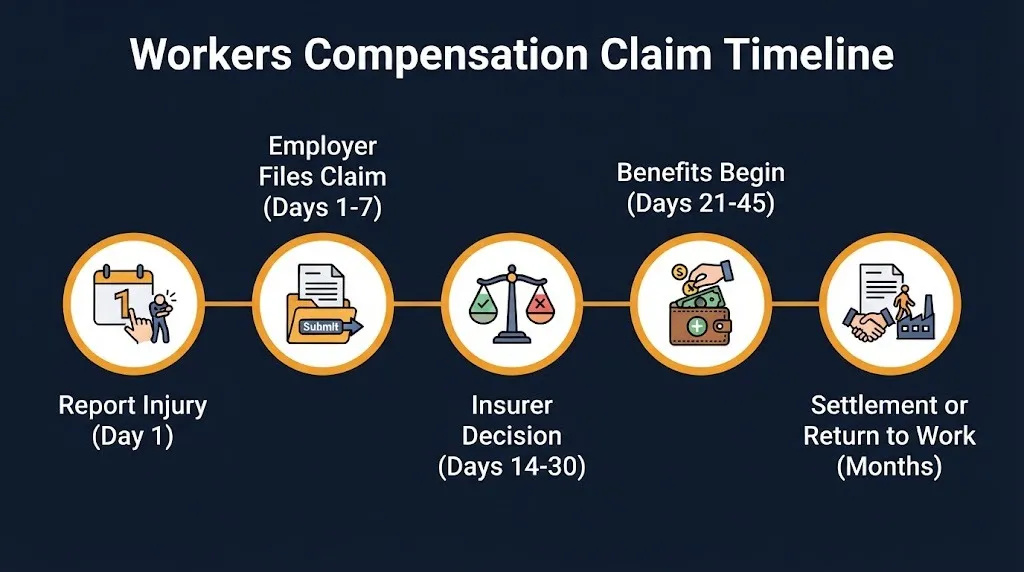
How Does the Workers Compensation Claim Process Work Step by Step?
The claim process follows a predictable sequence from injury to payment. Missing a step can delay or kill your claim.
- Report the injury to your employer immediately, or as soon as practical.
- Seek medical treatment from an approved provider if your state requires it.
- Your employer files a claim with their insurance carrier or state fund.
- The insurer investigates and accepts or denies the claim.
- If accepted, benefits begin based on your state’s payment schedule.
- If denied, you can appeal through your state’s workers compensation board.
The first report is the most time-sensitive step. Most states give you 30 days to notify your employer, but some allow less. Failing to report on time can result in a denied claim.
Medical treatment rules vary. Some states let you choose your own doctor. Others require you to see a provider from the employer’s approved list for the first visit or for a set number of visits.
Key Takeaway: Reporting your injury immediately and following your state’s medical provider rules are the two most critical first steps in any workers compensation claim.
How Much Does Workers Compensation Pay for Lost Wages?
Workers compensation pays temporary disability benefits, which usually equal about two-thirds of your average weekly wage. The exact percentage and weekly cap vary by state.
Most states calculate your average weekly wage from your earnings over the 52 weeks before the injury. If you worked less than a year, the insurer uses your actual earnings during that shorter period.
There is a waiting period before wage benefits start. In most states, you do not receive payment for the first three to seven days of disability unless your injury keeps you out of work for a longer period, often 14 to 21 days.
| Benefit Type | Typical Amount | Duration |
|---|---|---|
| Temporary Total Disability | 66.67% of average weekly wage | Until you return to work or reach maximum medical improvement |
| Temporary Partial Disability | 66.67% of wage difference | While working reduced hours |
| Permanent Partial Disability | Varies by body part and state schedule | Set number of weeks |
| Permanent Total Disability | 66.67% of wage, possibly for life | Until retirement age in some states |
Weekly benefit caps limit how much you can receive. A high earner does not get two-thirds of their full salary if that amount exceeds the state maximum, which often falls between $800 and $1,200 per week.
What Medical Expenses Does Workers Compensation Cover?
Workers compensation covers all reasonable and necessary medical treatment related to the work injury. This includes emergency care, surgeries, hospital stays, prescriptions, physical therapy, and medical equipment.
The key phrase is “reasonable and necessary.” The insurer does not have to pay for experimental treatments or care unrelated to the workplace injury.
Your medical bills should go directly to the insurer, not to you. If a provider bills you directly, contact the claims adjuster immediately with the bill.
In most states, you do not pay copays or deductibles for workers compensation medical care. That is different from regular health insurance, where you share costs.
Mileage reimbursement for travel to medical appointments is also available in many states. The rate is set by each state, often matching the IRS medical mileage rate.
What Are the Pros and Cons of Workers Compensation?
Workers compensation has real advantages and real limitations. Understanding both helps you decide whether to accept benefits or explore other options.
Pros:
- Medical bills are paid without you proving employer fault.
- Wage replacement starts relatively quickly after the waiting period.
- No lawsuit is required in most cases.
- Retaliation for filing is illegal.
- Permanent disability benefits are available for lasting injuries.
Cons:
- You cannot sue your employer for pain and suffering.
- Wage replacement is only partial, not your full salary.
- The insurer, not you, often controls medical treatment choices.
- Claims can be denied, delayed, or disputed.
- Settlement amounts are often lower than jury awards in personal injury cases.
Key Takeaway: Workers compensation trades the right to sue for guaranteed but limited benefits, a trade-off that helps some workers and frustrates others.
Can You Sue Your Employer Instead of Filing Workers Compensation?
In most cases, no. Workers compensation is an exclusive remedy, meaning it is the only route for workplace injuries. You generally cannot sue your employer, even if the employer was negligent.
There are narrow exceptions. You may sue if your employer intentionally injured you. You may also sue if your employer did not carry required workers compensation insurance.
Third-party lawsuits are different. If a defective machine, a negligent contractor, or a careless driver caused your injury, you can file a personal injury lawsuit against that third party while also receiving workers compensation benefits.
This is where real money can come in. A third-party lawsuit may include pain and suffering damages, which workers compensation does not provide.
How Long Do You Have to File a Workers Compensation Claim?
The claim filing deadline is not the same as the reporting deadline. Reporting means telling your employer. Filing means submitting a formal claim through your state’s workers compensation system.
Most states give you one to three years from the date of injury to file a formal claim. Some states use the date you discovered the injury, which matters for repetitive stress injuries and occupational illnesses.
The clock starts differently for different injury types. A broken leg has an obvious injury date. Carpal tunnel syndrome may have a discovery date when a doctor first linked it to your job.
Missing the filing deadline usually ends your claim permanently. Do not wait to file just because you are still treating or hope to return to work.
What Happens If Your Workers Compensation Claim Is Denied?
A denial is not the end of the road. You have the right to appeal through your state’s workers compensation board or commission.
First, read the denial letter carefully. It must state why the claim was denied. Common reasons include late reporting, disputes about whether the injury is work-related, or a pre-existing condition defense.
You can file an appeal, often called a petition for hearing or application for adjudication. This starts a legal process where a workers compensation judge reviews evidence from both sides.
Many denied claims are eventually approved at the hearing level. Having a workers compensation attorney at this stage increases your odds significantly. Attorneys typically work on contingency, taking a percentage of your recovery only if you win.
Key Takeaway: A denial means you need to file an appeal, not give up, and legal representation becomes more important at this stage.
Do You Need a Workers Compensation Lawyer?
You do not need a lawyer for every claim. Straightforward injuries with cooperative employers and accepting insurers may resolve without legal help.
You should consider a lawyer if your claim is denied, if you have a permanent impairment, if your employer disputes that the injury happened at work, or if the insurer stops paying benefits while you are still disabled.
Reality Check: No workers compensation insurance company pays more just because you ask nicely. Adjusters are trained to minimize payouts. A lawyer who knows your state’s system can identify benefits you did not know you qualified for.
Attorneys take a percentage of your settlement or award, usually between 15 and 25 percent depending on your state. You pay nothing upfront in most cases.
How Does Workers Compensation Settlement Work?
Most workers compensation cases end in a settlement, not a trial. A settlement is a lump-sum payment that closes your claim permanently.
Two main types exist. A compromise and release settlement pays you a lump sum and closes all future medical and wage claims. A stipulation settlement keeps future medical care open while settling the wage portion.
Settlement amounts depend on your injury severity, your wage rate, your state’s benefit schedule, and how much treatment you still need. A back strain settles for less than a spinal fusion.
You do not have to accept a settlement offer. You can continue receiving weekly benefits and medical care instead. But settling locks in a known amount now versus uncertain future payments.
What Is the Future of Workers Compensation in 2026?
Workers compensation is changing. Remote work injuries, mental health claims, and gig worker coverage are the biggest open questions in 2026.
Remote work injuries are increasingly accepted. If you slip on your stairs while carrying work documents, some states now treat that as a compensable injury. Others still deny it.
Mental health claims face a higher bar. Most states require a physical injury to accompany a mental health claim, though some now allow post-traumatic stress claims for first responders.
Gig workers remain largely excluded. Independent contractors are not employees under most state workers compensation laws. That leaves delivery drivers, rideshare drivers, and freelance workers without coverage unless they buy private policies.
| Trend | Status in 2026 |
|---|---|
| Remote work injuries | Increasingly covered, state-dependent |
| Mental health claims | Covered only with physical injury in most states |
| Gig worker coverage | Largely excluded, legislative battles ongoing |
| Medical marijuana reimbursement | Growing number of states allow it |
What Happens Next in Your Workers Compensation Claim?
If you are just starting, here is the sequence you can expect.
| Stage | Timing |
|---|---|
| Report injury to employer | Immediately, within 30 days |
| Employer files claim with insurer | Within days of your report |
| Insurer accepts or denies claim | 14 to 30 days in most states |
| Benefits begin if accepted | Within 14 to 21 days after acceptance |
| Return to work or maximum medical improvement | Weeks to months depending on injury |
| Settlement discussions | After maximum medical improvement |
Frequently Asked Questions
How does workers compensation work for part-time employees?
Part-time employees are covered the same as full-time employees in most states.
Your benefit amount is based on your actual average weekly earnings, which will be lower than a full-time worker’s.
Does workers compensation pay full salary?
No, workers compensation pays about two-thirds of your average weekly wage.
The exact percentage varies by state, typically between 60 and 70 percent.
Can I choose my own doctor for a workers compensation claim?
It depends on your state.
Some states let you choose any doctor. Others restrict you to an employer-approved list for the first visit or first 30 days.
What injuries are not covered by workers compensation?
Self-inflicted injuries, injuries from intoxication, and injuries from horseplay are typically not covered.
Commuting injuries are also excluded unless you were driving for work purposes.
How long does a workers compensation claim take?
Straightforward claims with accepted liability can start paying within a few weeks.
Disputed claims that require hearings can take six months to two years to resolve.
Can I be fired for filing a workers compensation claim?
No, retaliation for filing a claim is illegal in all 50 states.
If you are fired after filing, contact an employment attorney immediately.
Does workers compensation cover occupational diseases?
Yes, occupational diseases like carpal tunnel syndrome, mesothelioma, and hearing loss are covered.
The filing deadline may run from the date of diagnosis rather than the date of first exposure.
Check your state’s workers compensation board website for specific deadlines and benefit rates. Report any injury immediately, even if it seems minor. The single most important date is your state’s reporting deadline, often 30 days from the injury.