Workers Compensation Lawyers in California 2026: What Injured Workers Need to Know Before Hiring
Quick Answer:
- California workers compensation lawyers are real, licensed attorneys who represent injured workers in claims against employers and insurers.
- Attorney fees are capped by state law, typically 9 to 15 percent of your settlement or award.
- You have 30 days to report an injury and one year from the injury date to file a claim.
If you got hurt on the job in California and searched for workers compensation lawyers, you are not alone. The state processes hundreds of thousands of workplace injury claims every year.
The workers compensation system in California is supposed to work without a lawyer. In reality, denied claims, delayed payments, and low settlement offers push many workers to hire one.
This article explains what workers compensation lawyers in California actually do, what they cost, when hiring one makes sense, and how the 2026 rules affect your claim. One verified fact: California workers compensation attorney fees are among the most tightly regulated in the nation.
The Facts
| System | California Workers Compensation |
| Governing Agency | Division of Workers Compensation |
| Primary Law | California Labor Code |
| Attorney Fee Cap | 9 to 15 percent of settlement, judge approved |
| Injury Report Deadline | 30 days from injury date |
| Claim Filing Deadline | 1 year from injury date |
| Benefit Payments | Temporary disability, permanent disability, medical care |
| 2026 Status | Active, updated benefit rates in effect |
Is it worth hiring a workers compensation lawyer in California?
Hiring a workers compensation lawyer in California is worth it when your claim is denied, your benefits stop, or your employer disputes your injury. It may not be worth it for straightforward claims with no pushback.
Most workers compensation claims start the same way. You report an injury. Your employer files a claim with its insurer. A claims administrator reviews it. You get medical treatment and, if you miss work, temporary disability payments.
The system works fine for simple injuries. A sprained ankle, a minor burn, a small laceration. You see a doctor, you heal, you go back to work. No lawyer needed.
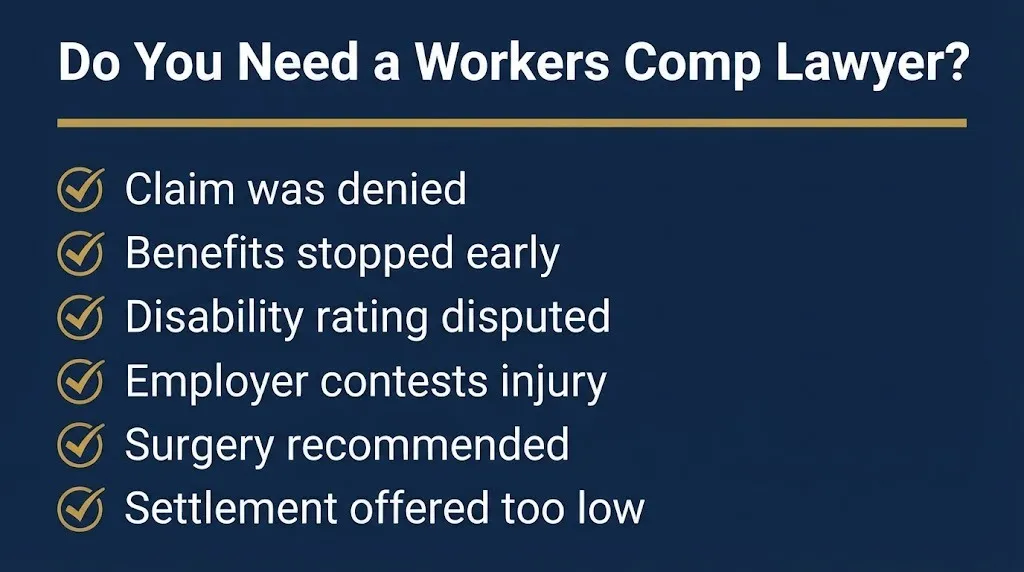
Where it breaks down is when the insurer denies liability, disputes the injury, or sends you to a doctor who says you can work when you cannot. That is when the value of a lawyer becomes obvious.
A workers compensation attorney can depose doctors, cross examine witnesses, demand a qualified medical evaluator, and push your case toward a hearing before a workers compensation judge. You can do some of that yourself, but the learning curve is steep.
Think of it like a warranty claim on a car. If the dealer honors it, you are done in an afternoon. If they fight you, the process becomes technical and slow. That is when you call someone who knows the rulebook.
Key Takeaway: A California workers compensation lawyer is worth hiring for disputed, denied, or complex claims, but unnecessary for simple accepted claims with no complications.
How much do workers compensation lawyers charge in California?
Workers compensation lawyers in California charge a contingency fee of 9 to 15 percent of your settlement or award. The judge must approve every fee agreement.
This is not a number pulled from a marketing site. It is set by California Labor Code Section 4906 and enforced by the Workers Compensation Appeals Board.
Here is how the fee structure works in practice:
| Recovery Type | Typical Attorney Fee Range |
|---|---|
| Stipulated settlement | 9 to 15 percent |
| Compromise and release | 9 to 15 percent |
| Trial award | Judge sets fee, often 12 to 15 percent |
| Ongoing benefits | Fee may be capped differently |
The percentage is not fixed. The judge reviews the complexity of the case, the amount of work the attorney did, and the outcome achieved. A simple settlement might produce a 9 percent fee. A hard fought case with multiple hearings could hit 15 percent.
You do not pay out of pocket. The fee comes out of your settlement check. If you lose and get nothing, you generally owe nothing for attorney fees. You may still owe for some costs like medical record copying or expert witness fees.
Some lawyers advance costs and deduct them from your recovery. Others ask you to pay costs as the case goes. Ask before signing.
Reality Check: No legitimate California workers compensation lawyer will charge you an upfront retainer for a standard claim. Anyone demanding thousands of dollars before filing is operating outside the system.
Do I need a workers compensation lawyer in Los Angeles?
You may need a workers compensation lawyer in Los Angeles if your claim involves a denied injury, a disputed permanent disability rating, or retaliation from your employer.
Los Angeles handles more workers compensation claims than any other county in California. The volume is enormous. The Workers Compensation Appeals Board has multiple district offices in the Los Angeles area, including Van Nuys, Long Beach, and Marina del Rey.
The sheer volume creates delays. Cases can sit for months waiting for a hearing date. Insurers know this and use delay as a tactic. A lawyer who practices regularly in Los Angeles district offices knows the local judges, the local evaluators, and the local patterns.
That does not mean you need a lawyer for every LA claim. It means the threshold for hiring one is lower in a high volume jurisdiction where getting lost in the system is easy.
Injured workers in Los Angeles also face a wider range of employers. From film production companies to warehouse operations to restaurant groups. Each industry has its own common injuries and its own insurer tactics. A lawyer with experience in your specific field can spot problems faster.
The decision comes down to leverage. If your employer and its insurer are moving your claim forward without friction, you may not need an attorney. If they are stalling, denying, or lowballing, that changes the math.
Key Takeaway: Los Angeles workers face more delays and more insurer resistance due to volume, making local legal representation more valuable for disputed claims.
California workers compensation lawyers near me: how to choose
Choosing a California workers compensation lawyer starts with verifying their State Bar status and their experience in the Workers Compensation Appeals Board system. Not all personal injury lawyers handle workers comp.
Workers compensation is a specialized area. It has its own courts, its own judges, its own medical evaluator system, and its own fee rules. A lawyer who does car accidents may never have stepped inside a workers comp hearing room.
Here are the factors that matter most:
- Years of dedicated workers compensation practice in California
- Number of cases taken to hearing, not just settled
- Familiarity with your specific injury type or industry
- Clear explanation of the fee agreement and what you might receive
- Availability to take your calls, not just a case manager
- Disciplinary record with the California State Bar
You can check a lawyer’s license status and discipline history on the State Bar of California website. It is free and public. Do that before you sign anything.
Reviews and testimonials help, but they are marketing. The State Bar record is the one source that cannot be edited by the firm.
Ask the lawyer how often they appear before the Workers Compensation Appeals Board. A lawyer who only settles and never litigates may push you toward a low offer because going to hearing is outside their comfort zone.
Key Takeaway: Verify any California workers compensation lawyer through the State Bar, confirm dedicated workers comp experience, and ask hard questions about hearing experience before hiring.
What does a workers compensation lawyer in California actually do?
A workers compensation lawyer in California manages every stage of your claim, from filing the initial forms to appearing at hearings and negotiating the settlement. Their work falls into clear categories.
The first thing a lawyer does is review your claim for problems. They check whether your employer filed the claim on time. They confirm the injury is documented. They make sure the insurance company has the right information.
From there, the work splits into tracks:
Medical evidence
- Reviewing treating doctor reports
- Requesting a qualified medical evaluator if you dispute the insurer’s doctor
- Deposing doctors to clarify disability ratings and work restrictions
Benefit enforcement
- Demanding temporary disability payments when they are late
- Filing for penalties when the insurer unreasonably delays or denies
- Pursuing permanent disability advances when appropriate
Hearings and settlement
- Representing you at mandatory settlement conferences
- Preparing for trial before a workers compensation judge
- Negotiating a stipulated award or compromise and release
A lawyer also handles the paperwork traps that trip up unrepresented workers. Missed deadlines, incomplete forms, and improper service can kill a claim. The attorney’s office manages those deadlines so you do not have to.
You are still responsible for showing up to medical appointments and communicating honestly with your lawyer. The lawyer handles the legal machinery. You handle your recovery.
How much is my California workers compensation case worth?
The value of a California workers compensation case depends on your average weekly wage, your disability rating, and whether your injury is permanent. No fixed dollar amount applies to everyone.
California workers compensation does not pay pain and suffering. That surprises people. You do not get a windfall for a bad injury. You get wage replacement and medical care, plus a disability payment if the injury leaves permanent impairment.
Here are the benefit types and what they pay:
| Benefit Type | What It Covers | Payment Basis |
|---|---|---|
| Temporary disability | Time off work while recovering | Two thirds of average weekly wage, capped |
| Permanent disability | Lasting impairment after recovery | Rating based, paid over time |
| Medical care | All reasonable treatment | Paid directly by insurer |
| Supplemental job displacement | Retraining voucher if you cannot return | Fixed amount set by law |
| Death benefits | Fatal workplace injuries | Paid to dependents |
The temporary disability cap changes annually. For 2026, the maximum temporary disability rate is tied to the state average weekly wage and is adjusted each January.
Permanent disability ratings run from 1 percent to 100 percent. The dollar value increases with the rating, your age, and your occupation. A 10 percent rating pays far less than a 50 percent rating.
A lawyer can give you a realistic range once your medical treatment reaches maximum medical improvement. Before that point, any dollar figure is a guess.
Key Takeaway: California workers compensation pays wage replacement, medical care, and disability benefits, not pain and suffering, and the value depends on your wage and disability rating.
Can I file a California workers compensation claim without a lawyer?
You can file a California workers compensation claim without a lawyer. The system is designed for worker access, and many simple claims succeed without legal representation.
The process starts with reporting your injury. You have 30 days to notify your employer. Then your employer files a claim with the insurer. The insurer has 90 days to accept or deny liability.
If the claim is accepted, you start receiving benefits. Medical treatment is covered. Temporary disability payments begin if you are off work for more than three days.
Where self representation gets hard is when something goes wrong. The insurer denies the claim. The treating doctor releases you to work too early. The disability rating comes back too low. The checks stop without explanation.
Each of those problems requires technical knowledge to fix. You need to file the right form, request the right evaluation, or demand the right hearing. Missing a step can delay your benefits for months.
The Division of Workers Compensation does provide information officers and forms on its website. You can file an application for adjudication of claim yourself. But information officers cannot give legal advice.
Self representation works best for short term, clear cut injuries. It works worst for permanent injuries, disputed claims, and cases against employers who contest everything.
What is the 2026 California workers compensation benefit rate update?
The 2026 California workers compensation benefit rates updated on January 1, 2026. The maximum temporary disability rate and permanent disability payments adjusted based on the state average weekly wage.
The California Division of Workers Compensation issues new rates each year. The rates apply to injuries occurring on or after the January 1 effective date.
For injuries in 2026, the temporary disability rate remains two thirds of your average weekly wage. The maximum weekly payment is tied to the statewide average weekly wage and adjusts upward each year.
Permanent disability rates also adjust. The total amount payable for a given disability rating increases with the annual adjustment. The increases are modest but real.
The exact 2026 dollar figures vary by injury date and wage history. You can find the current benefit rates on the Division of Workers Compensation website under the benefit rates section.
If you were injured before 2026, your benefits may be calculated under the rate schedule in effect at your injury date. Workers compensation benefits generally follow the law at the time of injury, not the time of settlement.
That nuance matters. A 2023 injury does not automatically get 2026 rates. Your lawyer or the claims administrator should calculate based on the correct injury date.
What is the biggest mistake injured workers make with California workers comp lawyers?
The biggest mistake injured workers make is waiting too long to hire a lawyer. The second biggest is hiring the wrong one.
Workers compensation deadlines move fast. You have 30 days to report the injury. You have one year from the injury date to file a claim. If you miss that year, your claim can be barred entirely.
Some workers wait because they assume the employer will take care of everything. Then the claim gets denied at day 85. By the time they call a lawyer, evidence is stale and witnesses are gone.
Other workers hire the first lawyer they see on a billboard. That lawyer may be excellent. Or that lawyer may run a high volume settlement mill that pushes every case toward the quickest check, not the best outcome.
The solution is the same in both cases. Move early and choose deliberately. You can fire a lawyer if the relationship is not working, but switching counsel mid case creates delays and can complicate the fee split.
Think of it like an infection. Treating it early is cheap and easy. Waiting until it spreads is expensive and painful. Your workers comp claim is the same.
How long does a California workers compensation case take with a lawyer?
A California workers compensation case takes anywhere from a few months for a simple stipulated settlement to over two years for a disputed claim that goes to trial.
The timeline depends on four factors:
- Whether the insurer accepts or denies the claim
- How long your medical treatment lasts
- Whether a permanent disability rating is disputed
- How crowded your local Workers Compensation Appeals Board docket is
A straightforward claim with a quick recovery might settle in four to six months. You reach maximum medical improvement, get a rating, and negotiate a settlement.
A disputed claim takes longer. You file for a hearing. The judge sets a mandatory settlement conference. Depositions happen. A panel qualified medical evaluator issues a report. That process alone can take a year.
If the case goes to trial, add another six to twelve months. Trials in the workers compensation system are shorter than civil trials, but the scheduling backlog is real. Some districts are hearing cases set a year earlier.
A lawyer does not always speed up the calendar. Some delay is built into the system. What a lawyer does is prevent unnecessary delay from insurer foot dragging and missed deadlines.
Key Takeaway: A California workers compensation case can resolve in months or stretch past two years depending on disputes, treatment length, and local hearing backlogs.
What happens when a California workers comp claim is denied?
When a California workers comp claim is denied, you have the right to challenge the denial by filing an application for adjudication of claim and requesting a hearing before a workers compensation judge.
The insurer must tell you in writing why it denied the claim. Common reasons include:
- The injury was not reported within 30 days
- The claim was filed after the one year deadline
- The insurer says the injury is not work related
- No medical evidence connects the injury to your job
- Your employer disputes that the injury happened at work
A denial is not the end of the road. It is the beginning of the litigation phase. You file the application. The case gets assigned a case number. A mandatory settlement conference is set.
At that conference, the judge tries to resolve the dispute. If resolution fails, the case moves toward trial. Both sides present evidence. The judge decides whether the injury is compensable.
Having a lawyer at this stage is critical. The insurer has its own attorneys. Walking into a hearing room without representation against a professional insurance defense firm is a mismatch.
The standard of proof is lower than in civil court. You do not have to prove your case beyond a reasonable doubt. You have to show by a preponderance of the evidence that the injury happened at work.
What is the difference between a workers compensation lawyer and a personal injury lawyer in California?
A workers compensation lawyer handles claims under the California Labor Code for workplace injuries. A personal injury lawyer handles civil lawsuits for injuries caused by someone else’s negligence.
The two systems operate under completely different rules.
Workers compensation is a no fault system. You do not have to prove your employer did something wrong. You only have to prove the injury happened at work. In exchange, your damages are limited to wage replacement, medical care, and disability benefits.
Personal injury is a fault based system. You have to prove the other party was negligent. If you win, you can recover medical bills, lost wages, and pain and suffering. The payouts can be much larger, but the burden of proof is higher.
Some workers comp lawyers also handle personal injury cases. Many do not. The skills do not perfectly overlap.
Workers compensation hearings are administrative, heard by judges in a specialized division. Personal injury cases go through the civil court system with juries and different rules of evidence.
If a third party, not your employer, caused your workplace injury, you may have both a workers comp claim and a personal injury claim. A lawyer who understands both systems can help coordinate the two.
How do I report a California workplace injury correctly in 2026?
You report a California workplace injury by notifying your supervisor or employer in writing within 30 days of the injury. Oral notice is not enough.
The written report should include:
- The date and time of the injury
- The location where it happened
- What you were doing when it happened
- The body parts injured
- Any witnesses present
Your employer must give you a workers compensation claim form, the DWC 1, within one working day of your report. You fill out your portion and return it. The employer fills out its portion and files it with the insurer.
Keep a copy of everything. Take a photo of the completed form before you hand it in. If the employer refuses to give you the form, that is itself a violation. You can file directly with the Division of Workers Compensation.
The one year clock starts from the injury date, not the date you report. If you discover an injury later, like a repetitive stress injury, the clock may start from the date you knew or should have known it was work related.
Reporting late is one of the fastest ways to get a claim denied. Even if your injury seems minor, file the report. You can always decide not to pursue the claim later.
What happens next in California workers compensation law for 2026?
California workers compensation law continues to evolve through legislation, court decisions, and administrative rule changes. Here is what to watch through the rest of 2026.
- January 2026: New benefit rates took effect based on updated state average weekly wage data.
- Ongoing 2026: The Division of Workers Compensation continues updating qualified medical evaluator regulations.
- Late 2026: Expected legislative proposals on presumptive injury rules for certain occupations.
- Ongoing: The Workers Compensation Appeals Board issues panel decisions that shape benefit disputes.
These dates are general expectations based on the annual regulatory cycle. Specific hearing dates, rule changes, and legislative actions will be announced through official channels.
For injured workers, the practical takeaway is unchanged. Report injuries immediately. File claims within one year. Watch for benefit rate updates if you have a new injury in 2026.
The system moves slowly but predictably. The workers who do best are the ones who follow the deadlines and get legal help early when something goes wrong.
Frequently Asked Questions
Do I need a workers compensation lawyer in California?
You may need a lawyer if your claim is denied, your benefits stop, or your disability rating is disputed.
Most simple accepted claims resolve without legal help.
How much does a workers compensation lawyer cost in California?
A workers compensation lawyer charges 9 to 15 percent of your settlement or award.
The judge must approve the fee, and you pay nothing upfront.
Can I file a workers compensation claim without a lawyer?
Yes, you can file without a lawyer.
The process works for simple claims but becomes hard when the insurer disputes your injury.
How long do I have to report a workplace injury in California?
You have 30 days from the injury date to report it to your employer.
Missing that deadline can jeopardize your claim.
How much will I get from my California workers comp case?
Your payment depends on your average weekly wage, disability rating, and whether the injury is permanent.
There is no pain and suffering payment in California workers compensation.
What is the 2026 maximum temporary disability rate in California?
The 2026 maximum temporary disability rate updated on January 1 based on the state average weekly wage.
Check the Division of Workers Compensation website for the current dollar figure.
Can I sue my employer in California for a work injury?
You generally cannot sue your employer for a work injury.
Workers compensation is the exclusive remedy, except in limited cases involving serious employer misconduct.
When should I hire a workers compensation lawyer?
Hire a lawyer as soon as your claim is denied or your benefits stop.
Waiting can make evidence harder to gather and deadlines harder to meet.
The California workers compensation system is not designed to be adversarial. It is designed to get injured workers medical care and wage replacement quickly.
But when an insurer denies a claim or a doctor lowballs your disability rating, the system stops working in your favor. That is when a workers compensation lawyer in California earns their fee. The most important deadline is the one year claim filing window. Do not let it pass while you wait for the insurer to do the right thing.