NJ Workers Compensation Rates 2026: Benefit Chart and Insurance Costs
Quick Answer
- The 2026 maximum NJ workers’ comp weekly benefit is $1,199, and the minimum is $320, both effective January 1, 2026.
- NJ workers’ comp insurance premiums decreased 4.3% statewide for 2026, though the change varies by industry group.
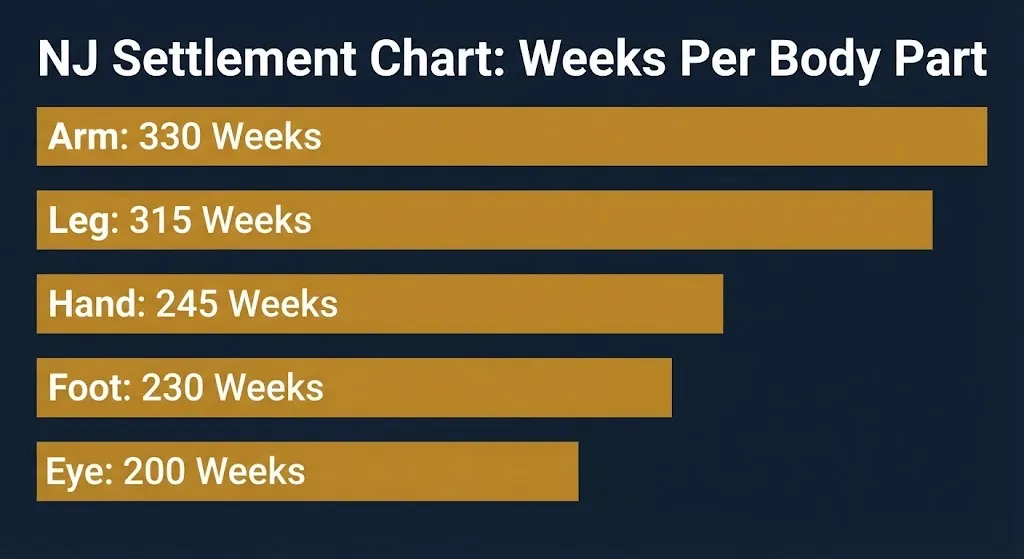
- The NJ settlement chart pays permanent partial disability based on fixed weeks per body part, for example 330 weeks for an arm, set by state statute.
New Jersey’s 2026 workers’ compensation weekly benefit rates increased even though employer insurance premiums went down. The maximum weekly benefit rate rose to $1,199 for injuries on or after January 1, 2026, up from $1,159 in 2025, according to the New Jersey Department of Labor and Workforce Development.
This affects two different groups: injured workers trying to estimate their weekly check, and employers budgeting for coverage. The number that matters most for workers: benefits are calculated at 70% of your average weekly wage, capped at $1,199 and floored at $320 per week for most claims in 2026.
This article breaks down the confirmed 2026 weekly benefit rates, the separate 4.3% insurance premium rate change approved for employers, and how New Jersey’s settlement chart actually calculates a permanent disability payout. One detail worth knowing upfront: the benefit rate chart and the insurance premium rate chart are two completely different numbers, and mixing them up is a common mistake.
The Facts
| Applies To | New Jersey workplace injuries and NJ employer workers’ comp insurance policies |
| Benefit Rate Authority | New Jersey Department of Labor and Workforce Development |
| Insurance Rate Authority | New Jersey Compensation Rating and Inspection Bureau (NJCRIB), approved by the NJ Department of Banking and Insurance |
| 2026 Max Weekly Benefit | $1,199 (up from $1,159 in 2025), effective January 1, 2026 |
| 2026 Min Weekly Benefit | $320 (up from $309 in 2025), effective January 1, 2026 |
| 2026 Insurance Rate Change | Statewide average decrease of 4.3%, effective January 1, 2026 |
| Wage Replacement Formula | 70% of average weekly wage, subject to the maximum and minimum rates |
| Settlement Chart Basis | Fixed weeks per body part under N.J.S.A. 34:15-12(c), for example an arm equals 330 weeks |
Are the 2026 NJ workers compensation rates official and confirmed
Yes, the 2026 rates come directly from two verified government sources: the New Jersey Department of Labor and Workforce Development for benefit rates, and the New Jersey Compensation Rating and Inspection Bureau for insurance premium rates.
The NJDOL announced the new benefit rates on December 29, 2025, confirming the maximum weekly workers’ compensation benefit rate for temporary disability, permanent total disability, permanent partial disability, and dependency claims rises to $1,199 from $1,159. Separately, NJCRIB Circular No. 2510, dated October 29, 2025, confirmed the Department of Banking and Insurance approved a 4.3% decrease in workers’ comp and employers’ liability insurance rates effective the same date.
Key Takeaway: The benefit rate increase for injured workers and the insurance premium decrease for employers are two separate, independently confirmed 2026 changes, not the same figure.
Is the NJ workers’ comp settlement chart the same every year
No, only part of the settlement chart stays fixed year to year. The number of weeks assigned to each body part is set by statute and does not change annually, but the dollar value of each week does change every year along with the benefit rate.
Under N.J.S.A. 34:15-12(c), body parts carry fixed base values in weeks of compensation. These week values are statutory and stable across years. What changes annually is the maximum and minimum weekly dollar rate, which is multiplied against those weeks to calculate an actual dollar payout.
Reality Check: A “2025 settlement chart” and a “2026 settlement chart” will show the same weeks per body part, but different dollar-per-week values, since only the rate changed, not the underlying weeks structure.
What is the maximum NJ workers compensation weekly rate for 2026
The maximum NJ workers’ compensation weekly rate for 2026 is $1,199, applying to temporary disability, permanent total disability, permanent partial disability, and dependency benefits for injuries occurring on or after January 1, 2026.
This is an increase from the 2025 maximum of $1,159. The rate is recalculated annually based on the statewide average weekly wage from the second preceding calendar year. The 2026 rate reflects a $1,598.66 average weekly wage for 2024, itself a 3.4% increase from $1,545.60 in 2023.
| Year | Maximum Weekly Rate |
|---|---|
| 2025 | $1,159 |
| 2026 | $1,199 |
Key Takeaway: Your benefit rate is locked in based on your injury date, so a worker hurt in December 2025 uses the 2025 rate even if their claim is processed after January 1, 2026.
What is the minimum NJ workers compensation weekly rate for 2026
The minimum NJ workers’ compensation weekly rate for 2026 is $320, up from $309 in 2025, according to NJCRIB Circular No. 2510.
This minimum applies to most disability categories, though permanent partial disability carries its own separate minimum. The minimum weekly benefit for permanent partial injuries specifically remains at $35, unchanged and separate from the general minimum rate.
| Benefit Category | 2026 Minimum Weekly Rate |
|---|---|
| General disability minimum | $320 |
| Permanent partial disability minimum | $35 (unchanged) |
Not yet determined for your specific claim: your actual weekly rate, since it depends on your own average weekly wage before your injury, subject to these floor and ceiling limits.
How much did NJ workers compensation insurance rates change in 2026
New Jersey workers’ compensation insurance rates decreased by a statewide average of 4.3% for 2026, approved by the Department of Banking and Insurance effective January 1, 2026.
This is not a flat change applied evenly to every employer. The overall decrease results from several offsetting factors: a 12.0% upward adjustment for loss experience, a 15.5% downward adjustment for the trend factor, a 0.6% downward adjustment for expenses, and a 1.2% upward adjustment tied to the benefit rate increases described above.
| Industry Group | 2026 Average Rate Change |
|---|---|
| Manufacturing | -4.4% |
| Contracting | -3.8% |
| Office & Clerical | -6.4% |
| Goods & Services | -2.8% |
| Miscellaneous | -6.7% |
| Maritime & FELA | -4.6% |
| Statewide Average | -4.3% |
Reality Check: A statewide average decrease does not mean every employer’s premium goes down. Individual classification rates vary widely, and NJCRIB reported 141 classifications saw rate increases even as 401 classifications saw decreases for 2026.
How does the NJ workers’ compensation settlement chart calculate payouts
Not yet determined for any specific claim, since the settlement chart produces different dollar amounts depending on the body part, the percentage of disability, and the applicable weekly rate for your injury date.
The chart works in two parts. Scheduled losses cover specific, listed body parts with fixed base weeks of compensation, while non-scheduled losses, like back or neck injuries, are compensated as a percentage of a 600-week basis.
| Body Part | Statutory Base Weeks (N.J.S.A. 34:15-12(c)) |
|---|---|
| Thumb | 75 weeks |
| Index finger | 50 weeks |
| Hand | 245 weeks (300 weeks if loss of function is 25% or greater) |
| Arm | 330 weeks |
| Foot | 230 weeks (285 weeks if loss of function is 25% or greater) |
| Leg | 315 weeks |
| Eye (vision loss) | 200 weeks (plus 25 weeks for enucleation) |
| Hearing, one ear | 60 weeks |
| Hearing, both ears | 200 weeks |
| Natural tooth | 4 weeks each |
To value a scheduled award, you multiply the percentage of disability by the body part’s base weeks, then multiply that result by your applicable weekly dollar rate.
Key Takeaway: The settlement chart’s weeks per body part are fixed by statute, but the dollar value only becomes real once multiplied by the 2026 rate that applies to your specific injury date.
How to calculate your NJ workers comp weekly benefit
You can estimate your NJ workers’ comp weekly benefit by taking 70% of your average weekly wage before the injury, then checking it against the 2026 maximum and minimum limits.
- Determine your average weekly wage before the injury, typically based on recent earnings.
- Multiply that wage by 70% to get your base benefit calculation.
- Compare the result against the 2026 maximum of $1,199.
- Compare the result against the 2026 minimum of $320.
- If your calculated amount exceeds $1,199, your benefit is capped at $1,199.
- If your calculated amount falls below $320, your benefit is generally raised to $320.
- Confirm which year’s rate applies based on your actual injury date, not your filing date.
Key Takeaway: Your benefit rate is determined by the date you were injured, not the date your claim gets processed or approved.
How to use the NJ settlement chart for a body part injury
You use the settlement chart by identifying your specific injury’s listed body part, applying your assigned disability percentage, and multiplying by the applicable weekly rate for your injury year.
- Identify the specific body part involved in your permanent injury.
- Confirm the statutory base weeks assigned to that body part.
- Obtain your permanent disability percentage from your evaluating physician.
- Multiply the base weeks by your disability percentage to get your compensable weeks.
- Multiply your compensable weeks by the applicable weekly dollar rate for your injury date.
- Confirm the result against any relevant minimum or maximum limits for permanent partial disability.
A comparison worth keeping in mind: this works something like a warranty claim tiered by damage severity. A small dent pays out a smaller claim than a totaled panel, even though both use the same underlying schedule.
What to do if your employer’s insurer disputes your NJ workers comp rate
If your employer’s insurer disputes your calculated rate, you generally have the right to challenge that determination through New Jersey’s Division of Workers’ Compensation.
Steps to take if you believe your rate is calculated incorrectly:
- Request a written explanation of how your average weekly wage was calculated.
- Compare that calculation against your actual pay stubs or tax records.
- Confirm which year’s maximum and minimum rates the insurer applied, based on your injury date.
- Request the specific weeks assigned to your body part if a scheduled loss is involved.
- File a formal dispute with the Division of Workers’ Compensation if the numbers do not match.
- Consider consulting a workers’ compensation attorney if the dispute involves a significant dollar difference.
Reality Check: Rate disputes are common and are not automatically a sign of bad faith. Wage calculation errors happen, especially for workers with variable hours, overtime, or multiple jobs, which is why checking the math yourself matters.
What is the latest 2026 NJ workers compensation insurance rate news
The latest confirmed 2026 development beyond the base rate change involves the Second Injury Fund surcharge, which NJCRIB set at 3.75% of modified premium for 2026, alongside a Uninsured Employers’ Fund surcharge of 0.00%, currently suspended.
NJCRIB also confirmed there are 550 classifications in the workers’ comp manual effective January 1, 2026, six of which carry no rate assignment. Of the remaining classifications, 141 experienced increased rates, two experienced no change, and 401 classifications experienced decreased rates for 2026.
Key Takeaway: Even within a statewide average decrease, individual businesses can see very different premium outcomes depending on their specific classification code.
How do NJ workers comp rates compare to 2025
The 2026 maximum weekly benefit rate of $1,199 represents a $40 increase over the 2025 maximum of $1,159, while the minimum rose $11, from $309 to $320.
On the insurance side, 2026’s statewide 4.3% premium decrease follows a larger 6.9% statewide average decrease that took effect for 2025, meaning New Jersey employers have now seen consecutive years of rate relief even as benefit payouts to workers have risen.
| Metric | 2025 | 2026 |
|---|---|---|
| Max weekly benefit | $1,159 | $1,199 |
| Min weekly benefit | $309 | $320 |
| Statewide insurance rate change | -6.9% | -4.3% |
Why do NJ workers compensation rates change every year
New Jersey recalculates benefit rates annually because state law ties the maximum and minimum weekly rates to the statewide average weekly wage, which itself shifts with wage growth each year.
The maximum benefit rate equals 70% of a worker’s average earnings, capped at a ceiling tied to that statewide average weekly wage figure. Since the 2024 statewide average weekly wage rose 3.4% to $1,598.66, the corresponding 2026 benefit ceiling rose as well.
Insurance premium rates change separately and are driven by different factors: actual claims experience, loss trends, and expense provisions analyzed by NJCRIB using the three most recent complete policy years of data, including losses tied to the COVID-19 pandemic.
What is the New Jersey Compensation Rating and Inspection Bureau
The New Jersey Compensation Rating and Inspection Bureau, known as NJCRIB, is the rating organization responsible for setting workers’ compensation insurance rates statewide, subject to approval by the Department of Banking and Insurance.
NJCRIB is headquartered at One Newark Center in Newark, New Jersey. It analyzes claims data, loss trends, and expense provisions each year to recommend rate changes, which the Department of Banking and Insurance then approves or modifies before they take effect.
NJCRIB also maintains the classification system employers use to determine their insurance premium, covering 550 distinct job classifications as of the 2026 manual, from clerical work to construction and maritime operations.
How does the NJ workers compensation system work overall
New Jersey’s workers’ compensation system is a no-fault program that pays injured workers a portion of their wages and covers medical treatment for job-related injuries, without requiring proof that the employer was negligent.
Benefits fall into several categories: temporary disability while you cannot work, permanent partial disability for lasting impairment that still allows some work capacity, permanent total disability for injuries that end your ability to work, and dependency benefits for surviving family members in fatal cases.
Permanent total disability initially pays for 450 weeks, after which the worker must undergo an evaluation, and if they can show they underwent any ordered rehabilitation but remain unable to earn at their pre-injury level, benefits can be extended.
What Happens Next
January 1, 2026: The new $1,199 maximum and $320 minimum weekly benefit rates took effect for all injuries occurring on or after this date (already occurred).
January 1, 2026: NJCRIB’s 4.3% statewide insurance rate decrease took effect for new and renewal policies (already occurred).
Ongoing: Individual employer premiums continue adjusting based on classification-specific rate changes, ranging from decreases to increases depending on industry group.
Expected late 2026: NJDOL typically announces the following year’s benefit rate changes in December, based on the 2025 statewide average weekly wage.
Frequently Asked Questions
What is the maximum workers comp payment in NJ for 2026?
The maximum weekly workers’ compensation benefit in New Jersey for 2026 is $1,199, effective for injuries on or after January 1, 2026.
This applies to temporary disability, permanent total disability, permanent partial disability, and dependency benefits.
What is the minimum workers comp rate in NJ for 2026?
The minimum weekly workers’ compensation rate in New Jersey for 2026 is $320, up from $309 in 2025.
Permanent partial disability claims carry a separate, lower minimum of $35 per week.
Did NJ workers comp insurance rates go up or down in 2026?
NJ workers’ compensation insurance rates decreased by a statewide average of 4.3% for 2026, effective January 1, 2026.
The change varies significantly by industry group and individual classification code.
How is the NJ workers comp settlement chart used?
The settlement chart assigns fixed statutory weeks of compensation to specific body parts, which are multiplied by a disability percentage and the applicable weekly rate.
An arm, for example, carries a base value of 330 weeks under New Jersey law.
How much is an arm worth in NJ workers compensation?
An arm carries a statutory base value of 330 weeks of compensation under N.J.S.A. 34:15-12(c).
The actual dollar payout depends on your disability percentage and the weekly rate applicable to your injury date.
Do NJ workers comp rates change based on when I was injured?
Yes, your applicable maximum and minimum weekly rates are determined by your injury date, not your filing or approval date.
A worker injured in 2025 uses 2025 rates even if the claim resolves after January 1, 2026.
Why did my employer’s workers comp insurance go down while benefits went up?
These are two separate rate systems: NJCRIB sets insurance premiums based on claims experience and trend data, while NJDOL sets worker benefit rates based on statewide wage growth.
Both changed for 2026, but independently of each other.
Where do I find New Jersey’s official workers comp rate schedule?
The official source for benefit rates is the New Jersey Department of Labor and Workforce Development, and the official source for insurance premium rates is NJCRIB Circular No. 2510.
Both are government or state-authorized rating bureau publications, not third-party estimates.
If you are trying to estimate a specific benefit or settlement amount, use the 2026 maximum of $1,199 and minimum of $320 as your starting reference points, then confirm your exact injury date determines which year’s rates actually apply to your claim.