Missouri Workers Compensation: 2026 Claims, Deadlines, and What You Can Actually Get
Quick Answer
- Missouri workers compensation is a state-mandated insurance system, not a lawsuit settlement.
- Weekly benefit amounts depend on your average weekly wage and injury date, not a fixed fund.
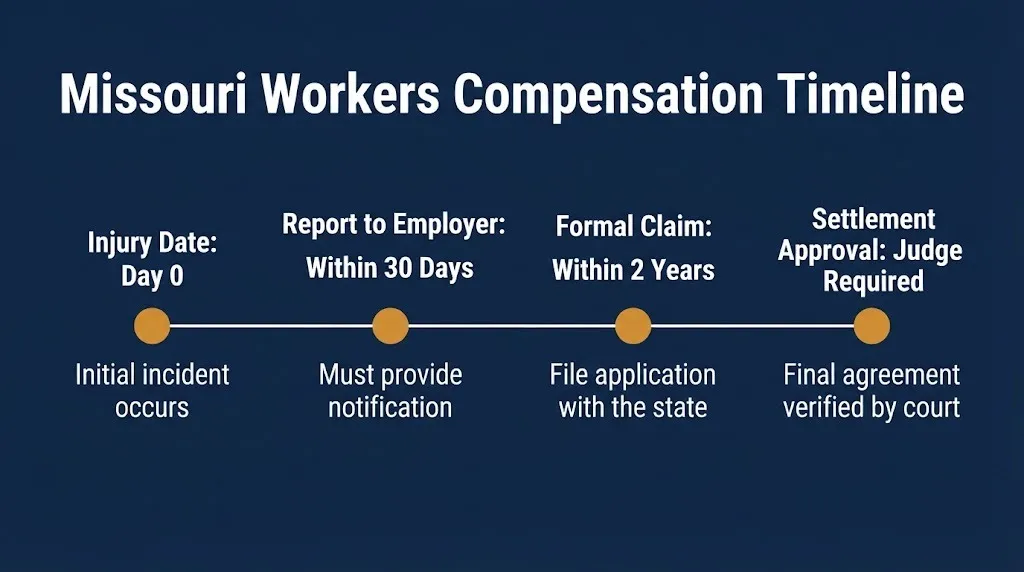
- Most workplace injury claims must be reported to your employer within 30 days of the accident.
If you searched “Missouri workers compensation” because you got hurt at work or saw something about a payout, this page will tell you what’s real, what you may qualify for, and how the system actually pays. The Missouri Division of Workers’ Compensation oversees every claim in the state, and the rules changed in some important ways that most summary articles miss.
Here’s the surprising part: Missouri has no state-operated workers compensation insurance fund. Employers must buy coverage from private insurers or get approved to self-insure. That single fact changes how claims get paid, how disputes work, and why some injured workers wait far longer than others.
The Facts
| Fact | Detail |
|---|---|
| Governing agency | Missouri Division of Workers’ Compensation |
| Governing law | Missouri Workers’ Compensation Law, Chapter 287 RSMo |
| Insurance requirement | Employers with 5+ employees must carry coverage |
| Average weekly wage formula | Based on 13 weeks before the injury |
| Claim reporting deadline | 30 days to employer, 2 years to file formal claim |
| Maximum weekly benefit 2026 | Adjusted annually, see official rate schedule |
| Settlement approval | Required from an administrative law judge |
| Current system status | Active, no class action fund pending |
Is Missouri Workers Compensation Legit or a Scam?
Missouri workers compensation is a legitimate state-mandated insurance system that has existed for decades. It is not a lawsuit settlement, a class action payout, or a fund you can claim without a workplace injury.
The system requires most Missouri employers to carry workers compensation insurance. If you get hurt on the job, that insurance covers your medical care and part of your lost wages. The trade-off: you generally cannot sue your employer for a workplace injury.
The Missouri Division of Workers’ Compensation is the state agency that oversees the entire system. It maintains a searchable database where you can check whether your employer actually has coverage. That matters because some employers break the law and do not carry insurance.
If your employer lacks coverage, you may still have options through the Missouri Second Injury Fund or through a direct lawsuit against the employer. The state also has a dedicated fraud unit that investigates employers who falsely claim coverage.
Key Takeaway: Missouri workers compensation is a real state system, not a settlement fund. You only qualify if you have a verified workplace injury or occupational disease.
How Much Does Missouri Workers Compensation Pay?
The amount you may receive depends on your average weekly wage before the injury and the severity of your disability. There is no flat per-person payout like a data breach settlement.
For temporary total disability, which means you cannot work at all while recovering, Missouri generally pays two-thirds of your average weekly wage. The state sets a maximum weekly rate that adjusts each year. The official 2026 rate schedule is published by the Division of Workers’ Compensation.
Here is a simplified breakdown of benefit types:
| Benefit Type | What It Covers | Typical Rate |
|---|---|---|
| Temporary Total Disability | Cannot work at all during recovery | 66.67% of average weekly wage |
| Temporary Partial Disability | Can work but at reduced hours or pay | 66.67% of wage difference |
| Permanent Partial Disability | Lasting impairment after recovery | Based on body part and impairment rating |
| Permanent Total Disability | Cannot return to any work | 66.67% of average weekly wage, ongoing |
| Death Benefits | Surviving dependents of a fatal injury | Weekly benefits plus burial costs |
The average weekly wage calculation looks at your gross earnings for the 13 weeks before the injury. If you had multiple jobs, only wages from the job where you got hurt typically count.
Missouri also caps permanent partial disability based on a schedule of body parts. A hand injury has a different maximum than a back injury. The official schedule is available from the Division.
Reality Check: No one from “Missouri workers compensation” will call or text you to offer money. If you received an unsolicited message about a workers comp payout, it is almost certainly a scam. Filing a claim costs nothing, and the state never charges a fee to process your paperwork.
What Is the Missouri Division of Workers Compensation?
The Missouri Division of Workers’ Compensation is the state agency within the Missouri Department of Labor and Industrial Relations that administers all workers compensation claims, hearings, and settlements.
The Division runs the administrative court system where disputes get resolved. Administrative law judges hear cases, review settlement agreements, and issue awards. This is not a typical county courthouse process. It is a specialized system designed to move faster than civil litigation.
The Division also maintains the state’s coverage verification database. You can search by employer name to see if they carry valid workers compensation insurance. If your employer shows no coverage, that is a major red flag.
One often-missed function: the Division hosts mediation and pre-hearing conferences. Many cases resolve at this stage without a formal hearing. Settlement agreements must be approved by an administrative law judge, and the approval is a public record. Those records sometimes surface in news articles about large employer-wide settlements.
Key Takeaway: The Missouri Division of Workers’ Compensation is the only official source for claim status, coverage verification, and hearing dates.
How Do I File a Missouri Workers Compensation Claim?
Filing a claim in Missouri follows a strict sequence. Missing a step can delay or deny your benefits.
- Report the injury to your employer immediately, in writing if possible.
- Your employer must file a Report of Injury with the Division within 30 days of learning about it.
- Seek medical treatment from an authorized provider if your employer directs one.
- If your employer denies the claim or disputes it, file a Claim for Compensation with the Division.
- The Division assigns a case number and may schedule a mediation or pre-hearing conference.
- Attend all scheduled hearings, bring documentation of wages, medical records, and any witness statements.
- If a settlement is offered, review it carefully before signing. An administrative law judge must approve it.
The 30-day reporting window is not a hard deadline in all cases, but it is the cleanest path. Missouri law says you should report “within 30 days” unless there is a valid reason for delay. The formal claim filing deadline is generally two years from the injury date or from the last payment of benefits.
If your employer retaliates after you file, that is illegal under Missouri law. You may have a separate claim for wrongful termination or discrimination.
Key Takeaway: The filing process starts with you notifying your employer. Every day you wait after the injury weakens the paper trail.
What Is Missouri Workers Compensation Insurance and Who Must Carry It?
Missouri workers compensation insurance is the policy your employer buys from a private carrier or through an approved self-insurance arrangement. Missouri does not run its own state insurance fund, unlike some other states.
Employers with five or more employees must carry coverage. Construction industry employers must carry coverage if they have one or more employees. Sole proprietors and partners are generally excluded unless they opt in.
Here is the coverage requirement breakdown:
| Employer Type | Threshold |
|---|---|
| Most private employers | 5 or more employees |
| Construction employers | 1 or more employees |
| Sole proprietors and partners | Excluded unless they elect coverage |
| Corporate officers | Included unless they file an exemption |
| LLC members | May be included depending on role |
A surprising number of Missouri employers either do not carry coverage or let it lapse. The state’s fraud and noncompliance unit investigates these cases. If your employer had no coverage at the time of injury, you can file a tort lawsuit directly against them, which often means higher potential damages but a longer legal fight.
Key Takeaway: Most Missouri employers with five or more workers must carry private workers compensation insurance. Construction is stricter: one employee triggers the requirement.
How Does Workers Compensation Work in Missouri After an Injury?
The system replaces the right to sue with a structured benefit framework. You give up a lawsuit, and in exchange you get faster, no-fault medical care and wage replacement. The key word is no-fault. You do not need to prove your employer did anything wrong.
After you report an injury, the employer’s insurance carrier investigates. It may accept or deny the claim. If accepted, the carrier pays medical bills directly to approved providers and sends wage replacement checks to you. If denied, you can request a hearing.
Missouri uses a fee schedule for medical care. Providers who treat injured workers agree to accept those rates. That keeps costs predictable but also means some specialists decline to treat workers comp patients.
The system can feel slow. Insurance carriers have legal timeframes to respond, but disputes over causation, pre-existing conditions, and impairment ratings routinely add months. The average contested Missouri workers comp case takes 12 to 18 months to resolve, according to Division statistics reported in prior years.
Key Takeaway: Workers compensation is a no-fault system that trades lawsuit rights for structured benefits. Speed depends on whether your employer’s insurer disputes anything.
What Are the Most Common Missouri Workers Compensation Disputes?
Disputes arise in predictable patterns. Knowing them helps you avoid the same traps.
The most common dispute is causation. The insurer argues your injury is not work-related or stems from a pre-existing condition. Missouri law uses a “prevailing factor” standard, which means work must be the primary cause of the injury or disability.
The second most common dispute is the impairment rating. Permanent partial disability in Missouri is based on a percentage rating assigned by a physician. A 10 percent hand rating pays far less than a 25 percent hand rating. Insurers push for lower ratings, workers push for higher ones, and administrative law judges decide.
Wage disputes come third. If you worked irregular hours, received tips, or had a second job, calculating average weekly wage gets messy. Insurers may try to exclude overtime or bonuses.
Other recurring fights involve unauthorized medical treatment, refusal of light-duty work, and the Second Injury Fund, which covers disabilities combined from prior injuries.
Key Takeaway: Causation, impairment ratings, and wage calculations drive most Missouri workers comp disputes. Document everything from day one.
Are There Any Missouri Workers Compensation Class Action Lawsuits in 2026?
No verified class action settlement involving Missouri workers compensation is pending or paying out as of August 30, 2026. That claim appears across several clickbait articles, and it does not hold up under scrutiny.
Workers compensation is an administrative system, not a typical litigation pipeline. Class actions do sometimes emerge around specific employer practices, such as failing to maintain coverage or systematically denying claims. But those cases target individual employers, not the state system itself.
One area worth watching: the Missouri Second Injury Fund has faced solvency challenges for years. Employers pay into it through surcharges, and injured workers with qualifying combined disabilities can claim from it. Lawmakers have debated restructuring the fund, but no confirmed payout change has been enacted.
If you saw an article or ad claiming a “Missouri workers compensation settlement” with a deadline, check the source carefully. The official Division website posts all rule changes and hearing notices. It is the only place to verify system-wide changes.
Key Takeaway: No class action settlement fund tied to Missouri workers compensation exists as of this writing. Treat any claim of one as unverified until the Division confirms it.
How Long Does a Missouri Workers Comp Settlement Take?
Most Missouri workers comp settlements take between six and eighteen months from injury to approved agreement. Some straightforward cases resolve in three to four months. Highly contested cases can stretch past two years.
The timeline depends on three variables. First, whether the insurer accepts liability. Second, whether you reach maximum medical improvement, which is the point where your condition stabilizes. Third, whether both sides agree on a permanent partial disability rating.
Missouri does not allow lump-sum settlements of future medical benefits in most cases. You can settle the disability portion, but medical benefits often remain open. That differs from some neighboring states and catches people by surprise.
A settlement must be approved by an administrative law judge. The judge reviews the agreement to make sure it is not grossly unfair. Once approved, the insurer typically issues payment within 30 to 60 days.
Key Takeaway: Settlements are not instant. Six to eighteen months is a realistic window for most contested Missouri workers comp cases.
What Is the Missouri Second Injury Fund?
The Missouri Second Injury Fund is a state-managed pool that pays benefits when a new workplace injury combines with a pre-existing disability to create a larger overall disability. It is not a general fund for all injured workers.
To qualify, you must show that your pre-existing condition was a hindrance to employment and that the combined disability is greater than the new injury alone. The fund has strict eligibility rules and limited money.
The fund has faced insolvency threats for over a decade. Surcharges on employers fund it, and the balance has fluctuated. In some years, the fund suspended or delayed payments because it ran low. The Division posts annual reports showing the fund’s financial status.
If you have a prior injury, a prior workers comp settlement, or a documented medical condition that affected your ability to work, ask about the Second Injury Fund when you file. Missing the claim can forfeit that portion of your benefits.
Key Takeaway: The Second Injury Fund covers combined disabilities, not ordinary single-injury claims. Eligibility is narrow and funds are limited.
What Happens If My Missouri Employer Has No Workers Comp Insurance?
If your Missouri employer was legally required to carry coverage and did not, you have a different legal path. You can file a workers comp claim, but there may be no insurance to pay it. That is where a direct lawsuit comes in.
Missouri allows injured workers to sue an uninsured employer in civil court. That strips away the normal workers comp limits. You can potentially recover full tort damages, including pain and suffering, which workers comp does not include.
The state also has an Uninsured Employers Fund, though its scope is limited compared to some other states. The Division may issue stop-work orders and fines against noncompliant employers.
If you are in this situation, move quickly. Evidence and witnesses fade. A civil lawsuit has a longer filing window than a workers comp claim in some circumstances, but your report to the Division should still happen within the normal timelines.
Key Takeaway: An uninsured employer exposes you to a longer fight but potentially larger recovery. Report the injury to the Division regardless of coverage.
What Is the 30-Day Rule for Missouri Workers Compensation?
Missouri law requires you to report a workplace injury to your employer within 30 days of the accident or within 30 days of discovering an occupational disease. The clock starts when you knew or should have known the injury was work-related.
Missing the 30-day window does not automatically kill your claim, but it creates a problem. The insurer will argue delay. The administrative law judge will want an explanation. Legitimate reasons include hospitalization, inability to communicate, or an injury that developed gradually.
For occupational diseases like carpal tunnel or lung conditions, the 30-day clock starts at diagnosis or when you first connected the condition to work. That is often later than the first symptom.
The hard deadline is two years from the injury date or from the last benefit payment to file a formal claim with the Division. Missing that bars your claim entirely in most cases.
Key Takeaway: Report within 30 days. File the formal claim within two years. These are the two deadlines that matter most.
What Medical Treatment Does Missouri Workers Comp Cover?
Missouri workers compensation covers all reasonable and necessary medical treatment related to your workplace injury. That includes emergency care, surgeries, prescriptions, physical therapy, and durable medical equipment.
Your employer or its insurer has the right to direct your medical care. That means you may have to see a doctor they choose. If you see your own doctor without approval, the insurer may refuse to pay.
Missouri uses a treatment schedule and fee schedule adopted by the Division. Providers who accept workers comp patients agree to those rates. Some doctors decline workers comp entirely because of the paperwork and lower reimbursement.
If the insurer denies a specific treatment as unnecessary, you can request a hearing. The administrative law judge may order the treatment if medical evidence supports it.
Mileage to and from medical appointments is reimbursable in Missouri. The current mileage rate is published by the Division and adjusts periodically.
Key Takeaway: Medical care is covered but controlled. Use the insurer’s approved providers or get pre-approval for your own doctor.
What Is Permanent Partial Disability in Missouri?
Permanent partial disability is a lasting impairment after you reach maximum medical improvement. It does not mean you cannot work. It means part of your body works worse than before.
Missouri uses a schedule that assigns maximum weeks of benefits to specific body parts. An arm has a certain number of weeks. A leg has another. Your impairment rating, expressed as a percentage, is multiplied against those weeks to determine your benefit.
The weekly rate is generally two-thirds of your average weekly wage, subject to the state maximum. So a 20 percent impairment to a body part with a 200-week schedule would pay 40 weeks at your compensation rate.
Insurers routinely contest impairment ratings. Independent medical evaluations are common. An administrative law judge resolves disagreements.
Permanent total disability is different. It means you cannot return to any employment. The standard is high, and the burden is on you to prove it with medical and vocational evidence.
Key Takeaway: Permanent partial disability pays based on a body-part schedule and your impairment rating. Permanent total disability is much harder to prove.
What Does the Future Hold for Missouri Workers Compensation?
The next five stages for Missouri workers compensation involve legislative sessions, rate adjustments, and fund solvency.
- Expected January 2027: The Missouri General Assembly convenes and may consider workers comp reform bills.
- Expected July 2027: New maximum weekly benefit rates take effect for injuries on or after that date.
- Ongoing through 2026: The Division continues posting updated coverage verification data and hearing decisions.
- Expected late 2026: The Second Injury Fund annual report shows whether solvency improved or worsened.
- Watch for: Any rulemaking from the Division on medical fee schedule updates or dispute resolution changes.
Frequently Asked Questions
Is Missouri workers compensation the same as a lawsuit settlement?
No.
Missouri workers compensation is a mandatory insurance system for workplace injuries.
It replaces lawsuits with structured benefits for medical care and lost wages.
Can I get workers compensation if I caused my own injury?
Usually yes, if the injury happened during work.
Workers compensation is a no-fault system.
Serious misconduct like intoxication may bar benefits.
How long do Missouri workers comp benefits last?
It depends on the type of benefit.
Temporary benefits last until you reach maximum medical improvement.
Permanent partial disability lasts for a set number of weeks based on the body part.
Do I need a lawyer for a Missouri workers comp claim?
Not for a simple undisputed claim.
A lawyer helps when the insurer denies the claim or disputes the impairment rating.
Contested cases are hard to win without legal help.
Can I be fired for filing a workers comp claim in Missouri?
Missouri law prohibits retaliation for filing a claim.
If fired for filing, you may have a separate claim against the employer.
Retaliation cases have their own deadlines, so act quickly.
What is the Missouri workers comp mileage rate for 2026?
The Division publishes the current rate on its official website.
It is based on the IRS medical mileage rate.
Check the Division’s mileage rate page for the current figure.
Does Missouri workers comp cover mental health injuries?
Rarely, and only in specific circumstances.
Mental injuries generally must stem from a physical injury.
Standalone stress claims are almost never covered under Missouri law.
Where can I check if my Missouri employer has workers comp insurance?
Use the Missouri Division of Workers’ Compensation online coverage verification tool.
Search by employer name.
No coverage means the employer may be operating illegally.
Missouri workers compensation is one of the few legal systems where the rules are written for speed. But speed only happens when you report fast, document everything, and verify your employer’s coverage before you ever get hurt. The 30-day reporting window and the two-year filing deadline are the two dates you cannot miss.
As of August 30, 2026, the system is active, no class action settlement exists, and the official Division website remains the only source worth trusting for rate schedules, coverage checks, and hearing notices.