How to File a Malpractice Lawsuit in 2026: Steps, Deadlines, and What You Need Before You Start
Quick Answer
- Filing a malpractice lawsuit means proving a medical provider violated the accepted standard of care and caused measurable harm.
- The statute of limitations in most states runs one to three years from the date of injury or discovery.
- You need medical records, an expert opinion, and a lawyer admitted in the state where the care happened.
You asked how to file a malpractice lawsuit. The honest answer is that filing is the easy part. Winning is hard. And the single biggest mistake people make is waiting too long to start.
Every state sets its own filing deadline. Most fall between one and three years. Some states use a discovery rule. Some do not. The clock is already running on your case, whether you are ready or not.
This guide explains the verified process, the documents you need, the deadlines that control everything, and what to expect before you ever see a courtroom. It is written for someone sitting at a kitchen table, holding a stack of medical records, wondering where to start.
The Facts
| Fact | Verified Value |
|---|---|
| Case Type | Individual medical malpractice lawsuit |
| Jurisdiction | State court where the care was provided |
| Filing Deadline | 1 to 3 years in most states, varies by state law |
| Legal Standard | Breach of accepted standard of care causing injury |
| Required Expert | Medical expert opinion typically required before filing |
| Court Fee | $100 to $500 depending on state and county |
| Contingency Fee | 30% to 40% of recovery in most cases |
Is it hard to file a malpractice lawsuit?
Yes. It is hard to file, hard to litigate, and hard to win. Most medical malpractice cases never reach a verdict. Many are dismissed before trial. The ones that succeed require strong facts, credible experts, and patience.
The difficulty starts before you file. Most states require a certificate of merit or an affidavit from a qualified medical expert. That expert must review your records and confirm that the care you received fell below the accepted standard. You cannot get into court without that document.

Then you face a defense team paid by an insurer. Hospitals and doctors carry malpractice insurance precisely for this moment. The insurer hires experienced lawyers. They will challenge your expert, your injuries, and your timeline.
The data supports the caution. Studies of malpractice litigation show that plaintiffs lose the majority of cases that go to trial. The cases that settle do so because the facts are strong and the damages are clear. Filing is the first step, not the finish line.
How much does it cost to file a malpractice lawsuit?
The upfront filing fee is modest. Most state courts charge between $100 and $500 to file a civil complaint. Some counties add surcharges. You can check your county clerk’s fee schedule online.
The real cost is everything after filing. Medical experts charge thousands of dollars for case review and testimony. Depositions cost money. Court reporters, exhibit preparation, and motion practice add up. A contested malpractice case can cost $50,000 to $150,000 or more to litigate through trial.
That is why almost no one pays out of pocket. Malpractice lawyers work on contingency. You pay nothing upfront. The lawyer advances case costs and recovers them from any settlement or verdict. If you lose, you owe nothing in most states.
Here is the typical cost structure:
- Court filing fee: $100 to $500, sometimes waived for hardship.
- Medical records retrieval: $50 to $500 depending on the volume.
- Expert review: $3,000 to $10,000 for an initial opinion.
- Full litigation costs: $50,000 to $150,000 or more.
- Lawyer fee: 30% to 40% of the recovery, plus costs.
Key Takeaway: You do not need money to start. You need a lawyer willing to invest in your case, and that only happens if the facts are strong.
What is the statute of limitations for malpractice?
The statute of limitations is the legal deadline to file your lawsuit. Miss it, and your case is over before it starts. No exception for a busy schedule or a slow lawyer.
Most states set the limit between one and three years from the date of the injury. Some states use the date you discovered the injury, called the discovery rule. A few states use a hybrid approach.
Here are verified examples from state laws:
| State | Filing Deadline |
|---|---|
| California | 1 year from discovery, 3 years maximum from injury |
| New York | 2.5 years from the date of malpractice |
| Texas | 2 years from the date of the incident |
| Florida | 2 years from discovery, 4 years maximum |
| Illinois | 2 years from discovery, 4 years maximum |
These deadlines are not the same as insurance claim deadlines. Even if the hospital says it is reviewing your case, the court deadline still runs. Never rely on a hospital’s internal process to protect your rights.
How do I file a lawsuit against a hospital?
Filing against a hospital requires naming the right defendants. Sometimes that is the hospital itself. Sometimes it is the doctor, the nurse, the anesthesiologist, or all of them. The correct parties depend on who employed the people who made the mistake.
Your lawyer will investigate the employment relationships. A doctor may be an independent contractor, not a hospital employee. That matters because it changes who you sue and which insurance policies respond.
The filing process itself is straightforward once the investigation is done. Your lawyer drafts a complaint. The complaint names the defendants, describes what happened, and states the legal claims. It is filed with the clerk of the court in the county where the care occurred. The defendants are then served with the complaint.
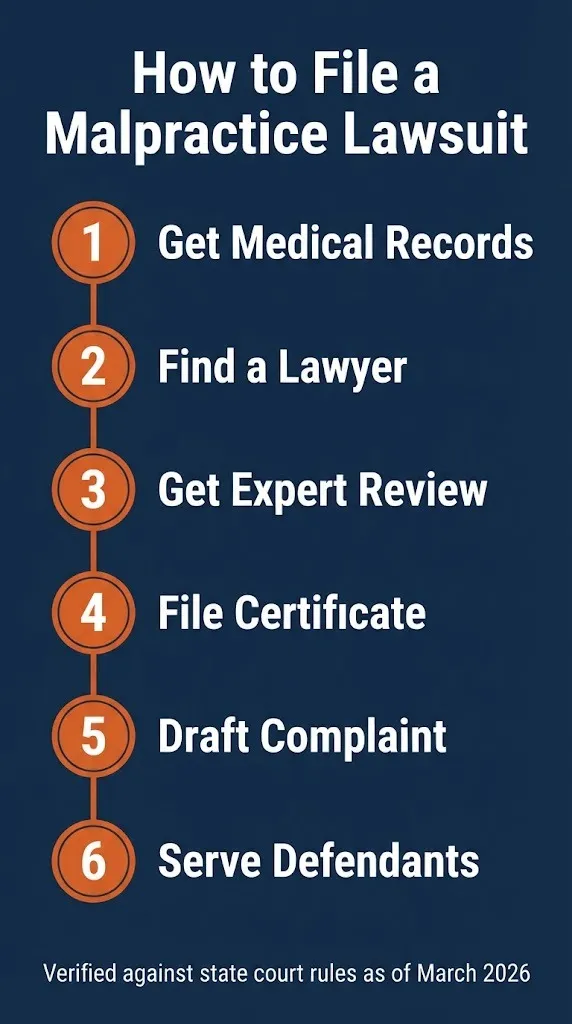
Here are the verified steps:
- Gather all medical records from every provider involved.
- Obtain an expert medical review and certificate of merit.
- Identify the correct defendants and their employers.
- Draft the complaint with specific factual allegations.
- File the complaint and pay the filing fee.
- Serve the complaint on each defendant.
- Await the defendants’ answer or motion to dismiss.
How do I start a medical malpractice lawsuit?
Starting the process is not the same as filing the complaint. The process starts with records and review, not with a trip to the courthouse.
Your first move is to request your complete medical records. You have a legal right to them under federal law. The provider must respond within 30 days, though extensions are allowed. Request everything: office notes, lab results, imaging reports, medication orders, and discharge summaries.
Next, contact a malpractice lawyer in the state where the care happened. Not any lawyer. You need one who handles medical negligence cases in that state. Malpractice law is state-specific. A lawyer in another state cannot help you.
The lawyer will order the records, review the timeline, and send the case to a medical expert for evaluation. That review determines whether you have a case worth filing. If the expert says no, a good lawyer will tell you.
Key Takeaway: Starting a malpractice case means getting records and an expert review. Filing comes later, only if the review supports your claim.
What do I need to prove in a malpractice lawsuit?
You must prove four elements. The first is duty. The provider owed you a professional duty of care. That is usually easy if a doctor-patient relationship existed.
The second is breach. The provider violated the accepted standard of care. This is where the expert opinion matters. The expert must explain what a competent provider would have done and how your care fell short.
The third is causation. The breach caused your injury. It is not enough that the care was bad. You must connect the bad care to the harm you suffered.
The fourth is damages. You have measurable losses: medical bills, lost wages, pain, disability, or death. Without damages, there is no case.
Here is the breakdown:
- Duty: The provider treated you.
- Breach: The treatment fell below the accepted standard.
- Causation: The breach caused your injury.
- Damages: You suffered measurable harm.
What kind of damages can I recover in malpractice?
Damages fall into three buckets. Economic damages are your out-of-pocket losses: medical bills, rehabilitation, lost income, and future care costs. These are usually the largest category.
Non-economic damages cover pain, suffering, emotional distress, and loss of enjoyment of life. Many states cap non-economic damages. The cap amounts vary widely.
Punitive damages are rare in malpractice cases. They punish intentional or reckless conduct, not ordinary negligence. Most malpractice settlements include no punitive component.
Here is the typical breakdown:
- Economic damages: medical bills, lost wages, future care, no cap in most states.
- Non-economic damages: pain and suffering, often capped by state law.
- Punitive damages: rare, only for extreme misconduct.
Key Takeaway: Your recoverable damages depend on your state’s cap laws. A lawyer can tell you the realistic range for your specific facts.
Do I need an expert witness to file malpractice?
Yes, in nearly every state. Most jurisdictions require a certificate of merit or an expert affidavit before you can file. The expert must be a licensed medical professional in the same or a similar specialty as the defendant.
The expert reviews your records and forms an opinion. If the expert says the care met the standard, your case does not move forward. If the expert says the care fell below the standard and caused harm, the lawyer attaches the affidavit to the complaint.
This rule is designed to screen out meritless cases. It also means you cannot file a malpractice lawsuit on your own in most states. The expert requirement effectively forces you to work with a lawyer who has relationships with qualified experts.
How long does a malpractice lawsuit take?
Most malpractice cases take two to four years from filing to resolution. That is the norm. Some settle earlier. A few take longer.
The timeline looks like this:
- Records and expert review: 2 to 6 months before filing.
- Filing and service: 1 to 2 months.
- Discovery and depositions: 12 to 24 months.
- Settlement talks or trial preparation: 6 to 12 months.
- Trial, if needed: 1 to 3 weeks.
This is not a fast process. It is the opposite of a store return. You are not getting your money back in a week. You are building a case that may take years to resolve.
What if the hospital offers me a settlement?
Do not sign anything before talking to a lawyer. Hospitals and insurers sometimes offer quick settlements for small amounts. The offer may feel generous in the moment. It rarely reflects the full value of your claim.
A quick settlement usually includes a release. That release ends your right to sue forever. If complications arise later, you cannot go back for more. The first offer is often the lowest one.
A malpractice lawyer can evaluate the offer against the strength of your case. That evaluation costs you nothing upfront. If the offer is fair, the lawyer will tell you. If it is low, the lawyer will negotiate or file.
Key Takeaway: A hospital settlement offer is not a gift. It is a business decision designed to close your claim cheaply.
Can I file malpractice without a lawyer?
Technically, you can file a lawsuit without a lawyer. You have a legal right to represent yourself. In malpractice cases, that is almost always a mistake.
The expert affidavit requirement alone stops most self-represented plaintiffs. You need a qualified expert to review your records and sign a certificate. Finding that expert without a lawyer is nearly impossible.
Then you face procedural rules, discovery deadlines, and defense lawyers who do this every day. The court will hold you to the same standard as a licensed attorney. One missed deadline can end your case.
The practical answer is no. You should not file malpractice without a lawyer. The only exception is if your claim is so small that no lawyer will take it, and even then, you are better off not filing at all.
How do I find the right malpractice lawyer?
Start with referrals. Ask other lawyers you know. Ask doctors or nurses who are willing to talk. Personal recommendations beat billboards.
Then verify the lawyer’s credentials. Check your state bar’s website for disciplinary history. Look for board certification in medical malpractice or trial practice. Read reviews, but treat them as one data point, not the whole picture.
Meet with two or three lawyers. Ask these questions:
- How many malpractice cases have you handled to resolution?
- What is your success rate at trial and in settlement?
- Will you handle the case personally or pass it to an associate?
- How often do you take cases to trial versus settling?
- What is your honest assessment of my case?
A good lawyer will tell you the weaknesses of your case. A bad lawyer will promise a big payday. Choose the one who is honest, not the one who flatters you.
What should I do right now if I think I have a case?
Act immediately. The deadline is running. You do not need a perfect file. You need to start.
Here is the immediate checklist:
- Write down everything you remember about the care: dates, names, what was said.
- Request your complete medical records from every provider and facility.
- Preserve all bills, insurance statements, and prescription records.
- Take photos of visible injuries if they still exist.
- Contact a malpractice lawyer in the state where the care occurred.
- Do not post about the case on social media.
- Do not sign any document from the hospital or its insurer.
- Calendar every deadline the lawyer gives you.
This is like a warranty claim on a broken appliance. The sooner you act, the stronger your position. Waiting does not help you.
Reality Check
No one will call you to say you have a malpractice claim. Lawyers do not buy lists of injured patients and dial them up. If someone contacts you claiming they can get you a settlement, treat it as a scam. Real malpractice cases start with you contacting a lawyer, not the other way around. And no legitimate lawyer charges a fee just to evaluate your case.
What Happens Next
| Timeline | Expected Stage |
|---|---|
| Now to 30 days | Request and receive medical records |
| 1 to 3 months | Lawyer review and expert screening |
| 2 to 6 months | Certificate of merit and complaint filing |
| 6 to 18 months | Discovery, depositions, and expert reports |
| 18 to 36 months | Settlement talks or trial |
These dates are estimates. Every case moves at its own pace.
Frequently Asked Questions
How long do I have to file a malpractice lawsuit?
Most states give you one to three years from the injury or its discovery.
Do I need a lawyer to file malpractice?
Yes. The expert requirement and procedural rules make self-representation impractical.
What does a malpractice lawyer cost upfront?
Nothing in most cases. Malpractice lawyers work on contingency and advance case costs.
Can I sue a hospital for a doctor’s mistake?
Yes, if the doctor was a hospital employee or the hospital shares responsibility for the care.
What is the hardest part of a malpractice case?
Proving causation. You must connect the provider’s breach directly to your injury.
How much is a malpractice case worth?
It depends on your medical bills, lost income, pain, and your state’s damage caps.
What if I signed a consent form before treatment?
A consent form is not a waiver of malpractice. You can still sue if the care fell below the standard.
Will my case go to trial?
Most malpractice cases settle. Only a small percentage reach a jury verdict.
The First Step Is the Only Step That Matters Today
You cannot file a malpractice lawsuit by reading an article. You file it by requesting records, finding a lawyer, and getting an expert review. The process starts with a phone call, not a court form.
The deadline is the only date that matters right now. Every state sets a different limit. Every day you wait makes your case harder to win. Find the deadline for your state. Meet it. The rest of the process follows from there.