Pedestrian Hit by Car Lawsuit 2026: Who Can Sue, What You Can Recover, and Deadlines That Control Everything
Quick Answer
- A pedestrian hit by a car can sue the at-fault driver for medical bills, lost wages, pain, and future care costs.
- Most pedestrian accident cases settle through the driver’s auto insurance before a lawsuit is ever filed.
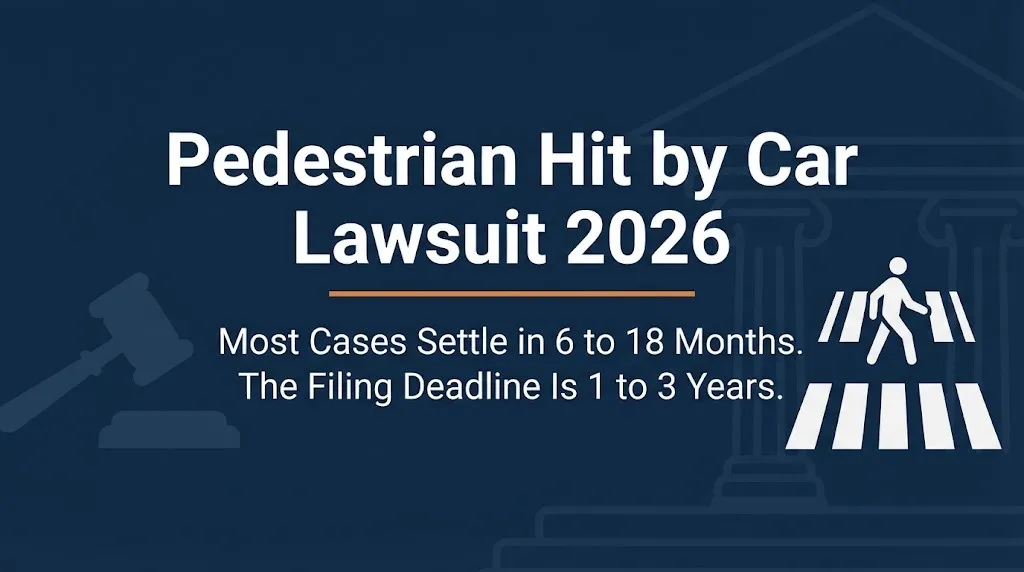
- The filing deadline is your state’s statute of limitations, usually one to three years from the crash date.
You were walking. A car hit you. Now you are injured, the medical bills are arriving, and the driver’s insurance company is calling. You want to know if you can sue, how much you can get, and how long it will take.
The short answer is yes, pedestrians can sue. The longer answer is that most cases settle without a lawsuit. The insurance company knows it will lose at trial if the driver was clearly at fault. The fight is usually about how much money, not whether money is owed.
This article explains the verified rules for pedestrian accident lawsuits, what you can recover, what can reduce your payout, and the deadlines that will end your case if you miss them.
The Facts
| Fact | Verified Value |
|---|---|
| Case Type | Personal injury lawsuit, pedestrian versus driver |
| Jurisdiction | State court where the crash occurred |
| Statute of Limitations | 1 to 3 years in most states |
| Insurance Source | Driver’s liability coverage, sometimes your own policy |
| Common Damages | Medical bills, lost wages, pain and suffering |
| Settlement Timeline | 6 to 18 months for most injury cases |
Can a pedestrian sue after being hit by a car?
Yes. A pedestrian who is hit by a car has the right to sue the at-fault driver. That right exists regardless of whether the driver received a traffic ticket or faced criminal charges.
The lawsuit is a civil claim for negligence. You must prove the driver failed to act with reasonable care and that failure caused your injuries. Running a red light, speeding, distracted driving, or failing to yield at a crosswalk all count as negligence.
You do not need the driver to be convicted of anything. The civil standard is lower than the criminal standard. Even if the prosecutor declines to file charges, you can still sue and win.
The driver’s insurance company defends the case and pays any settlement or verdict up to policy limits. If the driver has no insurance or too little coverage, your own uninsured motorist coverage may step in.
How much is a pedestrian accident lawsuit worth?
There is no fixed amount. The value depends on your injuries, your medical costs, your lost income, and the driver’s insurance limits.
A minor injury case with a few thousand dollars in medical bills may settle for $10,000 to $25,000. A serious injury with surgery, permanent disability, or long-term care can be worth hundreds of thousands or millions.
Here is a verified breakdown of value factors:
| Factor | Impact on Value |
|---|---|
| Medical bills | Higher bills mean higher value |
| Lost wages | Documented income loss adds value |
| Permanent injury | Scarring, disability, or chronic pain increase value |
| Future care needs | Ongoing treatment or therapy adds significant value |
| Insurance limits | The policy cap limits what you can collect |
| Liability clarity | Clear fault makes settlement more likely |
The insurance company will not volunteer a fair number. It will start low. Your job, with a lawyer, is to document every loss and negotiate from a position of evidence.
Key Takeaway: Your case value is not a guess. It is built from medical records, wage statements, and expert opinions.
What damages can a pedestrian recover?
Pedestrian accident victims can recover economic and non-economic damages. Economic damages are the measurable financial losses. Non-economic damages cover the human cost.
Economic damages include:
- Emergency room and hospital bills.
- Surgery and rehabilitation costs.
- Prescription medications and medical equipment.
- Lost wages from missed work.
- Lost earning capacity if you cannot return to your old job.
- Future medical care for ongoing needs.
Non-economic damages include:
- Pain and suffering.
- Emotional distress.
- Loss of enjoyment of life.
- Scarring and disfigurement.
- Loss of consortium for a spouse.
Some states cap non-economic damages. Others do not. The cap, if any, depends on where the crash occurred. A lawyer in your state can explain the specific limits.
What if the pedestrian was partially at fault?
Most states use comparative negligence. That means your recovery is reduced by your percentage of fault. If you were 20 percent at fault, you receive 80 percent of your damages.
Some states use a modified rule. If you are 50 percent or 51 percent at fault, you recover nothing. A few states still use contributory negligence, where any fault bars recovery entirely.
Here is how it works in practice:
| State Type | Rule |
|---|---|
| Pure comparative | You recover minus your fault percentage |
| Modified comparative | You recover if your fault is below 50% or 51% |
| Contributory negligence | Any fault bars recovery |
The insurance company will try to shift blame. It may argue you were jaywalking, distracted by your phone, or wearing dark clothing at night. Those arguments matter. Your lawyer must push back with evidence.
How long do I have to file a pedestrian accident lawsuit?
The deadline is your state’s statute of limitations for personal injury. Most states allow one to three years from the crash date.
Here are verified examples:
| State | Deadline |
|---|---|
| California | 2 years |
| Texas | 2 years |
| New York | 3 years |
| Florida | 2 years |
| Illinois | 2 years |
If the crash involved a government vehicle, special notice requirements may apply. Some states require a notice of claim within 90 days or six months. Those deadlines are much shorter than the standard statute of limitations.
Do not guess your deadline. A missed deadline ends your case no matter how strong the facts are.
Key Takeaway: The clock starts on the day of the crash, not the day you hire a lawyer.
How do I file a pedestrian accident lawsuit?
The process starts with an insurance claim, not a court filing. Most cases settle before a lawsuit is necessary. But you must protect your rights from day one.
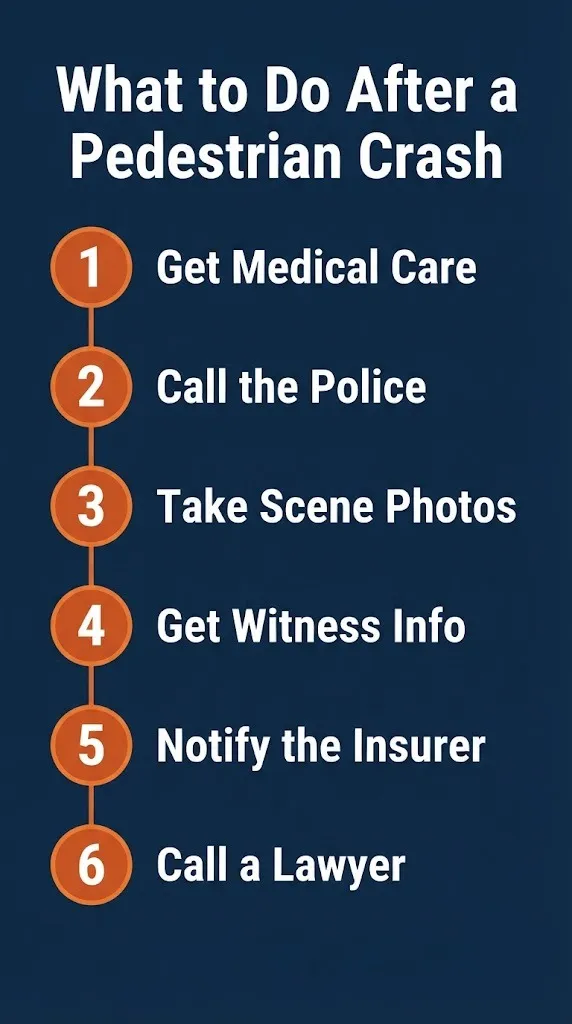
Here are the verified steps:
- Seek immediate medical care and follow every treatment recommendation.
- Report the crash to the police and obtain a copy of the report.
- Document the scene with photos if you are able.
- Gather witness names and contact information.
- Notify the driver’s insurance company of your claim.
- Keep a file of all medical bills, records, and wage loss statements.
- Consult a personal injury lawyer before accepting any settlement offer.
- File a lawsuit before the statute of limitations expires if no settlement is reached.
This is like a warranty claim on a major appliance. The sooner you document the problem, the stronger your position. Waiting weakens everything.
What does the driver’s insurance company owe the pedestrian?
The driver’s liability insurance covers your damages up to the policy limit. The minimum limits vary by state. Some states require as little as $15,000 per person. Others require $50,000 or more.
If the driver has a $25,000 policy and your damages are $100,000, the insurer will only pay $25,000. The rest would have to come from the driver personally, which is often impossible if the driver has limited assets.
That is why your own uninsured and underinsured motorist coverage matters. You buy that coverage for exactly this situation. It fills the gap when the at-fault driver’s policy is too small.
Check your own auto policy. Even though you were walking, your policy may cover you as a pedestrian. Many policies do.
What if the driver fled the scene?
A hit-and-run changes the insurance picture. You may not be able to identify the driver or their insurer. Your own uninsured motorist coverage becomes your primary source of recovery.
Uninsured motorist coverage applies when the at-fault driver is unknown or has no insurance. You file a claim with your own insurer. The process is different from a liability claim against another driver.
Your insurer will investigate the crash and evaluate your injuries. The claim proceeds like any other insurance claim, but the relationship is different. Your insurer is paying out of its own pocket, not defending a third party.
Should I accept the first settlement offer?
Almost never. The first offer is an opening number, not a final one. The insurance adjuster’s job is to close the claim for as little as possible.
Wait until you know the full extent of your injuries. Settling before you finish treatment is a mistake. You may discover long-term problems after you sign the release. The release ends your claim forever.
A personal injury lawyer can evaluate the offer against your actual damages. Most injury lawyers work on contingency. You pay nothing upfront. The lawyer only gets paid if you recover.
Key Takeaway: The insurance company wants speed. You want completeness. Those goals are in conflict.
How long does a pedestrian accident lawsuit take?
Most cases settle in 6 to 18 months. Cases that go to trial take 18 to 36 months or longer. The timeline depends on the severity of your injuries, the clarity of liability, and whether a lawsuit is filed.
Here is a typical timeline:
| Stage | Duration |
|---|---|
| Medical treatment | 1 to 6 months |
| Insurance claim and negotiation | 2 to 6 months |
| Lawsuit filing if no settlement | 6 to 12 months after crash |
| Discovery and depositions | 6 to 12 months |
| Trial or settlement | 12 to 24 months after filing |
You cannot rush the process. The insurance company will not pay serious money until it sees your full medical picture. Patience is part of the strategy.
What evidence matters most in a pedestrian accident case?
The police report is often the most important document. It establishes the facts, identifies witnesses, and may include the officer’s opinion about fault.
Medical records are equally important. They prove your injuries and connect them to the crash. Gaps in treatment can hurt your case. Follow your doctor’s instructions and keep every appointment.
Photographs help. Scene photos, vehicle damage photos, and injury photos all tell the story. Witness statements can confirm your version of events. Surveillance footage from nearby businesses may exist but must be requested quickly before it is overwritten.
What if the pedestrian was in a crosswalk?
A pedestrian in a marked crosswalk usually has the right of way. The driver must yield. If the driver hit you in a crosswalk, fault is often clear.
But the insurance company may still argue. It may claim you darted into traffic, crossed against the signal, or were not visible. The facts of your specific case matter.
The law is not automatic. Crosswalk laws vary by state and by local ordinance. In most places, drivers must exercise due care to avoid hitting pedestrians, even those outside a crosswalk. The exact rule depends on where you were hit.
Reality Check
No insurance company will text you a settlement offer. No legitimate adjuster asks for a gift card to release your funds. Pedestrian accident claims settle through documented negotiations, not phone promises. If someone pressures you to sign something you have not read, stop. That is the oldest trick in the book, and it works because people want the pain to be over.
What Happens Next
| Timeline | Expected Stage |
|---|---|
| Day 1 to 30 | Medical care, police report, photos, witness statements |
| Month 1 to 3 | Insurance claim filed, initial treatment documented |
| Month 3 to 6 | Demand letter sent, negotiations begin |
| Month 6 to 12 | Settlement reached or lawsuit considered |
| Month 12 to 24 | Litigation if no settlement, then trial or resolution |
These dates are estimates. Your case moves at the pace of your recovery and the insurer’s cooperation.
Frequently Asked Questions
Can I sue if I was hit by a car while walking?
Yes. Pedestrians have the right to sue negligent drivers for their injuries.
How much is a pedestrian accident lawsuit worth?
It depends on your medical bills, lost wages, pain, and the driver’s insurance limits.
What if I was partially at fault?
Most states reduce your recovery by your fault percentage. Some states bar recovery if your fault is too high.
How long do I have to file?
Most states give one to three years from the crash date.
What if the driver has no insurance?
Your uninsured motorist coverage may pay your claim.
Do I need a lawyer for a pedestrian accident?
Not for minor cases, but any serious injury benefits from legal representation.
What should I do right after a pedestrian accident?
Get medical care, call the police, take photos, and gather witness information.
Will my case go to trial?
Most pedestrian accident cases settle. Only a small percentage reach trial.
The Deadline Is the Only Enemy You Cannot Negotiate With
You can negotiate with an insurance adjuster. You can dispute a police report. You can gather more evidence. You cannot negotiate with the statute of limitations.
The deadline is fixed. It does not care about your recovery time or your good intentions. Mark the date. Work backward from it. Every step you take should move you toward resolving your case before that date arrives.