Workers Compensation Quote and Benefits Calculator: 2026 Guide
Quick Answer
- Workers compensation is a real, state-mandated insurance system covering work injuries, not a lawsuit settlement.
- Weekly benefits typically equal two-thirds of your average weekly wage, capped by state limits.
- Report your injury within 30 days in most states to protect your claim rights.
You got hurt at work. Now you’re trying to understand what your claim might pay. The search for a “workers compensation quote” leads to insurance premium sites, lawyer ads, and state benefit calculators that all seem to assume you already know how the system works.
Here’s what the verified data shows. Workers compensation is not a settlement you negotiate like a car accident claim. It’s a statutory benefit system with fixed formulas. Your weekly benefit amount is set by state law, not by what an insurance adjuster thinks your case is worth.
This article covers how workers compensation quotes actually work, what you may receive weekly, how settlements differ from ongoing benefits, and the deadlines that matter most. One surprising fact: most injured workers receive far less than they expect because they don’t understand how the formula applies to their specific wage history.
The Facts
| Case | Individual workers compensation claims, not a class action or lawsuit |
| Status | Ongoing system; claims filed daily through state agencies |
| Fund Size | No national fund; benefits paid by employer insurance or state funds |
| Est. Per Person | Typically two-thirds of average weekly wage, state-capped |
| Claim Deadline | 30 days to report injury in most states; 1 to 3 years to file |
| Administrator | State workers compensation board or commission |
| Proof Needed | Medical records, incident report, wage documentation, employer notice |
Is a Workers Compensation Quote Real?
Yes, but the term “workers compensation quote” usually refers to insurance premiums for employers, not benefit estimates for injured workers. If you’re an injured worker, what you actually need is a benefit calculation, not a quote.
Insurance companies use “workers compensation quote” to describe what they’d charge an employer for coverage. That’s a business transaction, not a benefit projection. Injured workers searching for a quote often land on the wrong pages.

Your benefit amount is not negotiable. It’s calculated by a formula set in state statute. The formula starts with your average weekly wage, usually calculated over the 13 or 52 weeks before your injury. Then the state applies a percentage, typically 66.67 percent, subject to a maximum weekly amount.
So the real question isn’t “what’s my quote.” It’s “what’s my average weekly wage, and what’s my state’s maximum weekly benefit.”
How Is a Workers Compensation Quote Calculated?
A workers compensation benefit calculation uses a three-part formula: average weekly wage, compensation rate, and state maximum. The average weekly wage is your gross earnings before taxes over a set period.
Most states calculate your average weekly wage from the 13 weeks, 26 weeks, or 52 weeks before your injury. That total is divided by the number of weeks to produce your average weekly wage. Overtime is often included, which can increase your benefit.
The compensation rate is typically two-thirds, or 66.67 percent, of your average weekly wage. Some states use 60 percent. Others use 70 percent. Check your state’s specific rate.
The state maximum caps the weekly benefit. If two-thirds of your wage exceeds the state’s maximum, you receive the maximum. For 2026, many states have maximum weekly benefits between $900 and $1,200, though some are higher.
| State Example | 2026 Max Weekly Benefit |
|---|---|
| California | Not yet confirmed |
| New York | Not yet confirmed |
| Texas | Not yet confirmed |
| Florida | Not yet confirmed |
| Pennsylvania | Not yet confirmed |
These figures require verification from state sources. Check your state’s workers compensation board for the current rate.
How Much Will I Get in Workers Compensation Weekly Benefits?
Your weekly benefit is typically two-thirds of your average weekly wage, subject to your state’s maximum. The exact amount depends on your wage history.
Let’s say you earned $1,000 per week before your injury. Two-thirds of that is $667 per week. If your state’s maximum is $1,200, you’d receive the full $667. If you earned $2,000 per week, two-thirds is $1,333, but the state cap would limit you to the maximum.
The calculation gets more complicated with irregular hours, multiple jobs, or seasonal work. Your average weekly wage may be calculated differently depending on your situation.
Taxes are another factor. Workers compensation benefits are generally not subject to federal income tax. That means $667 per week in workers compensation is worth more than $667 in taxable wages.
Key Takeaway: Your weekly benefit is a fixed formula based on your pre-injury wages, not a negotiation, and the state maximum caps what you can receive regardless of earnings.
What Is the Difference Between a Workers Compensation Quote and a Settlement?
A workers compensation quote, in the benefit context, is an estimate of your weekly benefit amount. A settlement is a lump sum agreement that closes your claim entirely.
Ongoing weekly benefits are temporary. They continue while you’re disabled and receiving medical treatment. A settlement, often called a compromise and release, pays a lump sum in exchange for ending your claim. You give up future benefits in return for immediate cash.
The choice between ongoing benefits and a settlement is significant. Ongoing benefits provide security if your condition worsens. A settlement provides certainty and immediate access to funds. But once you settle, you can’t reopen your claim.
Settlement amounts vary widely based on your injury, your expected future medical needs, and your state’s rules. A minor strain might settle for a few thousand dollars. A permanent disability might settle for six figures.
What Is the Deadline to Report a Work Injury?
The deadline to report a work injury is typically 30 days in most states, though some allow longer. Reporting means telling your employer, not necessarily filing a formal claim.
Here’s the sequence that matters.
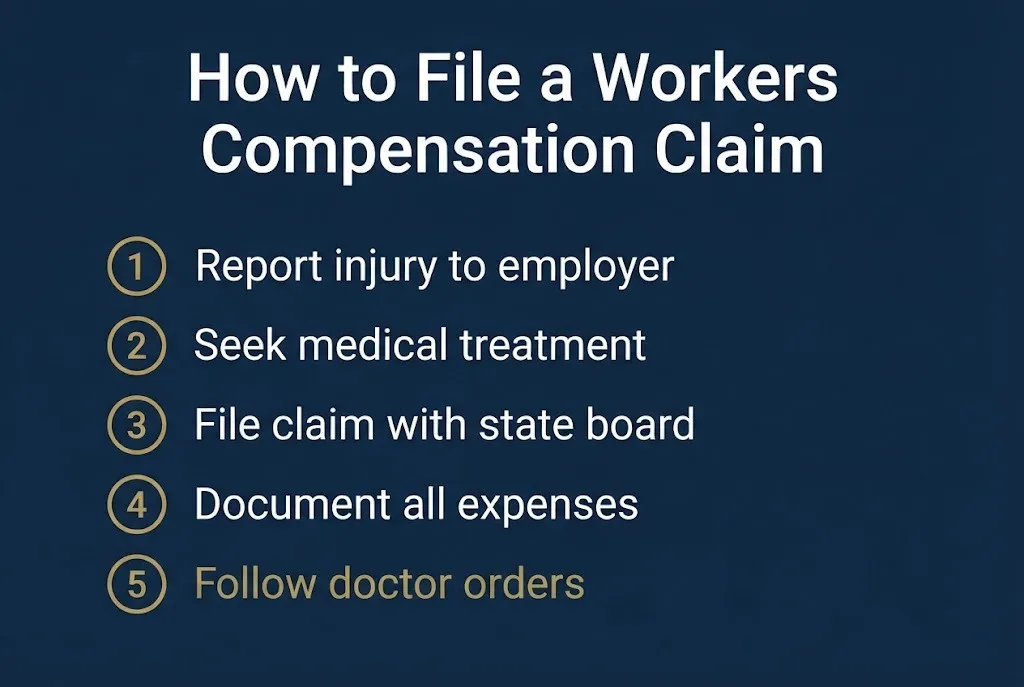
- Report the injury to your supervisor immediately, ideally in writing.
- Seek medical treatment from an approved provider if required.
- Complete an incident report or first report of injury form.
- File a formal claim with your state workers compensation board.
- Meet any state-specific deadlines for claim filing.
The 30-day reporting deadline is critical because late reporting gives the insurance company a reason to deny your claim. Even if your state allows longer, reporting immediately protects your rights.
Think of it like a store return without a receipt. The sooner you show up with documentation, the smoother the process goes. Delay creates suspicion and complications.
What Does Workers Compensation Cover?
Workers compensation covers medical treatment, a portion of lost wages, and certain other benefits depending on your state. The exact coverage varies.
- Medical care: all reasonable and necessary treatment for your work injury.
- Temporary disability: weekly payments while you’re unable to work.
- Permanent disability: compensation if your injury leaves lasting impairment.
- Vocational rehabilitation: job training if you can’t return to your old work.
- Mileage: reimbursement for travel to medical appointments.
- Death benefits: payments to dependents if a worker dies from a work injury.
The system is no-fault. You don’t have to prove your employer was negligent. You only need to show the injury happened at work or was caused by your work.
In exchange for that no-fault system, you generally give up the right to sue your employer. That’s the core trade of workers compensation.
Can I Sue My Employer Instead of Filing Workers Compensation?
In most cases, no. Workers compensation is an exclusive remedy, meaning you can’t sue your employer for a work injury except in limited circumstances.
The exceptions are narrow. You may be able to sue if your employer intentionally caused your injury, if the employer had no workers compensation insurance, or if a third party, not your employer, caused the injury.
Third-party claims are the most common exception. If you were injured by a defective machine, a negligent subcontractor, or a car accident while working, you may file a personal injury lawsuit against the third party while also receiving workers compensation benefits.
Those cases can produce larger recoveries because personal injury settlements include pain and suffering, which workers compensation does not. But they require proving fault, which workers compensation does not.
What If My Workers Compensation Claim Is Denied?
If your workers compensation claim is denied, you have the right to appeal. The process varies by state but typically involves a hearing before a workers compensation judge.
A denial doesn’t mean the fight is over. Insurance companies deny claims for many reasons: late reporting, disputes about whether the injury is work-related, pre-existing conditions, or insufficient medical evidence.
Here’s what to do after a denial.
- Read the denial letter carefully to identify the stated reason.
- Gather additional medical evidence supporting your claim.
- Request a hearing with your state workers compensation board.
- Consider hiring a workers compensation attorney.
- Meet all appeal deadlines, which are often short.
Many denied claims are later approved on appeal. The key is acting quickly and strengthening your medical evidence.
Key Takeaway: A workers compensation denial is not the end; it’s the start of an appeal process that many injured workers win with added evidence and legal help.
How Do I Get a Workers Compensation Quote for My Specific Injury?
You don’t get a quote for a specific injury. You get a benefit calculation based on your wages and your state’s formula. The injury type determines how long you receive benefits, not the weekly amount.
A minor sprain might keep you out of work for two weeks. A herniated disc might cause months of disability. The weekly benefit amount is the same. The duration changes.
The injury type does matter for permanent impairment ratings. If your injury leaves permanent restrictions, a doctor assigns an impairment rating. That rating determines any permanent disability award, which can be a lump sum or additional weekly payments.
So the right question isn’t “what’s the quote for a shoulder injury.” It’s “what’s my average weekly wage, and what’s my state’s maximum weekly benefit for temporary disability.”
What Is the Average Workers Compensation Settlement?
No single average workers compensation settlement exists because settlements depend on injury severity, state law, and future medical needs. But published patterns provide context.
Minor injuries with full recovery often settle for $5,000 to $20,000. Moderate injuries with some permanent impairment might settle for $20,000 to $75,000. Severe injuries, such as spinal cord damage or amputation, can settle for $150,000 to $500,000 or more.
These ranges reflect the value of future medical care and wage loss. A settlement is not a windfall. It’s a trade of future benefits for present cash.
The insurance company’s first offer is often low. Insurers know that injured workers facing financial pressure may accept less than the claim is worth. That’s why representation matters, especially for significant injuries.
How Does a Workers Compensation Settlement Work?
A workers compensation settlement, often called a compromise and release, is a lump sum payment that closes your claim permanently. You give up the right to future benefits in exchange for immediate cash.
The settlement must be approved by a workers compensation judge. The judge reviews the agreement to ensure it’s voluntary and reasonably fair. Once approved, the settlement is final.
Settlements are structured differently depending on your state and whether you have future medical needs. Some settlements include a medical set-aside, which is money reserved specifically for future medical care. Others close medical coverage entirely.
Here’s the key decision. If your injury is stable and you know your future needs, a settlement may make sense. If your condition could worsen, ongoing benefits provide more security.
What Should I Do Immediately After a Work Injury?
The first 24 to 48 hours after a work injury shape the entire claim. Here’s what to do.
- Report the injury to your supervisor immediately, in writing.
- Seek medical care from an approved provider if your state requires one.
- Describe the injury accurately to every medical provider.
- Take photos of the injury and the accident scene.
- Keep a copy of every form you sign.
- Note witness names and contact information.
- Track all mileage and out-of-pocket expenses.
- Don’t give a recorded statement to the insurance company without legal advice.
Insurance adjusters may call quickly, sometimes within days. Their job is to minimize the company’s payout. Anything you say can be used to reduce or deny your claim.
Reality Check: No one from a workers compensation board or insurance company will text you asking for your Social Security number. Legitimate claim communications come by mail or through your employer.
What Happens Next in a Workers Compensation Claim?
Week 1: Report the injury and seek medical care.
Week 2: File the formal claim with your state workers compensation board.
Month 1: Begin receiving temporary disability payments if approved.
Month 3: Medical treatment progresses; return-to-work evaluation occurs.
Month 6: If still disabled, permanent impairment evaluation may begin.
Year 1: Claim resolution through return to work, settlement, or ongoing benefits.
These timelines are typical but vary by state and injury severity.
Frequently Asked Questions
Is workers compensation taxable?
No. Workers compensation benefits are generally not subject to federal income tax.
State tax treatment follows the federal rule in most cases.
How long does a workers compensation claim take?
Simple claims with clear liability and minor injuries may resolve in weeks.
Disputed claims or serious injuries can take months or years.
Can I choose my own doctor for a work injury?
It depends on your state. Some states require using an employer-approved provider.
Others allow you to choose your own doctor after a certain period.
What if my employer doesn’t have workers compensation insurance?
Most states require employers to carry coverage, and uninsured employers face penalties.
You may still recover through a state uninsured employer fund.
Can I work another job while on workers compensation?
Usually no, if your doctor says you’re disabled from all work.
Light-duty restrictions may allow some work depending on your state.
What is a workers compensation quote for an employer?
It’s an insurance premium estimate based on payroll, industry classification, and claims history.
That’s different from an injured worker’s benefit calculation.
Do I need a lawyer for a workers compensation claim?
Not for simple claims, but serious injuries or denials often warrant representation.
Attorneys work on contingency, typically 15 to 25 percent in workers compensation.
What is the maximum workers compensation benefit in 2026?
Each state sets its own maximum weekly benefit, typically between $900 and $1,200.
Check your state’s workers compensation board for the current figure.
If you were injured at work, the most important deadline is the 30-day reporting window in most states. Missing it gives the insurance company grounds to deny your claim, even if your injury is real.
Report the injury, get medical care, and document everything. Then calculate your average weekly wage to understand what your benefit should be. The formula is fixed by law. Knowing it is your best protection.