How Much Is Workers Compensation Insurance in 2026: Cost Guide
Quick Answer
- Workers compensation insurance is a real, legally required coverage for most employers.
- Average costs run $0.75 to $2.50 per $100 of payroll, with high-risk trades far higher.
- Rates vary by state classification codes and your claims history.
You’re starting a business, hiring your first employee, or renewing a policy. Now you need to know what workers compensation insurance actually costs in 2026.
Here’s what the verified data shows. Workers compensation is priced per $100 of payroll, not as a flat fee. The rate depends on your industry classification code, your state’s rate structure, and your company’s claims history. A clerical worker might cost $0.25 per $100 of payroll. A roofer might cost $15 or more.
This article covers how rates actually work, what you’ll likely pay, how classification codes affect your premium, and what you can do to lower your costs. One surprising fact: many small businesses overpay because they’re misclassified, and fixing the classification can save hundreds or thousands annually.
The Facts
| Case | Not a lawsuit; insurance pricing and regulatory system |
| Status | Active market; rates filed with state regulators |
| Fund Size | Not applicable |
| Est. Per Person | $0.75 to $2.50 per $100 of payroll for most businesses |
| Claim Deadline | Not applicable |
| Administrator | State rating bureaus and private carriers |
| Proof Needed | Payroll records, employee classifications, claims history |
Is Workers Compensation Insurance Required?
Yes. Workers compensation insurance is legally required for most employers in nearly every U.S. state. The exact threshold varies by state, but if you have employees, you almost certainly need coverage.
The requirement exists to protect both workers and employers. Workers receive medical care and partial wage replacement after a work injury. Employers receive protection from lawsuits through the exclusive remedy doctrine.
Some states allow exemptions for very small businesses, sole proprietors, or certain agricultural workers. Texas is the notable exception: it doesn’t require private employers to carry workers compensation at all, though many choose to.
If you’re unsure whether you need coverage, check your state’s workers compensation board or division of insurance. The penalties for operating without required coverage can be steep.
How Is Workers Compensation Insurance Priced?
Workers compensation insurance is priced per $100 of payroll using a formula that multiplies your payroll by a classification rate and an experience modifier. The formula is set by state regulators and industry rating bureaus.
The classification code is the starting point. Every type of work has a four-digit code, such as 8810 for clerical workers or 5403 for carpentry. Each code carries a base rate that reflects the injury risk of that work type.
Your payroll is divided by 100 and multiplied by the base rate. If your clerical payroll is $100,000 and the clerical rate is $0.25 per $100, your base premium is $250.
The experience modifier then adjusts that base premium based on your claims history. A clean history lowers your premium. A history of frequent claims raises it.
Key Takeaway: Your premium is a formula, not a negotiation. Classification, payroll, and claims history determine your cost, not an insurance agent’s discretion.
What Is the Average Cost of Workers Compensation Insurance?
The average cost of workers compensation insurance varies too widely for a single meaningful number. Most small businesses in low-risk industries pay between $0.75 and $2.50 per $100 of payroll.
A business with $100,000 in clerical payroll might pay $250 to $500 per year. A landscaping company with the same payroll might pay $3,000 to $7,000. A roofing company with the same payroll might pay $15,000 to $30,000.
The difference is classification. High-risk work costs more because injuries are more frequent and more severe. That’s the entire pricing logic.
For a typical small business, the annual premium often ranges from $500 to $5,000, depending on payroll size and industry. But those figures are reference points, not quotes.
What Factors Affect Workers Compensation Insurance Prices?
Several verified factors affect your workers compensation insurance price. The most important is your industry classification code.
- Classification code: the risk level of your specific work type.
- Payroll size: more payroll means more premium, simple math.
- Experience modifier: your claims history compared to similar businesses.
- State rate structure: each state sets its own base rates.
- Premium discounts: safety programs, drug-free workplace credits, and small business credits.
The classification code is fixed by your actual work activities, not by what you’d prefer. Misclassification, whether intentional or accidental, is a common cause of premium errors. If you’re classified as a higher-risk code than your work warrants, you’re overpaying.
How Do Classification Codes Affect Workers Compensation Costs?
Classification codes are the single largest factor in your workers compensation premium. Each code represents a specific type of work and carries a rate based on that work’s injury history.
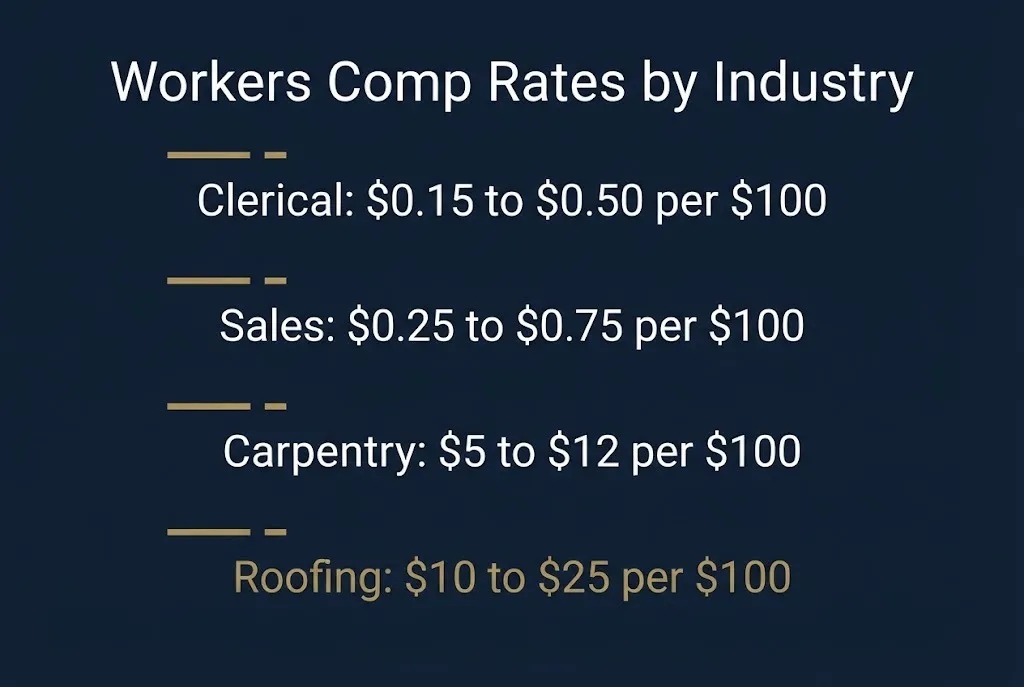
Here’s how different codes compare per $100 of payroll in a typical state.
| Classification | Work Type | Typical Rate Range |
|---|---|---|
| 8810 | Clerical office | $0.15 to $0.50 |
| 8742 | Sales, outside | $0.25 to $0.75 |
| 5403 | Carpentry | $5 to $12 |
| 5551 | Roofing | $10 to $25 |
| 3632 | Machine shop | $2 to $6 |
These ranges reflect general rate patterns, not specific state rates. Your actual rate depends on your state’s filing and your claims history.
If your business does multiple types of work, each type gets its own code and rate. A contractor who does both carpentry and office work pays different rates for each payroll segment.
What Is an Experience Modification Rate?
The experience modification rate, often called an ex-mod or e-mod, is a multiplier that adjusts your premium based on your company’s claims history compared to other businesses in your industry.
A mod of 1.0 means your claims history is average. A mod of 0.8 means your history is better than average, so you pay 20 percent less. A mod of 1.3 means your history is worse than average, so you pay 30 percent more.
The mod applies to your entire premium, not just one classification. A high mod can add thousands to your annual cost. A low mod can save you thousands.
Small businesses often start with a mod of 1.0 and earn lower mods through safety improvements and clean claims histories. That’s the incentive the system creates.
Key Takeaway: Your claims history, expressed through your experience modifier, can swing your premium by 20 to 50 percent or more in either direction.
How Do I Get a Workers Compensation Insurance Quote?
Getting a workers compensation insurance quote requires accurate payroll figures, correct classification codes, and your recent claims history. Here’s the process.
- Gather your payroll records for the past 12 months.
- Identify your correct classification codes by work type.
- Collect your loss runs, which are your claims history reports.
- Contact multiple insurance carriers or a broker.
- Provide the same information to each for comparable quotes.
- Review the quotes for classification accuracy.
- Ask about discounts for safety programs or drug-free workplace policies.
Don’t accept a quote without checking the classification. An agent who classifies you incorrectly may quote you a lower premium now, but you’ll face an audit adjustment later that could cost far more.
What Is a Workers Compensation Audit?
A workers compensation audit is a review of your actual payroll and classifications after your policy period ends. Insurers audit policies because premiums are initially based on estimates.
The audit compares your estimated payroll to your actual payroll. If you paid based on $100,000 of payroll but actually had $150,000, you’ll owe additional premium. If the reverse is true, you’ll receive a refund.
Classification errors also surface during audits. If the auditor finds that some of your employees were misclassified, your premium adjusts accordingly.
Audits are a common source of surprise bills for small businesses. The best way to avoid surprises is accurate reporting from day one.
Reality Check: No legitimate insurance provider quotes you a premium by text message or social media ad. Real quotes come through licensed agents or directly from insurance carriers, always in writing, always after reviewing your payroll and classifications.
What Does Workers Compensation Insurance Cover?
Workers compensation insurance covers the costs of work-related injuries and illnesses. The coverage is defined by state law, not by the insurance policy’s marketing language.
- Medical treatment: all reasonable and necessary care for the work injury.
- Temporary disability: partial wage replacement while the worker cannot work.
- Permanent disability: compensation for lasting impairment.
- Vocational rehabilitation: retraining if the worker cannot return to their old job.
- Death benefits: payments to dependents if a worker dies from a work injury.
- Employer liability: legal defense if a worker sues despite the exclusive remedy rule.
The policy does not cover injuries that happen outside work, intentional self-harm, or injuries caused by intoxication. Those exclusions are standard.
How Much Does Workers Compensation Insurance Cost for Small Business?
Small businesses in low-risk industries typically pay between $500 and $3,000 per year for workers compensation insurance. The exact figure depends on payroll size, classification, and state.
A one-person consulting firm with $50,000 in clerical payroll might pay under $200 per year. A small landscaping company with three employees and $150,000 in payroll might pay $5,000 to $10,000.
The payroll dollar amount matters more than the number of employees. Two workers earning $75,000 each generate the same premium as three workers earning $50,000 each, assuming the same classification.
If you’re a small business owner, ask about small business credits. Many states and carriers offer discounts for businesses under a certain premium threshold.
How Does State Affect Workers Compensation Insurance Prices?
Workers compensation insurance prices vary significantly by state because each state sets its own rate structure and benefit levels. A roofer in California may pay a different rate than a roofer in Florida.
Some states, like California and New York, have relatively high workers compensation costs due to higher benefit levels and medical costs. Other states, like Indiana and Virginia, have lower costs due to different regulatory structures.
Monopolistic states, including Ohio, Washington, Wyoming, and North Dakota, operate state-run workers compensation funds rather than private insurance markets. In those states, you buy coverage from the state, not from private carriers.
The state where your employees work, not where your business is headquartered, controls the rate. If you have employees in multiple states, you need coverage in each.
Can I Lower My Workers Compensation Insurance Costs?
Yes. Several verified strategies can lower your workers compensation premium without cutting coverage.
- Maintain a clean claims history to improve your experience modifier.
- Implement a safety program and document it.
- Enroll in a drug-free workplace program if your state offers a credit.
- Verify your classification codes are correct.
- Report payroll accurately to avoid audit surprises.
- Shop quotes through multiple carriers or a broker.
- Ask about premium discounts for small businesses or new ventures.
The most effective long-term strategy is claims prevention. Every avoided injury keeps your mod low and your premium down. Safety isn’t just good for your workers. It’s good for your insurance bill.
Key Takeaway: The fastest way to lower your premium is to check your classification codes, because misclassification is the most common source of overpayment.
What Happens If I Don’t Carry Workers Compensation Insurance?
If you don’t carry required workers compensation insurance, the consequences can be severe and immediate.
- Fines from your state workers compensation board.
- Stop-work orders that shut down your business.
- Personal liability for a worker’s injury costs.
- Criminal penalties in some states for willful noncompliance.
- Inability to bid on contracts that require proof of coverage.
- Higher premiums if you later obtain coverage because of the gap.
The penalties vary by state, but the pattern is consistent. Operating without coverage is a serious violation with serious consequences.
Frequently Asked Questions
Is workers compensation insurance tax deductible?
Yes. Workers compensation premiums are a deductible business expense.
The deduction applies in the year the premium is paid.
How is workers compensation premium calculated?
It’s calculated by multiplying your payroll by your classification rate, then applying your experience modifier.
The formula uses payroll per $100 of payroll.
What is the cheapest workers compensation insurance?
The cheapest coverage depends on your classification and state.
Clerical businesses in low-cost states typically pay the least.
Do I need workers compensation for part-time employees?
Yes in most states. Part-time employees are covered the same as full-time employees.
The premium is based on their payroll, not their hours.
Can I buy workers compensation insurance online?
Yes. Many carriers and brokers offer online quotes and policies.
But you’ll still need accurate payroll and classification information.
What is a workers compensation classification code?
It’s a four-digit code that identifies the type of work your employees perform.
Each code has a rate based on the injury risk of that work type.
How often do workers compensation rates change?
Rates can change annually when state regulators approve new rate filings.
Your premium also changes when your payroll or claims history changes.
Is workers compensation required for independent contractors?
Usually no, but misclassification of contractors is a common audit issue.
If a contractor is actually an employee under state law, you owe premium for them.
If you’re pricing workers compensation insurance for 2026, the most important number is your correct classification code. That single factor determines your rate more than anything else.
Get quotes from multiple sources, verify your classifications, and invest in safety. The system rewards clean histories and accurate reporting. And if a quote seems too low, check the classification. An audit surprise later is always more expensive than the right premium now.