Qui Tam Lawsuit 2026: What Whistleblowers Need to Know Before Filing
Quick Answer
- A qui tam lawsuit lets a private whistleblower sue on behalf of the government to recover fraud losses.
- Whistleblowers may receive 15 to 30 percent of the recovered amount if the government joins and wins.
- The False Claims Act requires filing under seal, and the government gets at least 60 days to investigate.
A qui tam lawsuit is not a class action. It is a whistleblower claim filed by a private person on behalf of the government.
The term comes from a Latin phrase meaning “he who sues for the king as well as for himself.” In modern practice, it means you sue a company or person for defrauding the government, and you share in any recovery.
The federal False Claims Act is the main qui tam law. It covers Medicare fraud, defense contractor fraud, pandemic relief fraud, and any scheme that takes money from federal programs.
This article explains how qui tam works, who can file, what whistleblowers can expect, the risks, and the timeline from filing to potential payout.
The Facts
| Item | Details |
|---|---|
| Primary Law | False Claims Act (31 U.S.C. 3729) |
| Whistleblower Share | 15 to 30 percent |
| Sealed Filing Period | At least 60 days |
| Typical Case Duration | 2 to 5 years |
| Retaliation Protection | Yes, under FCA |
| 2026 Legislative Change | None confirmed |
What Is a Qui Tam Lawsuit?
A qui tam lawsuit is a legal action where a private citizen sues on behalf of the government to recover money lost to fraud.
The whistleblower is called the “relator.” The relator files the case under seal, which means it is hidden from the public while the government investigates.
If the government decides the case has merit, it can intervene and take over the prosecution. If the government declines, the relator may still pursue the case on their own.
The False Claims Act authorizes this mechanism. It was signed by Abraham Lincoln in 1863 to stop Civil War contractors from selling defective goods to the Union Army.
How Much Money Can a Qui Tam Whistleblower Receive?
A qui tam whistleblower can receive between 15 and 30 percent of the government’s total recovery.
The exact percentage depends on whether the government intervenes. If the government takes over the case, the whistleblower’s share is usually 15 to 25 percent. If the whistleblower proceeds alone and wins, the share can be 25 to 30 percent.
Here is how the math works on a $10 million recovery:
| Scenario | Whistleblower Share | Amount |
|---|---|---|
| Government intervenes, lower share | 15 percent | $1.5 million |
| Government intervenes, higher share | 25 percent | $2.5 million |
| Relator proceeds alone | 30 percent | $3.0 million |
The whistleblower may also recover attorney fees and costs from the defendant.
Key Takeaway: The whistleblower share is a percentage of the government’s recovery, not a fixed fee. Bigger recoveries mean bigger awards.
What Are the Largest Qui Tam Settlements in Recent Years?
Qui tam settlements regularly reach hundreds of millions of dollars. The largest recoveries come from healthcare fraud, pharmaceutical kickbacks, and defense contractor schemes.
Here are examples of major False Claims Act recoveries reported by the Department of Justice:
| Year | Industry | Recovery Amount |
|---|---|---|
| 2024 | Healthcare | Over $1 billion (multiple cases) |
| 2023 | Pharmaceutical | $900 million (single case) |
| 2022 | Defense contracting | $300 million (multiple cases) |
| 2021 | COVID relief fraud | Over $1 billion (multiple cases) |
These figures represent total government recoveries, not whistleblower awards. The relator’s share comes out of those totals.
Who Can File a Qui Tam Lawsuit?
Any person with direct, non-public knowledge of fraud against the government may file a qui tam lawsuit.
You do not need to be an employee of the company committing fraud. You can be a competitor, a contractor, a patient, or anyone who discovered the fraud through their own investigation.
Here is what you need to file:
- Specific facts showing fraud against a government program.
- Evidence that is not already public knowledge.
- A lawyer experienced in False Claims Act litigation.
- Willingness to remain quiet while the case is under seal.
- Patience for a process that may take years.
The “original source” rule matters. If the government already knows about the fraud from public disclosures, you may not qualify as the whistleblower.
What Types of Fraud Qualify for a Qui Tam Case?
Qui tam cases cover any scheme that defrauds the federal government or state government programs.
The most common categories are healthcare fraud, government contracting fraud, and grant fraud. Recent years have added pandemic relief fraud as a major category.
Here are the main types:
| Fraud Type | Examples |
|---|---|
| Healthcare | Billing for services not provided, kickbacks |
| Pharmaceutical | Off-label marketing, false pricing |
| Defense | Overbilling, defective products |
| COVID relief | False loan applications, misuse of PPP funds |
| Grants | Falsified research, misused funds |
| Housing | False certifications, subsidy fraud |
Key Takeaway: If the scheme takes money from a government program, it likely qualifies for a qui tam case.
How Do I File a Qui Tam Lawsuit?
Filing a qui tam lawsuit is not a do-it-yourself process. You need an experienced False Claims Act attorney.
The attorney drafts a complaint and files it under seal in federal court. The government receives a copy, but the defendant does not know the case exists during the initial seal period.
Here is the filing process:
- Gather documents, emails, and records showing the fraud.
- Hire a lawyer who specializes in False Claims Act cases.
- Your lawyer drafts a detailed complaint.
- The complaint is filed under seal in federal court.
- The government receives the complaint and a disclosure statement.
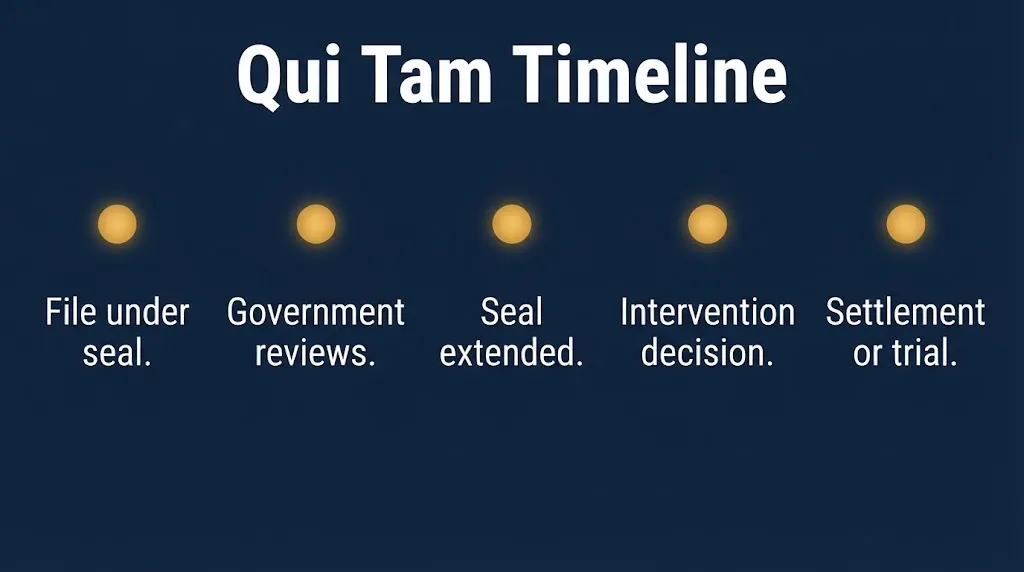
- The government investigates for at least 60 days.
- The seal is often extended for months or years.
- The government decides to intervene or decline.
Reality Check: No legitimate qui tam lawyer asks for money upfront. False Claims Act attorneys work on contingency and only get paid if you win.
What Happens After I File a Qui Tam Lawsuit?
After filing, the case sits under seal while the government investigates. You cannot discuss the case with anyone except your lawyer.
The government may ask for extensions of the seal period. Those extensions can stretch the investigation to a year or more.
Here is the typical timeline:
| Stage | Timing |
|---|---|
| Filing under seal | Day 0 |
| Initial seal period | 60 days |
| Seal extensions | 6 months to 2 years |
| Government intervention decision | Varies widely |
| If government intervenes | It takes over the case |
| If government declines | Relator may proceed alone |
| Settlement or trial | 2 to 5 years total |
Can I Be Fired for Filing a Qui Tam Lawsuit?
The False Claims Act protects whistleblowers from retaliation.
If your employer fires, demotes, suspends, or harasses you for filing a qui tam case, you may have a separate retaliation claim.
The retaliation claim can recover double back pay, reinstatement, and attorney fees. It is filed in addition to the qui tam case.
Here is what the retaliation protection covers:
| Protected Action | Employer Response That Violates |
|---|---|
| Filing a qui tam case | Termination |
| Cooperating with the government | Demotion or pay cut |
| Refusing to participate in fraud | Harassment or threats |
What Is the Deadline to File a Qui Tam Lawsuit?
The False Claims Act has two possible deadlines, whichever is later: six years from the fraud, or three years after the government knew or should have known about the fraud.
The absolute maximum under the statute is ten years from the fraud.
Here is how the deadlines work:
| Trigger | Deadline |
|---|---|
| Date of fraud | 6 years from that date |
| Government knowledge | 3 years from when it knew |
| Absolute maximum | 10 years from fraud |
Missing the deadline bars the case. Courts take this strictly.
What Is the Difference Between a Qui Tam Case and a Class Action?
A qui tam lawsuit is filed on behalf of the government, not on behalf of a class of consumers.
A class action represents many individuals with similar claims. A qui tam case represents the government’s interest in recovering fraud losses.
Here is the comparison:
| Feature | Qui Tam | Class Action |
|---|---|---|
| Plaintiff | Private relator | Class representative |
| Beneficiary | The government | Class members |
| Recovery | Government gets most | Class members split |
| Whistleblower share | 15 to 30 percent | Class rep award only |
| Sealed filing | Yes | No |
Key Takeaway: Qui tam cases pay the government, not consumers. Class actions pay consumers, not the government. They serve different purposes.
What Happens Next
Expected 2026: False Claims Act enforcement continues at current levels, with healthcare fraud remaining the top category.
Ongoing: The Department of Justice reports recoveries annually. The 2026 report will arrive early in 2027.
Your move: If you have evidence of government fraud, consult a False Claims Act attorney before telling anyone else.
Critical warning: Do not share your evidence with anyone except your lawyer. Public disclosure can destroy the case.
Qui tam lawsuits are powerful tools for recovering government money. They pay whistleblowers real money for real fraud.
But they are also slow, secretive, and demanding. You need evidence, patience, and an experienced lawyer.
The False Claims Act has not changed in 2026. The rules are stable. If you have a case, the clock is ticking.