Workers Compensation Insurance Carriers 2026: How They Work, How to Find Yours, and How to Fight a Denial
Quick Answer
- Workers compensation insurance carriers are private companies or state funds that pay benefits to injured workers.
- Your employer’s carrier, not your employer directly, pays your medical bills and wage replacement.
- You can find your employer’s carrier by checking workplace posters or asking your HR department.
Workers compensation insurance carriers are the companies that actually pay when you get hurt on the job.
Your employer buys a policy from a carrier. That carrier then pays your medical bills, your weekly benefits, and any settlement you eventually receive.
Most states require employers to carry workers compensation insurance. The carrier can be a private company, a state-run fund, or a self-insured employer.
This article explains how carriers work, how to find yours, what they owe you, and how to push back when a carrier denies your claim.
The Facts
| Item | Details |
|---|---|
| System | State-regulated insurance |
| Payers | Private carriers, state funds, self-insured employers |
| Benefit Rate | Usually 66.67% of average weekly wage |
| Denial Rate | Varies by state and injury type |
| Appeals | Through state workers compensation board |
| 2026 Changes | None confirmed federally |
What Is a Workers Compensation Insurance Carrier?
A workers compensation insurance carrier is a company that provides workers compensation coverage to employers.
When you are injured at work, the carrier pays your benefits. That includes medical treatment, wage replacement, and permanent disability awards.

The carrier is not your employer. It is a separate company with its own adjusters, attorneys, and financial interests.
Here are the main types of carriers:
| Carrier Type | Description |
|---|---|
| Private insurer | Commercial company like Travelers or Liberty Mutual |
| State fund | State-run insurance pool, common in monopolistic states |
| Self-insured employer | Large employer that pays claims directly |
| Assigned risk pool | High-risk employers placed with a carrier |
How Do I Find Out My Employer’s Workers Compensation Insurance Carrier?
You have a legal right to know which carrier covers your employer.
The easiest way is to ask your employer directly. Most states require employers to post workers compensation information in the workplace.
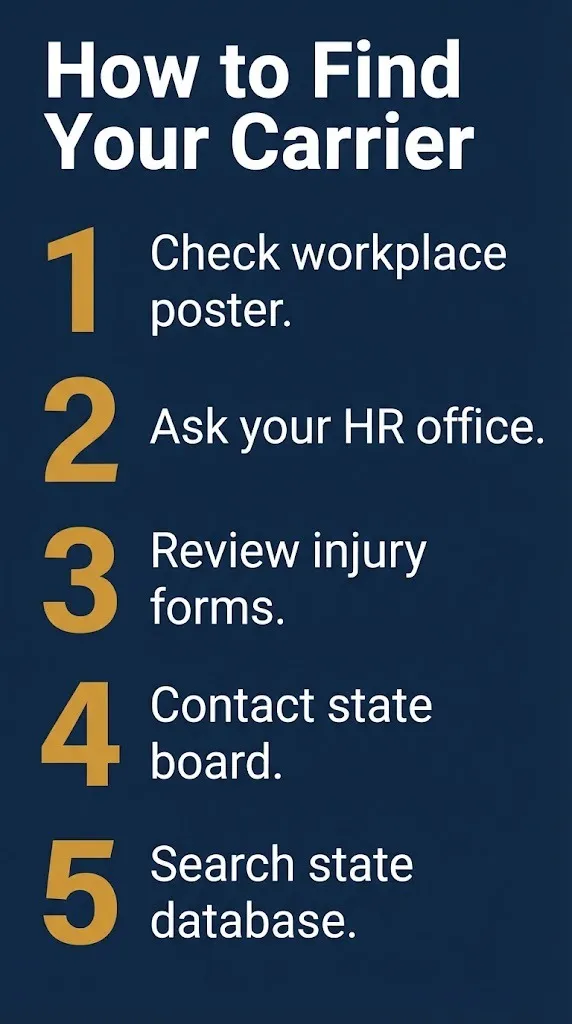
Here is how to find the carrier:
- Check the workplace poster required by your state.
- Ask your HR department or manager.
- Look for the carrier name on any injury report forms.
- Contact your state workers compensation board for help.
- Check your state’s online employer coverage database.
Key Takeaway: Your employer must tell you which carrier covers their workers compensation. Refusing to provide that information is a red flag.
What Does a Workers Compensation Carrier Owe an Injured Worker?
The carrier owes you medical care, wage replacement, and permanent disability benefits if your injury qualifies.
Medical care covers doctor visits, surgery, medication, physical therapy, and medical equipment. The carrier must pay for all reasonable and necessary treatment.
Wage replacement is usually two-thirds of your average weekly wage, up to a state maximum. Benefits start after a short waiting period.
Here is the breakdown:
| Benefit Type | What It Covers |
|---|---|
| Medical | Doctor visits, surgery, medication, therapy |
| Temporary disability | Wage replacement while you recover |
| Permanent disability | Compensation for lasting impairment |
| Vocational rehab | Job retraining if you cannot return |
| Death benefits | Paid to dependents of a deceased worker |
Why Do Workers Compensation Carriers Deny Claims?
Carriers deny claims for several reasons. The most common is a dispute over whether the injury happened at work.
Other denials come from missed deadlines, pre-existing condition arguments, or disagreements about medical necessity.
Here are the top reasons claims get denied:
| Denial Reason | What It Means |
|---|---|
| Injury not work-related | Carrier says it happened outside work |
| Late reporting | You missed the state deadline |
| Pre-existing condition | Carrier blames an old injury |
| No medical evidence | Doctor did not link injury to work |
| Intoxication | Carrier claims you were impaired |
Reality Check: A denial is not the end. Every state gives you the right to appeal a workers compensation denial through the state board or commission.
How Do I Appeal a Workers Compensation Carrier Denial?
You appeal by filing a claim petition or request for hearing with your state workers compensation board.
The process varies by state, but the basic steps are the same everywhere. You file a form, the board schedules a hearing, and a judge or commissioner decides.
Here is the appeal process:
- Receive the carrier’s denial letter in writing.
- Note the deadline to appeal, usually 30 to 90 days.
- File the appeal form with your state board.
- Gather medical records and witness statements.
- Attend the hearing with or without an attorney.
- Present evidence that your injury is work-related.
- Wait for the judge’s written decision.
- Appeal further if you disagree with the outcome.
How Much Does a Workers Compensation Carrier Pay?
The carrier pays a percentage of your average weekly wage, not your full salary.
The exact percentage varies by state, but two-thirds is the most common rate. Some states use 60 percent or 70 percent.
Here is how the math works on a $900 weekly wage:
| Calculation | Amount |
|---|---|
| Average weekly wage | $900 |
| Compensation rate (66.67%) | $600 |
| State maximum check | Varies |
| Weekly benefit paid | $600 (if below maximum) |
Benefits are tax-free. That means $600 in workers compensation is roughly equal to $750 in taxable wages.
What Is the Difference Between a Workers Compensation Carrier and an Agency?
A carrier is the insurance company that pays claims. An agency is a business that sells insurance policies.
The agency works with employers to find coverage. The carrier underwrites the policy and handles claims.
Here is the distinction:
| Entity | Role |
|---|---|
| Carrier | Pays claims, manages benefits |
| Agency | Sells policies to employers |
| Third-party administrator | Handles claims for self-insured employers |
| State board | Regulates the system, hears disputes |
Can I Sue the Workers Compensation Carrier Directly?
No, in most cases. Workers compensation is a no-fault system. You cannot sue the carrier for your work injury.
The trade-off is that you do not need to prove your employer was negligent. You get benefits regardless of fault, but you give up the right to sue.
There are narrow exceptions. If the carrier acts in bad faith or violates state law, a separate claim may exist.
Here are the rare exceptions:
| Exception | When It Applies |
|---|---|
| Bad faith | Carrier deliberately delays or denies valid claims |
| Third-party injury | Someone other than your employer caused the injury |
| Uninsured employer | Employer had no coverage, state fund may step in |
What Is a Third-Party Administrator in Workers Compensation?
A third-party administrator, or TPA, handles claims for self-insured employers or insurance carriers.
The TPA processes claims, pays bills, and manages the day-to-day work. The employer or carrier funds the payments.
When you call the number on your workers compensation paperwork, you may be talking to a TPA, not the carrier itself.
Here is how the roles break down:
| Entity | Function |
|---|---|
| Carrier | Underwrites risk, pays large claims |
| TPA | Handles day-to-day claims work |
| Adjuster | Investigates and values your claim |
| Nurse case manager | Coordinates medical care |
What Happens Next
Expected 2026: No federal changes to workers compensation carrier rules are pending.
Ongoing: State regulators continue overseeing carrier practices and claim timelines.
Your move: If your claim is denied, file an appeal before your state’s deadline. Do not wait.
Key document: Get the carrier’s denial in writing. That letter starts your appeal clock.
Workers compensation carriers are not your enemy and not your friend. They are insurance companies with a financial interest in paying as little as possible.
Your job is to know your rights, document your injury, and push back when a denial is wrong.
The system is state-run, the rules are specific, and the deadlines are real. Miss a deadline and you lose, no matter how valid your claim.