Workers Compensation Insurance New Hampshire 2026: Requirements, Benefits, and Claim Rules
Quick Answer:
- New Hampshire mandates workers compensation coverage for nearly all employers, even those with a single part-time worker.
- Injured workers receive about 60 percent of their average weekly wage, subject to a state maximum.
- You must report a work injury to your employer within 2 years to preserve your New Hampshire claim.
You work in New Hampshire. You got hurt on the job. Now you need to know whether your employer even has coverage, what the insurance pays, and how fast you need to act.
The short answer: New Hampshire takes workers compensation seriously. The state requires almost every employer to carry it. But the benefits are modest, and the deadlines are strict.
This article covers New Hampshire workers compensation in detail for 2026. You will learn who must carry coverage, what benefits look like, how to file a claim, and where the system bends against you.
The most surprising verified fact: New Hampshire lets employers opt out only in very limited cases, unlike neighboring states with looser rules. Most Granite State workers are covered by law from day one.
The Facts
| Detail | Verified Information |
|---|---|
| System | New Hampshire workers compensation insurance |
| Governing Agency | New Hampshire Department of Labor |
| Coverage Requirement | Most employers with any employees |
| Typical Wage Replacement | 60 percent of average weekly wage |
| Reporting Deadline | 2 years from injury date |
| Claim Filing | Through employer and insurance carrier |
| Proof Needed | Medical records, incident report, wage records |
Is workers compensation required in New Hampshire?
Yes, New Hampshire law requires nearly all employers to carry workers compensation insurance.
The rule is broader than many states. If you have one or more employees, full-time or part-time, you generally need coverage. That includes family members working in a family business in some situations.
The requirement comes from New Hampshire Revised Statutes Annotated Chapter 281-A. It applies to private employers, most public employers, and many nonprofit organizations.
There are narrow exceptions. Sole proprietors and some corporate officers can exempt themselves. Certain agricultural employers have different rules. But the default rule is coverage.
The New Hampshire Department of Labor enforces this. Employers who fail to carry required coverage face fines and can be held personally liable for work injury costs.
What is workers compensation coverage in New Hampshire?
Workers compensation coverage in New Hampshire pays for medical treatment and partial lost wages after a work injury or occupational illness.
The coverage is no-fault. You do not need to prove your employer was negligent. You only need to show the injury arose out of and in the course of your employment.
Here is what standard New Hampshire workers compensation covers:
| Covered Benefit | What It Pays |
|---|---|
| Medical treatment | Doctor visits, surgery, medication, therapy |
| Temporary total disability | About 60 percent of wages while fully out of work |
| Temporary partial disability | A portion of lost earnings while on light duty |
| Permanent impairment | Scheduled benefits based on body part and severity |
| Vocational rehabilitation | Job retraining if you cannot return to your old role |
| Death benefits | Payments to surviving dependents |
The state sets maximum and minimum weekly benefit amounts. Those figures adjust each year based on the state average weekly wage.
What is workers compensation insurance New Hampshire employers buy?
Workers compensation insurance in New Hampshire is a policy employers purchase from a private insurer or through a self-insurance arrangement.
Most employers buy coverage through the voluntary market. Insurance carriers licensed in New Hampshire write the policies. Premiums depend on the employer’s industry, payroll size, and claims history.
Some employers obtain coverage through an assigned risk pool if they cannot find a carrier willing to insure them. The New Hampshire Insurance Department oversees the market.
The key point for injured workers: the insurance company is the one paying your benefits. Your employer reports the injury. The carrier investigates and decides whether to accept or deny the claim.
That means you are dealing with a for-profit insurance company, not a state agency. The insurer has a financial incentive to minimize payouts. Document everything.
Key Takeaway: New Hampshire employers must carry coverage, but the claims process is run by private insurance companies with their own financial interests.
How much does New Hampshire workers compensation pay per week?
New Hampshire workers compensation pays about 60 percent of your average weekly wage, subject to a state maximum and minimum.
The exact rate is set by state law. The 60 percent figure is lower than the national typical rate of about two-thirds. That makes New Hampshire one of the less generous states for wage replacement.
Here is how the calculation works in practice:
| Pre-Injury Weekly Wage | 60 Percent Rate | State Maximum | Actual Weekly Benefit |
|---|---|---|---|
| $600 | $360 | Varies annually | $360 |
| $1,000 | $600 | Varies annually | $600 or capped amount |
| $2,000 | $1,200 | Varies annually | Capped amount |
The state maximum adjusts each year. You should verify the current figure with the New Hampshire Department of Labor before calculating your expected benefit.
How much does workers compensation pay in New Hampshire in 2026?
The 2026 New Hampshire workers compensation benefit rates follow the state formula of 60 percent wage replacement with annual adjustments.
The New Hampshire Department of Labor publishes updated benefit rates each year. The maximum weekly benefit changes based on the state average weekly wage.
The payment structure includes several tiers depending on your situation:
| Payment Type | When It Applies |
|---|---|
| Temporary total disability | You cannot work at all |
| Temporary partial disability | You work reduced hours or lighter duty |
| Permanent partial disability | You reached maximum medical improvement with lasting impairment |
| Permanent total disability | You can never return to any work |
| Death benefits | Paid to surviving dependents |
The duration of temporary benefits can extend for years in some cases, but permanent partial disability benefits use a schedule based on the body part injured.
Reality Check
New Hampshire’s 60 percent wage replacement rate is below the national average of about two-thirds. That means a New Hampshire worker injured on the job takes a larger financial hit than workers in most other states. The insurance company knows this. Denials and delays are common. Treat every interaction with the insurer as an adversarial process and document everything.
How do I file a workers compensation claim in New Hampshire?
Filing a workers compensation claim in New Hampshire requires prompt reporting to your employer and follow-through with medical documentation.
The process has specific steps. Missing one can delay your benefits or create grounds for denial.
Here is the sequence:
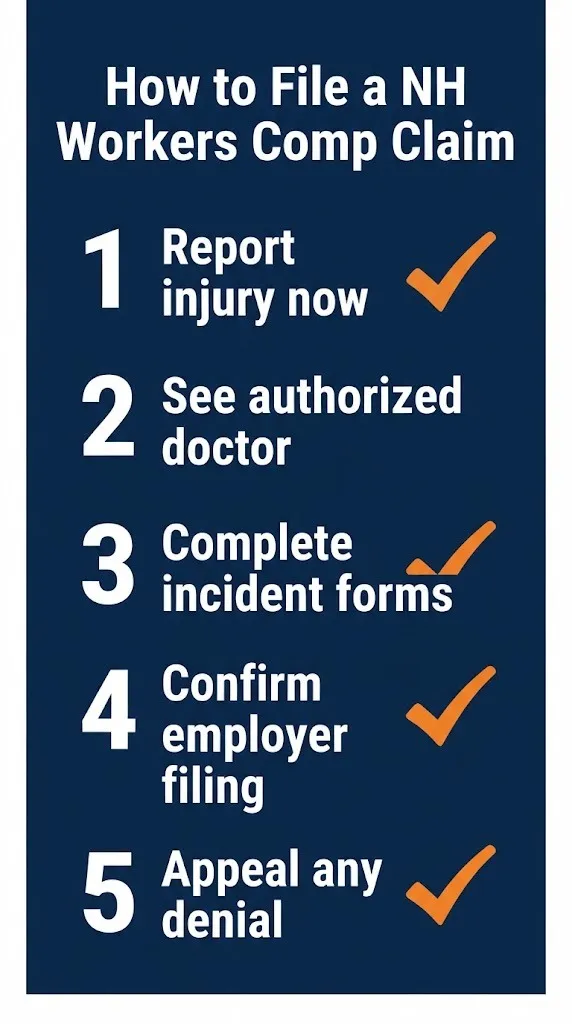
- Report the injury to your employer immediately, preferably in writing.
- Seek medical treatment and tell the provider it was a work injury.
- Complete any employer-provided incident report forms.
- Confirm your employer has filed the claim with their insurance carrier.
- Follow all treatment recommendations from the authorized medical provider.
- Keep copies of every medical record, bill, and wage statement.
- Track all deadlines and respond to any insurer requests promptly.
- Contact the New Hampshire Department of Labor if the insurer denies or ignores your claim.
The reporting deadline is generous compared to many states. You have 2 years from the date of injury to file a claim. But waiting that long is never wise. Evidence disappears. Witnesses forget. Insurers get suspicious.
What is the deadline to report a work injury in New Hampshire?
You have 2 years from the date of injury to file a workers compensation claim in New Hampshire.
That is longer than many states. Some states require notice within 30 days. New Hampshire gives you a two-year window to file the formal claim.
But the practical deadline is much shorter. Here is why:
| Deadline | What It Means |
|---|---|
| Immediate reporting | Strongest position for your claim |
| 2 years from injury | Legal deadline to file |
| After 2 years | Claim is barred, with narrow exceptions |
The legal deadline is the floor, not the ceiling. Reporting immediately gives you the best chance of approval. Waiting months or years makes the insurer suspicious and harder to satisfy.
What injuries does New Hampshire workers compensation cover?
New Hampshire covers any injury or illness that arises out of and in the course of employment.
The legal standard mirrors most states. Your injury must be work-related in both time and causation. You were on the job, and the job caused the harm.
Covered conditions include:
- Sudden accidents, such as falls, equipment injuries, or vehicle crashes during work.
- Repetitive stress injuries, such as carpal tunnel syndrome or back strain.
- Occupational illnesses, such as respiratory disease from workplace exposure.
- Aggravation of pre-existing conditions, if work made the condition worse.
- Mental health conditions in limited circumstances, usually tied to a physical injury.
Injuries during your commute are generally not covered. Injuries from intoxication or fighting are generally not covered.
Key Takeaway: The standard is work-relatedness. If your injury did not happen at work or because of work, New Hampshire workers compensation will not pay.
What is the New Hampshire workers compensation maximum benefit in 2026?
The maximum weekly benefit changes annually based on the state average weekly wage.
The New Hampshire Department of Labor calculates the state average weekly wage each year. The maximum benefit is a percentage of that figure, set by statute.
You should check the current maximum directly with the Department of Labor before calculating your expected benefit. The figure changes every year, and quoting a stale number could mislead you.
The minimum benefit is also set annually. Workers with very low pre-injury wages receive the minimum, not the 60 percent formula.
Can I see my own doctor for a New Hampshire workers compensation injury?
New Hampshire gives your employer the right to choose the initial treating physician.
This is a critical limitation. Your employer or their insurance carrier selects the doctor who evaluates and treats your injury. You do not get free choice of provider at the start.
The rules are not absolute. If the employer does not provide a physician, you may seek care on your own and seek reimbursement. Some situations allow you to change doctors after a period.
The practical effect is that the doctor treating you may have an ongoing relationship with the insurance company. That can affect treatment recommendations and return-to-work opinions.
If you disagree with the employer-chosen doctor’s assessment, you may have the right to an independent medical examination. That is a second opinion from a neutral provider.
What happens if my New Hampshire workers compensation claim is denied?
A denial is not final. You have the right to challenge it through the New Hampshire Department of Labor.
The most common denial reasons are disputes about whether the injury is work-related, missed deadlines, or medical evidence the insurer says does not support the claim.
Here is what to do after a denial:
- Read the denial letter carefully and note the exact reason.
- Check the deadline to appeal. It is usually short.
- Gather additional medical records and witness statements.
- File a hearing request with the New Hampshire Department of Labor.
- Prepare for a hearing before a hearing officer.
- Consider consulting a New Hampshire workers compensation attorney.
The hearing process is administrative, not a full court trial. A hearing officer reviews the evidence and issues a decision. That decision can be appealed further if necessary.
Key Takeaway: A denial is the insurance company’s opening position, not the final outcome. New Hampshire provides an administrative appeal process that many workers never use.
What happens next with New Hampshire workers compensation?
Here is what to expect if you are entering the New Hampshire workers compensation system in 2026:
- Immediately: Report your injury and seek medical care.
- Within days: Your employer should file the claim with their insurance carrier.
- Within weeks: The insurer investigates and accepts or denies the claim.
- If denied: Your appeal clock starts. File quickly with the Department of Labor.
- During recovery: You may face independent medical examinations and return-to-work pressure.
These stages are general. Your case may differ. The key is to act quickly at every step.
Frequently Asked Questions
Is workers compensation required for all New Hampshire employers?
Yes, nearly all employers with one or more employees must carry coverage. Exceptions are narrow.
How much does New Hampshire workers compensation pay?
About 60 percent of your average weekly wage, up to a state maximum that adjusts annually.
How long do I have to report a work injury in New Hampshire?
You have 2 years from the injury date to file a claim, but you should report immediately.
Can my employer fire me for filing a workers compensation claim in New Hampshire?
No, retaliation for filing a claim is illegal. But proving retaliation can be difficult.
Does New Hampshire workers compensation cover mental health claims?
Mental health claims are harder to win and usually must be tied to a physical injury.
Do I need a lawyer for a New Hampshire workers compensation claim?
Not always, but a lawyer can help if your claim is denied or involves permanent disability.
What if my employer does not have workers compensation insurance?
You can still file a claim through the New Hampshire Department of Labor. Your employer may face penalties.
Can I see my own doctor for a work injury in New Hampshire?
Generally no. Your employer chooses the initial treating physician, though exceptions apply.
Closing
The single most important action in New Hampshire is reporting your injury immediately, even though the legal deadline is 2 years.
Workers compensation is not generous here. The 60 percent rate is below average. The insurer controls the process. Document everything and push back on denials.