Workers Compensation Attorney Denver 2026: Claim Deadlines, Colorado Benefit Rates, and What a Lawyer Actually Changes
Quick Answer:
- Denver workers compensation attorneys handle claims through the Colorado Division of Workers’ Compensation, not class action settlements.
- Average Colorado workers comp settlements range from $20,000 to $90,000 depending on injury severity and impairment rating.
- The deadline to report a workplace injury in Colorado is four days for most injuries, with a two-year filing limit.
If you searched for “workers compensation attorney denver” after a workplace injury, you are likely facing medical bills, lost wages, or an insurance carrier that already denied your claim.
Colorado recorded over 60,000 nonfatal workplace injuries in 2025 according to Bureau of Labor Statistics data released in 2026. Denver metro accounts for the largest share of those claims.
This article gives you the verified 2026 numbers: benefit rates, deadlines, attorney fees, and settlement ranges. One surprising verified detail: Colorado caps permanent partial disability at 75 percent of your average weekly wage, but many injured workers settle for less because they don’t understand the impairment rating system.
The Facts
| Item | Detail |
|---|---|
| Governing Body | Colorado Division of Workers’ Compensation |
| Average Settlement Range | $20,000 to $90,000 (varies by injury type) |
| Injury Reporting Deadline | 4 days to employer, 2 years to file claim |
| Attorney Fee Cap | 20% of benefits recovered, capped by statute |
| Average Weekly Wage Basis | 2026 Colorado schedule, prior 26 weeks |
| Waiting Period | 3 days before temporary disability starts |
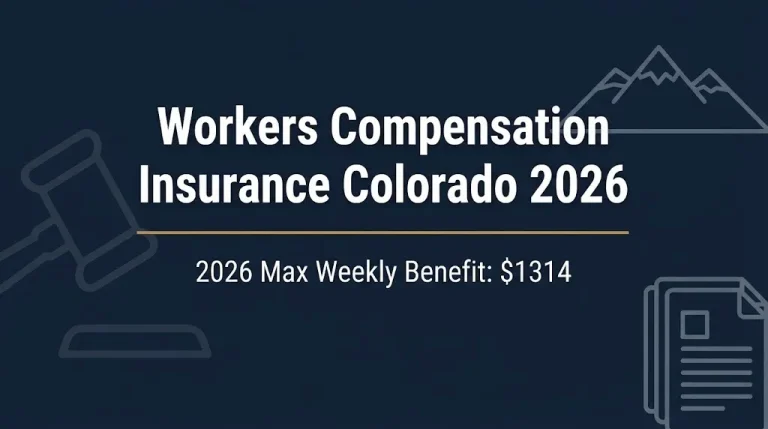
| Maximum Weekly Benefit 2026 | $1,247.10 (confirmed by state schedule) |
| Minimum Weekly Benefit 2026 | $311.77 (confirmed by state schedule) |
Is a Denver Workers Compensation Attorney Legit or a Scam?
A Denver workers compensation attorney is a licensed Colorado lawyer who files claims through the Division of Workers’ Compensation. It is not a scam.
You can verify any attorney’s license through the Colorado Supreme Court Office of Attorney Regulation. The search is free and shows disciplinary history.

Be cautious about unsolicited calls or texts after a workplace injury. Colorado law restricts attorney solicitation, and legitimate Denver workers compensation lawyers do not cold-text accident victims.
The Colorado Division of Workers’ Compensation has issued consumer alerts about companies charging fees to “expedite” claims. No third party can move your claim faster than the statutory process allows.
Filing directly with the Division or through a licensed attorney are the only legitimate paths. Any fee request before you receive benefits is a red flag.
Key Takeaway: A Denver workers compensation attorney is a licensed professional, but always verify the license through the state’s Office of Attorney Regulation before signing anything.
How Much Does a Denver Workers Compensation Attorney Cost?
A Denver workers compensation attorney works on contingency. You pay nothing upfront. The attorney takes a percentage only if you win benefits.
Colorado law caps workers compensation attorney fees at 20 percent of the benefits recovered. The Division of Workers’ Compensation must approve every fee agreement.
If your claim is denied and the attorney loses at hearing, you generally owe no attorney fee. You may still owe case costs like medical record copying or expert witness fees.
Some Denver attorneys charge less than 20 percent for straightforward accepted claims. Ask about the exact percentage and costs before signing the fee agreement.
The contingency model aligns the attorney’s incentive with yours. The lawyer only gets paid if you get paid.
Key Takeaway: Denver workers compensation lawyers charge nothing upfront and take a maximum of 20 percent of recovered benefits, with Division approval required.
What Is the Average Workers Compensation Settlement in Colorado?
The average Colorado workers compensation settlement is not published by any state agency. Attorneys and legal data providers report typical ranges from $20,000 to $90,000 for permanent partial disability claims in 2026.
Your actual amount depends on three verified factors: your average weekly wage, your impairment rating from the treating physician, and whether you can return to your previous job.
A worker earning $1,200 per week with a 10 percent permanent impairment rating might receive roughly $12,000 to $18,000 for that impairment, calculated using Colorado’s scheduled injury formula.
A worker with a back injury requiring surgery and a 25 percent impairment rating could see a settlement in the $50,000 to $100,000 range. Catastrophic injuries involving total disability can exceed $250,000 over the life of the claim.
These are estimates based on attorney-reported data, not guaranteed amounts. The Colorado Division of Workers’ Compensation does not publish settlement averages.
Reality Check: No one can guarantee a specific settlement amount before your claim is evaluated. Any website promising an exact payout is guessing. Your impairment rating from an authorized treating physician is what matters.
What Are the Deadlines for Filing a Workers Comp Claim in Denver?
You must report your workplace injury to your employer within four days of the injury. This is the rule under Colorado Revised Statutes section 8-43-102.
The four-day reporting deadline preserves your right to benefits from the date of injury. Late reporting can delay benefit start dates.
You have two years from the date of injury to file a formal claim with the Division of Workers’ Compensation. This is the hard legal deadline.
For occupational diseases or repetitive stress injuries, the two-year clock runs from the date you knew or should have known the condition was work-related.
| Deadline Type | Time Limit |
|---|---|
| Report injury to employer | 4 days |
| File claim with Division | 2 years from injury or discovery |
| Protest a final admission | Varies, often 30 days |
| Request hearing on disputed issue | 30 to 60 days depending on issue |
| Reopen a closed claim | 2 years from last benefit, with new evidence |
Missing the two-year filing deadline nearly always bars your claim. There are very few exceptions.
What Does a Workers Comp Attorney Do for You in Denver?
A Denver workers compensation attorney handles the legal filings, medical evidence, and hearing representation you would otherwise manage alone against an insurance carrier that handles thousands of claims.
The attorney files your claim with the Division, requests the correct hearing if benefits are denied, and cross-examines the insurance company’s independent medical examiner at hearing.
If the insurer disputes your impairment rating, the attorney arranges for an independent evaluation and presents that evidence to the Administrative Law Judge.
Think of it like a tax audit: you can technically represent yourself, but the other side does this every day. A lawyer levels the field.
The attorney negotiates the final settlement. Colorado workers comp settlements require Division approval, so a judge reviews the terms to ensure they are not unfair to you.
How Does the Colorado Workers Compensation System Work Step by Step?
The Colorado workers compensation system is a no-fault system. You do not prove your employer was negligent. You only prove the injury happened at work or was caused by work.
Here is the process in order:
- Report the injury to your employer within four days.
- Seek medical treatment from an authorized provider selected by your employer or insurer.
- Your employer files a First Report of Injury with the Division within 10 days.
- The insurer accepts or denies the claim within 20 days typically.
- If accepted, you receive medical care and temporary disability payments after the 3-day waiting period.
- When you reach maximum medical improvement, the authorized physician assigns an impairment rating.
- You receive permanent partial disability benefits based on that rating, or negotiate a settlement.
- If denied, you or your attorney file an Application for Hearing with the Division.
- An Administrative Law Judge hears the case and issues a decision.
This process takes months, sometimes over a year for disputed claims. A lawyer shortens the timeline by avoiding procedural errors.
What Types of Injuries Qualify for Workers Compensation in Denver?
Any injury that arises out of and in the course of employment qualifies under Colorado law. This includes sudden accidents, repetitive motion injuries, occupational diseases, and mental health conditions caused by workplace events.
Common qualifying injuries in Denver include:
- Construction site falls and crush injuries
- Back and neck injuries from lifting
- Repetitive stress injuries like carpal tunnel
- Altitude-related illness in outdoor work
- Motor vehicle accidents while driving for work
- Toxic exposure claims
- Mental stress claims tied to specific traumatic events
Pre-existing conditions that are aggravated by work also qualify. A worker with prior back issues who worsens the condition through job duties can file a claim.
Injuries during your commute are generally not covered unless you were driving for work purposes. Injuries from horseplay or intoxication are not covered.
Key Takeaway: The injury must arise from work and happen during work, with aggravation of pre-existing conditions included, but commute and intoxication injuries excluded.
How Long Do You Have to Wait for Workers Comp Payments in Denver?
Colorado has a three-day waiting period before temporary disability payments begin. If your disability lasts more than 14 days, the waiting period is retroactively paid.
Temporary total disability pays 66.67 percent of your average weekly wage, up to the 2026 maximum of $1,247.10 per week. Payments are issued every two weeks.
The insurance carrier must begin payments within 20 days of receiving notice of your disability, according to Division rules. In practice, many payments start within 30 to 45 days.
If the carrier denies your claim, you receive nothing until a judge rules in your favor. This is why a lawyer matters for denied claims. Hearings can take three to six months to schedule.
Can You Sue Your Employer Outside of Workers Comp in Denver?
You generally cannot sue your employer for a workplace injury in Colorado. Workers compensation is the exclusive remedy. You trade the right to sue for guaranteed benefits regardless of fault.
There are narrow exceptions. If your employer intentionally injured you, you may sue in civil court. If your employer failed to carry workers compensation insurance, you can sue in civil court.
You can also sue third parties. If a defective tool caused your injury, you may have a product liability claim against the manufacturer. If a subcontractor caused your injury, you may have a claim against that subcontractor.
These third-party claims can produce larger recoveries than workers comp benefits because they include pain and suffering, which workers comp does not pay.
A Denver workers compensation attorney evaluates whether a third-party claim exists alongside your workers comp claim. Pursuing both is legal and common.
What Questions Should You Ask Before Hiring a Denver Workers Compensation Lawyer?
Ask these questions before signing any fee agreement:
- How many Colorado workers comp cases have you handled in the last two years?
- Will you personally handle my case or pass it to a paralegal?
- What is your success rate at Division hearings?
- Have you ever been disciplined by the Colorado Office of Attorney Regulation?
- What costs will I owe if we lose?
- How do you communicate case updates?
- Will you handle a third-party lawsuit if one exists?
- What is your honest assessment of my claim value?
An attorney who refuses to answer these questions or pressures you to sign immediately is a red flag. You have two years to file, so you have time to interview multiple lawyers.
Key Takeaway: Interview multiple attorneys, verify their license, and demand clear answers about fees, costs, and case handling before signing.
What Are the 2026 Colorado Workers Comp Benefit Rates?
The 2026 Colorado workers compensation benefit rates are set by the Division of Workers’ Compensation and took effect July 1, 2026.
| Benefit Type | 2026 Rate |
|---|---|
| Maximum weekly benefit | $1,247.10 |
| Minimum weekly benefit | $311.77 |
| Temporary total disability | 66.67% of average weekly wage |
| Permanent total disability | 66.67% of average weekly wage |
| Permanent partial disability | Varies by impairment rating |
| Mileage reimbursement | $0.67 per mile |
The average weekly wage is calculated using your earnings over the 26 weeks before the injury. This includes overtime and bonuses in most cases.
The maximum weekly benefit means even if you earned $2,000 per week, your workers comp check is capped at $1,247.10. This surprises many high-wage earners.
What Happens Next in Your Denver Workers Compensation Claim?
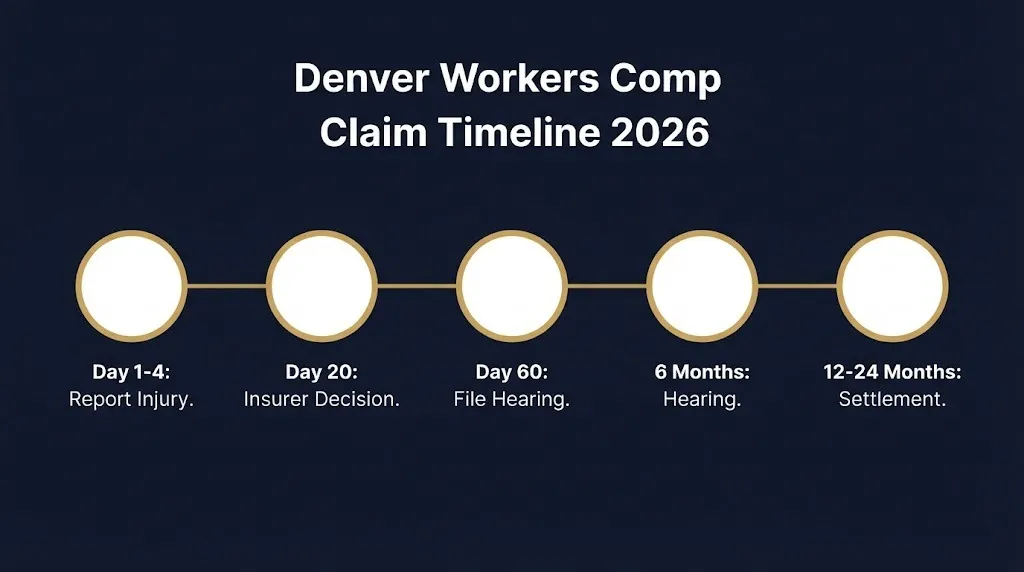
Here is the expected timeline for a 2026 Denver workers compensation claim:
Within 4 days: Report injury to employer and seek medical care.
Within 20 days: Insurance carrier issues acceptance or denial.
Within 60 days: If denied, file Application for Hearing with the Division.
3 to 6 months after request: Administrative Law Judge hearing scheduled.
6 to 12 months after hearing: Decision issued, with possible appeal.
12 to 24 months total: Settlement negotiations conclude for most permanent disability claims.
2 years from injury: Deadline to file claim, and deadline to reopen a closed claim with new evidence.
Every case moves at its own pace. A straightforward accepted claim with no disputes can resolve in six months. A denied claim with appeals can take two years.
The single most important date is the two-year filing deadline. Missing it ends your claim before it starts. Calendar it now.
Frequently Asked Questions
Is there a class action lawsuit for Colorado workers compensation?
No. Workers compensation claims are individual claims filed through the Division of Workers’ Compensation, not class actions.
How much is the average workers comp settlement in Denver?
Attorney-reported data suggests $20,000 to $90,000 for permanent partial disability, but the Division publishes no official averages.
Can I file a workers comp claim without a lawyer in Colorado?
Yes, you can file directly with the Division, but denied claims and disputed impairment ratings are harder to win without representation.
What is the deadline to report a work injury in Colorado?
Four days to report to your employer, and two years to file a formal claim with the Division.
How much does a Denver workers compensation attorney cost?
Contingency fee of up to 20 percent of recovered benefits, approved by the Division, with nothing owed if you lose.
What is the maximum weekly workers comp benefit in Colorado for 2026?
The maximum weekly benefit is $1,247.10, based on the 2026 state schedule.
Can I sue my employer for pain and suffering in Colorado?
No, workers compensation excludes pain and suffering, except in narrow cases of intentional injury or third-party liability.
How long does a Colorado workers comp claim take?
Accepted claims can resolve in 6 months. Denied claims with hearings and appeals can take 12 to 24 months.
If you were injured at work in Denver, the next step is clear: report the injury to your employer today if you have not already, then file your claim with the Division of Workers’ Compensation. That filing preserves your rights while you decide whether to hire counsel.
The two-year deadline is absolute for most claims. Do not let a delay in filing become the reason your claim dies.