18-Wheeler Accident Lawsuit in 2026: Average Settlement, Minimum Payout, and What to Expect
Quick Answer
- An 18-wheeler accident lawsuit is an individual injury claim, not a class action with one shared payout.
- Reported averages run from roughly $90,000 to $150,000, though severe or fatal cases often reach $500,000 to several million.
- There is no universal filing deadline. Your state’s statute of limitations, typically 2 to 4 years from the crash, controls your case.
If you got hurt by a semi truck, tractor-trailer, or big rig this year, you are probably searching for one thing: a number. You want to know what your case might actually be worth before you sign anything an insurance adjuster hands you.
Here is the direct answer. There is no fixed “18-wheeler lawsuit” payout because these are individual claims, not a shared settlement fund. One law firm’s review of over 400 trucking cases settled between 2021 and 2024 puts the average truck accident settlement at $103,654.08, though the median was far lower.
This article breaks down real reported ranges by injury type, walks through how a claim actually moves from crash to check, and flags where insurers try to lowball you first. One detail that surprises most people: Louisiana changed its fault rules for crashes on or after January 1, 2026, barring recovery if you’re 51% or more at fault, a shift that can swing a settlement by hundreds of thousands of dollars.
The Facts
| Case Type | Individual 18-wheeler injury lawsuits (no single class action or shared fund) |
| Status | Filed case-by-case nationwide, ongoing in 2026 |
| Settlement Fund | Not applicable, each case is negotiated or litigated separately |
| Est. Per Person | Roughly $20,000 to $500,000 for moderate injuries, into the millions for catastrophic or fatal cases |
| Claim Deadline | Set by your state’s statute of limitations, generally 2 to 4 years from the crash date |
| Administrator | None, handled through the civil court system and the trucking company’s insurer |
| Proof Needed | Police crash report, medical records, driver logs, black box data, witness statements |
Is There One 18-Wheeler Accident Lawsuit Right Now?
No. An 18-wheeler accident lawsuit is not a single case you join, it is a personal injury claim you file individually after your own crash.
Unlike a defective-drug or data-breach settlement, there’s no shared fund, no claims administrator, and no one deadline for everyone. Each crash generates its own file, its own insurer, and its own negotiation.
That said, the phrase gets searched as if it were one event because the process looks similar across cases. You get hurt, a trucking company’s insurer gets involved, and a settlement or lawsuit follows a fairly predictable path.
What “18-wheeler accident lawsuit” actually means in practice:
- A civil claim against the driver, the trucking company, or both
- Often a third claim against a cargo loader or maintenance contractor
- Sometimes a claim against a freight broker who hired an unsafe carrier
What Is the Average Settlement for a Semi Truck Accident in 2026?
The average semi truck accident settlement is reported around $90,000 to $150,000, though this figure hides enormous variation.
One firm’s dataset of over 400 cases resolved from 2021 to 2024 shows an average of $103,654.08. Separate industry compilations put the broader average closer to $150,000 or higher, with severe cases routinely exceeding $1,000,000, compared to roughly $19,000 for an average car accident claim.
| Data Source | Reported Average |
|---|---|
| Brown & Crouppen case review (2021 to 2024) | $103,654.08 |
| Industry-wide legal estimate | $150,000+ |
| California-specific claims | $200,000+ |
Key Takeaway: treat any single “average” number with skepticism. Your case value depends on your injuries, the insurance limits involved, and where you filed, not a national average.
What Is the Minimum Truck Settlement You Might See?
The minimum truck settlement can be as low as a few thousand dollars for very minor injuries with quick recovery.
One legal-industry summary cites a reported low of just $1,000 at the bottom end and a high past $3.6 million at the top, which shows why averages alone tell you little. Minor soft-tissue or whiplash claims commonly settle in the $20,000 to $100,000 band, not lower, once medical bills and lost wages are documented.
Red flags that signal a lowball opening offer:
- The offer arrives within days of the crash, before treatment is finished
- It ignores future medical care or ongoing therapy
- It asks you to sign a release without an attorney reviewing it first
- The adjuster pressures you to give a recorded statement immediately
Average Truck Accident Settlement by Injury Severity
Settlement value tracks injury severity closely, and legal sources report fairly consistent tiers across states.
Minor injury cases, such as sprains or fractures with full recovery, typically settle for $20,000 to $100,000. Moderate injuries requiring surgery or months of recovery run $100,000 to $500,000.
| Injury Tier | Typical Settlement Range |
|---|---|
| Minor (whiplash, minor fractures) | $20,000 to $100,000 |
| Moderate (surgery, months of recovery) | $100,000 to $500,000 |
| Severe (TBI, spinal injury, amputation) | $500,000 to $2,000,000+ |
| Catastrophic or wrongful death | $1,000,000 to $10,000,000+ |
This is not evenly distributed. A Dallas County jury awarded roughly $604 million after a catastrophic tractor-trailer crash in Mississippi that killed three people in 2026, an outlier verdict, not a typical settlement, but a reminder that catastrophic cases can move far beyond ordinary ranges.
What Is a Wrongful Death 18-Wheeler Settlement Worth?
Wrongful death claims from 18-wheeler crashes generally settle far higher than injury claims, commonly in the seven-figure range.
Reported ranges for fatal commercial truck crashes run from roughly $1,000,000 up to $10,000,000 or more, depending on the victim’s age, income, and number of dependents. Federal data adds important context here: about 70% of fatalities in truck crashes are occupants of the other vehicle, not the truck itself, according to FMCSA 2023 figures.
Factors that push a wrongful death settlement higher:
- Lost future earnings for a primary household earner
- Young dependents who lost parental support
- Clear evidence of driver fatigue, speeding, or hours-of-service violations
- A trucking company with a prior safety violation record
How Do You File an 18-Wheeler Accident Lawsuit?
You file an 18-wheeler accident lawsuit by first pursuing an insurance claim, then filing in civil court if negotiations stall.
Most cases never reach a courtroom. They resolve through a demand letter and negotiation, but the lawsuit route stays open the whole time as leverage.
Steps most 18-wheeler cases follow:
- Get medical treatment and document every injury immediately
- Preserve evidence: photos, the police report, and truck data if possible
- Hire an attorney before speaking to the trucking company’s insurer
- File an insurance claim with the responsible carrier
- Send a demand package once treatment stabilizes
- Negotiate, or file a formal lawsuit if the offer is too low
- Proceed through discovery, mediation, and settlement or trial
What Proof Do You Need to Win a Truck Accident Claim?
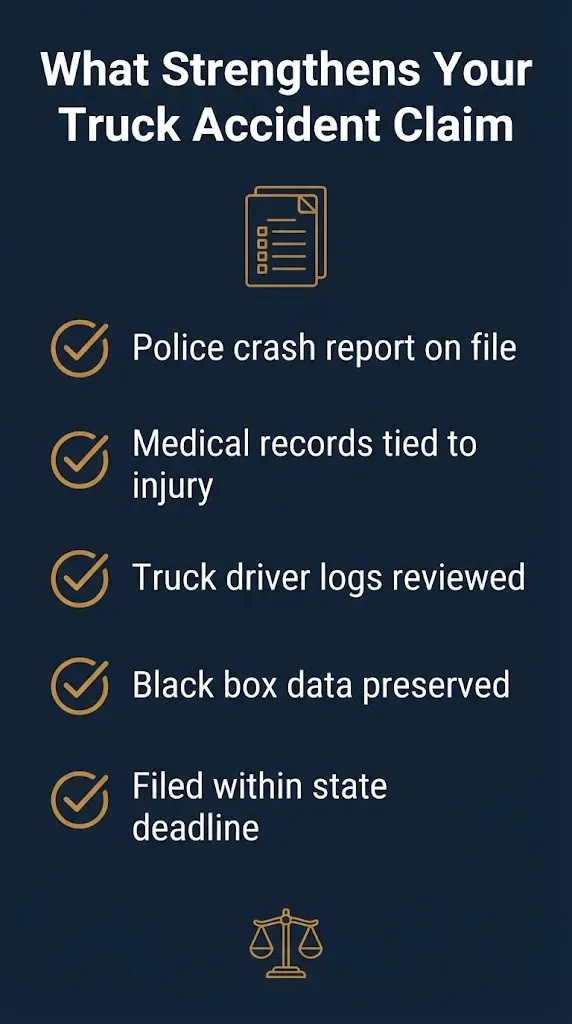
You need documentation that proves the truck driver or company was negligent and that ties your injuries directly to the crash.
Commercial trucking involves federal safety rules that don’t apply to ordinary drivers, and violations of those regulations can prove negligence and strengthen a claim. This is one reason truck cases often settle higher than car accident claims with similar injuries.
Evidence that carries the most weight:
- Police crash report and citations issued
- Truck’s black box (event data recorder) data
- Driver logs showing hours-of-service compliance or violations
- Maintenance and inspection records for the truck
- Medical records linking treatment directly to the crash date
Key Takeaway: federal trucking regulations give injury victims a paper trail car-accident cases usually lack, which is a major reason average payouts run higher.
Reality Check
No settlement administrator or trucking company will text or email you out of nowhere offering a specific payout figure. Filing a claim or lawsuit costs nothing upfront in a standard contingency arrangement, and no legitimate attorney demands a fee before doing any work. If someone contacts you claiming to “process” your truck accident payout for an advance fee, that is not how any real settlement works.
How Long Does an 18-Wheeler Lawsuit Take to Settle?
Most 18-wheeler lawsuits take between 6 and 24 months to resolve, depending on injury severity and whether the case goes to trial.
One law firm reports settlement typically arriving between six and 16 months from the accident date, while another estimates 12 to 24 months as more typical, with catastrophic cases taking longer because future medical costs can’t be valued until treatment plateaus.
| Phase | Typical Timeframe |
|---|---|
| Investigation and initial treatment | Months 1 to 3 |
| Continued treatment, records gathering | Months 3 to 12 |
| Demand sent, lawsuit filed if needed | Months 12 to 18 |
| Discovery, mediation, settlement or trial | Months 18 to 24+ |
| Fund disbursement after settlement | 30 to 60 days after agreement |
Think of it like a delayed tax refund dispute. The check doesn’t come the moment you file, it comes after every number gets checked and cleared.
What’s Changing in Trucking Accident Law in 2026?
Several states adjusted fault and damages rules for crashes in 2026, and these changes directly affect settlement math.
Louisiana’s Act 15 (HB 431) bars recovery entirely if you are found 51% or more at fault for crashes on or after January 1, 2026, replacing the state’s older pure comparative fault system. A separate 2026 Louisiana law, Act 466 (SB 231), changed how past medical bills get valued in auto cases.
Why this matters beyond Louisiana: several states have debated similar fault-threshold changes, and any shift toward a “bar” rule can turn a borderline liability dispute into a total loss for an injured claimant rather than a reduced payout.
Why Are Truck Accident Settlements Higher Than Car Accidents?
Truck accident settlements run higher than car accident settlements because of the physical force involved and the multiple parties who can share liability.
A fully loaded 18-wheeler weighs around 80,000 pounds, compared to 3,000 to 4,000 pounds for an average car, and the physics of that collision produce far more catastrophic injuries. Higher federal insurance minimums for interstate carriers also raise the ceiling on available compensation.
Key Takeaway: the size gap between trucks and passenger vehicles is the single biggest driver of the settlement gap, not just legal strategy.
Who Can Be Held Liable in an 18-Wheeler Accident Lawsuit?
Liability in an 18-wheeler crash can extend well beyond the driver to the trucking company and other businesses in the supply chain.
Common defendants include the truck driver, the motor carrier that employs or contracts them, the company that loaded the cargo if it shifted during transit, and sometimes the freight broker who selected an unsafe carrier. Multiple defendants often mean multiple insurance policies, which can raise the total available for compensation.
Parties frequently named in these lawsuits:
- The truck driver
- The trucking or motor carrier company
- A cargo loading contractor
- A freight broker or logistics company
- A truck or parts manufacturer, in equipment failure cases
What Causes Most 18-Wheeler Accidents?
Driver fatigue, unsafe lane changes, speed, and pressure to meet delivery windows cause a large share of 18-wheeler crashes.
Trucking companies sometimes push drivers toward unrealistic schedules, which can lead to hours-of-service violations and preventable fatigue-related crashes. Poor vehicle maintenance and improperly secured cargo add further risk on top of driver-related factors.
Recurring causes reported across cases:
- Driver fatigue and hours-of-service violations
- Speeding or unsafe following distance
- Improper lane changes and blind-spot collisions
- Poor brake or tire maintenance
- Improperly loaded or secured cargo
Crash volume backs this up at the state level. Texas alone saw over 38,000 crashes involving 18-wheelers in 2022, leading to 716 fatalities, and California recorded 13,149 truck crashes and 392 deaths in 2023.
What Happens Next
Now through late 2026: individual cases continue filing state by state, no unified deadline applies.
Within 2 to 4 years of your crash: your state’s statute of limitations closes your window to sue, varying by jurisdiction.
During active cases: demand packages go out, insurers counter, and most claims settle before trial.
For catastrophic or fatal cases: expect the longest timelines, often 18 to 24+ months, since future medical and lost-earnings damages need full documentation first.
Frequently Asked Questions
Is an 18-wheeler accident lawsuit a class action?
No, each crash produces its own individual lawsuit against the driver and trucking company.
There is no shared settlement fund or single claims administrator to apply to.
What is a realistic average settlement for a semi truck accident?
Reported averages run roughly $90,000 to $150,000 based on case reviews from 2021 through 2024.
Severe injury or wrongful death cases regularly exceed $500,000 to several million.
What is the minimum I could realistically get?
Minor injury cases have settled as low as a few thousand dollars in isolated reports.
Most documented minor-injury settlements fall between $20,000 and $100,000 once medical bills are counted.
How long do I have to file after a truck accident?
It depends entirely on your state’s statute of limitations, typically 2 to 4 years from the crash date.
Missing that window generally ends your ability to recover compensation.
Why do truck accidents settle higher than car accidents?
The size and weight of an 18-wheeler, often 80,000 pounds loaded, causes more severe injuries.
Multiple liable parties and higher federal insurance minimums also raise the available compensation.
Should I accept the trucking company’s first settlement offer?
The first offer is typically designed to close your case quickly and cheaply, before your medical costs are fully known.
Most attorneys recommend having your case independently evaluated before signing anything.
Do I need a lawyer to file an 18-wheeler lawsuit?
It’s not legally required, but commercial trucking cases involve federal regulations and corporate insurers most people aren’t equipped to navigate alone.
Many personal injury attorneys work on contingency, meaning no upfront fee.
What proof matters most in these cases?
Police reports, medical records tying injuries to the crash, and the truck’s own data recorder carry the most weight.
Driver logs showing hours-of-service violations can also significantly strengthen a claim.
Every 18-wheeler case is different, and the range between a minor settlement and a catastrophic one is enormous. If you’re dealing with one now, get medical treatment documented immediately and calendar your state’s filing deadline before anything else. Watch for lowball offers that arrive before your treatment is even finished.