Certified Compensation Professional in 2026: What the Credential Means, How to Get It, and Why It Matters
Quick Answer
- A Certified Compensation Professional is a credential for HR professionals who specialize in pay and benefits design.
- The certification requires passing multiple exams and meeting experience requirements, typically taking 6 to 18 months.
- The most important deadline is the exam registration window, which opens quarterly through WorldatWork.
If you searched for “certified compensation professional,” you’re likely an HR professional considering the credential, a hiring manager evaluating candidates, or someone researching whether the certification is worth pursuing.
This article gives you the verified facts as of September 9, 2026. It explains what the credential actually is, how to earn it, what it costs, and whether it translates to higher pay.
Here’s the part most articles skip: the CCP isn’t a legal requirement for any job. It’s a professional credential that signals expertise, and its value depends heavily on your specific career path.
The Facts
| Item | Detail |
|---|---|
| Credential Name | Certified Compensation Professional |
| Administering Body | WorldatWork |
| Total Exams Required | 10 courses, including 9 exams plus one elective |
| Typical Completion Time | 6 to 18 months |
| Total Cost | $8,000 to $12,000 including courses and exams |
| Renewal Requirement | Recertification every 3 years |
| 2026 Update | Updated exam content reflecting new pay transparency laws |
Is the Certified Compensation Professional Credential Legit?
Yes, it’s the real thing. WorldatWork, formerly the American Compensation Association, has administered the CCP since 1976.
The credential is recognized across HR, compensation, and benefits professions. It’s not a government license. It’s a private certification, like a CPA for accountants or a PMP for project managers.
WorldatWork is a legitimate professional association with thousands of members worldwide. The CCP is its flagship credential, and it’s held by compensation professionals across Fortune 500 companies, consulting firms, and government agencies.
The credential is not a scam. But it’s also not a magic ticket. It validates knowledge; it doesn’t guarantee a job or a salary bump on its own.
Key Takeaway: The CCP is legitimate and respected, but it’s a professional development tool, not a legal requirement or a job guarantee.
What Does a Certified Compensation Professional Do?
A CCP designs, implements, and manages compensation programs within organizations.
The work includes:
- Setting salary structures and pay ranges
- Designing bonus and incentive plans
- Conducting market pricing for jobs
- Ensuring pay equity compliance
- Managing executive compensation
- Advising on pay transparency requirements
- Structuring variable compensation programs
The role sits at the intersection of HR, finance, and legal compliance. Compensation professionals need to understand labor markets, tax law, employment regulations, and organizational psychology.
In 2026, the role has expanded to include AI-driven compensation analytics and compliance with new pay transparency laws in multiple states.
How Do You Become a Certified Compensation Professional?
The path to CCP requires completing a structured curriculum through WorldatWork.
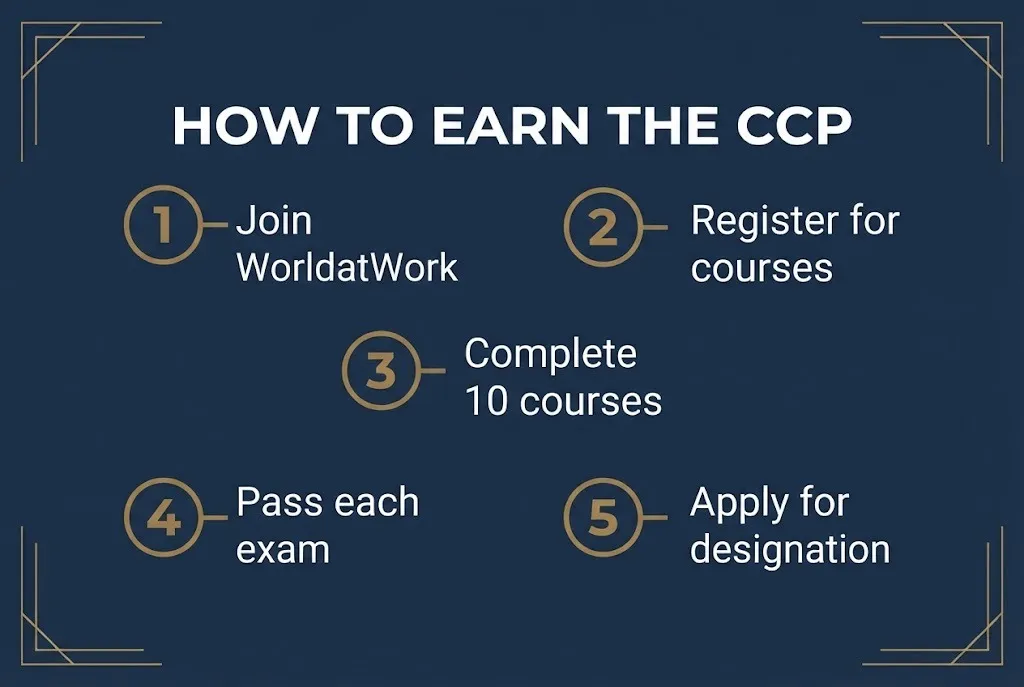
Here’s the step-by-step process:
- Join WorldatWork as a member to access member pricing.
- Register for the required courses in the CCP track.
- Complete the foundational courses in total rewards and compensation.
- Pass the exam for each course, typically online or at testing centers.
- Complete the elective course requirement.
- Apply for the CCP designation.
- Maintain the credential through recertification every three years.
The program is self-paced for most candidates. Some finish in under a year. Others take two years or more, especially if they’re working full-time.
There’s no single “final exam.” The CCP is earned by passing each course exam individually, not by taking one comprehensive test at the end.
How Much Does the CCP Cost?
The total cost ranges from $8,000 to $12,000 depending on membership status and course format.
Here’s the breakdown:
| Item | Approximate Cost |
|---|---|
| WorldatWork membership | $400 to $500 annually |
| Each course | $1,000 to $1,500 for members |
| Each exam | Included with course or $300 to $500 separately |
| Total for 10 courses | $8,000 to $12,000 |
| Recertification | $200 to $500 every 3 years |
Many employers cover these costs through tuition reimbursement or professional development budgets. If your employer supports continuing education, ask before paying out of pocket.
The cost is significant. Whether it’s worth it depends on your career goals and whether your employer values the credential.
Key Takeaway: The CCP is an investment of $8,000 to $12,000 and 6 to 18 months. Employer sponsorship changes the calculus significantly.
Is the CCP Worth It in 2026?
The answer depends on your career path and industry.
For compensation professionals already working in the field, the CCP often leads to better roles and higher pay. For HR generalists, it may be less valuable than broader credentials like the SHRM-CP or PHR.
Industry data shows that CCP holders earn more than non-certified peers in similar roles. The premium varies, but surveys consistently show a 10% to 20% salary advantage in compensation-specific positions.
The credential matters most in:
- Large corporations with formal compensation structures
- Consulting firms serving corporate clients
- Government agencies with complex pay systems
- Organizations prioritizing pay equity and transparency
It matters less in small businesses, startups, or roles where compensation is only one of many responsibilities.
What Are the 2026 Changes to the CCP Program?
WorldatWork updated the CCP curriculum for 2026 to reflect new regulatory and market realities.
The changes include:
- New content on pay transparency laws in California, New York, Colorado, and other states
- Expanded coverage of AI tools in compensation analytics
- Updated material on pay equity audits and compliance
- New case studies reflecting remote and hybrid work compensation
- Revised exam questions on variable compensation design
The core structure remains the same: 10 courses, including 9 exams and one elective. But the content has shifted to reflect what compensation professionals actually deal with in 2026.
Reality Check: No legitimate credential requires you to pay a “registration fee” to a third-party service. WorldatWork is the only source for CCP courses and exams. If someone offers to “fast-track” your CCP for a fee, it’s a scam.
How Does the CCP Compare to Other HR Certifications?
The HR certification landscape is crowded, and the CCP sits in a specific niche.
| Credential | Focus | Administered By |
|---|---|---|
| CCP | Compensation specifically | WorldatWork |
| SHRM-CP/SHRM-SCP | Broad HR | SHRM |
| PHR/SPHR | Broad HR | HRCI |
| CEBS | Employee benefits | International Foundation |
| GRP | Global remuneration | WorldatWork |
For compensation-specific roles, the CCP is the gold standard. For general HR roles, SHRM or HRCI credentials carry more weight.
The CCP is deeper but narrower. It’s the right choice for someone building a career specifically in compensation, not for someone who wants a generalist HR credential.
What Jobs Require or Prefer a CCP?
Few jobs legally require the CCP, but many prefer or list it as a qualification.
Common job titles for CCP holders:
- Compensation Manager
- Compensation Analyst
- Total Rewards Director
- Executive Compensation Consultant
- Pay Equity Specialist
- Compensation and Benefits Manager
In job postings, “CCP preferred” is common for mid-level and senior compensation roles. For entry-level roles, the credential is often listed as “nice to have” rather than required.
The credential opens doors. It doesn’t replace experience. A CCP with no relevant work experience still starts near the bottom of the compensation career ladder.
How Long Does It Take to Earn the CCP?
Most candidates finish in 6 to 18 months, depending on study pace and work schedule.
The timeline breaks down roughly:
| Approach | Typical Timeline |
|---|---|
| Full-time study | 4 to 6 months |
| Part-time with work | 12 to 18 months |
| Very part-time | 24 months or more |
Each course requires study time plus exam preparation. WorldatWork estimates 20 to 30 hours per course for most candidates. That’s 200 to 300 hours total.
The fastest path is taking multiple courses concurrently, but that’s rare for working professionals. Most people take one course at a time while maintaining their day job.
Can You Fail the CCP Exams?
Yes, and it happens. The exams are not pro forma.
WorldatWork doesn’t publish pass rates, but the exams require genuine study. They test applied knowledge, not just memorization. You need to understand how compensation concepts work in practice, not just recall definitions.
If you fail an exam, you can retake it. WorldatWork allows retakes for a fee, and there’s usually a waiting period before you can sit again.
The failure rate is real but manageable. Candidates who study the materials and understand the concepts generally pass on the first attempt.
What Is the Recertification Requirement?
The CCP requires recertification every three years.
Recertification requires:
- Earning continuing education credits
- Paying a recertification fee
- Demonstrating ongoing professional development
The continuing education requirement is typically 30 to 40 credit hours over the three-year period. Credits can come from WorldatWork courses, industry conferences, webinars, and other approved activities.
Failing to recertify means the credential lapses. You can’t legally use the CCP designation if you haven’t maintained it.
Key Takeaway: The CCP is not a one-time achievement. It requires ongoing investment to maintain.
What Should You Do If You’re Considering the CCP?
Think through your goals before spending the money.
- Check whether your current employer values the credential.
- Ask if tuition reimbursement or professional development funds are available.
- Review the current CCP curriculum on WorldatWork’s official site.
- Talk to CCP holders in your network about their experience.
- Compare the CCP against other HR credentials based on your career path.
- Consider starting with one course to see if the material fits.
- Commit to the full program only if it aligns with a specific career goal.
The CCP is a significant investment of time and money. It pays off for people building careers in compensation specifically. It may not pay off for generalists.
What Happens Next With Compensation Certification?
The field is evolving, and the CCP is evolving with it.
- Late 2026: WorldatWork expected to announce updates for the 2027 exam cycle.
- 2027: Possible integration of more AI and analytics content.
- Ongoing: Pay transparency laws continue to drive demand for compensation expertise.
The demand for compensation professionals is growing. Pay transparency laws make employers more careful about pay structures, which means they need people who understand compensation design and compliance.
The CCP is positioned well for this trend, but it’s not the only path. Experience, other credentials, and demonstrated skills all matter.
The most important date is your own decision timeline. The program is self-paced, so the clock starts when you’re ready.
Frequently Asked Questions
What is a Certified Compensation Professional?
A certification for compensation specialists.
Administered by WorldatWork.
Validates expertise in pay design and management.
How do I get the CCP?
Complete 10 courses through WorldatWork.
Pass the exam for each course.
Apply for the designation after finishing.
How much does the CCP cost?
Between $8,000 and $12,000 total.
Membership reduces course costs.
Many employers reimburse.
Is the CCP worth it?
For compensation-focused careers, usually yes.
Salary premiums of 10% to 20% are common.
For HR generalists, other credentials may be better.
How long does the CCP take?
Six to eighteen months for most candidates.
Full-time study can finish faster.
Part-time study takes longer.
Can I take CCP courses online?
Yes, WorldatWork offers online courses.
Exams are also available online.
No in-person attendance is required.
Does the CCP expire?
Yes, after three years without recertification.
Recertification requires continuing education.
The fee is $200 to $500.
What jobs require the CCP?
Few legally require it.
Many compensation roles prefer it.
It’s most valuable in large organizations.
If you’re building a career in compensation, the CCP is the clearest signal you can send to employers. But it’s not the only path, and it’s not cheap. Check whether your employer will fund it, and talk to people who hold the credential before committing.
The most important fact: the CCP validates expertise, but expertise itself comes from doing the work, not just passing the exams.